CELPIP Reading Practice Test 4
By Iris
A complete CELPIP Reading practice test: all 4 parts and 38 questions in the real test order. Set a timer for 55–60 minutes and do all four parts in one sitting. Check your answers at the bottom of the page to see your score and an estimated CLB.
In this test
- Part 1: Reading Correspondence, “Fitness Class Feedback” (questions 1–11) · practise this part alone
- Part 2: Reading to Apply a Diagram, “Sustainable Living Expo Information” (questions 12–19) · practise this part alone
- Part 3: Reading for Information, “Technology in Education” (questions 20–28) · practise this part alone
- Part 4: Reading for Viewpoints, “Podcasts vs. Books for Learning” (questions 29–38) · practise this part alone
Part 1: Reading Correspondence
Dear Gym Members,
I’m planning our summer fitness schedule and need your input! We’ve offered yoga, spin, and Zumba this spring, with steady attendance of 20–25 per class. For June–August, I’m thinking of adding outdoor boot camps or Pilates—any preferences? We could also extend evening slots from 6 p.m. to 7:30 p.m. to suit post-work schedules. Should we keep classes free with membership, or introduce a $5 fee for extras like equipment rental?
Our next trial class is June 5th at 6 p.m. in the park—light snacks provided post-workout. Should this be a one-off, or a weekly event? I’d also need three volunteers to help set up mats and speakers from 5:30 p.m. that day. Please reply by May 20th with your thoughts—I want these classes to energize everyone!
Best,
Ravi (Fitness Manager)
Ravi’s email is intended to…
The trial class will occur…
After the trial class, attendees will get…
Extended evening classes are proposed to…
Volunteers are requested…
Potential new classes could be…
Here is a response to the message. Complete the response by filling in the blanks. Select the best choice for each blank.
Dear Ravi,
Love the summer plan—I’ve been needing a fitness boost! Offering after the trial class is a nice touch, and it’ll keep us chatting post-workout. I’d pick sounds intense, and I’m ready to sweat it out in the fresh air. A $5 fee is fine— covers costs without feeling like a big hit to my wallet. Weekly park classes would be great keeps me motivated through the summer slump. I can help at is no issue, and I’ll bring some energy to the setup crew! Can’t wait to get moving.
Cheers,
Maya
Part 2: Reading to Apply a Diagram
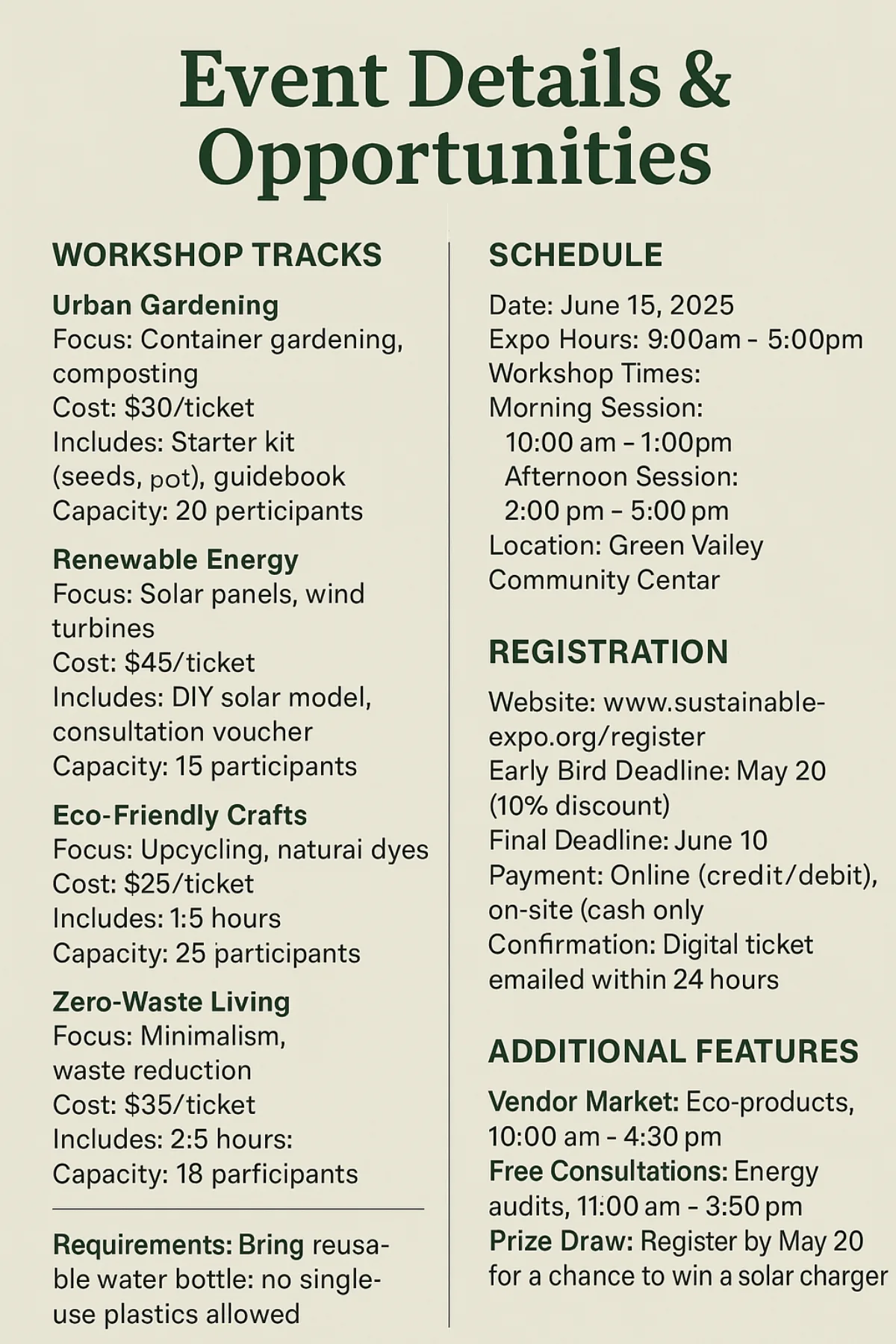
Read the following email message. Complete the email by filling in the blanks. Select the best choice for each blank.
Hi Alex,
I’m super excited for the Sustainable Living Expo! I’ve signed up for the workshop because I’m obsessed with solar power. You’d probably enjoy the one since you love DIY projects. My ticket was which includes some cool extras. The expo’s on at the community center, and you need to bring a to follow the rules. Want to join me?
Best,
Riley
Riley is writing this email to...
The Renewable Energy workshop differs from the Eco-Friendly Crafts workshop in that it...
According to the diagram,...
Part 3: Reading for Information
A
Online learning platforms have revolutionized education by providing access to courses worldwide. Platforms like Coursera offer university-level courses to millions, often at low or no cost. These platforms use adaptive learning algorithms to personalize content for students. However, unreliable internet access in rural areas limits their reach. Digital literacy is also a barrier for older learners. Despite these challenges, online learning continues to grow rapidly.
B
Virtual reality (VR) is enhancing classroom experiences by simulating real-world scenarios. Medical students, for example, use VR to practice surgeries in a risk-free environment. Schools in Singapore have integrated VR into history lessons, allowing students to explore ancient civilizations. However, VR equipment is expensive, and not all schools can afford it. Teachers also need training to use the technology effectively.
C
Artificial intelligence (AI) is streamlining administrative tasks in education. AI-powered tools grade assignments and provide feedback, saving teachers time. For instance, an AI system in Australia reduced grading time by 30%. These tools also analyze student performance to identify learning gaps. However, overreliance on AI risks reducing human interaction in education. Privacy concerns about student data are another issue.
D
Coding is becoming a core part of school curricula to prepare students for tech-driven careers. Countries like Estonia teach coding from primary school, fostering problem-solving skills. Students create apps and games, making learning engaging. However, a shortage of qualified coding teachers hinders implementation. Some argue that focusing on coding neglects other essential subjects like literature. Still, coding education is seen as vital for future job markets.
Decide which paragraph, (A) to (D), has the information given in each statement below. Select (E) if the information is not given in any of the paragraphs.
- Coursera provides access to university-level courses.
- VR is used to simulate surgical training for medical students.
- AI tools in Australia reduce grading time.
- Estonia teaches coding starting in high school.
- Online learning platforms face challenges due to poor internet access.
- All schools now use VR for history lessons.
- AI in education raises concerns about student data privacy.
- Coding education is criticized for neglecting other subjects.
- Adaptive learning algorithms personalize online courses.
Part 4: Reading for Viewpoints
The rise of diverse learning platforms has fueled debate over whether podcasts or books are better suited for knowledge acquisition. In Austin, a hub for innovation and education, perspectives from locals and experts illuminate the strengths and limitations of each. Dr. Lila Nguyen, an education researcher, champions podcasts for their accessibility. “Podcasts deliver insights during commutes or chores, making learning seamless,” she says. However, she notes that retaining specific details can be challenging without transcripts. In contrast, Marcus Evans, a history professor, prefers books. “Books allow deep engagement and easy reference through annotations,” he explains, though he admits they demand more time and focus.
Meanwhile, Sofia Ramirez, a graphic designer, blends both methods. “Podcasts inspire quick ideas, but books provide the depth I need for complex topics,” she says. She values their complementarity but finds podcasts less reliable for fact-checking. Conversely, Ethan Cole, a software developer, relies solely on podcasts. “They’re free, fast, and fit my multitasking lifestyle—books feel outdated,” he argues, though he acknowledges limited depth in some episodes. A 2024 Learning Trends Report supports these views, finding that podcasts account for 40% of informal learning hours, yet 65% of learners prefer books for academic or technical subjects due to their comprehensive nature. Critics of podcasts highlight their superficial coverage, while books face scrutiny for being less engaging for auditory learners. Education consultant Clara Hu offers a balanced perspective: “Podcasts democratize learning, but books ensure rigor. Educators should integrate both to meet diverse needs.” The choice between podcasts and books hinges on learning goals, time constraints, and preferred engagement styles, with no single method prevailing.
Why does Dr. Nguyen favor podcasts?
What does Marcus Evans highlight as a strength of books?
How does Sofia Ramirez approach learning?
What does Ethan Cole criticize about books?
According to Clara Hu, what should educators do?
The following is a comment by a reader. Complete the comment by choosing the best option to fill in each blank.
As a lifelong learner, I find podcasts for their flexibility, echoing Dr. Nguyen’s view on accessibility. However, Marcus’s emphasis on books’ resonates when I need thorough understanding. Sofia’s blended approach by leveraging each method’s strengths for different tasks. Still, Ethan’s podcast-only stance since books remain vital for in-depth study. Educators should both formats to support varied learning styles, ensuring knowledge is both accessible and rigorous.
Answer key
Show all 38 answers
- Ravi’s email is intended to… A. seek feedback on class updates.
- The trial class will occur… D. in the park on June 5th.
- After the trial class, attendees will get… B. light snacks.
- Extended evening classes are proposed to… D. suit after-work availability.
- Volunteers are requested… A. at 5:30 p.m. on June 5th.
- Potential new classes could be… A. outdoor boot camps.
- D. snacks
- D. boot camps
- D. a fee
- D. weekly
- D. 5:30
- B. Renewable Energy
- C. Eco-Friendly Crafts
- B. $45
- A. June 15, 9:00am - 5:00pm
- D. reusable water bottle
- Riley is writing this email to... A. encourage Alex to attend the expo
- The Renewable Energy workshop differs from the Eco-Friendly Crafts workshop in that it... B. includes a consultation voucher
- According to the diagram,... C. registering by May 20 enters you in a prize draw
- Coursera provides access to university-level courses. A
- VR is used to simulate surgical training for medical students. B
- AI tools in Australia reduce grading time. C
- Estonia teaches coding starting in high school. E
- Online learning platforms face challenges due to poor internet access. A
- All schools now use VR for history lessons. E
- AI in education raises concerns about student data privacy. C
- Coding education is criticized for neglecting other subjects. D
- Adaptive learning algorithms personalize online courses. A
- Why does Dr. Nguyen favor podcasts? B. They are convenient and accessible.
- What does Marcus Evans highlight as a strength of books? C. They offer depth and referenceability.
- How does Sofia Ramirez approach learning? C. She combines podcasts and books.
- What does Ethan Cole criticize about books? C. They are slow and outdated.
- According to Clara Hu, what should educators do? A. Integrate both learning methods.
- C. valuable
- A. comprehensive depth
- D. enhances versatility
- A. overlooks book value
- B. promote
What does your score mean? See the CELPIP Reading score chart.
CELPass is an independent practice platform and is not affiliated with Paragon Testing Enterprises. CELPIP is a trademark of Paragon Testing Enterprises. Check the official CELPIP website and IRCC for current test rules and requirements.