CELPIP Speaking Task 5 Sample Answer: Help with Housework
By David
The speaker must convince his wife that hiring a neighbour's student daughter is better than buying a robot vacuum. The tricky part is handling the student's lack of experience and exam absences.
The question
You and your wife, Bridget, both work full-time, and you have three children, aged 9, 12 and 15. The house is always messy, and you spend most of every Sunday cleaning, so the family has very little time together. You want to find a way to keep the house cleaner. You found two suitable options. Using the pictures and information, choose the option that you prefer. In the next section, you will need to persuade Bridget that your choice is the better choice.
If you do not choose an option, the computer will choose one for you. You do not need to speak for this part.
 Cleaning Service Every Two Weeks
- $160 per visit for two cleaners for 3 hours
- cleans the kitchen, bathrooms and floors
- you must tidy up before they arrive, and they do not work on weekends
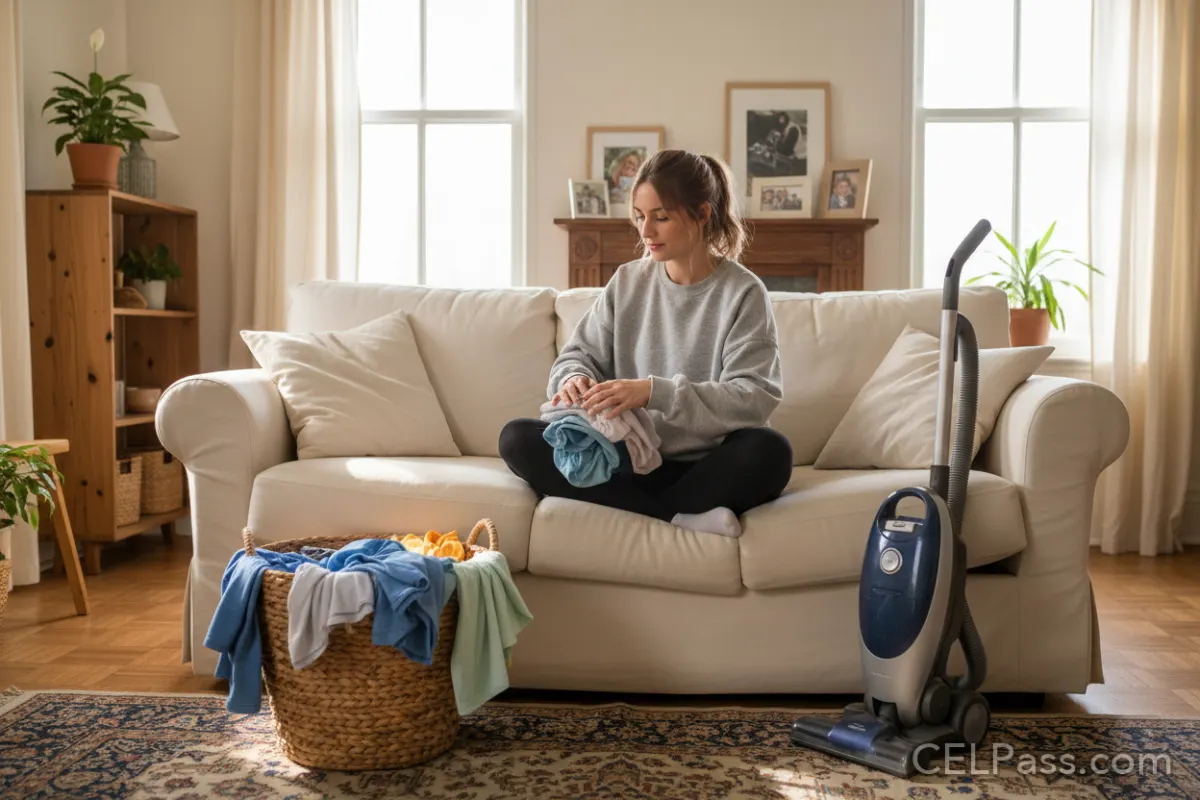 Neighbour’s University-Student Daughter
- $20 an hour for 4 hours every Saturday morning
- does laundry, vacuuming and dishes, and is very flexible
- has no cleaning experience and will be away during exam periods
 Robot Vacuum and Mop
- $850, one-time cost
- cleans the floors every day by itself and is controlled by a phone app
- cannot clean stairs, counters or bathrooms, and gets stuck on toys and cords
How to plan your answer
What they want
- Pick a way to keep the house cleaner (you both work full-time; kids aged 9, 12, 15; Sundays lost to cleaning), then persuade Bridget it beats her idea: a robot vacuum and mop ($850).
- The cleaning service ($160 every two weeks) is easier to argue: it does the hard jobs the robot can't.
Plan (60 sec)
- Acknowledge: "Bridget, the robot is a one-time cost, I agree."
- Coverage: the robot only does floors; it can't clean bathrooms, counters or stairs.
- Problems: it gets stuck on toys and cords; with three kids, that's every day.
- Quality: two professional cleaners, three hours, do the kitchen, bathrooms and floors.
- Sundays: they come on weekdays, so our weekends are free for family.
- Close: "The kids can do a quick tidy-up before they come; that's a good habit."
Useful vocabulary
- cleaning service, professional, deep clean, every two weeks
- tidy up, get stuck, family time, worth it
Phrases
- "I see your point, but..."
- "Compared to the robot,..."
- "Most importantly,..."
Avoid
- Only describing your option; compare it with the robot.
- Ignoring your downside: the ongoing cost.
Excellent answer (transcript): around CLB 11–12
135 words
Why it scores high
- Vocabulary: "stuck on Lego and charger cords" and "the jobs that eat up most of our weekend" are vivid, precise choices.
- Task Fulfillment: the exam periods are answered with "the kids can help her", and the real benefit is named, "getting our Sundays back as a family".
- Content/Coherence: the speaker first shows understanding, "I understand why the robot vacuum appeals to you", then builds a clear, convincing argument.
Good answer (transcript): around CLB 7–8
102 words
What works, and what's missing
- Content/Coherence: the speaker contrasts what the student does with the robot's limits, "the stairs, the counters or the bathrooms", in a clear order.
- Task Fulfillment: the toys and cords point is well chosen, but "she can learn quickly" is a weak answer to her lack of experience.
- Vocabulary: "our Sundays will be free for the family" is clear, but the language stays simple where stronger persuasion would help.
Basic answer (transcript): around CLB 4–5
67 words
What holds it back
- Task Fulfillment: the main comparison, "Robot only clean floor. It can't clean bathroom or counter", is clear, but the student's weaknesses are not answered.
- Listenability: "She come every Saturday", "we don't need clean on Sunday" and "Robot get stuck" contain errors in nearly every sentence.
- Vocabulary: "I think it is worth it" is a general phrase, and the reasons are listed without strong persuasive words.
These are original CELPass examples written at each level. The CLBs are our estimates, not official CELPIP scores. How we estimate CLB
More Task 5 sample answers
- Art & Culture Festival Organization (next)
- Attending Live Theater Performances vs. Watching Movies
- City Animal Welfare Plan
- City Road Improvement Project
- City Transportation Expansion
- City Waste Management System
- Community Fitness Program
- Community Fitness Program
- Community Volunteer Program
- Digital Textbooks vs. Printed Textbooks
All 59 Task 5 sample answers · Task 5 template, tips and FAQs · All CELPIP sample answers
CELPass is an independent practice platform and is not affiliated with Paragon Testing Enterprises. CELPIP is a trademark of Paragon Testing Enterprises. Check the official CELPIP website and IRCC for current test rules and requirements.