CELPIP Reading Practice Test 1
By Iris
A complete CELPIP Reading practice test: all 4 parts and 38 questions in the real test order. Set a timer for 55–60 minutes and do all four parts in one sitting. Check your answers at the bottom of the page to see your score and an estimated CLB.
In this test
- Part 1: Reading Correspondence, “Tech Conference Planning” (questions 1–11) · practise this part alone
- Part 2: Reading to Apply a Diagram, “Local Library Event Schedule” (questions 12–19) · practise this part alone
- Part 3: Reading for Information, “Waste Management Systems” (questions 20–28) · practise this part alone
- Part 4: Reading for Viewpoints, “The Debate Over Online vs In-Store Shopping” (questions 29–38) · practise this part alone
Part 1: Reading Correspondence
Dear Team,
Our annual tech conference is set for September 15th–16th at the Horizon Center, and I need your input to finalize the agenda! We’ve booked keynote speakers on AI trends and cybersecurity, plus workshops on coding and cloud systems. Attendance is projected at 300, up from last year’s 250, so I’m considering hybrid access—live-streaming some sessions online. Should we charge extra for virtual tickets, or bundle them with in-person passes? The budget’s tight, so every decision counts.
Lunch will be provided—think sandwiches, salads, and wraps—but I’m debating a networking dinner on the 15th. Would you prefer a formal sit-down or a casual buffet? I’d also like to add a panel discussion—any topic suggestions? Finally, setup starts at 7 a.m. on the 15th; I need four volunteers for two hours to test AV equipment and arrange signage. Please respond by August 20th with your preferences—let’s make this our best event yet!
Regards,
Evan (Event Lead)
Evan’s email is intended to…
The conference will take place…
Lunch will feature…
Hybrid access is proposed to…
Volunteers are requested…
The networking dinner might be…
Here is a response to the message. Complete the response by filling in the blanks. Select the best choice for each blank.
Dear Evan,
Great plan—I’m already looking forward to the conference! The lunch menu featuring sounds tasty, and it’s a nice touch for a long day. I’d charge for virtual tickets— helps the budget without overcomplicating registration, plus it’s fair for those attending in person. A casual dinner works— suits me since it keeps things relaxed after all the sessions. I’d suggest a panel on AI ethics— is timely with all the buzz around it lately. I can help at 7 a.m.— is manageable, and I’m comfortable setting up the AV stuff if needed. Can’t wait for this!
Best,
Nia
Part 2: Reading to Apply a Diagram
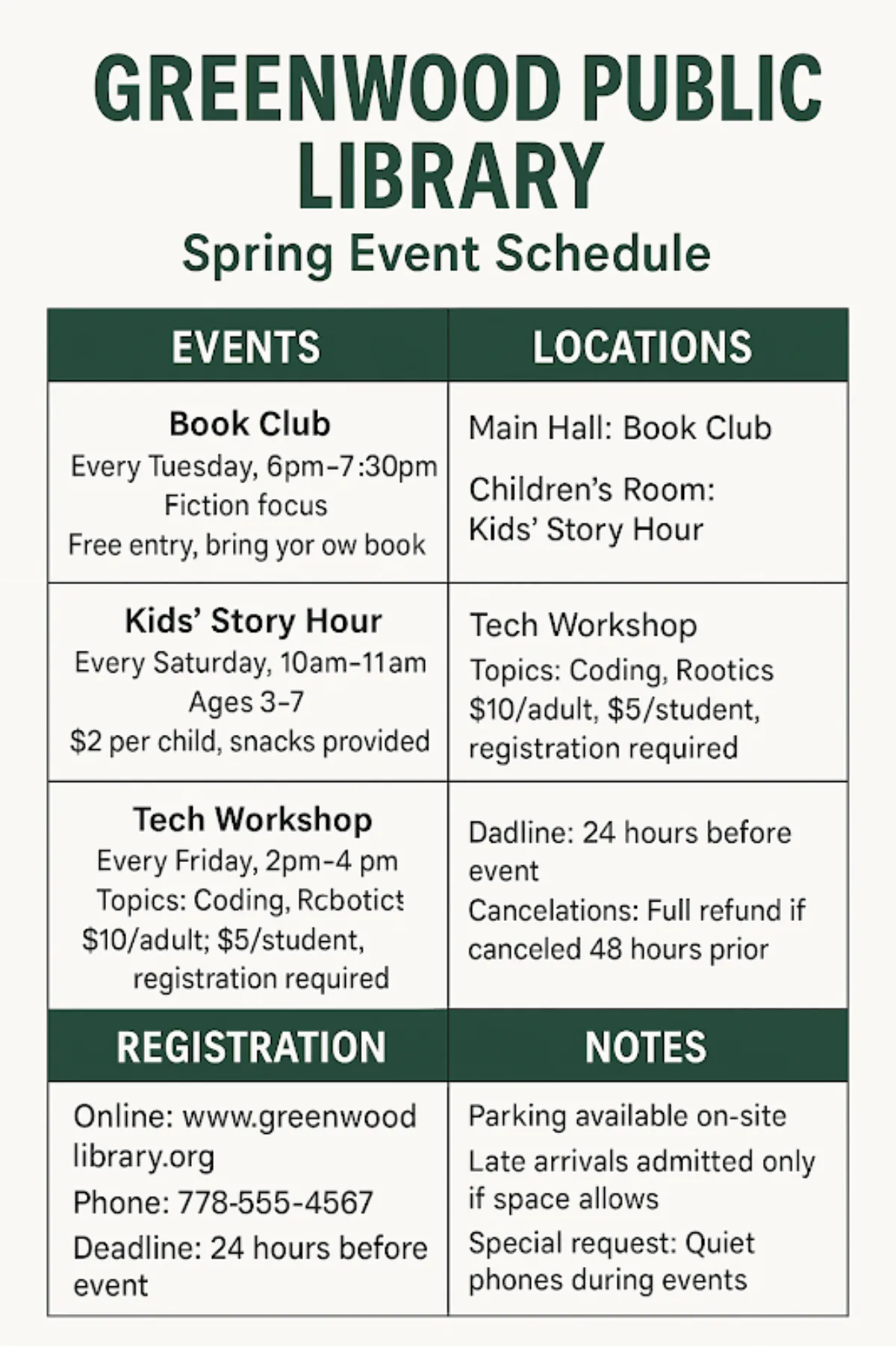
Read the following email message. Complete the email by filling in the blanks. Select the best choice for each blank.
Hi Priya,
I’ve been checking out the Greenwood Library events, and they’re great! Since you love reading, the happens every Tuesday evening. I’m taking my nephew to the because he’s 5 and loves stories. It’s only which is a steal! The tech workshop looks cool too, but you need to ahead of time. Oh, and they ask everyone to during events. Want to join me next week?
Best,
Anil
Anil is writing this email to...
The Tech Workshop differs from the Book Club in that it...
According to the schedule,...
Part 3: Reading for Information
A
Cities worldwide are grappling with growing waste volumes due to population increases and consumerism. Modern waste management systems now prioritize recycling and composting to reduce landfill use. For example, cities like San Francisco have implemented mandatory composting programs, diverting 80% of organic waste from landfills. Advanced sorting technologies, such as optical scanners, help separate recyclables efficiently. However, high costs of installing these systems can strain municipal budgets. Public education campaigns are also critical to ensure residents sort waste correctly.
B
Incineration is another method gaining traction in waste management, particularly in space-constrained urban areas. Modern incinerators convert waste into energy, powering thousands of homes. For instance, Copenhagen’s incineration plant generates heat for over 150,000 households. These facilities use filters to minimize air pollution, though concerns about emissions persist. The technology requires significant investment, but it reduces landfill dependency. Some critics argue that incineration discourages recycling by prioritizing energy production.
C
Single-use plastics pose a significant challenge to waste management systems. Many cities have banned plastic bags and straws, encouraging reusable alternatives. For example, Toronto introduced a bylaw requiring businesses to charge for plastic bags, reducing usage by 60%. However, plastic packaging remains difficult to eliminate due to its convenience and low cost. Innovations like biodegradable plastics are emerging, but they often require specialized composting facilities. Public resistance to change can also slow progress.
D
Community-based waste management initiatives are proving effective in smaller urban areas. These programs involve residents in local recycling and waste reduction efforts. For instance, a neighborhood in Seoul organizes monthly clean-up drives and workshops on upcycling. Such initiatives foster a sense of responsibility and reduce illegal dumping. However, they rely heavily on volunteer participation, which can be inconsistent. Scaling these efforts to larger cities remains a challenge due to logistical complexities.
Decide which paragraph, (A) to (D), has the information given in each statement below. Select (E) if the information is not given in any of the paragraphs.
- Optical scanners are used to improve the efficiency of recycling processes.
- Incineration plants can generate energy to heat homes.
- Biodegradable plastics are widely used in most cities.
- San Francisco has a successful composting program.
- Toronto’s plastic bag fee led to a significant reduction in usage.
- Community clean-up drives in Seoul occur weekly.
- Incineration is criticized for potentially reducing recycling efforts.
- Plastic straw bans have eliminated all single-use plastics.
- High costs of advanced waste systems can burden city budgets.
Part 4: Reading for Viewpoints
The surge in online shopping has transformed consumer behavior, sparking debate over its merits compared to traditional in-store shopping. As retailers adapt, perspectives from Seattle residents and experts reveal the strengths and challenges of both approaches. Dr. Laura Bennett, a retail economist, supports online shopping for its efficiency. “Consumers access vast inventories and compare prices instantly, saving time,” she says. However, she notes that inaccurate product descriptions can lead to dissatisfaction. In contrast, Thomas Reed, a local bookstore owner, defends in-store shopping. “Handling products and engaging with staff create a sensory experience that builds trust,” he argues. He admits, though, that physical stores struggle to match online price competitiveness.
Meanwhile, Aisha Khan, a working parent, blends both methods. “I buy groceries online for convenience, but I visit stores for clothes to ensure quality,” she explains. She values flexibility but finds online returns cumbersome. Conversely, Ethan Park, a software developer, sees online shopping as superior. “It’s fast, crowd-free, and tailored to my needs through algorithms,” he says, though he acknowledges occasional delivery delays. A 2024 Retail Trends report underscores these views, noting that online sales grew 15% last year, yet 60% of consumers prefer in-store shopping for high-value items like apparel due to tactile evaluation. Critics of online shopping highlight its environmental impact from packaging and shipping, while in-store shopping faces challenges like limited stock and travel costs. Both methods cater to distinct needs: online for speed and variety, in-store for tangibility and immediacy. Retail analyst Maria Vargas concludes, “Neither format will vanish. The future lies in hybrid models where online accuracy improves and stores enhance experiential elements.” Ultimately, the best choice depends on consumers’ priorities, lifestyles, and purchase types.
What does Dr. Bennett highlight as a benefit of online shopping?
According to Thomas Reed, what is a strength of in-store shopping?
How does Aisha Khan approach shopping?
What does Ethan Park admit about online shopping?
What does Maria Vargas predict about the future of shopping?
The following is a comment by a reader. Complete the comment by choosing the best option to fill in each blank.
As a frequent shopper, I see the appeal of both online and in-store shopping. Online platforms my need for quick purchases, like household essentials, but inaccurate listings frustrate me. In-store shopping, as Thomas suggests, a unique experience, especially for items like furniture where quality matters. Aisha’s hybrid approach resonates because allows me to adapt to my schedule and needs. However, Ethan’s view overlooks that for certain products, like tailored clothing, remains unmatched in stores. Retailers should online accuracy and in-store engagement to create a seamless shopping experience, ensuring consumers like me benefit from both worlds.
Answer key
Show all 38 answers
- Evan’s email is intended to… B. gather input on event details.
- The conference will take place… A. at the Horizon Center.
- Lunch will feature… C. items such as wraps.
- Hybrid access is proposed to… A. accommodate a larger audience.
- Volunteers are requested… C. on September 15th at 7 a.m.
- The networking dinner might be… A. a casual gathering.
- B. wraps
- C. charging
- D. casual
- D. AI ethics
- D. early
- A. Book Club
- A. Kids’ Story Hour
- D. $2 per child
- C. register 24 hours
- D. quiet phones
- Anil is writing this email to... B. invite Priya to library events
- The Tech Workshop differs from the Book Club in that it... A. requires a fee
- According to the schedule,... C. Tech Workshop ends at 4pm
- Optical scanners are used to improve the efficiency of recycling processes. A
- Incineration plants can generate energy to heat homes. B
- Biodegradable plastics are widely used in most cities. E
- San Francisco has a successful composting program. A
- Toronto’s plastic bag fee led to a significant reduction in usage. C
- Community clean-up drives in Seoul occur weekly. E
- Incineration is criticized for potentially reducing recycling efforts. B
- Plastic straw bans have eliminated all single-use plastics. E
- High costs of advanced waste systems can burden city budgets. A
- What does Dr. Bennett highlight as a benefit of online shopping? B. It allows instant price comparisons.
- According to Thomas Reed, what is a strength of in-store shopping? D. It offers a sensory and trustworthy experience.
- How does Aisha Khan approach shopping? C. She uses both methods based on the purchase type.
- What does Ethan Park admit about online shopping? A. It can involve delivery delays.
- What does Maria Vargas predict about the future of shopping? C. Both formats will coexist with improvements.
- B. fulfill
- A. provides
- B. it offers practical flexibility
- A. physical evaluation
- C. enhance
What does your score mean? See the CELPIP Reading score chart.
CELPass is an independent practice platform and is not affiliated with Paragon Testing Enterprises. CELPIP is a trademark of Paragon Testing Enterprises. Check the official CELPIP website and IRCC for current test rules and requirements.