CELPIP Reading Practice Test 2
By Iris
A complete CELPIP Reading practice test: all 4 parts and 38 questions in the real test order. Set a timer for 55–60 minutes and do all four parts in one sitting. Check your answers at the bottom of the page to see your score and an estimated CLB.
In this test
- Part 1: Reading Correspondence, “Community Garden Proposal” (questions 1–11) · practise this part alone
- Part 2: Reading to Apply a Diagram, “Community Recycling Program Guide” (questions 12–19) · practise this part alone
- Part 3: Reading for Information, “Art and Cultural Festivals” (questions 20–28) · practise this part alone
- Part 4: Reading for Viewpoints, “Public Transportation vs. Personal Driving” (questions 29–38) · practise this part alone
Part 1: Reading Correspondence
Dear Neighbors,
I’m excited to propose a community garden project for our block and would love your feedback! After months of research, I’ve secured a vacant lot on Elm Street, available starting June 1st, for us to transform into a shared green space. The goal is to grow fresh produce—like tomatoes, herbs, and squash—while fostering a sense of community. The city has agreed to waive the permit fees if we commit to maintaining it, but we’ll need to fund tools, seeds, and irrigation ourselves. I estimate $800 to start—would a crowdfunding campaign work, or should we seek a local sponsor?
I envision raised garden beds to accommodate all skill levels, plus a compost system to keep it sustainable. Should we limit plots to one per household, or allow multiple based on interest? I’d also like to host a kickoff event—perhaps a planting day with refreshments. Would you prefer mid-June or early July, considering summer schedules? Finally, I could use volunteers to clear weeds and prep the soil on May 25th from 9 a.m. to noon. Please reply by May 15th with your thoughts—I’d hate to move forward without everyone’s input!
Best regards,
Lila (Unit 12B)
Lila is emailing to…
The garden will be on…
The product might include…
Lila suggests raised beds to…
Volunteers are needed on…
The kickoff event could be in…
Here is a response to the message. Complete the response by filling in the blanks. Select the best choice for each blank.
Dear Lila,
Love the garden idea—I’ve been hoping for something like this on our block! The idea of growing fresh sounds delicious, and I think it’ll bring us all closer together. I’d go with crowdfunding— seems practical since it spreads the cost evenly and gets everyone invested. One plot per household is fine— keeps it fair, especially with limited space. I’d pick mid-June for the event— works better for me because July’s already packed with travel plans. I can volunteer on the 25th— is convenient, and I’m happy to pitch in with the weeding crew! Looking forward to seeing this take root.
Cheers,
Sam
Part 2: Reading to Apply a Diagram
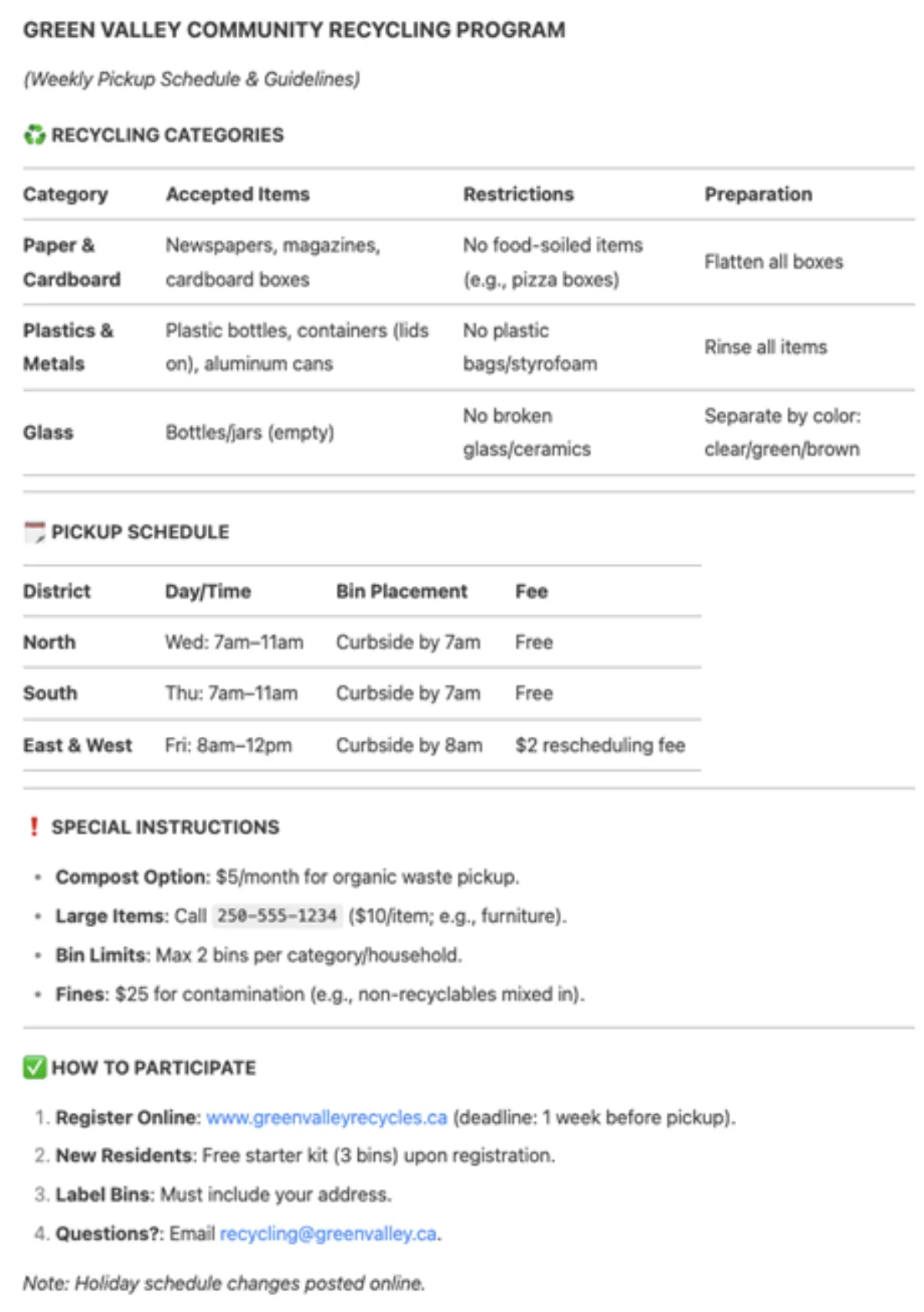
Read the following email message. Complete the email by filling in the blanks. Select the best choice for each blank.
Hi Mark, I’ve been meaning to tell you about the Green Valley recycling program since you just moved to the South District! They pick up recyclables I usually sort my because it’s easy to rinse and keep separate. It’s all free unless you miss the pickup time, which I’ve never had to worry about since it’s always at You can also add if you want to get rid of food scraps too—it’s super convenient. Just make sure you so you’re ready to start. Let me know if you need help signing up!
Cheers,
Lisa
Lisa is writing this email because...
The East & West Districts differ from the South District in that they...
According to the pickup schedule,...
Part 3: Reading for Information
Paragraph A
Art and cultural festivals attract millions of visitors, boosting local economies. Events like the Edinburgh Fringe Festival generate over $200 million annually for the city. These festivals showcase diverse performances, from theater to street art, fostering cultural exchange. They also provide platforms for emerging artists to gain recognition. However, high ticket prices can limit accessibility for some attendees. Organizers often rely on sponsorships to keep costs manageable.
Paragraph B
Many festivals emphasize sustainability to reduce their environmental footprint. For example, Glastonbury Festival in the UK has banned single-use plastics and uses solar-powered stages. Attendees are encouraged to use public transport to lower carbon emissions. These efforts align with growing public demand for eco-friendly events. However, implementing green initiatives can increase operational costs. Some festivals struggle to balance sustainability with affordability.
Paragraph C
Cultural festivals often preserve and promote traditional practices. The Diwali Festival in Leicester, UK, features traditional Indian dance and cuisine, drawing thousands of attendees. Such events strengthen community bonds and educate younger generations about their heritage. However, organizers face challenges in securing venues large enough to accommodate growing crowds. Funding shortages can also limit the scale of these celebrations.
Paragraph D
Technology is transforming the festival experience, making events more accessible. Virtual festivals, like the online version of South by Southwest (SXSW), allow global audiences to participate. Live-streamed performances and interactive apps enhance engagement for remote attendees. However, technical glitches can disrupt virtual events. In-person festivals also use apps for ticketing and scheduling, though not all attendees are tech-savvy. Balancing digital and traditional elements remains a challenge.
Decide which paragraph, (A) to (D), has the information given in each statement below. Select (E) if the information is not given in any of the paragraphs.
- The Edinburgh Fringe Festival significantly boosts the local economy.
- Glastonbury Festival uses solar power for its stages.
- Diwali Festival in Leicester promotes traditional Indian culture.
- Virtual festivals eliminate the need for physical venues.
- High ticket prices can make festivals less accessible.
- All festivals now use apps for ticketing.
- Technical issues can affect virtual festival experiences.
- Sustainability efforts increase costs for festival organizers.
- Leicester’s Diwali Festival struggles with funding shortages.
Part 4: Reading for Viewpoints
As urban populations grow and transportation options diversify, the debate over whether public transportation or personal driving should take priority intensifies. In Portland, city officials are exploring incentives to boost transit use, sparking varied reactions from residents and experts.
Sophie Nguyen, an environmental advocate, strongly favors public transportation. "It’s cheaper than owning a car and kinder to the planet," she says. "I avoid the stress of traffic and parking, though I’ll admit crowded buses can be a downside during peak hours." She sees it as an essential tool for sustainable urban living.
Liam Carter, a freelance photographer, leans toward driving. "I love the freedom to hit the road whenever I want," he explains. "Nothing beats a car for road trips or spontaneity." However, he acknowledges that in cities choked with traffic, public transit can sometimes be the more practical choice.
Ava Reynolds, a retail manager, embraces a blended approach. "I take the train to work to skip parking fees, but I drive for errands or weekend getaways," she notes. "Each has its perks depending on the day." She believes a one-size-fits-all solution misses the mark for diverse lifestyles.
Noah Patel, a graduate student, relies solely on public transportation. "Cars are an unnecessary expense, and they clog up the streets," he argues. "Buses and trains get me where I need to go without the hassle of ownership." He views driving as a contributor to urban gridlock that cities could do without.
Meanwhile, urban planner Clara Mendes offers a pragmatic take. "Public transit needs better funding to ease crowding, but driving’s appeal isn’t going away," she says. "The goal should be a system where both coexist—transit for efficiency, cars for flexibility." She advocates for improvements rather than an either/or choice.
Sophie Nguyen prefers public transportation mainly because it...
Liam Carter’s primary reason for choosing driving is that he...
Ava Reynolds’ perspective differs from Sophie’s and Noah’s in that she...
Noah Patel believes public transportation is superior because it...
Clara Mendes’ perspective suggests that...
The following is a comment by a reader. Complete the comment by choosing the best option to fill in each blank.
As someone who navigates the city daily, I think public transportation . Sophie’s focus on cost and eco-benefits is spot-on, but . Ava’s idea of mixing both options . Yet, I can see Noah’s point that . The best approach might be to while preserving driving as a viable choice.
Answer key
Show all 38 answers
- Lila is emailing to… A. propose a garden and gather opinions
- The garden will be on… B. Elm Street
- The product might include… B. squash.
- Lila suggests raised beds to… B. suit all gardeners.
- Volunteers are needed on… C. May 25th.
- The kickoff event could be in… C. early July.
- A. squash
- B. crowdfunding
- B. fairness
- C. mid-June
- D. morning
- B. every Thursday morning
- B. plastics and metals
- A. 7am sharp
- C. compost option
- B. register one week in advance
- Lisa is writing this email because... B. she wants to help Mark join the recycling program
- The East & West Districts differ from the South District in that they... A. have a later pickup time
- According to the pickup schedule,... C. East & West Districts have a fee for rescheduling
- The Edinburgh Fringe Festival significantly boosts the local economy. A
- Glastonbury Festival uses solar power for its stages. B
- Diwali Festival in Leicester promotes traditional Indian culture. C
- Virtual festivals eliminate the need for physical venues. E
- High ticket prices can make festivals less accessible. A
- All festivals now use apps for ticketing. E
- Technical issues can affect virtual festival experiences. D
- Sustainability efforts increase costs for festival organizers. B
- Leicester’s Diwali Festival struggles with funding shortages. C
- Sophie Nguyen prefers public transportation mainly because it... D. is cost-effective and environmentally friendly
- Liam Carter’s primary reason for choosing driving is that he... A. enjoys the independence and convenience of a car
- Ava Reynolds’ perspective differs from Sophie’s and Noah’s in that she... A. uses both driving and public transit depending on the situation
- Noah Patel believes public transportation is superior because it... A. reduces costs and urban congestion
- Clara Mendes’ perspective suggests that... B. both transportation methods should be enhanced and balanced
- C. is a practical option with some limitations
- B. Liam’s love for driving’s flexibility rings true for me
- A. suits people with varied schedules
- D. cars worsen city traffic problems
- B. expand public transit funding and access
What does your score mean? See the CELPIP Reading score chart.
CELPass is an independent practice platform and is not affiliated with Paragon Testing Enterprises. CELPIP is a trademark of Paragon Testing Enterprises. Check the official CELPIP website and IRCC for current test rules and requirements.