CELPIP Reading Practice Test 9
By Iris
A complete CELPIP Reading practice test: all 4 parts and 38 questions in the real test order. Set a timer for 55–60 minutes and do all four parts in one sitting. Check your answers at the bottom of the page to see your score and an estimated CLB.
In this test
- Part 1: Reading Correspondence, “Office Relocation Notice” (questions 1–11) · practise this part alone
- Part 2: Reading to Apply a Diagram, “Community Fitness Class Schedule” (questions 12–19) · practise this part alone
- Part 3: Reading for Information, “Digital Banking Transformation” (questions 20–28) · practise this part alone
- Part 4: Reading for Viewpoints, “Remote Learning vs. In-Person Education” (questions 29–38) · practise this part alone
Part 1: Reading Correspondence
Dear Team,
I hope you’re all doing well! I’m writing to let you know that our office will be relocating to a new building downtown next month, starting April 15th. The new space is bigger and closer to public transit, which should make commuting easier for most of us. I wanted to get your thoughts on a few things before we finalize plans.
The move will happen over a weekend, but we’ll need to pack up our desks by Friday, April 12th. Will you need boxes or extra help for that? Also, the new office has an open-plan layout—do you prefer assigned desks or a flexible seating setup? I’m leaning toward assigned spots to keep things organized, but I’m open to ideas.
One more thing—parking is limited at the new spot. Should we reserve spots for carpoolers, or just let it be first-come, first-served? Oh, and are there any specific amenities you’d like in the break room? I’ll pass your feedback to the planning team soon, so please let me know by Wednesday!
Best,
Rachel (HR Manager)
Rachel is emailing to…
The new office location benefits…
Employees need to pack by April 12th to…
Rachel asks about seating because…
Parking is a concern since…
Rachel needs replies by Wednesday to…
Here is a response to the message. Complete the response by filling in the blanks. Select the best choice for each blank.
Dear Rachel,
Gratitude for apprising us of the forthcoming relocation—I’m enthused about the enhanced premises! I’ll require several receptacles for my effects, so would be most efficacious. I advocate for predetermined workstations, as fosters continuity amid the transition. Regarding parking, allocating spaces for those partaking in vehicular collaboration seems judicious— would derive optimal utility. A sophisticated espresso apparatus in the respite area would be sublime; would relish such an indulgence. I’ll remit this by Wednesday— ?
Cordially,
Sam
Part 2: Reading to Apply a Diagram
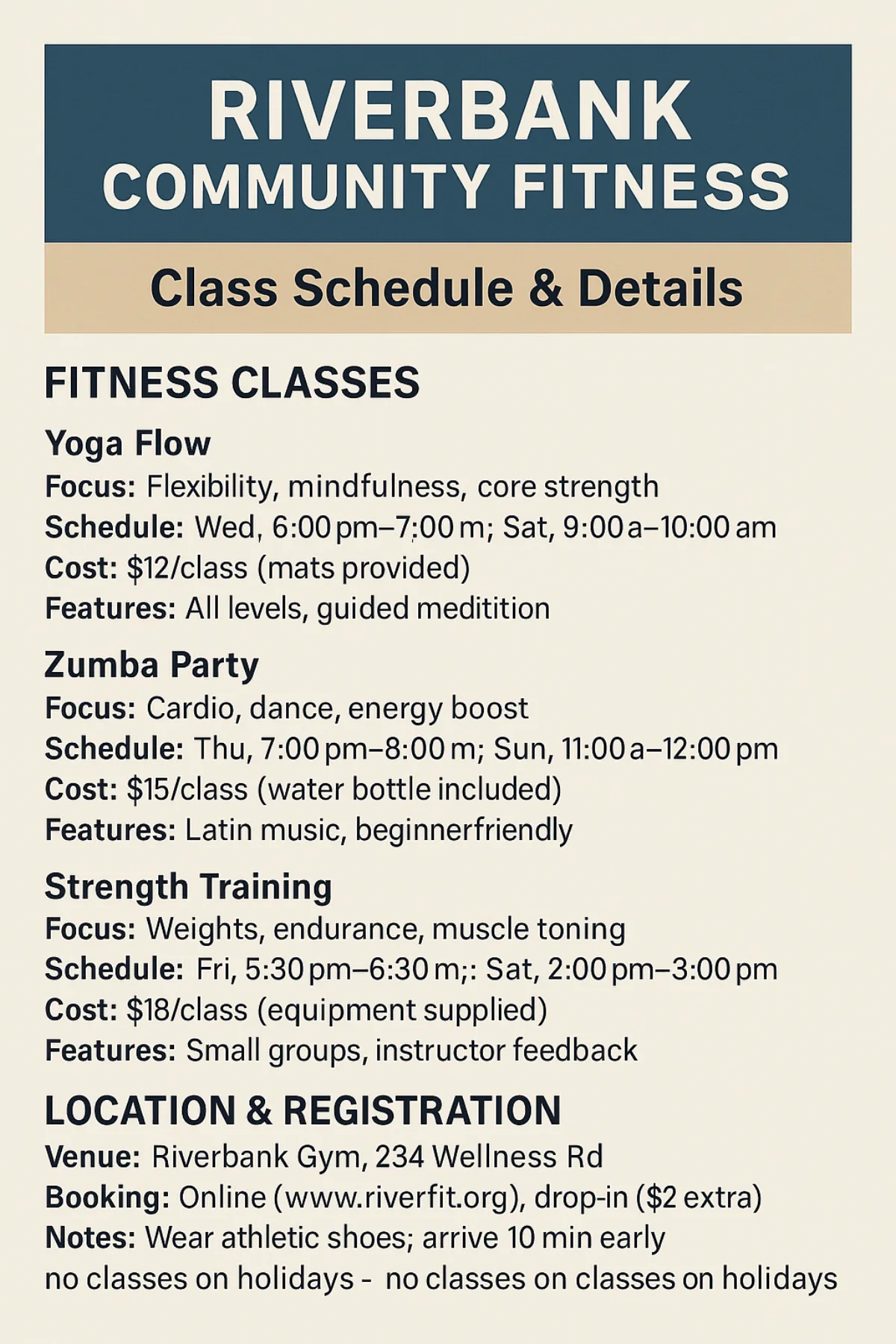
Read the following email message. Complete the email by filling in the blanks. Select the best choice for each blank.
Hi Priya,
I’ve been checking out the Riverbank Community Fitness classes, and they sound so fun! I’m signing up for on Saturday morning—it’s perfect for stretching out. You’d love if you’re into dancing; it’s got a great vibe and comes with a water bottle. My class is which isn’t bad for the setup. Yours kicks off at on Sunday, so we could recover together after! Just make sure to since spots fill up fast. My colleague’s joining too—she’s all about weights. Want to sweat it out with me?
Cheers,
Liam
Liam is writing this email because...
The Zumba Party differs from Yoga Flow in that...
According to the diagram,...
Part 3: Reading for Information
A
Digital banking has reshaped how people manage money, offering convenience through mobile apps and online platforms. Customers can transfer funds, pay bills, or apply for loans without visiting a branch. In 2024, over 60% of Canadians used digital banking regularly. Features like real-time transaction alerts enhance user experience. However, older generations sometimes struggle with the technology.
B
Security is a top priority in digital banking. Banks use encryption and biometric authentication, like fingerprint scans, to protect accounts. Despite these measures, cyberattacks remain a threat, with phishing scams targeting unsuspecting users. Banks invest millions in cybersecurity to stay ahead of hackers. Customer education on safe online practices is also emphasized.
C
Digital banking has reduced operational costs for financial institutions. By closing physical branches, banks save on rent and staffing. These savings are often passed on to customers through lower fees. For example, some online-only banks offer no-fee accounts, attracting younger clients. However, branch closures can inconvenience rural customers who rely on in-person services.
D
Financial inclusion is a key benefit of digital banking. In developing countries, mobile banking apps provide access to financial services for those without nearby banks. For instance, Kenya’s M-Pesa platform has empowered millions to save and borrow money. Yet, limited internet access in remote areas hinders widespread adoption. Efforts to expand connectivity are critical to closing this gap.
Decide which paragraph, (A) to (D), has the information given in each statement below. Select (E) if the information is not given in any of the paragraphs.
- Over 60% of Canadians use digital banking regularly.
- Digital banking eliminates all cybersecurity risks.
- Online-only banks offer no-fee accounts.
- Mobile banking improves financial inclusion in developing countries.
- All customers prefer digital banking over branch visits.
- Banks use biometric authentication for security.
- Rural customers are unaffected by branch closures.
- M-Pesa is a mobile banking platform in Kenya.
- Digital banking apps are difficult for all users to navigate.
Part 4: Reading for Viewpoints
The shift from traditional in-person education to remote learning has transformed pedagogy, prompting debate over flexibility, engagement, and social development. In Toronto, a hub for educational innovation, diverse perspectives illuminate the trade-offs. Morgan Ellis, a university student, champions remote learning. “Digital platforms offer scheduling flexibility and integrate interactive tools, enhancing my study efficiency,” she says. Remote learning reduces commuting costs, but she notes feelings of isolation.
“Virtual classes can feel detached,” she admits. In contrast, Riley Chen, a high school teacher, prefers in-person education. “Face-to-face interaction fosters dynamic discussions and immediate feedback,” he explains. Classroom settings build community, though distractions like noisy peers pose challenges. “Focus isn’t always guaranteed,” he observes.
Jordan Lee, a part-time graduate student, adopts a hybrid approach. “I attend in-person labs for hands-on practice and take online courses for theory,” they say, valuing balance but frustrated by inconsistent online platforms.
Avery Patel, a school counselor, staunchly supports in-person education. “It cultivates social skills and structured routines critical for young learners,” she argues, though she acknowledges commuting burdens. A 2024 Education Insights Report highlights that remote learning has gained traction among working students for its adaptability, while in-person education remains preferred for fostering collaboration and emotional growth. Remote learning risks social disconnection, whereas in-person settings face logistical constraints. Education psychologist Dr. Nora Khalid concludes: “Blended models, combining remote flexibility with in-person engagement, will redefine equitable education.” The choice depends on learning styles, career demands, and developmental needs.
What primary benefit does Morgan Ellis emphasize for remote learning?
What challenge does Morgan associate with remote learning?
Why does Riley Chen prefer in-person education?
How does Jordan Lee’s approach differ from Morgan Ellis’s and Avery Patel’s?
According to Dr. Nora Khalid, how will blended educational models impact the future?
The following is a comment by a reader. Complete the comment by choosing the best option to fill in each blank.
I value remote learning’s flexibility but cherish in-person education’s vibrancy. Remote platforms my study schedule, integrating tools that enhance focus. Yet, disconnection, as Morgan notes, often dampens engagement. In-person classes excel for collaboration, fostering lively discussions, though classroom distractions frustrate. Dr. Khalid’s blended model ; I’d mix online lectures with in-person seminars to optimize learning. My primary concern is ; inconsistent digital platforms disrupt remote sessions. For now, I lean toward remote for independent study, joining in-person for group dynamics.
Answer key
Show all 38 answers
- Rachel is emailing to… D. announce an office move.
- The new office location benefits… B. transit users.
- Employees need to pack by April 12th to… C. prepare for the move.
- Rachel asks about seating because… D. she wants input.
- Parking is a concern since… D. spots are scarce.
- Rachel needs replies by Wednesday to… C. finalize the move.
- C. dispatching a few
- A. consistency
- D. the collective
- A. our cohort
- D. further stipulations
- D. Yoga Flow
- B. Zumba Party
- A. $12
- B. 11:00am
- C. Book online
- Liam is writing this email because... A. He is inviting Priya to join fitness classes
- The Zumba Party differs from Yoga Flow in that... A. It focuses on cardio and dance
- According to the diagram,... C. Drop-in classes cost $2 more than online booking
- Over 60% of Canadians use digital banking regularly. A
- Digital banking eliminates all cybersecurity risks. E
- Online-only banks offer no-fee accounts. C
- Mobile banking improves financial inclusion in developing countries. D
- All customers prefer digital banking over branch visits. E
- Banks use biometric authentication for security. B
- Rural customers are unaffected by branch closures. E
- M-Pesa is a mobile banking platform in Kenya. D
- Digital banking apps are difficult for all users to navigate. E
- What primary benefit does Morgan Ellis emphasize for remote learning? B. Flexibility and digital tool integration
- What challenge does Morgan associate with remote learning? C. Feelings of social isolation
- Why does Riley Chen prefer in-person education? A. It fosters dynamic interaction and feedback
- How does Jordan Lee’s approach differ from Morgan Ellis’s and Avery Patel’s? B. They combine in-person and online methods.
- According to Dr. Nora Khalid, how will blended educational models impact the future? D. They will balance flexibility and engagement.
- A. substantially liberate
- C. Persistent social
- D. interpersonal dynamic
- C. harmonizes diverse learning needs
- A. technological unreliability
What does your score mean? See the CELPIP Reading score chart.
CELPass is an independent practice platform and is not affiliated with Paragon Testing Enterprises. CELPIP is a trademark of Paragon Testing Enterprises. Check the official CELPIP website and IRCC for current test rules and requirements.