CELPIP Listening: 8 Common Traps and How to Avoid Them
By Iris · Listening · Published · 17 min read
Most wrong answers in CELPIP Listening are not random. The wrong options are built to catch listeners in a few predictable ways: they repeat words you heard, give an opinion to the wrong speaker, or offer the plan that was dropped a minute later. This post goes through the eight traps we see most often. Each one comes with a real question from the CELPass practice bank to try on the page (our own material, written in the CELPIP style, not official test content), what the wrong option did and a strategy to overcome it.
What are the most common traps in CELPIP Listening?
Eight traps cover nearly every wrong option: matching words with a changed meaning, the right topic with the wrong detail, an answer that sounds true but was never said, the wrong speaker, old plans, missed negatives, literal readings of tone, and options that are too narrow or too broad.
We know this because every wrong option in our Listening and Reading practice is labelled with the one trap that makes it wrong. Among CELPass learners, the three traps that catch the most people are matching words, wrong detail and "sounds true, not stated".
| Trap | What the wrong option does | Where it shows up most |
|---|---|---|
| Matching words, wrong meaning | Repeats words from the audio but changes what was said | Every part |
| Right topic, wrong detail | Gets the number, time, place or person wrong | Parts 1-4 |
| Sounds true, not stated | Makes sense from common knowledge, but nobody said it | Every part |
| Mixed up who said it | Gives one speaker's view to another | Part 5, Part 6 |
| Order or timing | Was the first plan, or happened earlier | Part 1, Part 2 |
| Missed "not / except / only" | Ignores a negative or a limit | Part 4, Part 6 |
| Took words literally | Takes the words at face value when the question asks about feeling or meaning | Part 2, Part 4, Part 5 |
| Too narrow or too broad | Covers one point when the question asks about the whole | Part 5, Part 6 |
Each section below has a real question from the CELPass practice bank to try: play the clip once, as in the test, choose an answer and press Check to see the trap.
Why are options that repeat words from the audio often wrong?
Because CELPIP builds wrong options from words you really heard, put together to say something the speaker never meant. The correct option is usually a paraphrase, so it can sound less familiar than the trap.
From the CELPass practice "A Leak in the Kitchen Ceiling" (Part 1, section 2). In section 1, the woman told the building manager the water was coming through the kitchen ceiling, "right above the fridge". Now he checks the empty flat upstairs.
Try it: play the clip once, then answer
What does the man suspect?
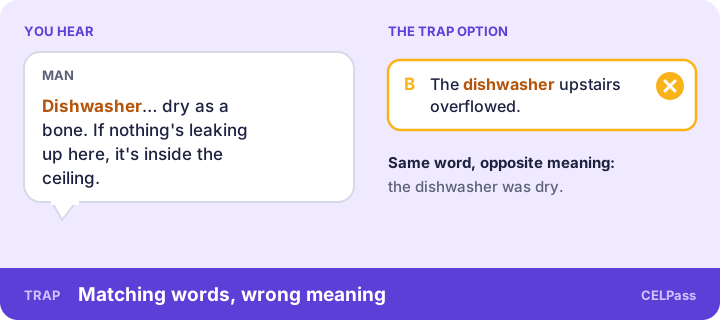
A. B and C use words you heard clearly, "dishwasher" and "fridge", but the dishwasher is "dry as a bone" and the fridge is only where the water lands. The right answer never says "cold pipe": you have to connect "they turned the heat right down", "something inside the ceiling" and "minus twenty-eight on Tuesday" yourself. D is a different trap, covered in the next section.
Transcript (read it after you answer)
MAN: Okay, I've got the master key. Normally I have to give owners a day's notice in writing before I go in, but water coming through a ceiling counts as an emergency. Hello? Building manager!
WOMAN: Wow, it's freezing in here.
MAN: They turned the heat right down before they left. Kitchen's this way. Let's see… floor's dry. Under the sink, dry. Dishwasher… dry as a bone.
WOMAN: So it's not them?
MAN: Doesn't look like it. Which honestly worries me more. If nothing's leaking up here, it's something inside the ceiling, between your place and theirs. And with the heat this low…
WOMAN: Oh no. You mean it—
MAN: Could be. It was minus twenty-eight on Tuesday. I'm turning their heat back up before we go.
Strategy: when an option repeats a word you noted, ask what the speaker said about that thing, not just whether it was mentioned. Expect the right answer to use different words from the audio.
Practise this trap free: create an account and go straight to
Why do I pick answers that sound right but are not in the recording?
Because the option fits the situation so well that your brain fills the gap. CELPIP asks what you heard, not what is likely, and these options are written to be sensible.
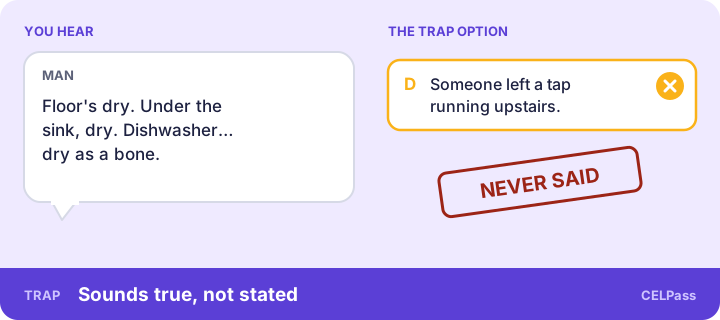
Look again at option D in the leak question: "Someone left a tap running upstairs." It is a common cause of a ceiling leak in real life, which is exactly why it works as a trap. Nobody in the conversation suggests it, and the manager finds the sink dry.
Strategy: before you choose, point to the moment in your notes that supports the option. If you cannot, it is probably the trap.
Practise this trap free: create an account and go straight to
How do I avoid choosing the right topic with the wrong detail?
Check the one detail that differs between similar options, such as a time, a date or a reason, against what the speaker actually said about it.
From the CELPass practice "Help with a First Tax Return" (Part 3). A newcomer arrives at a free tax clinic.
Try it: play the clip once, then answer
Why is the woman nervous at first?
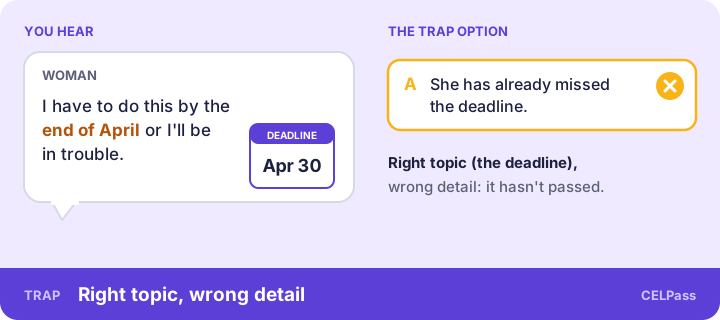
D. "I really can't afford to hand over a big amount" means she is afraid of paying money. A is on the right topic, the deadline, but the detail is wrong: the deadline is the end of April and she has not missed it. B reuses "co-worker", and nothing says the information was wrong. C is never mentioned.
Transcript (read it after you answer)
WOMAN: Hi, sorry, is this where I get the free help with taxes? The sign at the front desk was a little confusing.
MAN: You're in the right place. I'm one of the volunteers here. Is this about your own return?
WOMAN: Yes, my first one. I moved to Winnipeg from Colombia last July, and my co-worker said I have to do this by the end of April or I'll be in trouble. To be honest, I've been dreading it. I really can't afford to hand over a big amount.
MAN: Well, let's not panic yet. A lot of people in their first year actually get money back, not the other way around.
Strategy: when two options are about the same thing, find the word that makes them different (missed or not yet, owe or get back) and check it against your notes. Write numbers and dates the moment you hear them.
Practise this trap free: create an account and go straight to
How do I stop mixing up who said what?
Note each speaker's name with their view as you listen, because Part 5 and Part 6 questions ask about one particular person and the wrong options are often another person's opinion.
From the CELPass practice "Opening the Dental Office on Saturdays" (Part 5). Three co-workers, Gina, Lawrence and Brooke, discuss which weekday to take off in exchange for Saturday shifts.
Try it: play the clip once, then answer
In the test, Part 5 is a video. Here you hear the audio of the same discussion.
Why does Brooke prefer Wednesday as the day off?
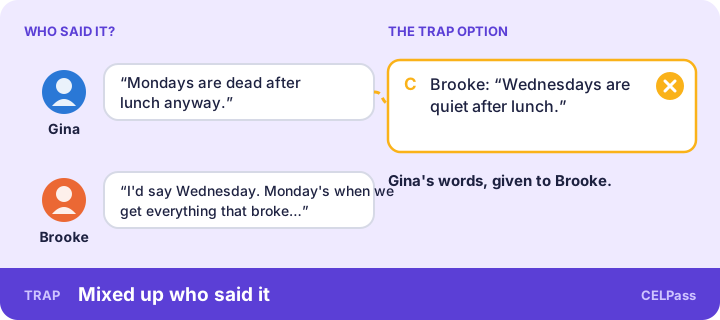
B. Brooke says Monday is when they get "everything that broke over the weekend", such as cracked teeth. C is built from Gina's line, "Mondays are dead after lunch", and moves it to a different day, so a listener who caught the words but not the speaker picks it. Brooke actually disagrees with Gina. A and D are never said.
Transcript (read it after you answer)
Gina: Nobody's talking about every Saturday, Lawrence. What I had in mind was a rotation. Each of us would do maybe one in four.
Lawrence: One in four I could probably live with. Would we get a weekday off in exchange, or is it just extra hours?
Gina: That's the part I'd have to sort out with Dr. Chen. My guess is she'd want us to take Monday afternoons. Mondays are dead after lunch anyway.
Brooke: Are they? I'd say Wednesday. Monday's when we get everything that broke over the weekend. Cracked teeth from Saturday's barbecue, that sort of thing.
Strategy: set up one column per speaker before the audio starts and write each opinion under its owner, with one word for the reason. When an option sounds right, ask whose words it is built from.
Practise this trap free: create an account and go straight to
Why do I choose a plan the speakers changed?
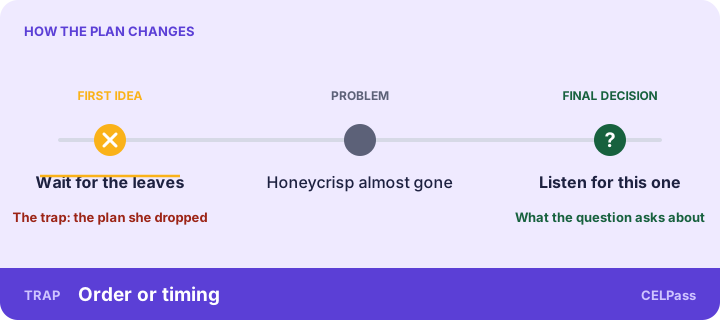
Because the first plan is said clearly and it sticks in your memory. Speakers change their minds, and questions like "What will she probably do?" ask about the final decision.
From the CELPass practice "A Day at the Apple Orchard" (Part 2). A man tells a woman about taking his kids apple picking, and she asks for advice. This is the whole conversation, about two minutes, as in the test.
Try it: play the clip once, then answer
What will the woman probably do?
D. The man's main tip is "book online", and she ends with "I'm going on their website the minute I get home." A was her first plan, going later in October for the leaves, and she drops it when she hears the Honeycrisp apples will be gone. C is the other farm, which the man says is not the one he went to. B reuses the farmers' market from an earlier part of the talk.
Transcript (read it after you answer)
WOMAN: So how was the weekend? Didn't you say you were taking the kids apple picking?
MAN: We did, yeah. We went to that orchard out past Milton, the one with the corn maze. The kids loved it. Although, honestly, I think they spent more time riding around on the hay wagon than actually picking anything.
WOMAN: Oh, the one with the petting farm? With the goats? I took my nephew there once.
MAN: No, no, that's the place on the other side of the highway. This one's bigger, more of a proper farm. Anyway, word of advice, book online. We just showed up around eleven, and they'd already sold out of picking times for the morning. We had to wait until one o'clock.
WOMAN: Two hours? With kids? What on earth did you do?
MAN: Well, they did the corn maze twice, and then we had lunch at the little café by the barn. Their apple fritters, by the way, are incredible. Bigger than your hand. Funny thing is, the kids keep saying the waiting part was their favourite.
WOMAN: Okay, fritters, noted. And what about the apples themselves? Is it expensive? Last time I bought a bag at the farmers' market I nearly fainted.
MAN: It's not cheap. It's $35 for a bag, but it's a big bag, and you can fill it right to the top, and believe me, my daughter did. We came home with about twenty pounds. We've had apple crisp three nights in a row.
WOMAN: Twenty pounds! Okay, so should I go this weekend, or wait a bit? I was thinking maybe later in October, when the leaves are—
MAN: —at their best? Sure, the colours will be gorgeous, but I'd go sooner if I were you. The guy at the gate told us the Honeycrisp are pretty much done, and by the end of the month it's mostly the sour ones people use for baking.
WOMAN: Hmm. Well, the sour ones are fine for pies, but Jamal won't touch anything except Honeycrisp. He'd never let me hear the end of it.
MAN: Then I wouldn't wait. And go early in the day, before the fritters sell out.
WOMAN: Okay, okay, you've convinced me. I'm going on their website the minute I get home.
Strategy: cross out a plan in your notes the moment it is rejected, and star the last one agreed. For "what will happen next", use the last decision, not the first idea.
Practise this trap free: create an account and go straight to
How do negatives like "not" and "only" catch listeners?
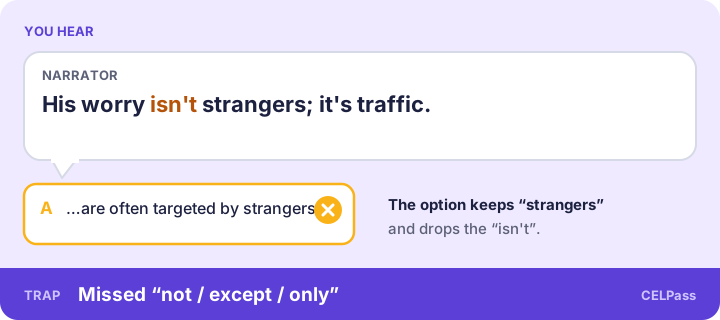
A speaker mentions an idea in order to reject it, and the option repeats the idea without the "not". If you note the topic but miss the negative, the trap looks correct.
From the CELPass practice "Walking to School Alone" (Part 6). The talk presents two views on whether children should walk to school on their own: Lisa Tremblay's, then Gary Mitchell's.
Try it: play the clip once, then answer
Gary Mitchell believes that younger children
B. Mitchell says they "cannot gauge the speed of an approaching vehicle". A takes "strangers" from the sentence where he rejects it: "His worry isn't strangers; it's traffic." D turns "however sensible they may be" upside down, and C reuses "no guard in sight". All three catch a listener who heard the keywords but not the structure around them.
Transcript (read it after you answer)
Tremblay contends that parents' fears are fuelled largely by headlines rather than evidence; the odds of a child being harmed by a stranger, she notes, are extremely low and have not risen in decades. Ironically, she adds, the line of cars idling outside schools every morning makes the street far more hazardous for the few children still on foot.
Gary Mitchell, who has supervised crossing guards in Hamilton for fifteen years, is unmoved. His worry isn't strangers; it's traffic. Neighbourhoods built decades ago were never meant for today's volume of cars, he observes, and many routes now cross four-lane roads with no guard in sight. Drivers, he adds, routinely ignore the reduced speed limits posted near schools, particularly during the morning rush. Younger children, Mitchell insists, simply cannot gauge the speed of an approaching vehicle, however sensible they may be.
Strategy: when you hear "not", "isn't", "rather than" or "however", mark it in your notes with an X or an arrow. An idea with an X next to it is what the speaker rejects, not what they believe.
Practise this trap free: create an account and go straight to
What does it mean to take a speaker too literally?
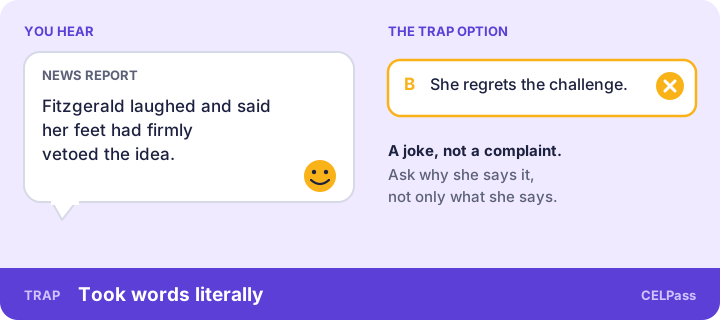
It means choosing what the words say when the question asks what the speaker means. Questions with "suggests", "feel" or "why does she say" want the meaning behind a joke, an understatement or a tone.
From the CELPass practice "Retired Teacher Walks for Literacy" (Part 4). A news report about a 68-year-old who walked 1,000 kilometres to raise money for adult literacy.
Try it: play the clip once, then answer
Fitzgerald's comment about her feet suggests she
D. Saying her feet "had firmly vetoed the idea" is a joke that means no to another walk. She laughed as she said it, so B reads regret into a joke. A and C reuse the blisters and the worn-out running shoes mentioned just before.
Transcript (read it after you answer)
Her original target was a modest $10,000, but donations accelerated dramatically after a trucker posted a video of her trudging through a thunderstorm near Wawa. The total now stands at more than $86,000. Fitzgerald's husband accompanied her in a camper van, preparing meals and treating what she describes as an unbelievable collection of blisters. She wore out four pairs of running shoes along the way. Organizers deliberately scheduled her arrival for International Literacy Day. Asked whether she would attempt another walk, Fitzgerald laughed and said her feet had firmly vetoed the idea. Instead, she intends to spend the winter volunteering as a reading tutor.
Strategy: for feeling and meaning questions, note reactions as well as words: a laugh, a sigh, "I suppose". Then ask why the speaker said it, and pick the option that matches the intention, not the image.
Practise this trap free: create an account and go straight to
Why is the answer to a main-idea question not the detail I remember?
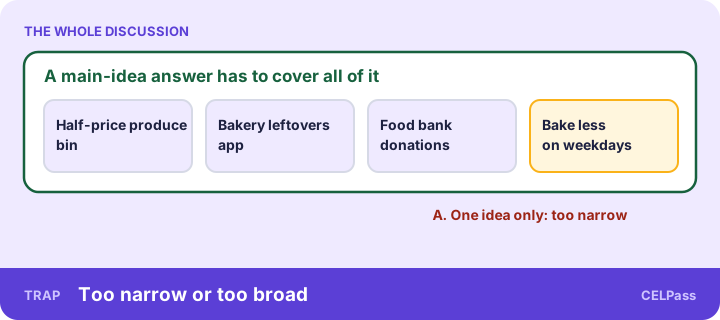
Because a question about the whole discussion, like a summary or an email subject line, needs an option that covers all of it. A true detail is too narrow.
From the CELPass practice "A Meeting of Store Managers" (Part 5). Dana, Keith and Ellen discuss how to cut food waste before Dana reports to head office.
Try it: play the clip once, then answer
In the test, Part 5 is a video. Here you hear the audio of the same discussion.
What is the best subject line for Dana's eventual report to head office?
C. Dana sums up: "I don't think we have to pick just one thing here. A bin for produce, the app for the bakery, donations if the timing works out." A was really said, but it is one idea among several. B overstates the donations, which depend on the food bank's van. D is the opposite of the half-price bin they plan to try.
Transcript (read it after you answer)
Dana: Okay, so head office wants our waste numbers down by spring. I pulled last month's report, and honestly, it's worse than I thought. Bakery and produce are almost two-thirds of it.
Keith: Well, produce is always going to be high. People pick through the apples and leave anything with a bruise on it. I can't sell those.
Ellen: Keith, you can, though. Lots of stores have a less-than-perfect bin. You bag up the bruised stuff and sell it at half price. My sister runs a store in Moncton, and she says it's gone by lunchtime most days.
Keith: Sure, and then people stop buying the full-price apples and just wait for the cheap bag. I've seen it happen.
Ellen: Some will. But right now we're making zero dollars on those apples. Zero.
Dana: What about the bakery, Ellen? How many loaves are you throwing out a night?
Ellen: Thirty, maybe forty on a slow day. Look, the real problem is we bake for our busiest day of the week, every single day. And a Tuesday is nothing like a Saturday.
Keith: So bake less on weekdays.
Ellen: That's what I've been asking for since last year! But then the shelves look half empty by six, and the regional manager walks in and—
Dana: —wants to know why the bakery looks bare. I know. I've had that conversation.
Keith: What about the food bank? Couldn't we just donate whatever's left at closing?
Dana: We tried that a couple of years ago. They could only pick up twice a week, so most of it went stale in the back room anyway. Although… I think somebody said they've got a van now.
Ellen: There's also that app, where people buy a surprise bag of leftovers at the end of the day. A bakery bag for five dollars. The students around here would love it.
Keith: Five dollars for forty loaves?
Ellen: No, no. A bag is three or four items. We'd sell, I don't know, maybe a dozen bags a night.
Keith: Huh. Well, that's more than we get for them now, I suppose.
Dana: Okay. I don't think we have to pick just one thing here. A bin for produce, the app for the bakery, donations if the timing works out.
Strategy: for summary, subject-line and main-idea questions, say the whole discussion to yourself in one sentence first. Then choose the option closest to that sentence, not to the line you remember best.
Practise this trap free: create an account and go straight to
How can I find out which trap catches me most?
Keep a tally of the trap behind each wrong answer. After 20 or 30 misses, one or two traps usually account for most of them, and those are the ones worth practising.
You can do this by hand: for every miss, find the line that proves the right answer and write down which of the eight traps your option was. It works, but it takes time, and it is easy to label your own mistakes too kindly.
CELPass does the tally for you. Every wrong option in our Listening and Reading practice already carries its trap and the words in the recording that set it up, so your misses add up to a profile:
- After each practice part and mock, wrong answers show their trap, the cue from the recording and a one-line tip.
- Error Analysis looks at your last 60 Listening or Reading misses and compares the traps you picked with the traps you could have picked, so it can say something like "you pick matching-words traps twice as often as chance". It only calls something a weakness once there is enough evidence.
- Each trap has a short lesson that uses your own missed question as the example, with three steps to fix it.
- Questions you miss come back as Fix cards to answer again later, and a trap drill replays only the misses with one trap.
- The trend shows whether a trap is fading as you practise.
On the free plan you see your most common trap with its tip and lesson. Paid plans show the trap behind every wrong answer, the full breakdown and the trap drills.
What should I practise next?
Start with notes, because almost every trap above is easier to spot with a clear record of who said what and which plan won. Then practise one part at a time and review every miss by its trap.
Frequently asked questions
Are the examples in this post from the real CELPIP test?
No. They are from the CELPass practice bank, our own questions written in the CELPIP style. Official test content is confidential.
Is the option that repeats the speaker's exact words usually wrong?
Often, but not always. Treat repeated words as a reason to check, not a reason to reject: confirm the option says what the speaker meant.
Keep reading
CELPass is an independent practice platform and is not affiliated with Paragon Testing Enterprises. CELPIP is a trademark of Paragon Testing Enterprises. Check the official CELPIP website and IRCC for current test rules and requirements.