CELPIP Reading: 8 Common Traps and How to Avoid Them
By Iris · Reading · Published · Updated · 19 min read
In CELPIP Reading, wrong options are rarely random. They are written to look right to a reader who is rushing: they copy words from the text, state something sensible the text never says, or give one person's opinion to another. This post goes through the eight traps we see most often. Each one comes with a real question from the CELPass practice bank to try on the page (our own material, written in the CELPIP style, not official test content), what the wrong option did and a strategy to avoid it.
What are the most common traps in CELPIP Reading?
Eight traps cover nearly every wrong option: matching words with a changed meaning, an answer that sounds true but is not stated, the right topic with the wrong detail, the wrong person's view, an unknown key word, a missed negative, the wrong order of events, and options that are too narrow or too broad.
We know this because every wrong option in our Reading practice is labelled with the one trap that makes it wrong. In the CELPass Reading question bank, nearly half of all wrong options (2,172 of 4,797) are matching-words traps, followed by "sounds true, not stated" (741) and wrong detail (574).
| Trap | What the wrong option does | Where it shows up most |
|---|---|---|
| Matching words, wrong meaning | Repeats words from the text but changes what it says | Part 3, then Part 1 |
| Sounds true, not stated | Makes sense from common knowledge, but the text never says it | Part 1, Part 4 |
| Right topic, wrong detail | Gets the day, time, amount, place or person wrong | Part 2, then Part 1 |
| Mixed up who said it | Gives one person's view to another, or to the writer | Part 4 |
| Unknown key word | Depends on misreading an idiom or a less common word | Part 3 |
| Missed "not / except / only" | Ignores a negative or a limit | Part 4, Part 1 |
| Order or timing | Puts a real event before or after it happened, or treats a plan as done | Part 1, Part 4 |
| Too narrow or too broad | Covers one point when the question asks about the whole | Part 4 |
Each section below has a real question from the CELPass practice bank to try: read the passage, choose an answer and press Check to see the trap.
Why are options that repeat words from the text often wrong?
Because CELPIP builds wrong options from words that really are in the text, put together to say something the writer never said. The correct option usually paraphrases, so it can look less familiar than the trap.
From the CELPass practice "Catering Business Launch Favour" (Part 1). Marisol, who is starting a catering business, writes to a former co-worker.
Try it: read the passage, then answer
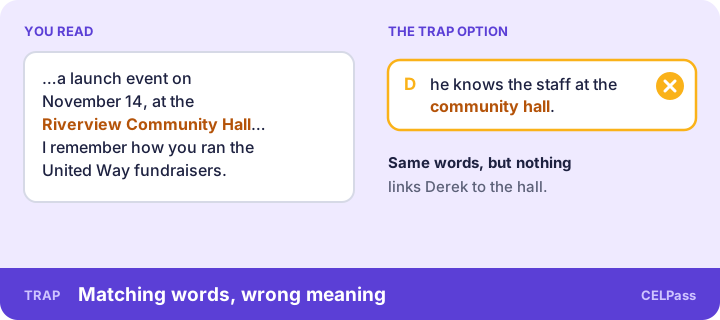
Now for the favour. We’re holding a launch event on Saturday, November 14, at the Riverview Community Hall: a free tasting where people can sample about a dozen dishes and book us for the holiday season. I remember how you ran the United Way fundraisers at Northgate. You had everybody laughing, and your team raised more than any team before it. Would you be willing to host the afternoon for us?
Marisol thinks Derek would be a good host because
B. She remembers that at the Northgate fundraisers he "had everybody laughing" and his team "raised more than any team before it": fun and successful, in other words. D reuses "community hall", but the hall is only where the launch takes place, and nothing links Derek to it. A and C sound reasonable but are never said: she mentions only his "new firm", and no farewell party.
Strategy: when an option repeats a name or phrase from the text, go back to that sentence and check what it says about that thing. This matters most in Part 3, where a statement often shares a keyword with one paragraph but matches the meaning of another.
Practise this trap free: create an account and go straight to
Why do I pick answers that sound true but are not in the text?
Because the option fits the situation so well that you fill the gap yourself. CELPIP asks what the text says or clearly suggests, not what is likely in real life, and these options are written to be sensible.
From the CELPass practice "Asking a Yukon Host Family for a Favour" (Part 1). Anika, a university student, writes to the family she stayed with during a summer of volunteering.
Try it: read the passage, then answer
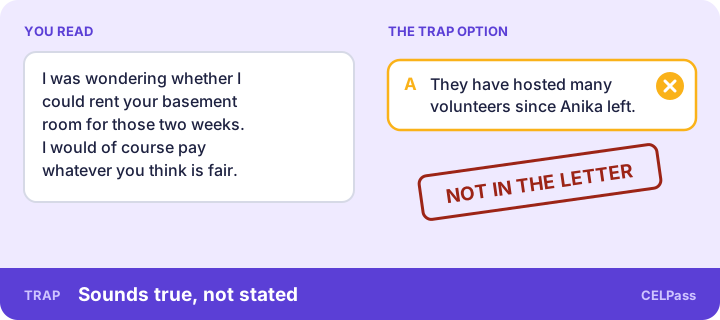
I was wondering whether I could rent your basement room for those two weeks. I would of course pay whatever you think is fair, and I would be happy to help around the house, including weeding Doug’s famous potato patch. I know spring is a hectic time for you, with the lodge getting ready to reopen, so please don’t feel any pressure. If it isn’t convenient, I completely understand, and perhaps you could suggest someone in town who rents rooms.
What can be inferred about Colleen and Doug?
D. Anika writes, "I know spring is a hectic time for you, with the lodge getting ready to reopen." A and C sound like things that could be true of a host family, but the letter never says them; asking to rent the basement room even suggests it is still free. B reuses "Doug's famous potato patch", but nothing says they sell vegetables.
Strategy: before you choose, find the sentence that supports the option. If you cannot, it is probably the trap. In Part 3, a statement that none of the four paragraphs makes is answer E, "not given": check all four paragraphs before you choose it.
Practise this trap free: create an account and go straight to
How do I avoid choosing the right topic with the wrong detail?
Check the one detail that differs between similar options, such as a day, a time, an amount or a condition, against the exact words of the text.
From the CELPass practice "Stepping Down as a Youth Soccer Coach" (Part 1). A volunteer coach writes to his soccer association.
Try it: read the passage, then answer
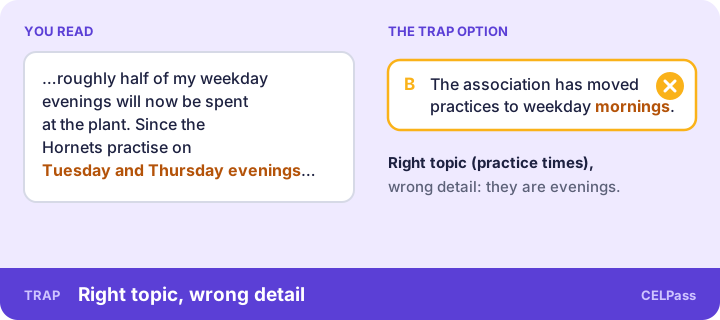
As you may know, I’ve accepted a position as an operator at the county water treatment plant. It’s a job I’ve wanted for years, but it comes with rotating twelve-hour shifts, and roughly half of my weekday evenings will now be spent at the plant. Since the Hornets practise on Tuesday and Thursday evenings, I simply can’t promise to be there, and the kids deserve a coach who shows up every week.
Stepping away is harder than I expected. I’ve coached this age group for six seasons, long after my own son moved up to the older division, and a few of my former players now help out as referees. …
Why can’t Gord continue as head coach?
D. His new job comes with "rotating twelve-hour shifts" that fill about half his weekday evenings, and the team practises on Tuesday and Thursday evenings. B is on the right topic, practice times, but the detail is wrong: nothing has moved to mornings. A reuses "my own son" and "the older division", and C contradicts him: stepping away is "harder than I expected".
Strategy: when two options are about the same thing, find the word that makes them different and check it in the text. In Part 2, this trap is often "half right": an option that fits most of the conditions but breaks one.
- List every condition in the email before you choose, not after.
- Read footnotes, asterisks and words like "per person" or "weekdays only".
- If an option fits most conditions quickly, double-check the last one. That is often where the trap is.
Practise this trap free: create an account and go straight to
How do I stop mixing up who said what?
Note each person's name with their view as you read, because Part 4 articles report several opinions and wrong options often give one person's view to another, or to the report or writer.
From the CELPass practice "Downtown Toronto Congestion Fee Debate" (Part 4). A news article about a proposed $12 charge for driving into downtown Toronto. Here are its first and fourth paragraphs.
Try it: read the passage, then answer
Should drivers have to pay to enter downtown Toronto? A report commissioned by the city has reopened that question by recommending a $12 charge for vehicles entering the core on weekdays between 7 a.m. and 7 p.m. Cameras would read licence plates, and the money raised, estimated at about $400 million a year, would be set aside for transit improvements. Vehicles carrying people with disabilities would be exempt. The idea is not new: London, Stockholm and, more recently, New York have introduced similar charges. In Toronto, however, it has divided residents, businesses and politicians.
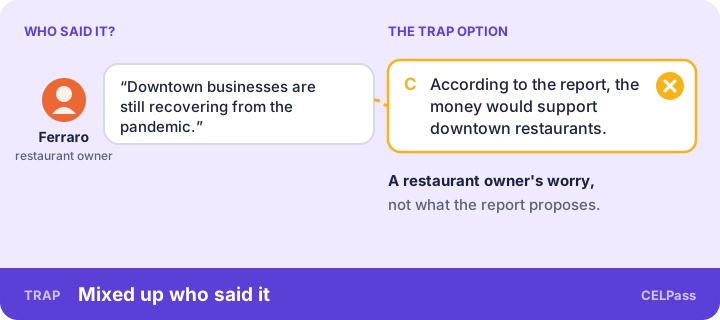
Tony Ferraro, who has run an Italian restaurant on King Street for twenty-two years, is far less enthusiastic. “About a third of my lunch customers drive in from the suburbs,” he says. “Add $12 to the price of a plate of pasta, and they’ll simply eat closer to home. Downtown businesses are still recovering from the pandemic. This could finish some of us off.” He admits that most of his dinner guests arrive after the charge ends, but says it is the lunch rush that pays his rent.
According to the report, the money raised would be used to
D. The report says the money "would be set aside for transit improvements." C comes from Tony Ferraro, a restaurant owner who worries about downtown businesses: supporting restaurants is his concern, not the report's plan. A and B are never mentioned.
Strategy: for each name in a Part 4 article, note who they are, whether they are for or against, and one word for why. When an option sounds right, ask whose idea it is. Choosing an argument the writer mentions only to reject it is a very common mistake.
Practise this trap free: create an account and go straight to
What if I don't know a key word or phrase?
Work out its meaning from the sentence around it, and distrust the option that depends on reading the phrase word by word. CELPIP often builds a trap on an idiom or a less common word.
From the CELPass practice "Arranging Care for Mom After Her Fall" (Part 1). Daniel writes to his sister about looking after their mother.
Try it: read the passage, then answer
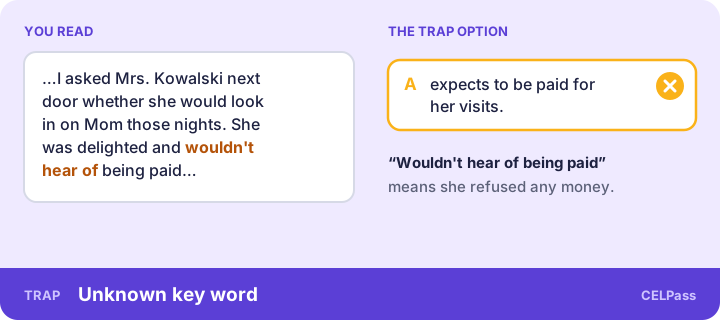
… I know Tuesday and Thursday evenings are impossible for you with Olivia’s swim practices, so I asked Mrs. Kowalski next door whether she would look in on Mom those nights. She was delighted and wouldn’t hear of being paid, although I suspect a tin of Mom’s famous shortbread will be expected once Mom is back in the kitchen.
Daniel suggests that Mrs. Kowalski
C. Daniel jokes that "a tin of Mom's famous shortbread will be expected": Mrs. Kowalski would welcome some of their mother's baking. A turns the phrase around: "wouldn't hear of being paid" means she refused any money. B and D reuse "Olivia" and "kitchen" from the same sentences.
Strategy: when a phrase is new to you, ask what the sentence must mean from what comes before and after it (here, "delighted" and "although"). After the test, add the phrase to your vocabulary list, because idioms and phrasal verbs come back.
Practise this trap free: create an account and go straight to
How do negatives like "not" and "only" catch readers?
The text mentions an action in order to rule it out, and the option repeats the action without the "not". If you notice the words but not the negative, the trap looks correct.
From the CELPass practice "Capping Food-Delivery App Commissions" (Part 4). An article on a plan to limit what delivery apps charge restaurants.
Try it: read the passage, then answer
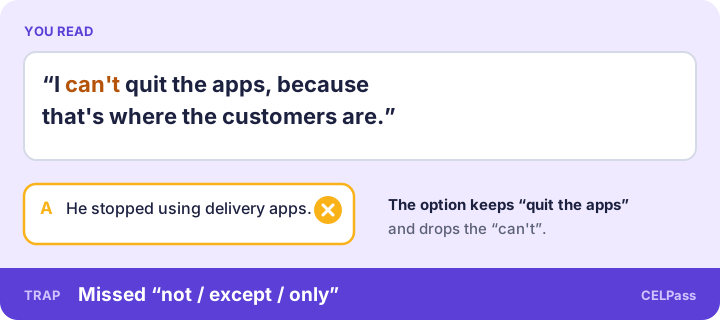
Luis Carvalho, who owns a Portuguese grill in Winnipeg’s West End, says delivery now accounts for nearly 40 percent of his sales. “On a $50 order, the app keeps up to $15. After food and wages, I’m often left with less than a dollar,” he says. Carvalho tried raising his menu prices on the apps, but customers noticed and complained in their reviews. “I can’t quit the apps, because that’s where the customers are. That’s not a partnership; that’s a toll booth.”
Economist Raymond Oduya of Assiniboine Valley University agrees that caps can have unintended consequences. … “ would be to encourage competition, for example by supporting delivery co-operatives owned by restaurants themselves.”
What did Luis Carvalho do to deal with the high commissions?
D. "Carvalho tried raising his menu prices on the apps, but customers noticed and complained in their reviews." A drops the negative: he says, "I can't quit the apps." C gives him economist Raymond Oduya's suggestion, and B is never mentioned.
Strategy: underline "not", "can't", "never", "only", "except" and "unless" as you read, in the question as well as the text. An action next to a negative is what someone did not or cannot do.
Practise this trap free: create an account and go straight to
Why do I mix up what happened and when?
Because letters and articles move between what was planned, what has happened and what is still to come. A trap option puts a real event in the wrong place on that timeline.
From the CELPass practice "Wedding Room Block Booking Error" (Part 1). Amira writes to a hotel about the rooms she reserved for her sister's wedding.
Try it: read the passage, then answer
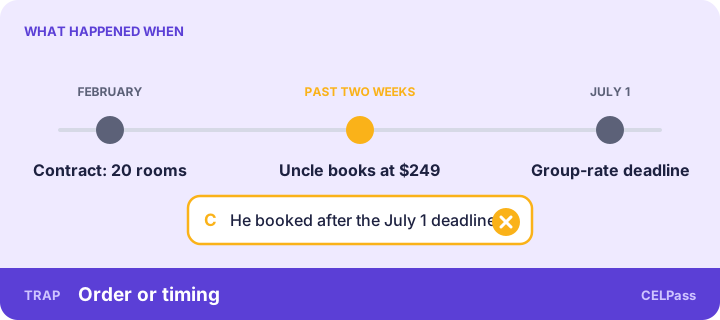
I am writing about the block of guest rooms I reserved at the Harbourview Hotel for my sister’s wedding on Saturday, August 14. In February, I signed a contract with your sales office for twenty rooms on the nights of August 13 and 14 at a group rate of $159 per night. The agreement states that guests may book at this rate until July 1, after which any unreserved rooms are released.
Over the past two weeks, I have received several worried calls from relatives. When they phoned your reservations line and gave the group code, they were told that no such block existed for those dates. Some were offered a room at your regular rate of $249 instead. My uncle, who is flying in from Beirut and did not want to risk being left without a room, accepted that rate, and at least three other families have since booked at a motel near the airport.
Why did Amira’s uncle pay the regular rate?
A. He "did not want to risk being left without a room." C gets the order wrong: the relatives called in the past two weeks, before the July 1 deadline, and were told the block didn't exist. D reuses "group code", but they gave the code and were still turned away. B is never mentioned.
Strategy: mark time words as you read (in February, over the past two weeks, until July 1, next month) and ask whether the option describes something that has happened, is planned or was only proposed. For Part 4 titles, check whether a decision has been made: "Council Approves…" is wrong if the vote is next month.
Practise this trap free: create an account and go straight to
Why is the answer to a main-purpose question not the detail I remember?
Because a question about the whole text needs an option that covers all of it. A true detail, however memorable, is too narrow. Other options go too far the other way, with words like always, never, all or completely.
From the CELPass practice "Thanking a Mentor About a Nursing Career" (Part 1). This is the whole letter, because the question is about all of it.
Try it: read the passage, then answer
Dear Deborah,
It has been almost nine years since I walked into Prairie Lane Marketing in Saskatoon as a nervous junior assistant, and I have been meaning to write to you for a long time. I’m not sure I ever properly thanked you for everything you did for me in those first two years. You were the one who pushed me to present our campaign to the Northern Co-op board when I was only three months into the job. I was terrified, and I’m fairly sure my hands shook the whole time, but you sat at the back of the room and nodded whenever I lost my place. I have given dozens of presentations since then, and I still picture you nodding at the back of the room.
A lot has changed for me since you retired. I’m now marketing manager at a software company in Regina, and by most measures my career is going well. However, last winter my father had a stroke, and I spent much of the spring at his bedside at Pasqua Hospital. The nurses who cared for him were extraordinary. They were calm, skilled and kind, even at the end of twelve-hour shifts, and they took the time to explain things to our family that the doctors were too rushed to discuss. Somewhere during those weeks, I realized that I wanted my work to matter to people the way theirs mattered to us. I have decided to become a nurse.
I know it sounds sudden at thirty-four, but I have been thinking it over carefully for months. My difficulty is choosing a route. The university offers an accelerated nursing degree that takes just under two years, but before I could apply, I would need to complete anatomy and chemistry courses, subjects I last studied in high school. The other choice is a practical nursing diploma at the polytechnic, which is shorter but leads to a more limited role. I’m also unsure whether we could manage our mortgage if I were earning only a part-time income.
I remember you telling me that your sister left banking to become a nurse in her forties. I would be very grateful to hear what she found most difficult, and what you think of my plans. I will be in Saskatoon for a conference from March 9 to 11. If you’re free, I would love to take you to lunch. If not, a phone call would mean just as much.
With sincere thanks,
Grace Oyelaran
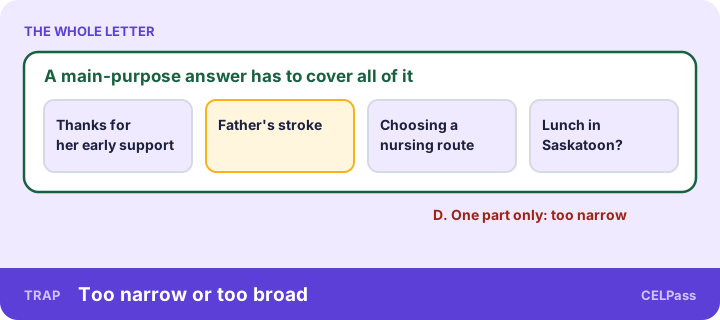
Why did Grace write this letter?
A. She thanks Deborah for her support early in her career, then asks what Deborah thinks of her plans and suggests meeting. D is true but too narrow: her father's stroke explains why she wants to change careers, not why she is writing. B reuses "conference" (Grace is attending one herself), and C is never asked.
Strategy: for purpose, main-idea and title questions, sum up the whole text in one sentence before you look at the options. Then check each option's strength: if an article says a policy "may reduce" traffic, an option saying it "will eliminate" traffic is too strong.
Practise this trap free: create an account and go straight to
What should I check before I choose an answer?
Find the evidence first, then match meaning rather than words, check the scope and reread the question. Four quick checks catch almost every trap above.
- Find the evidence: locate the sentence in the text that answers the question before you look closely at the options.
- Match meaning, not words: prefer the option that says the same thing in different words.
- Check the scope: is the option about the right person, the right time and the right strength of claim?
- Reread the question: confirm the option answers what was asked, not just something the text says.
This takes seconds once it becomes a habit. If you are short of time, at least do step 1: answers chosen with the evidence in front of you are far less likely to be traps.
How can I find out which trap catches me most?
Keep a tally of the trap behind each wrong answer. After 20 or 30 misses, one or two traps usually account for most of them, and those are the ones worth practising.
| Question | My answer | Correct | Trap type | What I will do next time |
|---|---|---|---|---|
| Part 2, gap 3 | B | D | Right topic, wrong detail | Check the footnote before choosing |
| Part 3, statement 5 | C | E | Sounds true, not stated | Use E only after checking all four paragraphs |
| Part 4, question 2 | A | C | Mixed up who said it | Mark who holds each opinion as I read |
CELPass does the tally for you. Every wrong option in our Listening and Reading practice already carries its trap and the words in the text that set it up, so your misses add up to a profile:
- After each practice part and mock, wrong answers show their trap, the cue from the text and a one-line tip.
- Error Analysis looks at your last 60 Reading misses and compares the traps you picked with the traps you could have picked, so it can say something like "you pick matching-words traps twice as often as chance". It only calls something a weakness once there is enough evidence.
- Each trap has a short lesson that uses your own missed question as the example, with three steps to fix it.
- Questions you miss come back as Fix cards to answer again later, and a trap drill replays only the misses with one trap.
- The trend shows whether a trap is fading as you practise.
On the free plan you see your most common trap with its tip and lesson. Paid plans show the trap behind every wrong answer, the full breakdown and the trap drills.
What should I practise next?
Work on the part where your traps cluster: Part 3 for matching words and unknown words, Part 4 for who said what, Part 2 for details. Then review every miss by its trap.
- CELPIP Reading Tips for Every Part
- CELPIP Reading Time Management: How to Finish Every Part
- CELPIP Reading Part 2: How to Read the Diagram
- CELPIP Reading Part 4: Reading for Viewpoints
- CELPIP Reading Part 3: Reading for Information
- CELPIP Listening: 8 Common Traps and How to Avoid Them
- Free CELPIP Reading sample tests
Frequently asked questions
Are the examples in this post from the real CELPIP test?
No. They are from the CELPass practice bank, our own questions written in the CELPIP style. Official test content is confidential.
Are CELPIP Reading answers usually paraphrased?
Often, yes. The correct option tends to say the same thing as the text in different words, while wrong options frequently reuse the text's exact words.
When should I choose option E in CELPIP Reading Part 3?
Only when you have checked all four paragraphs and none of them states the information, even if the statement is related to the topic.
Keep reading
CELPass is an independent practice platform and is not affiliated with Paragon Testing Enterprises. CELPIP is a trademark of Paragon Testing Enterprises. Check the official CELPIP website and IRCC for current test rules and requirements.