CELPIP Reading Practice Test 117
By Iris
A complete CELPIP Reading practice test: all 4 parts and 38 questions in the real test order. Set a timer for 55–60 minutes and do all four parts in one sitting. Check your answers at the bottom of the page to see your score and an estimated CLB.
Download as PDF with answer key
In this test
- Part 1: Reading Correspondence, “Hoping to Return to Rise & Crumb” (questions 1–11) · practise this part alone
- Part 2: Reading to Apply a Diagram, “A Holiday Skate in Thunder Bay” (questions 12–19) · practise this part alone
- Part 3: Reading for Information, “Freedom Seekers and the Underground Railroad” (questions 20–28) · practise this part alone
- Part 4: Reading for Viewpoints, “Kellerton’s Two Small Schools Debate” (questions 29–38) · practise this part alone
Part 1: Reading Correspondence
Dear André,
I hope this letter finds you and everyone at Rise & Crumb well. I still think of those early mornings in your kitchen, and I have to admit that no bread I’ve bought this past year has come close to your sourdough.
As you know, I left last October to look after my mother in Brandon after her stroke. I’m happy to tell you that she has made a far better recovery than her doctors expected. She is walking with a cane, cooking her own meals again and, as of last month, back to bossing my brother around. My brother has also moved into the house next door to hers, so she no longer needs me there every day, and I plan to return to Winnipeg at the end of this month.
I’m writing to ask whether there might be a place for me at the bakery again. I’m sure you have hired someone to replace me, and I would never expect you to let anyone go on my account. However, you mentioned last spring that you were hoping to open a second location in St. Boniface, and if that plan has gone ahead, I would be glad to work in either shop.
I haven’t been completely idle while I was away. I took an evening course in cake decorating at the college in Brandon, partly to keep my hands busy, and I’ve been making birthday and anniversary cakes for friends and neighbours ever since. You once told me that customers often asked for custom cakes and that you had to turn them away because nobody on staff had the time or the skill. Perhaps that is something I could take on.
I should be honest about one thing. I have promised to drive back to Brandon each Sunday evening and take my mother to her physiotherapy appointments on Monday mornings, so for the first few months I would need Mondays off. Her therapist expects her to manage on her own by the spring.
I would also understand completely if you aren’t able to offer me anything right now. In that case, I would be grateful if you could write me a reference, as I have applied to a couple of grocery store bakeries in the city.
I’ll be back in Winnipeg on the 28th, and I would love to drop by with a cake of my own and let you be the judge.
Warm regards,
Leah Kowalchuk
Leah is writing mainly
What has made it possible for Leah to leave her mother?
What does Leah suggest about the person who replaced her?
Why does Leah mention the custom cakes?
For the first few months, Leah would need
What does Leah plan to do once she is back in Winnipeg?
Here is a response to the message. Complete the response by filling in the blanks. Select the best choice for each blank from the drop-down menu.
Dear Leah,
What wonderful news about your mother! Please tell her that the whole kitchen is cheering her on, and that I’m glad to hear your brother .
Your timing is perfect. The St. Boniface shop opened in June, so you won’t be pushing anyone out. And yes, I remember how often I had to . If you’d like to take charge of those orders, the new shop has a counter just waiting for them.
Mondays are no trouble at all. I would much rather you than lose sleep over your schedule.
So you won’t need that reference after all, unless, of course, you would prefer to .
Come by on the 28th as you planned. I’ll have the coffee on, and I’ll be .
All the best,
André
Part 2: Reading to Apply a Diagram
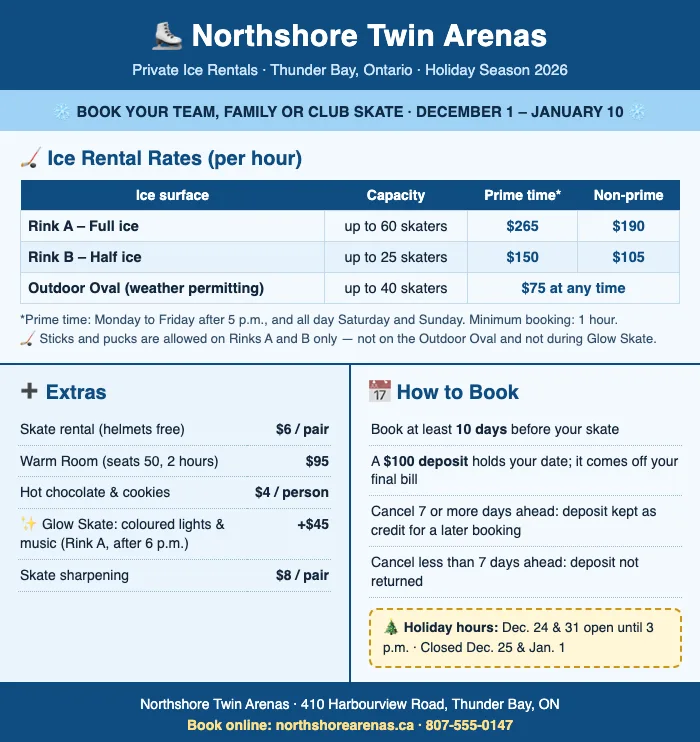
Read the following email message about the diagram on the left. Complete the email by filling in the blanks. Select the best choice for each blank from the drop-down menu.
Subject: Skating party in December
To: Ben Okafor
From: Nadia Ferreira
Hi Ben,
Thanks again for offering to help me plan our holiday skating party. I know it’s a tall order with only a few weeks to go, but I’ve been through the Northshore flyer and I think we can pull it off.
I’ve checked with everyone on the team, and with partners and kids we’ll be about 45 people, so we’ll need the biggest rink. Most people can’t get there before work ends, so I’m thinking of Friday evening, December 18, which means paying an hour.
The little ones will need somewhere to thaw out afterward, so let’s also book and order hot chocolate for everyone.
Raj and the others in shipping are already talking about a game of shinny, so as much fun as the lights and music sound, we’ll have to .
To hold the date, we need to pay up front, which comes off the final bill. I’ll put it on my card and give the receipt to Carla in accounting; she’s confirmed the company will pay me back.
The only catch is that the arena needs notice, so could you let me know what you think by Monday? I’d love to announce it at Tuesday’s staff meeting.
Thanks,
Nadia
Nadia and Ben most likely
What does Nadia plan to do about the deposit?
When Nadia says that planning the party is “a tall order,” she means that it is
Part 3: Reading for Information
Paragraph A
The Underground Railroad was neither underground nor a railroad. The name referred to a secret network of people, routes and hiding places that helped enslaved African Americans escape from the southern United States in the first half of the nineteenth century. Those involved borrowed the language of the railways that were then spreading across North America: guides were called “conductors,” the homes and barns where travellers hid were “stations,” and the people who sheltered them were “stationmasters.” Most journeys were made on foot, often at night, and could take weeks or even months. Many freedom seekers settled in the northern states, but for a growing number the final goal was British North America, where slavery had been abolished throughout the British Empire in 1834.
Paragraph B
The journey north became more urgent after 1850, when the United States passed the Fugitive Slave Act. The law allowed people who had escaped to be captured even in free northern states and returned to their enslavers, and it punished anyone who helped them. Suddenly, men and women who had lived quietly in northern cities for years were no longer safe. Crossing into what is now Canada, often over the Detroit or Niagara rivers, offered them real legal protection. Historians cannot give an exact figure for how many people made the journey, since those involved deliberately avoided keeping records that could be used against them, but most estimates run into the tens of thousands.
Paragraph C
Most newcomers settled in what is now southern Ontario, in and around towns such as St. Catharines, Chatham, Windsor and Amherstburg. Some founded communities of their own, where they built churches and schools and started farms and businesses. Harriet Tubman, the most famous conductor of all, lived in St. Catharines for several years in the 1850s and guided a number of people there. Mary Ann Shadd, a teacher and writer who had moved north herself, founded a newspaper, the Provincial Freeman, to encourage others to follow and to report on life in their new home. That life was far from easy, however. Many newcomers faced prejudice, and some schools refused to admit their children.
Paragraph D
After the American Civil War ended slavery in the United States in 1865, many families went back south, some of them hoping to find relatives from whom they had been separated, while others stayed and put down deep roots. Descendants of those who stayed still live in many of these communities. Today, their story is told at historic sites across Ontario, including the Buxton National Historic Site and Museum near Chatham, and in a growing number of classrooms. August 1, the anniversary of the end of slavery in the British Empire, has long been celebrated as Emancipation Day by some communities, and in 2021 Canada’s Parliament voted to recognize it across the country.
Decide which paragraph, A to D, has the information given in each statement below. Select E if the information is not given in any of the paragraphs.
- The network took its vocabulary from a form of transport that was new at the time.
- A national day of recognition was approved fairly recently.
- People who had escaped long before suddenly found themselves in danger again.
- Conductors were usually paid for guiding people north.
- Some freedom seekers established settlements of their own.
- Few travellers had the help of vehicles on their way north.
- Not everyone who reached Canada remained there for good.
- Nobody can say precisely how many people made the crossing.
- Those who arrived did not always receive fair treatment in their new home.
Part 4: Reading for Viewpoints
For over a century, the hamlets of Pine Hollow and Ashgrove have each maintained their own elementary school. The Kellerton School Division is now contemplating closing both and consolidating them in a single new building on the edge of Kellerton, about twenty-five kilometres from either hamlet. Between them, the schools enrol just 110 students from kindergarten to Grade 6, in classrooms that once accommodated twice that number.
Trustee Diane Mercer, chair of the facilities committee, finds the arithmetic unsentimental. Both buildings require new roofs, boilers and accessible washrooms, at an estimated $4.2 million, whereas provincial funding is reserved largely for new construction. Consolidation, she adds, would deliver a proper gymnasium, a science laboratory and a full-time music teacher in place of an itinerant one. “Small schools are charming,” she observes, “but charm doesn’t pay for a boiler.”
Rob Sinclair, whose two children attend Pine Hollow, never disputes the buildings’ condition; his quarrel is with the division’s accounting of human costs. His six-year-old’s fifteen-minute bus ride would lengthen to nearly fifty minutes each way. He calls that “a punishing day for a child who can barely tie his boots.” He foresees a wider unravelling besides: once the school disappears, young families stop arriving, and the store and rink follow.
Ana Pereira, who teaches a combined Grade 4–6 class at Ashgrove, is ambivalent. She treasures knowing every family by name, yet three grades in one room leave her overextended, particularly in mathematics. On balance she favours consolidation, conditional upon written limits on class sizes. Nor does the promised music teacher reassure her. “The division made the same pledge during a merger elsewhere,” she recalls, “and two years later it had quietly evaporated.”
Dr. Paul Lindqvist, a rural education researcher at a regional university, cautions against fixating on size, since evidence that small schools achieve superior results remains inconclusive. Prolonged commutes for the youngest pupils are another matter, eroding their sleep and all but precluding after-school activities. His compromise would keep kindergarten to Grade 3 in the hamlets and bring the older grades together in Kellerton, though he admits, “It’s hardly the most economical arrangement.”
Sinclair and Lindqvist would likely agree that
Ana Pereira leans toward consolidation chiefly because
Why is Pereira unmoved by the music teacher?
Mercer’s figures imply that
Which headline best suits the article?
The following is a comment by a visitor to the website page. Complete the comment by choosing the best option to fill in each blank.
I grew up in Ashgrove, and my grandchildren attend school there, so I read this with great interest. Ms. Mercer’s numbers are unanswerable: both buildings . But a gymnasium is cold comfort to a six-year-old facing .
Even Ms. Pereira, who , would accept a bigger school only with written limits on class sizes.
That is why Dr. Lindqvist’s idea appeals to me, since the little ones could . Yes, it would , as he admits; I can live with that, and I suspect most grandparents could too. Small places lose more than a building when a school goes, and no spreadsheet captures that.
Answer key
Count your correct answers, then find your estimated CLB:
Show all 38 answers
- Leah is writing mainly B. to find out whether André could take her back.
- What has made it possible for Leah to leave her mother? D. A relative has moved in next door to her.
- What does Leah suggest about the person who replaced her? A. André should not dismiss that person for her sake.
- Why does Leah mention the custom cakes? C. She could meet a demand the bakery once had to refuse.
- For the first few months, Leah would need B. to be away from work every Monday.
- What does Leah plan to do once she is back in Winnipeg? A. bring André a cake she has made
- C. now lives just a few steps away
- A. turn away people asking for special cakes
- D. got your mother to her appointments
- B. bake for one of the big supermarkets
- C. ready to taste your cake and give my verdict
- B. $265
- D. the Warm Room
- A. skip the Glow Skate
- C. $100
- D. ten days’
- Nadia and Ben most likely C. work for the same company.
- What does Nadia plan to do about the deposit? B. pay it herself and be repaid by work
- When Nadia says that planning the party is “a tall order,” she means that it is A. difficult to manage.
- The network took its vocabulary from a form of transport that was new at the time. A
- A national day of recognition was approved fairly recently. D
- People who had escaped long before suddenly found themselves in danger again. B
- Conductors were usually paid for guiding people north. E
- Some freedom seekers established settlements of their own. C
- Few travellers had the help of vehicles on their way north. A
- Not everyone who reached Canada remained there for good. D
- Nobody can say precisely how many people made the crossing. B
- Those who arrived did not always receive fair treatment in their new home. C
- Sinclair and Lindqvist would likely agree that D. long rides hurt young pupils.
- Ana Pereira leans toward consolidation chiefly because A. she teaches several grades together.
- Why is Pereira unmoved by the music teacher? C. The division broke such a pledge.
- Mercer’s figures imply that B. the division must fund most repairs.
- Which headline best suits the article? D. “Two Aging Schools or One New One?”
- C. have become money pits
- B. a much longer journey
- A. juggles several grades
- D. stay near home at first
- A. cost more than one school
What does your score mean? See the CELPIP Reading score chart.
Free CELPIP practice test · Free CELPIP Listening practice tests · CELPIP sample tests by part
CELPass is an independent practice platform and is not affiliated with Paragon Testing Enterprises. CELPIP is a trademark of Paragon Testing Enterprises. Check the official CELPIP website and IRCC for current test rules and requirements.