CELPIP Reading Practice Test 121
By Iris
A complete CELPIP Reading practice test: all 4 parts and 38 questions in the real test order. Set a timer for 55–60 minutes and do all four parts in one sitting. Check your answers at the bottom of the page to see your score and an estimated CLB.
Download as PDF with answer key
In this test
- Part 1: Reading Correspondence, “Bringing Grandpa’s Old Truck Back to Life” (questions 1–11) · practise this part alone
- Part 2: Reading to Apply a Diagram, “Ski Lessons at Kettle Ridge” (questions 12–19) · practise this part alone
- Part 3: Reading for Information, “Moose: Giants of the Northern Forest” (questions 20–28) · practise this part alone
- Part 4: Reading for Viewpoints, “Off-Leash Dog Hours on Sandpiper Beach Debate” (questions 29–38) · practise this part alone
Part 1: Reading Correspondence
Dear Uncle Ray,
I hope you and Aunt Carol had a good trip to the coast. Mom told me you came back with a sunburn and about twenty pounds of smoked salmon, which sounds like exactly the right way to spend a holiday.
I’m writing because of Grandpa’s truck. As you know, he left me his 1972 pickup, and since the spring it has been sitting in my garage in Calgary under a tarp. I keep promising myself I’ll do something with it, and this week I finally took it to a shop to find out what it would need. The good news is that the frame is solid and there’s very little rust underneath, which the mechanic said was rare for a truck that age. The bad news is everything else. The brakes have to be completely redone, the wiring is “a fire waiting to happen,” and the engine needs a rebuild. The shop quoted me almost eleven thousand dollars, and that’s before any bodywork or paint.
I’ll be honest: for a few days I thought about selling it. A collector in Red Deer has already offered me six thousand dollars for it as it is. But every time I lift the tarp, I remember Grandpa letting me steer it down the farm lane when I was about eight, sitting on his lap with both hands on the wheel, and I just can’t do it.
So here is my idea, and please say no if it’s too much to ask. You spent thirty years fixing engines, and you know this truck better than anyone. Would you be willing to let me bring it out to Vernon in July so we could work on it together in your shop? I have three weeks of holidays, and I would happily do all the heavy lifting if you could tell me what I’m doing. I’d pay for every part, of course, and I could rent a trailer to haul it out there. A friend of mine who rebuilds motorcycles has offered to help me with the wiring once it’s back in Calgary, so we would only need to tackle the brakes and the engine.
I know Aunt Carol has been hoping to finally get the shop cleared out, so I’d understand if the timing isn’t right. If it helps, I could stay at the motel in town rather than in your spare room.
Let me know what you think. Either way, I’d love to see you both this summer.
Your nephew,
Owen
What is the main purpose of Owen’s letter?
What did the mechanic find unusual about the truck?
Why has Owen decided not to sell the truck?
Owen offers to
Who is going to help Owen with the truck’s electrical system?
What does Owen suggest about Aunt Carol?
Here is a response to the message. Complete the response by filling in the blanks. Select the best choice for each blank from the drop-down menu.
Dear Owen,
Your letter made my week. I’m glad Dad’s truck went to someone who , and I would be delighted to help you bring it back to life.
Bring it out in July. Don’t worry about ; she has waited ten years for an empty shop and says a few more weeks won’t hurt. And forget the motel. You’ll stay with us.
Your mechanic is right that a solid frame is on a truck that old; most of the ones I worked on were rusted right through. Three weeks should be plenty for , as long as the parts arrive on time, so send me the list from the shop and I’ll start ordering.
Your grandfather always said that at eight, steering down , you had a better feel for the wheel than most grown men. Let’s get it back on the road for him.
Love,
Uncle Ray
Part 2: Reading to Apply a Diagram
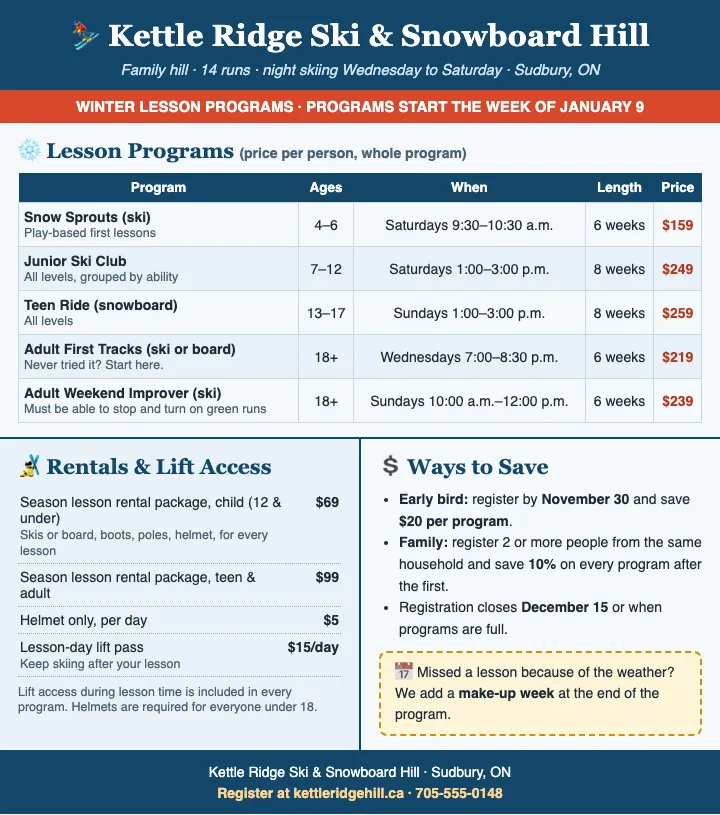
Read the following email message about the diagram on the left. Complete the email by filling in the blanks. Select the best choice for each blank from the drop-down menu.
Subject: Ski lessons this winter?
To: Daniel Okafor
From: Hannah Lindqvist
Hi Daniel,
Mateo hasn’t stopped talking about skiing since Ruby’s birthday party at Kettle Ridge, so I picked up their lesson flyer this morning. Ruby is ten and Mateo has just turned nine, so they would both fit in the program, and Saturday afternoons would suit us well.
Mateo already has a helmet, but neither of the kids owns skis, so I think we should get the season rental package. That would be for each of them, which seems fair for eight weeks.
I’ve also decided to take the plunge myself. I’ve never been on skis in my life, so is clearly the one for me. It’s on a weeknight, which works perfectly, since Steve is home by six and can stay with Mateo.
If we sign up before , we’ll each save $20 per program. And because I’m registering Mateo and myself together, .
Since we live only three doors apart, we could take turns driving the kids on Saturdays. Let me know by the weekend and I’ll register everyone at once.
Hannah
Hannah and Daniel are most likely
Why does a weeknight program suit Hannah?
When Hannah says she will “take the plunge,” she means she will
Part 3: Reading for Information
Paragraph A
Few animals are as closely linked with the Canadian wilderness as the moose. The largest member of the deer family, it is found across most of the country’s forested regions, from the Atlantic provinces to the Yukon. A full-grown bull can stand around two metres tall at the shoulder and weigh well over 500 kilograms, yet it can move almost silently through thick bush. Its unusually long legs allow it to step over fallen trees and wade through snow that would stop smaller animals. The English name was borrowed from an Algonquian language, and it is often said to mean “twig eater,” a fair description of how the animal spends much of its time. Despite their size, moose generally live alone, apart from mothers with young calves.
Paragraph B
A moose’s diet changes with the seasons. In summer, it feeds heavily on leaves and on plants that grow in lakes, ponds and marshes, wading in up to its shoulders and sometimes putting its head completely underwater to reach them. These water plants supply minerals, such as sodium, that are hard to find in other foods. Moose are also strong swimmers and will cross wide rivers and lakes without hesitation. When winter arrives and the water freezes, they switch to a much tougher diet of twigs, buds and bark from trees and shrubs such as willow, birch and balsam fir.
Paragraph C
Only male moose grow antlers. Each spring, a new set begins to grow, covered in a soft, blood-rich skin known as velvet. By late summer the antlers have reached full size, and the bull rubs the velvet off against trees. In the fall breeding season, males use their antlers to display their strength and, at times, to fight rivals. Once the season is over, the antlers drop off, usually in early winter. Calves are born in late spring, most often one at a time, although twins are not unusual. A calf stays close to its mother for about a year, until she drives it away shortly before her next calf is born.
Paragraph D
Moose have long been important to people in Canada. For many Indigenous communities, they provided meat, hides for clothing and shelter, and materials for tools. Today, moose also present challenges. Collisions with vehicles are a serious danger, because a moose’s long legs mean that a car often strikes the animal below its heavy body, which can then crash into the windshield. Dark fur makes moose hard to see at night, which is why many highways have warning signs and, in some places, fencing, and drivers are urged to take extra care after dark. Moose were not originally found on the island of Newfoundland; a small number were brought there a little over a century ago, and their population has since grown very large.
Decide which paragraph, A to D, has the information given in each statement below. Select E if the information is not given in any of the paragraphs.
- The word “moose” comes from an Indigenous language.
- During the warmer months, moose rely partly on food found underwater.
- A mother moose forces her young to leave before she has another.
- Hunting limits now keep the number of moose in Newfoundland under control.
- The shape of a moose’s body helps it travel through deep snow.
- A moose’s height makes crashes with cars particularly dangerous for drivers.
- Male moose lose their antlers every year and grow new ones.
- Moose need to eat more in winter than in summer.
- Humans introduced moose to one part of Canada.
Part 4: Reading for Viewpoints
For twenty years, Linden Bay has prohibited dogs on Sandpiper Beach from May through September. Councillor Meredith Ashdown would now permit off-leash dogs on the beach’s northern half before nine in the morning and after seven in the evening throughout the summer.
Ashdown maintains that the existing prohibition no longer reflects local realities. Licensing figures indicate that nearly a third of households own a dog, yet the sole off-leash facility is a fenced gravel lot beside the arena. “Owners already visit the sand at dawn, hoping to escape notice, and I’d sooner have explicit hours and proper signage,” she says. Free waste bags and a seasonal bylaw officer would be financed through a modest increase in licence fees.
Dr. Helen Okonkwo, a biologist who coordinates volunteer shorebird counts, remains unpersuaded. The northern end is exactly where piping plovers, an endangered species, have attempted nesting in three of the last five summers. “A dog doesn’t need to catch a chick to do harm,” she explains; flushing adults from a nest for minutes on a sweltering day can suffice. Having no objection to dogs on beaches generally, she would accept off-leash hours on the southern half, near the boat launch, where the birds seldom nest.
Phil Brennan, owner of the Driftwood Café opposite the main entrance, approaches the question commercially. He acknowledges that some dog-owning visitors bypass Linden Bay for rival seaside communities. “Families often tell me they choose this beach because it’s dog-free, some with youngsters frightened of animals,” he says. Those families sustain his summer, and he doubts dog owners would replace them.
Dog trainer Sunita Rao considers the difficulties manageable but declines to assume universal responsibility. Rules on paper that nobody observes accomplish little, so almost anything more explicit constitutes progress. “A dog that comes when called delights everyone on a beach. One that doesn’t troubles everyone,” she says. She therefore proposes restricting off-leash privileges to animals passing a short recall test, lest careless owners spoil matters for the rest.
Ashdown has signalled flexibility, even about relocating the off-leash area, should the bird counts warrant it. Okonkwo intends to present five summers of data.
Rao and Ashdown would agree that
Okonkwo mentions a chick to show that
Brennan is cautious because
We can reasonably conclude that
A fitting headline would be
The following is a comment by a visitor to the website page. Complete the comment by choosing the best option to fill in each blank.
As a dog owner who walks Sandpiper Beach outside summer, I welcomed this idea, but Councillor Ashdown has evidently chosen . If the birds Dr. Okonkwo studies have attempted nesting at the north end in , that alone is reason to look elsewhere.
Moving the hours to seems a fair compromise, and the councillor, to her credit, on the location.
Better still, off-leash privileges should be . My dog would manage, though I have seen others who wouldn’t, and their owners are why Mr. Brennan’s customers stay nervous. Compromise here costs very little, and a summer without bad feeling on the sand would be worth having.
Answer key
Count your correct answers, then find your estimated CLB:
Show all 38 answers
- What is the main purpose of Owen’s letter? C. to ask for his uncle’s hands-on help with a project
- What did the mechanic find unusual about the truck? B. Its underside was largely free of corrosion.
- Why has Owen decided not to sell the truck? D. It brings back a childhood memory of his grandfather.
- Owen offers to A. buy whatever parts are needed.
- Who is going to help Owen with the truck’s electrical system? C. a friend with experience repairing motorbikes
- What does Owen suggest about Aunt Carol? B. She may not want the shop filled up again.
- A. values it for more than its price
- B. your aunt
- D. hard to come by
- C. the brakes and the motor
- A. the old farm road
- B. Junior Ski Club
- C. $69
- A. Adult First Tracks
- D. the end of November
- B. one of our two programs will cost 10% less
- Hannah and Daniel are most likely C. neighbours with children of a similar age.
- Why does a weeknight program suit Hannah? A. Her husband can look after their son at that time.
- When Hannah says she will “take the plunge,” she means she will D. finally try something she has been unsure about.
- The word “moose” comes from an Indigenous language. A
- During the warmer months, moose rely partly on food found underwater. B
- A mother moose forces her young to leave before she has another. C
- Hunting limits now keep the number of moose in Newfoundland under control. E
- The shape of a moose’s body helps it travel through deep snow. A
- A moose’s height makes crashes with cars particularly dangerous for drivers. D
- Male moose lose their antlers every year and grow new ones. C
- Moose need to eat more in winter than in summer. E
- Humans introduced moose to one part of Canada. D
- Rao and Ashdown would agree that B. the present rules need clarifying.
- Okonkwo mentions a chick to show that D. brief scares can harm
- Brennan is cautious because A. families may stay away
- We can reasonably conclude that C. some residents flout the ban.
- A fitting headline would be D. “Not Everyone Wants Dogs Back”
- B. the wrong stretch of beach
- A. most recent summers
- C. the boat launch end
- D. seems open to persuasion
- B. earned through obedience, not assumed
What does your score mean? See the CELPIP Reading score chart.
Free CELPIP practice test · Free CELPIP Listening practice tests · CELPIP sample tests by part
CELPass is an independent practice platform and is not affiliated with Paragon Testing Enterprises. CELPIP is a trademark of Paragon Testing Enterprises. Check the official CELPIP website and IRCC for current test rules and requirements.