CELPIP Reading Practice Test 126
By Iris
A complete CELPIP Reading practice test: all 4 parts and 38 questions in the real test order. Set a timer for 55–60 minutes and do all four parts in one sitting. Check your answers at the bottom of the page to see your score and an estimated CLB.
Download as PDF with answer key
In this test
- Part 1: Reading Correspondence, “A Refund for a Cancelled Art Camp” (questions 1–11) · practise this part alone
- Part 2: Reading to Apply a Diagram, “Getting to the Halifax Airport from Truro” (questions 12–19) · practise this part alone
- Part 3: Reading for Information, “Pier 21: Canada’s Front Door” (questions 20–28) · practise this part alone
- Part 4: Reading for Viewpoints, “Alcohol in Greenholm’s Parks Debate” (questions 29–38) · practise this part alone
Part 1: Reading Correspondence
Dear Ms. Delacroix,
I am writing about the fee I paid for my son, Mateo, to attend the Junior Studio camp at the Seawall Arts Centre from July 13 to 17. As you know, the centre cancelled the camp on July 9, after a burst pipe flooded the second-floor studios. I was sorry to hear about the damage, and I understand that it was nobody’s fault. My concern is what has happened since.
Your email of July 9 offered families a choice: a full refund within ten business days, or a credit toward fall classes. I replied that same afternoon to ask for the refund, and I received an automatic message confirming that my reply had arrived. Nearly seven weeks have passed, and the money has not appeared on my credit card. When I called on July 28, a very polite young man named Tyler told me that he would pass the matter to your bookkeeper, and that someone would call me within a few days. No one did. I have since left two voice messages, on August 11 and August 19, and neither has been returned. I have kept copies of your email and the automatic message, and I can send them if the flood has affected your records.
To be clear about the amount, I paid $325 in April: $285 for the camp and $40 for the materials kit. Mateo picked up his kit in June and has been happily using it at home, so I don’t expect that portion back. I am asking only for the $285. I should add that finding another camp on four days’ notice cost me $340, which is more than I had budgeted. I realize that this isn’t the centre’s responsibility, and I’m not asking you to cover it.
Please let me know when I can expect the refund. If it hasn’t reached my account by September 15, I will have to dispute the charge through my credit card company. I would much rather not do that. Mateo has taken classes with you for three years, he adores his teacher, Ms. Oyelaran, and he is already asking about the winter session.
Sincerely,
Renata Silva
Renata is writing because
The camp was cancelled because of
When the centre offered families a choice, Renata decided to
Why does Renata not ask for the $40?
What does Renata say about the other camp?
We can reasonably conclude that Renata
Here is a response to the message. Complete the response by filling in the blanks. Select the best choice for each blank from the drop-down menu.
Dear Ms. Silva,
Please accept my apologies. I have read through your file, and everything happened just as you describe. You should not have had to wait so long, or to . During the repairs after , our office was moved twice, and many of our records and messages went astray. That explains the delay, but it doesn’t excuse it.
Our bookkeeper has now confirmed that the choice you made on July 9, , was never processed. I have asked her to send the back to your credit card today. It should reach your account well ahead of your mid-September date, so there is no need for you to .
Please tell Mateo that we would be very glad to see him this winter. Ms. Oyelaran asks about him often, and his place is waiting for him.
Sincerely,
Hélène Delacroix
Executive Director
Part 2: Reading to Apply a Diagram
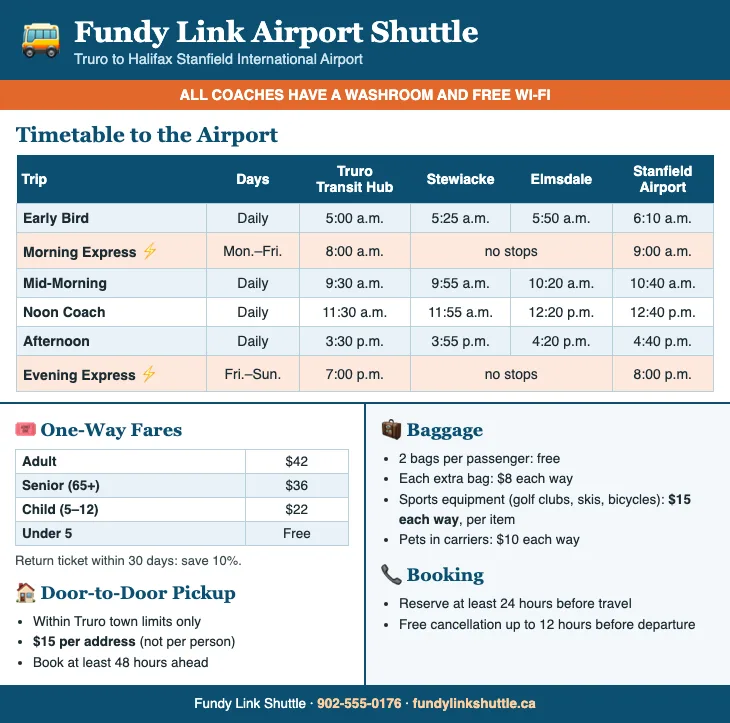
Read the following email message about the diagram on the left. Complete the email by filling in the blanks. Select the best choice for each blank from the drop-down menu.
Subject: Getting you to Stanfield on the 14th
To: Bernard Whelan
From: Moira Gillis
Hi Bernard,
I feel terrible that I can’t drive you and Margaret to the airport this time, but the surgeon says no driving for six weeks after my knee operation. Instead, I picked up this Fundy Link timetable at the library. Since your flight to Glasgow leaves at 1:15 p.m. on Tuesday and you need to check in three hours ahead, the latest one that works is the departure. Anything after that would be cutting it too close. It’s also a comfortable trip, since .
You’re both over 65, so you would pay each for the one-way fare. With Margaret’s hip, I wouldn’t ask her to drag a suitcase across the Transit Hub. For , they’ll pick you both up at the house. And if you’re serious about bringing your golf clubs to Scotland, you should know they’ll cost you . Do book soon, though, because the home pickup needs two days’ notice.
Don’t worry about the house. I can see your driveway from my kitchen window, so I’ll keep an eye on things, and I’ll send my grandson over to water your tomatoes.
Safe travels,
Moira
Moira and Bernard know each other because they
Why can’t Moira drive Bernard and Margaret?
When Moira says that a later bus would be “cutting it too close,” she means it would be
Part 3: Reading for Information
Paragraph A
For more than forty years, the first piece of Canada that many newcomers saw was a long shed on the Halifax waterfront. Pier 21 opened in 1928, at a time when most people crossing the Atlantic to Canada came by ship, and Halifax’s deep, ice-free harbour could receive large vessels all year. Between its opening and its closing in 1971, close to one million immigrants arrived there. Its location beside the railway was no accident. Once they had cleared immigration, many passengers needed only to walk a short distance to a waiting train, which would carry them inland, sometimes on a journey of several days to the Prairies.
Paragraph B
The people who passed through Pier 21 changed with world events. In the late 1920s, many were farm workers from Britain and from northern and central Europe, recruited to help settle the West. Arrivals dropped sharply during the Depression of the 1930s, when jobs were scarce and Canada tightened its immigration rules. During the Second World War, the building served a very different purpose, as roughly half a million Canadian service members left for Europe through the pier. When the fighting ended, it became the arrival point for tens of thousands of war brides, the wives of Canadian soldiers, who often came with young children.
Paragraph C
After the war, a new wave began. Refugees and displaced persons from war-torn Europe came in large numbers, followed by immigrants from countries such as Italy, the Netherlands and Germany, who were looking for work and a fresh start. Many carried all they owned in a few trunks and suitcases. Canada’s rules in those years strongly favoured Europeans, so the crowds in the immigration hall did not reflect the whole world. For those who did arrive, memories of the building are mixed. Officials examined documents and carried out medical checks, and the long waits could be stressful, especially for people who spoke little English. Yet volunteers from the Red Cross and from church and community groups were also on hand, looking after children and offering help to tired families.
Paragraph D
By the 1960s, air travel had begun to replace the ocean liners, and fewer and fewer immigrants were arriving by sea. Pier 21 closed in 1971, and the building was later put to other uses, while its history risked being forgotten. In the late 1980s, volunteers began working to save it, gathering the stories of those who had passed through, while Halifax community leader Ruth Goldbloom led the effort to raise funds. The site opened as a museum in 1999. It has since become a national museum, the Canadian Museum of Immigration at Pier 21, where families can look for records of their parents’ or grandparents’ arrival in Canada and see exhibits on the country’s immigration history.
Decide which paragraph, A to D, has the information given in each statement below. Select E if the information is not given in any of the paragraphs.
- Conditions in Halifax’s harbour allowed ships to arrive in every season.
- Fewer newcomers passed through Pier 21 during a time of economic hardship.
- Some war brides received free train tickets from the Canadian government.
- Passengers could often begin the next stage of their trip without going far from the pier.
- Canadians heading overseas to fight departed from Pier 21.
- Medical checks at Pier 21 caused some newcomers to be sent back to their home countries.
- The people arriving at Pier 21 after the war came mainly from one part of the world.
- A change in how people travelled led to the end of Pier 21 as an immigration centre.
- People today can search for information about relatives who arrived in Canada.
Part 4: Reading for Viewpoints
A glass of wine on a picnic blanket has long been illegal in Greenholm, though bottles in paper bags rarely attract attention. Council is contemplating a two-summer pilot permitting adults to drink in six parks between 11 a.m. and 9 p.m. Overlooking an offence, detractors counter, differs from licensing it. Two additional bylaw officers, according to a staff report, would cost approximately $120,000 annually.
Councillor Shanelle Prescott, the plan’s chief sponsor, treats the question as one of fairness. “If you have a backyard, you can enjoy a beer outdoors whenever you like. If you live in an apartment, you’re breaking the law.” Enforcement, she adds, is haphazard, falling chiefly on young people of modest means. She accepts that certain parks may prove unsuitable, and promises their removal should complaints accumulate after the first summer.
Dr. Ingrid Solheim, the region’s medical officer of health, stops short of outright opposition. “Easier access to alcohol generally correlates with greater harm,” she notes, yet research on park drinking remains scant and the cities experimenting with it report little serious trouble. What preoccupies her is teenagers absorbing the notion that alcohol belongs to any ordinary outing. “I can live with a trial, provided it is a real one,” she remarks, by which she means emergency visits and police calls tallied beforehand and afterward, with the results published.
Tom Wieczorek, chair of the Riverbend neighbourhood association, harbours no grudge against couples sharing wine over a sandwich. “My complaint is 9:30 p.m., after families depart: the noise, the broken glass, the people relieving themselves behind residential fences.” Doubting that two officers could patrol six parks, he would confine the experiment to one downtown park, remote from houses.
Lucia Ferrante, proprietor of a Main Street patio restaurant, might be expected to dread the competition, and partly does: her overhead includes a liquor licence, insurance and staff training, while a park drinker buys only the bottle. Still, she doubts quiet picnickers will inconvenience anyone, and livelier evenings generally benefit her business. Her resentment is reserved for helping to underwrite the scheme. “Let its beneficiaries fund the officers, through a modest permit fee for groups,” she suggests.
Whose acceptance of the pilot depends most on results?
Wieczorek and Ferrante would both maintain that
Prescott’s backyard comparison suggests that
What does the article suggest about the doubters?
Which headline best suits the article?
The following is a comment by a visitor to the website page. Complete the comment by choosing the best option to fill in each blank.
After nineteen years renting downtown without a yard, I have little patience for the idea that my glass of wine turns dangerous once carried outside. Yet Councillor Prescott’s case goes beyond backyards: today’s rule also singles out .
Nor do I dismiss Mr. Wieczorek. Living across from a busy park, I would dread too. Still, apartment dwellers across Greenholm would be poorly served by .
I am less moved by the restaurateur’s grievance that , which sounds to me like special pleading; nobody I know would abandon a dinner out for a warm can on a bench. So I would attach the one condition that turns an argument into evidence: .
Answer key
Count your correct answers, then find your estimated CLB:
Show all 38 answers
- Renata is writing because B. money she was promised has not been returned.
- The camp was cancelled because of D. water damage to part of the building.
- When the centre offered families a choice, Renata decided to A. get her money back instead of taking a credit.
- Why does Renata not ask for the $40? C. Her son has received and used what it paid for.
- What does Renata say about the other camp? B. It cost more, but she will not ask the centre to pay.
- We can reasonably conclude that Renata D. hopes to stay on good terms with the centre.
- C. leave messages that went unanswered
- A. the studios were flooded
- D. to be repaid rather than given a credit
- B. $285 camp fee
- C. dispute the charge with your card company
- B. 8:00 a.m.
- D. it goes straight through without stopping
- A. $36
- C. a flat $15 per address
- D. an extra $15 each way
- Moira and Bernard know each other because they A. live close to one another.
- Why can’t Moira drive Bernard and Margaret? C. She is recovering from a medical procedure.
- When Moira says that a later bus would be “cutting it too close,” she means it would be B. leaving too little time to spare.
- Conditions in Halifax’s harbour allowed ships to arrive in every season. A
- Fewer newcomers passed through Pier 21 during a time of economic hardship. B
- Some war brides received free train tickets from the Canadian government. E
- Passengers could often begin the next stage of their trip without going far from the pier. A
- Canadians heading overseas to fight departed from Pier 21. B
- Medical checks at Pier 21 caused some newcomers to be sent back to their home countries. E
- The people arriving at Pier 21 after the war came mainly from one part of the world. C
- A change in how people travelled led to the end of Pier 21 as an immigration centre. D
- People today can search for information about relatives who arrived in Canada. D
- Whose acceptance of the pilot depends most on results? C. Ingrid Solheim
- Wieczorek and Ferrante would both maintain that A. picnickers aren’t the real difficulty.
- Prescott’s backyard comparison suggests that D. the law favours backyard owners.
- What does the article suggest about the doubters? B. They could accept a limited pilot.
- Which headline best suits the article? C. “Is Greenholm Ready for Park Drinks?”
- A. the young and poor
- D. a lively evening’s aftermath
- B. a single downtown venue
- C. her overhead handicaps her
- A. keep score before and after
What does your score mean? See the CELPIP Reading score chart.
Free CELPIP practice test · Free CELPIP Listening practice tests · CELPIP sample tests by part
CELPass is an independent practice platform and is not affiliated with Paragon Testing Enterprises. CELPIP is a trademark of Paragon Testing Enterprises. Check the official CELPIP website and IRCC for current test rules and requirements.