CELPIP Reading Practice Test 55
By Iris
A complete CELPIP Reading practice test: all 4 parts and 38 questions in the real test order. Set a timer for 55–60 minutes and do all four parts in one sitting. Check your answers at the bottom of the page to see your score and an estimated CLB.
Download as PDF with answer key
In this test
- Part 1: Reading Correspondence, “Policy Number Ask” (questions 1–11) · practise this part alone
- Part 2: Reading to Apply a Diagram, “Library Programs” (questions 12–19) · practise this part alone
- Part 3: Reading for Information, “Cinnamon and Cassia” (questions 20–28) · practise this part alone
- Part 4: Reading for Viewpoints, “Plant-Based Meat” (questions 29–38) · practise this part alone
Part 1: Reading Correspondence
Dear Mum and Dad,
I got here in one piece, which I know is the only sentence you wanted, and the volunteer house in San Isidro has a working fan and a bunk that does not creak. Before I forget everything in the noise of the first week, could I ask one small favour? My travel-insurance certificate is in the blue folder in the desk drawer, and Ines, our coordinator, needs the policy number from me by Thursday.
Getting here took a day longer than planned, because the last stretch of road had flooded and the project truck could only meet us on the far side of a footbridge. A heat spell broke the morning before we landed, which was lucky, since two volunteers from the group ahead of us were treated for dehydration. It is still humid enough that we start at six, stop through the worst of the afternoon, and go back out around four.
We are adding two classrooms to the primary school, and the local carpenters run it entirely. They set the measurements and the safety rules, and we carry timber, mix mortar and do whatever they have cleared us to do. That is slower than letting them build it alone, but Marcos, the supervisor, says a school the village helped raise gets looked after differently. The roof frame went up on Friday, and if the rain holds off the metal panels go on Tuesday.
Children come by after school to watch and correct my Spanish, loudly, and I have stopped minding. I am already thinking about another placement next summer, although ask me again after three more weeks of five o'clock alarms. Honestly, I am more excited than homesick, just tired enough to appreciate a bunk.
Now the favour, properly. Five of us want to visit the coastal reserve on Saturday, and Ines only books the licensed driver once she has every volunteer's insurance on file, so my name has to be on that list before Thursday. Please send the policy number and the emergency phone line, nothing else. A photograph of the whole certificate is more of my details than the office needs. I will message the moment it lands, and I promise Monday's shift will not suffer for it.
Love,
Evan
Evan is writing mainly to
Evan's arrival is best described as
Site work is shaped by
How does Evan feel about the placement?
Evan presents the request as
Marcos values local building because
Here is a response to the message. Complete the response by filling in the blanks. Select the best choice for each blank from the drop-down menu.
Dear Evan,
Your policy number and the emergency line went to you in the message before this one, and I have not attached , since you were clear about that and your father agrees with you. The blue folder was not in the drawer; it had been moved to the file box with the passport copies. Give the number to Ines and your name can go on her list , with a day in hand for the driver to be booked. It settled your father to hear that the rules on that site are set by , though he has now read the policy twice and it will not cover you above ladder height. Drink more than you think you need, please: two of the group before yours , and your father has repeated it to me twice already. One last thing, since you mention , the answer is that we will help with the flights and nothing else.
Take care,
Mum
Part 2: Reading to Apply a Diagram
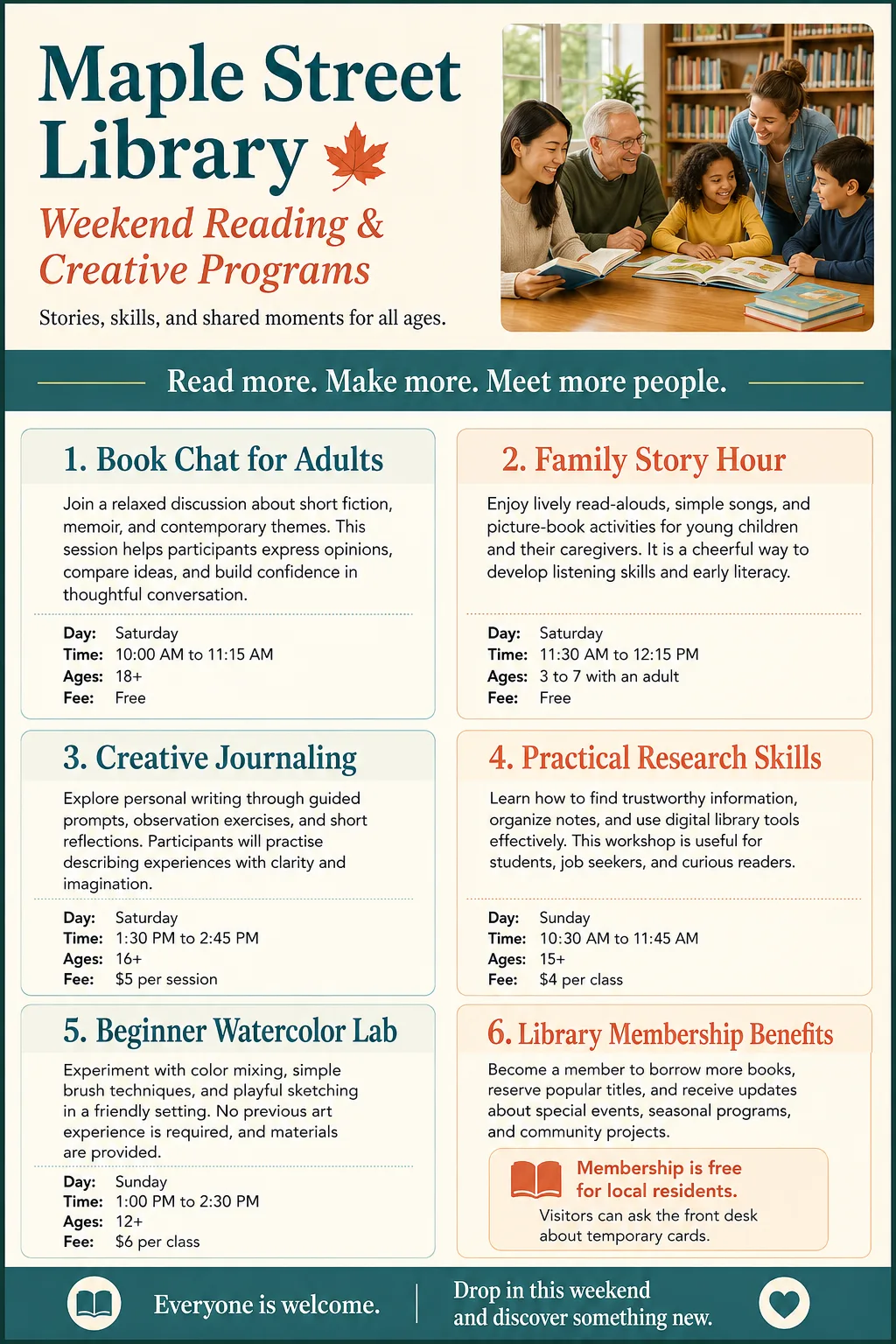
Read the following email message about the diagram on the left. Complete the email by filling in the blanks. Select the best choice for each blank from the drop-down menu.
Hi Ravi!
That library flyer has been folded up in my bag all week, and I've finally read it properly. Only two of the sessions carry no fee at all, and both of those . Money isn't really the issue, though; it's whether a roomful of strangers appeals. The one that starts at half past ten is all , while the half past one slot comes to . Neither of those is quite what I pictured when I picked the flyer up. Priya's thirteen-year-old could tag along to , at a push. The ten o'clock one is marked , which I hadn't spotted the first time round. The bus past the library has been rerouted since the bridge work started. Do you know whether it still stops on this side?
Cheers,
Dana
Dana and Ravi appear to …
Dana chiefly writes to …
Dana's position here is …
Part 3: Reading for Information
Paragraph A
What most Canadian shoppers purchase under the label cinnamon is not, in any strict botanical sense, cinnamon at all. The genuine article derives from Cinnamomum verum, a tree cultivated across Sri Lanka and southern India, of which only the slender inner layer of bark holds any commercial value. Once dried, that layer curls into pale, papery quills assembled from several delicate laminations. Dominating the international market instead is cassia, a coarser bark harvested from related species grown throughout southern China and Indonesia. Rather than a bundle of thin quills, cassia consolidates into a single solid tube, and its flavour carries a sharper pungency. Because cultivation costs considerably less, cassia has supplanted the superior bark across world markets.
Paragraph B
That affordability is a recent development. For millennia, cinnamon ranked among antiquity's most coveted commodities, reaching Egypt along trade routes whose origins remained wholly obscure to those receiving the shipments. Embalmers worked the bark into resins applied to the dead, while priests consigned it to temple incense as a ritual offering. Writing in the first century, Pliny the Elder recorded that the finest quills commanded as much as 1,500 denarii per pound. Two centuries later, when the imperial edict fixing maximum prices was promulgated in 301, even the inferior cassia was still valued at roughly five days of a labourer's wages for an equivalent quantity. A seasoning now sold for pennies was once reserved, at extravagant cost, for temples and tombs.
Paragraph C
This extraordinary valuation persisted partly because the merchants who conveyed the bark westward had every incentive to obscure its provenance. The Greek historian Herodotus reported that enormous birds gathered the sticks and built their nests upon inaccessible cliffs. Pliny dismissed the tale as a fabrication devised to protect the price, though he himself possessed no more reliable account of where the plant actually grew. Arab geographers eventually traced the island of origin correctly, and once a Portuguese fleet, driven off its intended course by a storm, reached that island early in the sixteenth century, the intermediaries were swept aside and Portugal secured a monopoly of its own.
Paragraph D
Cultivating the genuine species remains a slow undertaking, still performed largely by hand. Two years after planting, the principal stem is severed at ground level, a cut that induces fresh shoots to emerge from the surviving roots. Once a shoot has darkened and thickened to a diameter of a few centimetres, it is cut, scraped and peeled within the same day. Nothing goes to waste: the inner bark becomes quills or powder, the leftover scrapings are distilled into one essential oil, and the foliage yields a second, destined for the perfume trade. Sri Lanka continues to supply the greater share of the world's genuine cinnamon, notwithstanding the ascendancy of its coarser relative.
Paragraph E
Not given in any of the above paragraphs.
Decide which paragraph, A to D, has the information given in each statement below. Select E if the information is not given in any of the paragraphs.
- Every part of the harvested shoot is turned into some usable product.
- Those receiving the shipments in Egypt had no idea where the spice originally came from.
- Cassia's sharper taste comes from a higher concentration of its aromatic oil.
- Concealing the spice's true source worked to the traders' advantage.
- The bark that dominates the market today wins out on cost rather than on merit.
- Pliny found the story about the nest-building birds entirely convincing.
- An official ceiling on prices still rated the lesser bark as valuable.
- A voyage blown off course by bad weather brought a long chain of middlemen to an end.
- Cutting the main stem near the ground triggers fresh growth from what remains below.
Part 4: Reading for Viewpoints
A decade ago, most Canadians had only read about plant-based burgers. Today they fill whole freezer sections, and shoppers like Ottawa mother Jennifer Fortescue, who started buying them after her doctor warned her about her blood pressure, buy them every week. "They're on sale half the time, they keep forever in the freezer, and the kids eat them without a fuss." Their makers pitch them as better for both the body and the planet. Not everyone is buying it.
Teresa Zamora is marketing director at GreenPatty Foods, a Montreal maker of pea-protein burgers. She says swapping beef for plant protein eases pressure on farmland and water, and she cites studies showing that a pea-based patty produces roughly one tenth of the greenhouse gas emissions of a beef patty. "Sure, beef still wins on flavour, and on iron too. But when you look at what beef costs the environment, it's not even close, and that's what matters most to us." GreenPatty buys the bulk of its pea protein from processors in China.
Vera Penhale, a registered dietitian at a Toronto hospital, tells shoppers to read the nutrition label and ignore the pictures on the package. Many of these products, she says, are built from protein isolates, oils and binders rather than whole vegetables, and some contain a third of a day's recommended sodium in a single serving. "If your doctor has told you to watch your blood pressure, that's something you need to know about." She adds that people worry about protein for no good reason, since most products have about as much as beef.
Paul Weatherby, president of the Council for Whole Food Reform, is unimpressed by any of it. He says the patties are extruded at high heat, which strips out much of the fibre, and then loaded with coconut oil, which is high in saturated fat. He also argues that the peas are grown in huge monocultures that wear out the soil, and that much of the Prairie crop is shipped to China to be made into protein isolate. "These things are junk food in a green wrapper. Calling them health food is a joke."
A good title for this article would be "Plant-Based Meat:
Teresa Zamora would most likely promote GreenPatty burgers by pointing to their
What is probably true about Jennifer Fortescue?
Teresa Zamora would most likely describe plant-based meat as
Paul Weatherby would most likely agree that
The following is a comment by a visitor to the website page. Complete the comment by choosing the best option to fill in each blank.
I grow peas in Saskatchewan, and until now I'd never thought much about where they end up. It turns out the peas from my fields might before they reach a freezer in Montreal or Toronto. If so, the emissions figures GreenPatty likes to quote before they reach a freezer in Montreal or Toronto. If so, the emissions figures GreenPatty likes to quote . There are processors right here on the Prairies, so the long trip is about cost, not necessity.. There are processors right here on the Prairies, so the long trip is about cost, not necessity. Weatherby, though, I'm not worried about Weatherby, though, I'm not worried about . Farmers here rotate peas with wheat and canola, and peas put nitrogen back into the soil. The dietitian's advice makes the most sense to me: shoppers should. Farmers here rotate peas with wheat and canola, and peas put nitrogen back into the soil. The dietitian's advice makes the most sense to me: shoppers should instead of trusting the pictures on the box. My neighbour switched to veggie burgers last year and says his cholesterol hasn't budged.
Answer key
Count your correct answers, then find your estimated CLB:
Show all 38 answers
- Evan is writing mainly to B. obtain his policy details
- Evan's arrival is best described as D. safe but a day late
- Site work is shaped by C. the weather
- How does Evan feel about the placement? B. engaged, though frankly tired
- Evan presents the request as A. small and easily met
- Marcos values local building because D. the village will maintain it
- C. the certificate itself
- D. before Thursday
- A. the carpenters themselves
- D. were treated for dehydration
- C. going again next summer
- C. run on Saturday
- C. notes and digital tools
- A. five dollars a session
- C. the watercolour lab
- B. eighteen and over
- Dana and Ravi appear to … B. both know the area
- Dana chiefly writes to … A. talk through a weekend plan
- Dana's position here is … A. undecided
- Every part of the harvested shoot is turned into some usable product. D
- Those receiving the shipments in Egypt had no idea where the spice originally came from. B
- Cassia's sharper taste comes from a higher concentration of its aromatic oil. E
- Concealing the spice's true source worked to the traders' advantage. C
- The bark that dominates the market today wins out on cost rather than on merit. A
- Pliny found the story about the nest-building birds entirely convincing. E
- An official ceiling on prices still rated the lesser bark as valuable. B
- A voyage blown off course by bad weather brought a long chain of middlemen to an end. C
- Cutting the main stem near the ground triggers fresh growth from what remains below. D
- A good title for this article would be "Plant-Based Meat: A. Claims Under Scrutiny"
- Teresa Zamora would most likely promote GreenPatty burgers by pointing to their B. small carbon footprint.
- What is probably true about Jennifer Fortescue? B. Her choice may not serve her health goal.
- Teresa Zamora would most likely describe plant-based meat as D. a worthwhile compromise.
- Paul Weatherby would most likely agree that D. plant-based does not mean healthy.
- A. cross the Pacific twice
- C. may need a second look
- B. Unlike
- C. single-crop farming
- A. check the fine print
What does your score mean? See the CELPIP Reading score chart.
Free CELPIP practice test · Free CELPIP Listening practice tests · CELPIP sample tests by part
CELPass is an independent practice platform and is not affiliated with Paragon Testing Enterprises. CELPIP is a trademark of Paragon Testing Enterprises. Check the official CELPIP website and IRCC for current test rules and requirements.