CELPIP Reading Practice Test 60
By Iris
A complete CELPIP Reading practice test: all 4 parts and 38 questions in the real test order. Set a timer for 55–60 minutes and do all four parts in one sitting. Check your answers at the bottom of the page to see your score and an estimated CLB.
Download as PDF with answer key
In this test
- Part 1: Reading Correspondence, “Farah’s First Month in Halifax” (questions 1–11) · practise this part alone
- Part 2: Reading to Apply a Diagram, “Niagara Falls Staff Outing Tour Choice” (questions 12–19) · practise this part alone
- Part 3: Reading for Information, “Quebec Maple Syrup History And Reserve” (questions 20–28) · practise this part alone
- Part 4: Reading for Viewpoints, “Cashless Retailers And The Right To Pay Cash” (questions 29–38) · practise this part alone
Part 1: Reading Correspondence
Hi Marcus,
I’m so sorry it has taken me this long to write. You were the first person I meant to tell when I got here, but the past month has been such a whirlwind that I’ve barely had time to unpack, let alone answer emails. Yes, I really did it: I packed up my life in Winnipeg and moved to Halifax to start my new job as a communications officer at the Atlantic Ocean Research Institute.
The job itself has been everything I hoped for. My team is small but incredibly welcoming, and on my second day they took me out for fish and chips on the waterfront. My manager, Bernadette, has already handed me my first big project: helping the scientists explain their work on right whales to the public. I spend half my day turning complicated research into plain language, which is exactly the kind of challenge I was missing in my old job.
Outside of work, things have been bumpier. The apartment I had arranged online fell through two days before I arrived, when the landlord decided to rent it to his nephew instead. I’ve been staying in a furnished basement suite in Dartmouth ever since, which is fine for now but costs nearly twice what I paid in Winnipeg. On the bright side, it means I take the ferry across the harbour every morning. Fifteen minutes on the water with a coffee in hand is the best commute I’ve ever had, even on foggy days, and there have been plenty of those.
The weather is the other big adjustment. Everyone warned me about the rain, but nobody mentioned that it can change four times in a single afternoon. I left my umbrella at home exactly once and learned my lesson. I also miss you and the rest of the gang more than I expected. Thursday trivia nights just aren’t the same over a video call.
Which brings me to my question. Didn’t you say you had some vacation time saved up? The busker festival takes over the waterfront in August, and I would love to show you around. By then I should be in a proper apartment with a spare room, fingers crossed! Let me know what you think, and say hi to Priya for me.
Take care,
Farah
Why did Farah move to Halifax?
What does Farah seem to value most about her new job?
What happened to the apartment Farah had arranged?
How does Farah feel about her trip to work?
When Farah says she “learned my lesson,” she means that she
What does Farah ask Marcus to do?
Here is a response to the message. Complete the response by filling in the blanks. Select the best choice for each blank from the drop-down menu.
Hi Farah,
It was so good to hear from you! We’ve all been wondering how you were settling in. I’m sorry about the apartment. What a stressful way to ! Still, a ferry ride to work sounds a lot better than sitting in traffic on Portage Avenue.
I’m not surprised you love the new job. You were always the one who could , so it sounds like a perfect fit. As for the rain, you’ll just have to like the locals do. I hear they never let a little weather stop them!
Now, about your invitation: I do have two weeks saved up, and I’ve always wanted to see the ocean. Count me in for ! I’ll even bring my own umbrella. Just promise me you’ll have by then, because I’m not sleeping on a basement floor.
Priya says hi and wants a postcard.
Talk soon,
Marcus
Part 2: Reading to Apply a Diagram
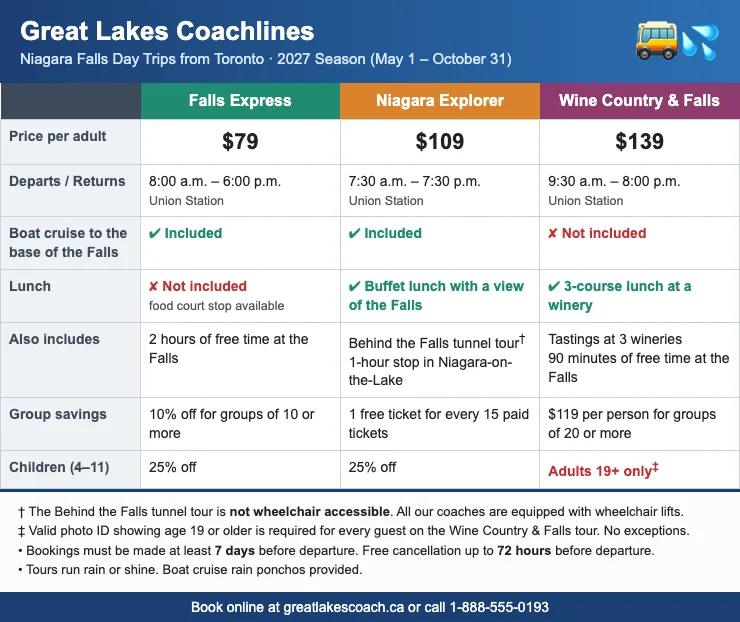
Read the following email message about the diagram on the left. Complete the email by filling in the blanks. Select the best choice for each blank from the drop-down menu.
Subject: Niagara staff outing
To: Omar Haddad
From: Rachel Huang
Hi Omar,
Thanks again for helping me organize this year’s staff outing. Two heads are better than one! I’ve gone through the Great Lakes Coachlines brochure, and here’s where I’ve landed.
First, the Wine Country & Falls tour is out of the question, since . That leaves the Falls Express and the Niagara Explorer. With 18 of us going, , which brings the Explorer’s total down nicely. The Express is cheaper, but lunch isn’t included, so everyone would have to , and I know people won’t want to spend their own money on the day.
Since the social committee is paying for everything and our budget is $2,000, I think we should book . It even includes a stop in Niagara-on-the-Lake, which several people asked for. One thing to keep in mind: Yasmin uses a wheelchair, and , so let’s plan something fun for her and a friend during that part of the day.
Could you send out a quick poll to confirm numbers? We have to book at least a week ahead, and I’d like to lock it in by the end of the month. The free cancellation policy gives us some breathing room if a couple of people drop out.
Thanks,
Rachel
Rachel and Omar are most likely
Rachel wants Omar to send a poll in order to
When Rachel says the cancellation policy gives them “some breathing room,” she means that
Part 3: Reading for Information
Paragraph A
Long before Europeans arrived in North America, Indigenous peoples of the St. Lawrence and Great Lakes regions collected the sweet sap of maple trees each spring. They cut into the bark, gathered the sap in birchbark containers, and concentrated it by dropping hot stones into the liquid or by leaving it out to freeze overnight and removing the layer of ice in the morning. French settlers in the 1600s learned these techniques and adapted them using iron kettles brought from Europe. Because imported cane sugar was expensive and hard to obtain, maple sugar soon became the main sweetener on farms throughout rural Quebec, and the spring harvest became an important event in the farming year.
Paragraph B
Maple sap flows only under particular weather conditions: nights below freezing followed by days above it. In Quebec, this usually means a season of six to eight weeks between early March and late April. Fresh sap contains only two to three percent sugar, so roughly 40 litres are needed to make a single litre of syrup. For generations, producers hung a bucket on each tree, but most now use networks of plastic tubing connected to vacuum pumps. Many also pass the sap through reverse-osmosis machines, which remove much of the water before the sap is boiled in an evaporator, saving both time and fuel. The season has a social side as well: every spring, families flock to rural sugar shacks to enjoy hearty meals and roll maple taffy on fresh snow.
Paragraph C
Today Quebec produces roughly 70 percent of the world’s maple syrup, and the industry supports thousands of family businesses. Most bulk syrup is sold through Quebec Maple Syrup Producers, an organization that negotiates prices on behalf of its members and limits how much each producer may sell through a quota system. In the early 2000s, after several years in which bumper crops caused prices to collapse, the organization created a strategic reserve. In good years, surplus syrup is stored in warehouses; in poor years, it is released to keep supply steady and prices stable for buyers around the world.
Paragraph D
The reserve has had its share of drama. Over several months in 2011 and 2012, thieves removed thousands of barrels of syrup worth roughly $18 million from a storage site. To avoid detection, they siphoned off the syrup and refilled many of the barrels with water. More recently, the reserve proved its worth when a short, warm spring in 2021 combined with rising demand left supplies tight. In 2022, the organization released about half of its stored syrup and then allowed producers to install millions of additional taps. Critics, however, argue that the quota system makes it difficult for newcomers to enter the industry.
Decide which paragraph, A to D, has the information given in each statement below. Select E if the information is not given in any of the paragraphs.
- Early settlers depended on maple partly because other sweeteners were costly.
- Modern equipment takes some of the water out of the sap before it is heated.
- Quebec’s share of global maple syrup production has been growing steadily.
- Syrup is kept in storage during plentiful years to make up for shortfalls later.
- The thieves tried to hide what they had done by refilling the containers.
- Sap can only be collected when temperatures rise and fall around freezing.
- The first people to make maple products used containers made of bark.
- After one disappointing harvest, around half of the stored syrup was released.
- Most of the stolen syrup was later found and returned to the reserve.
Part 4: Reading for Viewpoints
A discreet sign beside the till at Leah Dubois’s Ottawa café reads: “We’re card-only. Thanks for understanding.” Two years ago Dubois stopped accepting bills and coins at both of her locations, and she harbours no regrets. The hours she once surrendered each week to counting the float and queuing at the bank now go elsewhere; break-ins, an occasional worry, rarely cross her mind, and her employees can concentrate on customers. Cafés, food trucks and even some chain stores have followed suit.
Walter Fenwick, who volunteers with a seniors’ advocacy group, finds the trend troubling. Many older people, he observes, rely on cash to monitor their spending and to shield themselves from fraud, as do residents without bank accounts. He still recalls the nationwide network outage of 2022, when card terminals fell silent for most of a day: neighbours with bills in their wallets walked out with groceries, while everyone else abandoned their carts.
City councillor Teresa Morin has proposed a bylaw obliging most local businesses to accept cash, citing similar rules in Philadelphia and New York. “Cash is legal tender,” she argues. “A store shouldn’t be allowed to turn it away.”
Kyle Brandt, a spokesperson for an association of independent retailers, regards a mandate as an unwarranted burden on small enterprises, given the expense of security, insurance and staff time. “A family-run shop chooses its own hours. Why not how it gets paid? Unhappy customers can shop elsewhere.” He also disputes Morin’s legal reasoning: in Canada, legal tender applies chiefly to settling debts, not to purchases at a counter.
Samuel Osei, a payment-systems researcher in Toronto, observes that cash now accounts for a small fraction of Canadian purchases, yet a few percent of adults depend on it almost exclusively. He advocates a compromise: require cash wherever people buy essentials such as groceries, medication and public transit, and let boutiques and coffee shops decide for themselves. “Otherwise banks will dismantle ATMs as demand dwindles,” he cautions, “and still more merchants will refuse cash. That spiral’s hard to reverse.”
Morin, who has lately been meeting retailers, calls her draft “a starting point” ahead of this fall’s council debate.
Which saying sums up Dubois’s reasoning?
Whose outlook is closest to Dubois’s?
By recalling the 2022 outage, Fenwick implies that
Why might Osei reject Brandt’s advice to shop elsewhere?
Morin’s remarks suggest that her bylaw
The following is a comment by a visitor to the website page. Complete the comment by choosing the best option to fill in each blank.
Mr. Brandt’s advice to unhappy customers sounds reasonable until you live where I do. When our only grocery store went card-only, his suggestion that people simply became meaningless. My eighty-year-old father, one of the older people Mr. Fenwick has in mind, , and the change hit him hard.
Ms. Dubois may see cash as a chore, but Mr. Fenwick’s account of 2022 convinced me it is .
As for Councillor Morin’s bylaw, I find it ; Dr. Osei draws the line more sensibly, at . A rule that most owners can live with is likelier to survive council.
Answer key
Count your correct answers, then find your estimated CLB:
Show all 38 answers
- Why did Farah move to Halifax? C. to take up a new position
- What does Farah seem to value most about her new job? A. making research easy to understand
- What happened to the apartment Farah had arranged? D. It was rented to someone else.
- How does Farah feel about her trip to work? B. She enjoys it despite the weather.
- When Farah says she “learned my lesson,” she means that she A. now always takes an umbrella with her.
- What does Farah ask Marcus to do? C. come and visit her in August
- B. start your new life there
- D. explain things clearly to anyone
- A. get used to it
- C. the festival in August
- B. a spare room for me
- B. our two co-op students are 17
- D. one of our tickets is free
- C. buy their own meal
- A. the Niagara Explorer
- D. the tunnel tour isn’t accessible
- Rachel and Omar are most likely C. colleagues sharing a task
- Rachel wants Omar to send a poll in order to A. confirm how many people are coming
- When Rachel says the cancellation policy gives them “some breathing room,” she means that B. they can adjust if plans change.
- Early settlers depended on maple partly because other sweeteners were costly. A
- Modern equipment takes some of the water out of the sap before it is heated. B
- Quebec’s share of global maple syrup production has been growing steadily. E
- Syrup is kept in storage during plentiful years to make up for shortfalls later. C
- The thieves tried to hide what they had done by refilling the containers. D
- Sap can only be collected when temperatures rise and fall around freezing. B
- The first people to make maple products used containers made of bark. A
- After one disappointing harvest, around half of the stored syrup was released. D
- Most of the stolen syrup was later found and returned to the reserve. E
- Which saying sums up Dubois’s reasoning? D. “Time is money.”
- Whose outlook is closest to Dubois’s? B. Kyle Brandt
- By recalling the 2022 outage, Fenwick implies that A. there is no fallback without cash.
- Why might Osei reject Brandt’s advice to shop elsewhere? C. Places accepting cash may grow scarcer.
- Morin’s remarks suggest that her bylaw D. may change before the vote.
- C. take their custom down the road
- A. budgets in bills and coins
- D. cheap insurance
- B. heavy-handed
- D. what nobody can go without
What does your score mean? See the CELPIP Reading score chart.
Free CELPIP practice test · Free CELPIP Listening practice tests · CELPIP sample tests by part
CELPass is an independent practice platform and is not affiliated with Paragon Testing Enterprises. CELPIP is a trademark of Paragon Testing Enterprises. Check the official CELPIP website and IRCC for current test rules and requirements.