CELPIP Reading Practice Test 62
By Iris
A complete CELPIP Reading practice test: all 4 parts and 38 questions in the real test order. Set a timer for 55–60 minutes and do all four parts in one sitting. Check your answers at the bottom of the page to see your score and an estimated CLB.
Download as PDF with answer key
In this test
- Part 1: Reading Correspondence, “Welcome to the Food Bank Team” (questions 1–11) · practise this part alone
- Part 2: Reading to Apply a Diagram, “Choosing a Gym Plan Together” (questions 12–19) · practise this part alone
- Part 3: Reading for Information, “The Trans Canada Trail” (questions 20–28) · practise this part alone
- Part 4: Reading for Viewpoints, “Tipping Screens in Canadian Restaurants” (questions 29–38) · practise this part alone
Part 1: Reading Correspondence
Dear Tomás,
On behalf of everyone at the Harbourview Community Food Bank, welcome aboard! It was a pleasure meeting you at last Thursday’s orientation, and I was delighted to see that you chose to join our Saturday team. With demand up nearly 30 percent since last year, we truly need every pair of hands we can get.
Your first shift will be on Saturday, October 17, from 9:30 a.m. to 2:00 p.m. Saturday is our busiest day: clients arrive from 10:00 onwards to pick up their weekly hampers, and volunteers help pack bags, restock shelves and guide people through the line. Please arrive fifteen minutes early so that Marguerite, our Saturday team lead, can show you around before the doors open. When you arrive, sign in on the tablet at the front desk. We use these records when we apply for government funding, so it really matters.
There are a few rules I’d like to remind you of. For safety reasons, closed-toe shoes are required at all times, and long hair must be tied back. We provide gloves and aprons. Out of respect for our clients’ privacy, photos are never allowed in the distribution area, even if no faces are visible. Finally, volunteers may not take any food home, including dented cans or items close to their best-before date. Every donation has to be recorded, and our team leads decide what can still be given out.
If you are unable to make a shift, please let us know at least 48 hours ahead through the online scheduler so that we can find a replacement. Volunteers who miss three shifts without notice are removed from the schedule. I know life gets busy, so please don’t hesitate to reach out if your availability changes.
A quick note about getting here: street parking is nearly impossible on Saturday mornings because of the farmers’ market next door, so I recommend taking the number 52 bus, which stops right outside.
Lastly, if you are ever interested in helping with our after-school snack program, you would need to complete a police check, since you would be working with children. The food bank covers the cost. Our holiday hamper drive in December is also looking for volunteer drivers, so keep that in mind.
Thank you again for giving your time. I’m sure you’ll fit right in!
Warm regards,
Denise Arsenault
Volunteer Coordinator
Why did Denise write this letter?
On his first shift, Tomás will most likely
Volunteers are not allowed to take photos because
What does Denise say about dented cans?
If Tomás cannot come to a shift, he should
Tomás would need a police check if he decided to
Here is a response to the message. Complete the response by filling in the blanks. Select the best choice for each blank from the drop-down menu.
Dear Denise,
Thank you so much for the warm welcome. I’m really looking forward to on the 17th, and I’ll be there by 9:15 so that Marguerite can show me around.
I’ve made a note of all the rules. I’ve already bought a pair of work boots, since I realize that . I also understand why photos aren’t allowed, and I promise to while I’m working.
Thanks for the tip about parking. I live right on the 52 route, so will be no problem at all.
Finally, I’d love to help out in December. I have a clean driving record and a minivan, so please .
Best regards,
Tomás Herrera
Part 2: Reading to Apply a Diagram
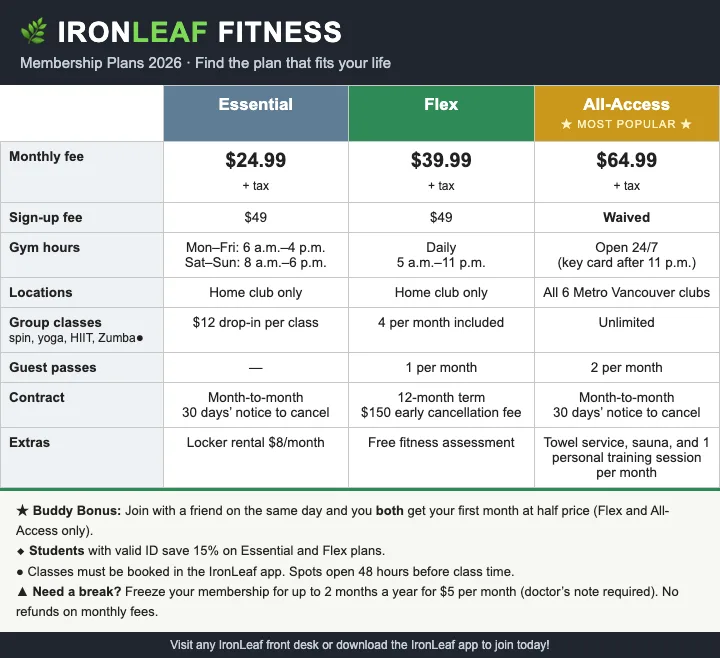
Read the following email message about the diagram on the left. Complete the email by filling in the blanks. Select the best choice for each blank from the drop-down menu.
Subject: Gym plans – let’s decide!
To: Sam Duval
From: Leah Brennan
Hi Sam,
I picked up the IronLeaf brochure on my way home, and I think I’ve figured out what works for both of us. Since I don’t get off work until 5:00, the Essential plan is out for me because .
You said you want to do spin and yoga at least twice a week, so . The All-Access plan includes as many classes as you like, and it works at all six clubs, so you could even work out near campus between lectures.
I was leaning toward Flex at first, but my company might transfer me to Calgary next spring, and I don’t want to . So I’ll probably go with All-Access too. It costs more, but with the sauna and the monthly session with a trainer, the difference is a drop in the bucket.
Here’s the best part: if we , we each get our first month at half price. How about Saturday morning? Also, remember that my knee surgery is in March. Rather than cancelling, I can just while I recover.
Let me know what you think!
Leah
What is the main purpose of Leah’s email?
Why does Leah decide against the Flex plan?
When Leah says the difference is “a drop in the bucket,” she means that
Part 3: Reading for Information
Paragraph A
In 1992, as Canada celebrated its 125th birthday, a small group of volunteers proposed an ambitious idea: a single recreational trail that would link communities from the Atlantic to the Pacific and north to the Arctic Ocean. The Trans Canada Trail was founded as a charitable organization that same year, with the goal of building a route that Canadians everywhere could share. Rather than designing one continuous path from scratch, organizers planned to connect hundreds of existing local trails, many of them created and maintained by municipalities, conservation groups and volunteer clubs. Early fundraising relied heavily on ordinary citizens, who could “buy” a metre of trail and have their names engraved on one of the pavilions built along the route.
Paragraph B
Turning the idea into reality took twenty-five years. One of the most valuable resources turned out to be abandoned railway lines. As rail companies closed unprofitable branch lines in the late twentieth century, many of the flat, gently curving rail beds were converted into gravel paths ideal for walking and cycling. In more remote areas, however, builders had to clear brush, construct bridges and negotiate with private landowners for permission to cross their property. Where no land route was practical, organizers designated rivers and lakes instead, so that paddlers could continue the journey by canoe or kayak. In 2017, in time for Canada’s 150th anniversary, the trail was declared fully connected, stretching roughly 24,000 kilometres.
Paragraph C
The celebration was not without controversy. Critics pointed out that a large share of the “connected” route followed roads and highway shoulders, some of them busy with fast-moving traffic, rather than off-road paths. Cyclists and walkers complained that these sections were unpleasant and, in places, unsafe. In response, the organization set a new goal: to replace road sections with dedicated greenways wherever possible and to improve signage and facilities such as rest areas and washrooms. Since then, it has helped fund hundreds of local projects, from new boardwalks over wetlands to paved paths that can be used by people in wheelchairs.
Paragraph D
Today, the trail is used in very different ways depending on the season and the region. In cities like Ottawa and Calgary, it serves as an everyday route for commuters on foot or by bike. In rural areas, it attracts horseback riders and, where local rules allow, snowmobilers and all-terrain vehicle users. Cross-country skiers enjoy groomed sections in Quebec and the Prairies, while long-distance hikers attempt journeys lasting several weeks, though very few people have ever travelled the entire length. Many small communities have found that the trail brings tourists who stop for meals and overnight stays, providing a modest but welcome boost to local economies. Some towns now hold yearly group walks and bike rides to celebrate their own section of the trail.
Decide which paragraph, A to D, has the information given in each statement below. Select E if the information is not given in any of the paragraphs.
- The trail was planned by linking together paths that were already in place.
- Old railway routes suited the trail well because they were fairly level.
- Parts of the route that were counted as finished were later criticized for being near traffic.
- Whether motorized vehicles may use the trail depends on the area.
- Individual supporters could have their names shown on structures along the trail.
- In some places, travellers have to continue on water instead of land.
- The trail is the longest recreational trail network in the world.
- Some upgrades have made the trail more accessible to people with disabilities.
- Hikers need a special permit to walk the whole length of the trail.
Part 4: Reading for Viewpoints
Not long ago, tipping in a Canadian restaurant meant adding about 15 percent after a sit-down meal. Today a bakery customer may be handed a terminal proposing 18, 20 or 25 percent before taking one bite. Such screens have proliferated since the pandemic, and in a recent national poll, 62 percent reported feeling pressured to tip more than they did half a decade earlier.
Gerald Thompson, a retired teacher in Moncton, recalls being prompted for a 20 percent gratuity on a muffin and a coffee he had collected himself. “Nobody had served me,” he says, “but with the cashier watching I felt like a cheapskate.” Nowadays he pays in cash wherever possible, purely to circumvent the screens.
For servers, though, gratuities remain indispensable. Alyssa Moreau, a Montreal server for nine years, earns more than half her income in tips and is unapologetic about the prompts. “Plenty of customers used to just round down,” she maintains, “and the suggestions remind diners we’re relying on that money for rent.”
Liam O’Connell, a consumer-behaviour researcher at an Ontario university, attributes the screens’ effectiveness largely to deliberate design. “Make the lowest option 18 percent,” he points out, “and few people bother to enter their own amount.” Many terminals also calculate the tip on the after-tax total, which inflates it inconspicuously. He would have provinces require a “no tip” button as prominent as the others and suggestions based on the pre-tax price.
Some owners have abandoned tipping entirely. In 2024 Nadia Haddad stopped accepting gratuities at her Calgary bistro and raised menu prices by roughly 18 percent; her staff now earn a fixed, higher hourly wage plus a share of the profits. The transition was turbulent: several regulars, concluding that the bistro had simply become expensive, disappeared. Yet staff turnover has dropped sharply, and her servers no longer dread a slow Tuesday.
Rajiv Mehra, of the Canadian Hospitality Owners’ Association, doubts that other restaurateurs will emulate her. A service-included menu looks costlier than a competitor’s even when the final bill is identical, so pioneers are penalized. The screens, he argues, have lifted staff incomes without forcing owners to raise menu prices.
Who would best support Thompson’s complaint?
What did Haddad change at her bistro?
What is O’Connell’s main point about the screens?
We can reasonably conclude that
Which headline best fits the article?
The following is a comment by a visitor to the website page. Complete the comment by choosing the best option to fill in each blank.
Having waited tables all through university, I side with Ms. Haddad. Tips made my earnings , precisely the problem her fixed wages solve. I sympathize with Ms. Moreau, but the screens shift the of paying staff from employers to customers, and nobody should feel guilty about skipping a tip on a muffin he . Professor O’Connell’s reforms would at least make the screens more honest, particularly basing suggestions on the amount. As for Mr. Mehra’s worry, I suspect diners will adapt once they notice the final bill is . I would gladly pay more on the menu knowing the staff were paid fairly.
Answer key
Count your correct answers, then find your estimated CLB:
Show all 38 answers
- Why did Denise write this letter? B. to welcome Tomás and explain what to expect
- On his first shift, Tomás will most likely D. help clients collect their food.
- Volunteers are not allowed to take photos because A. the food bank wants to protect clients’ privacy.
- What does Denise say about dented cans? C. Volunteers cannot take them home.
- If Tomás cannot come to a shift, he should B. update the online scheduler two days ahead.
- Tomás would need a police check if he decided to D. help with the after-school program.
- A. my first Saturday shift
- C. open-toed shoes are not permitted
- A. keep my phone in my pocket
- C. getting there by bus
- B. add me to the list of drivers
- C. it closes at 4 p.m. on weekdays
- A. the four classes on Flex won’t be enough
- D. pay $150 to break a contract
- B. sign up on the same day
- D. freeze my membership for $5 a month
- What is the main purpose of Leah’s email? C. to suggest that they both join on All-Access
- Why does Leah decide against the Flex plan? A. She may move before the contract ends.
- When Leah says the difference is “a drop in the bucket,” she means that B. the extra cost is small for what she gets.
- The trail was planned by linking together paths that were already in place. A
- Old railway routes suited the trail well because they were fairly level. B
- Parts of the route that were counted as finished were later criticized for being near traffic. C
- Whether motorized vehicles may use the trail depends on the area. D
- Individual supporters could have their names shown on structures along the trail. A
- In some places, travellers have to continue on water instead of land. B
- The trail is the longest recreational trail network in the world. E
- Some upgrades have made the trail more accessible to people with disabilities. C
- Hikers need a special permit to walk the whole length of the trail. E
- Who would best support Thompson’s complaint? C. Liam O’Connell
- What did Haddad change at her bistro? D. She folded service into her menu prices.
- What is O’Connell’s main point about the screens? A. They push people to give more than they intended.
- We can reasonably conclude that C. a restaurant dropping tips can lose customers.
- Which headline best fits the article? D. “Tip Screens Spark a Pay Debate”
- B. feast or famine
- A. burden
- C. fetched from the counter himself
- D. pre-tax
- B. essentially unchanged
What does your score mean? See the CELPIP Reading score chart.
Free CELPIP practice test · Free CELPIP Listening practice tests · CELPIP sample tests by part
CELPass is an independent practice platform and is not affiliated with Paragon Testing Enterprises. CELPIP is a trademark of Paragon Testing Enterprises. Check the official CELPIP website and IRCC for current test rules and requirements.