CELPIP Reading Practice Test 67
By Iris
A complete CELPIP Reading practice test: all 4 parts and 38 questions in the real test order. Set a timer for 55–60 minutes and do all four parts in one sitting. Check your answers at the bottom of the page to see your score and an estimated CLB.
Download as PDF with answer key
In this test
- Part 1: Reading Correspondence, “Reference Letter for a Master’s Program” (questions 1–11) · practise this part alone
- Part 2: Reading to Apply a Diagram, “Wedding Venue Package Choice” (questions 12–19) · practise this part alone
- Part 3: Reading for Information, “Sea Otters And BC Kelp Forests” (questions 20–28) · practise this part alone
- Part 4: Reading for Viewpoints, “Plastic Bag Bans Waste Debate” (questions 29–38) · practise this part alone
Part 1: Reading Correspondence
Dear Ms. Larocque,
I hope this letter finds you well and that the fall term at Cedar Ridge College is off to a good start. You may remember me from your Applied Hydrology and Field Methods courses in 2022 and 2023. I was the student who spent most of one spring knee-deep in Coldwater Creek, collecting samples for a capstone project on salmon spawning habitat. I am writing to ask whether you would be willing to write a reference letter in support of my application to the Master of Science program in Water Resource Management at Northshore University in Halifax.
Since earning my diploma, I have worked as a field technician for the City of Kamloops Utilities Department. My main duties include monitoring water quality at the city’s intake stations and preparing monthly reports for the provincial ministry. The job has been rewarding, but it has also shown me how much I still have to learn. Whenever our team has to explain why a reading has changed, the questions quickly go beyond my training, and I would like to be the person who can answer them. That is what has led me back to school.
My supervisor at the city, Mr. Haddad, has kindly agreed to write about my work experience. Since the program places a strong emphasis on independent research, however, I believe a letter from you would carry particular weight. You guided my capstone project from the proposal stage to the final presentation, and you were the first person to suggest that I might have a future in research. If possible, I would be grateful if your letter could focus on my research and data analysis skills rather than my course grades, which, as you may recall, were uneven in my first year.
As for timing, the official application deadline is January 15. However, applicants whose files are complete by December 1 are automatically considered for an entrance scholarship, which would make a real difference to me financially. For that reason, I am aiming to have everything submitted by November 24. Referees upload their letters through an online portal, and the university will email you a personal link as soon as I enter your name. I would also be happy to send you my resume, my statement of intent and a copy of my capstone report to refresh your memory.
I completely understand if your schedule this term does not allow it, and I would appreciate a quick reply either way so that I can make other arrangements if needed.
Thank you for considering my request.
Warm regards,
Daniel Okafor
What is the main purpose of Daniel’s letter?
Daniel decided to return to school because he
Daniel thinks a letter from Ms. Larocque would be valuable because she
What does Daniel suggest about his first-year grades?
Daniel hopes to submit everything by late November so that he
Daniel asks for a reply either way so that he can
Here is a response to the message. Complete the response by filling in the blanks. Select the best choice for each blank from the drop-down menu.
Dear Daniel,
Of course I remember you; it is not every year that a student comes back from Coldwater Creek with that much mud and that much data. I am delighted to hear about your plans, and I would be .
Your timing is good, as my marking load is lighter in November. Please send me your statement of intent and so that I can describe the project accurately. I agree that I am well placed to comment on your , and I will happily leave your work experience to .
I should mention that I will be away at a conference from November 18 to 22, so it would help if the portal link reached me rather than at the last minute. That way, my letter will be in well ahead of the scholarship cut-off.
All the best,
Elaine Larocque
Part 2: Reading to Apply a Diagram
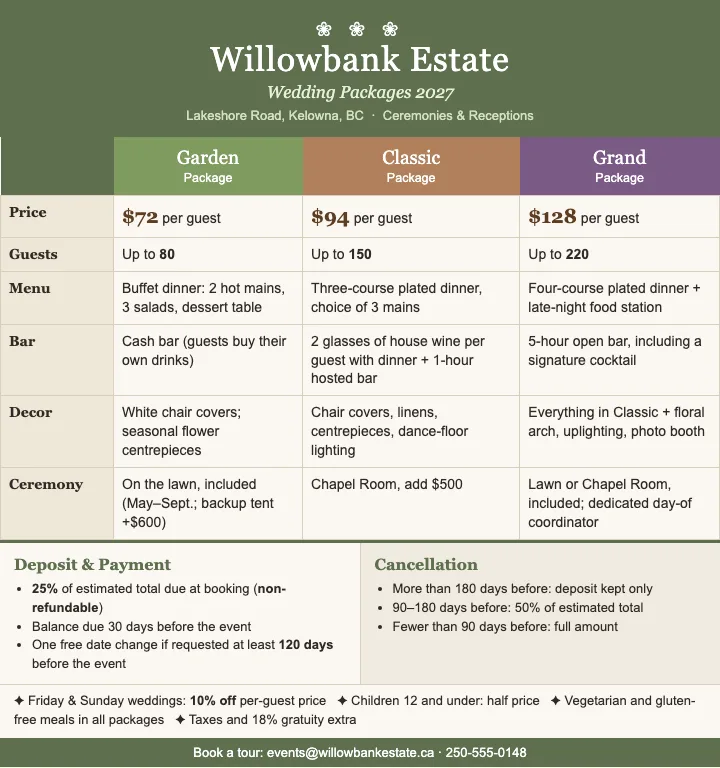
Read the following email message about the diagram on the left. Complete the email by filling in the blanks. Select the best choice for each blank from the drop-down menu.
Subject: I think we found it!
To: Leah Mensah
From: Amara Mensah
Hi Leah,
Jordan and I finally toured Willowbank Estate on Saturday, and I think we’ve found our venue! I’ve attached their package sheet so you can see for yourself. With the guest list sitting at about 120, the , which is a shame because the lawn is gorgeous.
I’m leaning toward the Classic. Mom would never forgive me if we served a buffet, and since half of Jordan’s family doesn’t drink, paying for in the Grand seems like a waste. The Classic still includes , so nobody will feel left out during the toasts.
Here’s where I need your level head. The coordinator said we’d have to pay when we book, and we wouldn’t get it back if anything went wrong. You know Jordan’s company might transfer him to Calgary next year, so the cancellation rules make me nervous. At least we could change the date once at no cost, as long as we ask . Jordan also suggested a Sunday to save a little, but I’ve got my heart set on a Saturday.
Could you come with me for a second look next weekend? I’d love your opinion before we sign anything. And please don’t tell Mom yet, or she’ll have the invitations printed by Tuesday!
Love,
Amara
Why does Amara prefer the Classic Package to the Grand Package?
Why do the cancellation rules worry Amara?
When Amara asks for Leah’s “level head,” she wants Leah to
Part 3: Reading for Information
Paragraph A
Few marine animals are as easy to love as the sea otter, which can often be seen floating on its back off the outer coast of British Columbia, cracking open a clam on its chest. Unlike whales and seals, sea otters have no layer of blubber to protect them from the cold Pacific. Instead, they rely on the thickest fur of any animal on Earth, with as many as 150,000 hairs on a single square centimetre of skin. Keeping that coat clean and full of trapped air is a full-time job, and otters spend hours each day grooming. To fuel their bodies, they must also eat roughly a quarter of their own weight every day, diving for sea urchins, crabs, clams and other shellfish. When resting, groups of otters often wrap themselves in strands of kelp so that they do not drift apart while they sleep.
Paragraph B
That remarkable fur very nearly caused the species’ disappearance. Beginning in the late 1700s, European, Russian and American traders paid high prices for otter pelts, and hunting spread rapidly along the Pacific coast. By the early twentieth century, sea otters had vanished from British Columbia altogether. An international treaty signed in 1911 finally banned the hunt, but by then there were no animals left in the province to protect. The turning point came between 1969 and 1972, when 89 otters were captured in Alaska and released in Checleset Bay, on the northwest coast of Vancouver Island. The newcomers adapted well, and their descendants have since spread north and south along the coast. Today the province’s population is estimated at more than 8,000, although the species is still listed as one of special concern.
Paragraph C
The return of the sea otter has had effects far beyond its own numbers. Scientists describe it as a keystone species, meaning that its presence shapes the entire ecosystem around it. The key lies in its appetite for sea urchins. Where otters are absent, urchins can multiply unchecked and graze kelp down to bare rock, leaving behind what researchers call “urchin barrens.” Where otters have returned, urchins hide in cracks rather than feeding in the open, and kelp forests recover, sometimes within a few years. These underwater forests provide shelter for young rockfish and herring, absorb carbon, and soften the force of waves before they reach the shore.
Paragraph D
Not everyone has welcomed the otters back, however. Coastal First Nations have harvested clams, crabs and urchins for thousands of years, and in some communities those foods have become noticeably harder to find since the otters arrived. Commercial divers who collect sea urchins and geoducks report similar losses. Some First Nations have asked for a role in managing otter numbers, pointing out that their ancestors once kept populations in balance through careful hunting. Meanwhile, a study from a BC university suggested that the gains from healthier kelp forests, including larger fish stocks and more visitors on wildlife tours, outweigh the losses to shellfish fisheries. Whether those benefits reach the communities that bear the costs remains an open question.
Decide which paragraph, A to D, has the information given in each statement below. Select E if the information is not given in any of the paragraphs.
- Sea otters change how their prey behaves, not just how many there are.
- Sea otters stay warm without the insulation many other ocean mammals rely on.
- Otters released in British Columbia were fitted with tracking devices.
- Legal protection came too late to save the province’s original otters.
- Some Indigenous communities want a say in how otter populations are controlled.
- Sea otters must eat a large amount of food for their body size.
- Kelp forests can help protect the shoreline.
- Shellfish harvesters have been paid for losses caused by otters.
- The otters that now live on BC’s coast descend from animals brought from another country.
Part 4: Reading for Viewpoints
When Harrowfield prohibited single-use plastic checkout bags three years ago, Councillor Marisa Delgado hailed the bylaw as “the easiest environmental win we will ever have.” Shoppers now bring their own bags or pay 25 cents for a paper one, and municipal crews report that plastic snagged in fences and storm drains has virtually vanished. Yet as such bylaws spread, a nagging question persists: are such bans reducing waste, or merely relocating it?
Dr. Anil Bhattacharya, who studies packaging at a university in southern Ontario, suspects both. The flimsy bags were frequently reused at home, chiefly as wastebasket liners and for collecting after dogs. Once they disappeared, sales of kitchen-catcher bags climbed sharply; being considerably thicker, these may mean some households now landfill more plastic, not less. Paper bags demand substantially more energy and water to manufacture, and a heavy cotton tote must be used dozens of times before its environmental footprint undercuts the bag it replaced.
Delgado remains unmoved. “Nobody pretended a bag ban would resolve the plastic problem single-handedly,” she insists, “but its value lies in altering habits. Carry a bag and you start scrutinizing everything else you discard.” A recent municipal survey found that seven in ten residents now bring their own bags without thinking.
Grocer Tom Kowalczyk, who owns two independent stores, voices a more pragmatic grievance. Paper bags cost him roughly four times as much as plastic, the fee does not fully recoup the difference, and “forgetful customers take it out on my cashiers, who’ve done nothing wrong.” He grudgingly acknowledges, though, that clearing litter from his parking lots has become cheaper.
For Joanne Pelletier, who organizes shoreline clean-ups, debates about carbon footprints miss the point: the bags she retrieved from the beach were never kitchen-catchers but the thin ones that blew out of shopping carts into the lake and the stomachs of birds. Her group’s annual tallies show waterfront bag litter down by more than 80 percent.
Bhattacharya concedes the decline in litter but insists that success be judged by total waste. He would pair bans with schemes for borrowing and returning reusable bags and with clearer guidance on alternatives. “Otherwise,” he cautions, “cities risk applauding themselves for a problem they’ve merely moved out of sight.”
Pelletier’s view is closest to that of
Why might some homes now discard more plastic?
Kowalczyk’s complaint about the charge is that it
What does the article suggest overall?
Which headline best reflects the article?
The following is a comment by a visitor to the website page. Complete the comment by choosing the best option to fill in each blank.
I grumbled when the bylaw passed, but this article has largely won me over. Dr. Bhattacharya is right that many of us simply replaced the free bags lining our bins with , and I plead guilty. Even so, I suspect he those flimsy bags did, given what Ms. Pelletier’s volunteers kept pulling out of the lake.
I do feel for Mr. Kowalczyk. It hardly seems fair that every time he restocks the checkout, all for a rule he never requested. As for Councillor Delgado’s claim that the ban , I can vouch for it: I now hesitate before buying anything wrapped in plastic. Add of the sort the professor proposes, and Harrowfield will have got this right.
Answer key
Count your correct answers, then find your estimated CLB:
Show all 38 answers
- What is the main purpose of Daniel’s letter? B. to ask her to support his graduate school application
- Daniel decided to return to school because he C. wants to understand the science behind his work better.
- Daniel thinks a letter from Ms. Larocque would be valuable because she B. observed his research work closely.
- What does Daniel suggest about his first-year grades? A. They were not consistently strong.
- Daniel hopes to submit everything by late November so that he A. can be considered for extra funding.
- Daniel asks for a reply either way so that he can D. find someone else if necessary.
- C. glad to write on your behalf
- D. your capstone report
- D. skills as a researcher
- C. Mr. Haddad
- C. before I leave on the eighteenth
- B. Garden Package won’t hold everyone
- A. a five-hour open bar
- D. two glasses of wine with dinner
- C. a quarter of the estimated total
- A. at least four months ahead
- Why does Amara prefer the Classic Package to the Grand Package? C. She does not want to pay for drinks many guests won’t have.
- Why do the cancellation rules worry Amara? B. Her fiancé may have to move for work.
- When Amara asks for Leah’s “level head,” she wants Leah to D. give her a calm, sensible opinion.
- Sea otters change how their prey behaves, not just how many there are. C
- Sea otters stay warm without the insulation many other ocean mammals rely on. A
- Otters released in British Columbia were fitted with tracking devices. E
- Legal protection came too late to save the province’s original otters. B
- Some Indigenous communities want a say in how otter populations are controlled. D
- Sea otters must eat a large amount of food for their body size. A
- Kelp forests can help protect the shoreline. C
- Shellfish harvesters have been paid for losses caused by otters. E
- The otters that now live on BC’s coast descend from animals brought from another country. B
- Pelletier’s view is closest to that of A. Marisa Delgado
- Why might some homes now discard more plastic? D. Residents buy thicker bags for home use.
- Kowalczyk’s complaint about the charge is that it B. does not cover his paper-bag costs.
- What does the article suggest overall? B. Less litter does not prove less waste.
- Which headline best reflects the article? D. “Bag Bans: Cleaner Shorelines, Uncertain Savings”
- A. thicker plastic ones
- D. underestimates the damage
- C. he is left out of pocket
- C. changes how people think
- A. a lending system
What does your score mean? See the CELPIP Reading score chart.
Free CELPIP practice test · Free CELPIP Listening practice tests · CELPIP sample tests by part
CELPass is an independent practice platform and is not affiliated with Paragon Testing Enterprises. CELPIP is a trademark of Paragon Testing Enterprises. Check the official CELPIP website and IRCC for current test rules and requirements.