CELPIP Reading Practice Test 82
By Iris
A complete CELPIP Reading practice test: all 4 parts and 38 questions in the real test order. Set a timer for 55–60 minutes and do all four parts in one sitting. Check your answers at the bottom of the page to see your score and an estimated CLB.
Download as PDF with answer key
In this test
- Part 1: Reading Correspondence, “Leaving the Office for an Electrician Apprenticeship” (questions 1–11) · practise this part alone
- Part 2: Reading to Apply a Diagram, “Renting Furniture for a Five-Month Stay” (questions 12–19) · practise this part alone
- Part 3: Reading for Information, “Lacrosse: Canada’s National Summer Sport” (questions 20–28) · practise this part alone
- Part 4: Reading for Viewpoints, “Right To Repair Law For Household Electronics” (questions 29–38) · practise this part alone
Part 1: Reading Correspondence
Dear Claire,
I hope you’re sitting down, because I have some news that may surprise you. After fifteen years of handling insurance claims, I handed in my resignation on Friday. In March, I’ll be starting a four-year apprenticeship as an electrician with a small contracting company here in Steinbach.
I know this sounds sudden, but it really isn’t. Do you remember when Paul and I redid the wiring in our basement two summers ago, with a licensed electrician checking every step? I enjoyed that project more than anything I’ve done at the office in years. Last fall, I quietly signed up for a pre-apprenticeship course at the college, two evenings a week. I didn’t tell anyone except Paul in case I failed, but I finished near the top of the class, and one of my instructors recommended me to his former employer.
I won’t pretend there are no downsides. For the first year, I’ll be earning a little more than half of my current salary, so we’ve sat down and redone our budget. We’re going to sell the second car, since the shop is only a ten-minute bike ride from home, and we’ve cancelled the trip to Portugal we had planned for the spring. Paul says it’s a small price to pay to stop hearing me complain every Sunday night, which I suppose is fair.
To be honest, I’m a bit nervous about the physical side of the job. Crawling through attics in July is a long way from sitting at a desk. I’ve also realized I’ll probably be the oldest apprentice on every site by about twenty years. Still, my new boss told me she likes hiring people with some life experience, because they tend to show up on time and know how to talk to customers.
That brings me to a favour. Each year of the apprenticeship includes an eight-week block of classroom training in Winnipeg, and my first block starts in late September. Would it be possible for me to stay in your spare room during the week? I would drive home every Friday, and of course I’d cover my share of the groceries.
Please don’t mention any of this to Mom yet. I want to tell her myself at Sunday dinner, before she hears it from someone at church.
Love,
Renée
What is the main purpose of Renée’s letter?
Why does Renée say her decision “really isn’t” sudden?
Before finding her new position, Renée completed
Which change will Renée and Paul make because of her lower pay?
According to Renée, her new boss values older apprentices because they
Why does Renée ask Claire not to tell their mother yet?
Here is a response to the message. Complete the response by filling in the blanks. Select the best choice for each blank from the drop-down menu.
Dear Renée,
I had to read your letter twice, but I couldn’t be happier for you! Honestly, after hearing you for so long, nobody who knows you well will be shocked. I’m also impressed that you kept the evening course a secret and still .
Of course you can stay with us during your . The spare room is yours from Monday to Friday, and the kids are thrilled to have their aunt around. You don’t need to pay for food, but if you insist, you can cook on Wednesdays.
As for being , I wouldn’t worry. Your boss is right that experience counts for something, and you were always better with your hands than I was.
My lips are sealed until Sunday, although Mom will surely ask why you waited so long to tell her, since you started .
Love,
Claire
Part 2: Reading to Apply a Diagram
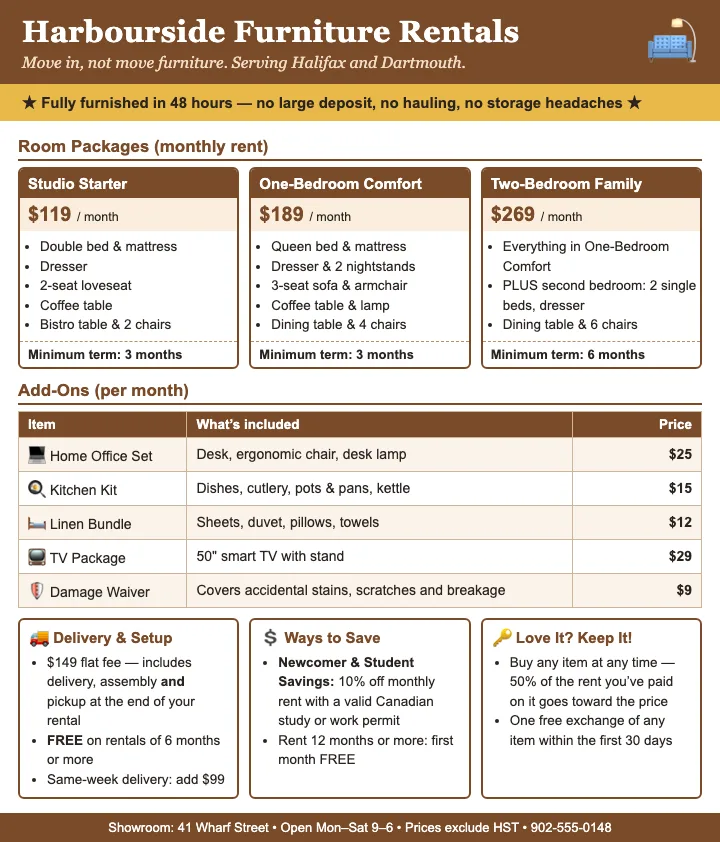
Read the following email message about the diagram on the left. Complete the email by filling in the blanks. Select the best choice for each blank from the drop-down menu.
Subject: Furniture for your apartment
To: Lucía Morales
From: Daniel Ortega
Hi Lucía,
My mom is so excited that her favourite niece will be in Halifax for five whole months, and congratulations on getting your work permit for the job at the hospital lab! Since your apartment comes unfurnished, I picked up this flyer from a rental place near my office.
Your place has a separate bedroom, and you’ll want a real table for when Mom comes over for dinner, so I’d go with the . There’s no rush, since you don’t arrive until January, but because you’re only renting for five months, you’ll have to pay for delivery. On the bright side, that also covers pickup when you leave.
You mentioned you’ll be writing up your research at home two days a week, so add the home office set. Mom has plenty of spare dishes and bedding to lend you, and I wouldn’t bother with the damage waiver. That brings your monthly rent to before the discount. To get the discount, just show them your when you sign.
I’d skip the TV, too. Mom’s old one is gathering dust in our basement, and it’s yours if you want it.
Finally, if you fall in love with that sofa, keep in mind that .
See you at the airport on January 6!
Daniel
Daniel and Lucía are
Why is Lucía coming to Halifax?
When Daniel says the old TV is “gathering dust,” he means it is
Part 3: Reading for Information
Paragraph A
Long before Europeans arrived in North America, many Indigenous nations across eastern North America were playing a game with sticks and a ball that would later become known as lacrosse. Among the Haudenosaunee, it is still called the Creator’s Game, and it carried a meaning that went far beyond entertainment. Matches could be held to settle quarrels between communities, to help heal the sick, or to give young men the strength and endurance they would need as hunters and warriors. Early versions had few fixed rules. A team might include hundreds of players, the field could stretch over a great distance, and a single contest sometimes lasted for days.
Paragraph B
French missionaries and settlers who watched the game in the 1600s are generally credited with giving it the name used today. By the mid-1800s, non-Indigenous players in Montreal had taken up the sport, and they sharpened their skills by playing against talented Mohawk teams from nearby communities. In the 1860s, a Montreal dentist named William George Beers wrote down a standard set of rules that helped turn a loosely organized pastime into a competitive sport. Beers promoted lacrosse with remarkable energy, and clubs soon appeared in towns across the young country. He even campaigned for the game to be recognized as Canada’s national pastime.
Paragraph C
In the early twentieth century, interest in the outdoor game began to fade. In the 1930s, arena owners came up with a solution that also solved a problem of their own: hockey rinks sat empty all summer, earning nothing. Box lacrosse, as the new version became known, is played indoors on the arena floor once the ice has been removed, with fewer players and a much smaller playing area than the field game. Its speed and constant physical contact drew large crowds, and box lacrosse soon became the dominant form of the sport in Canada. Today, the country’s best senior and junior box lacrosse teams compete each year for two national trophies, the Mann Cup and the Minto Cup.
Paragraph D
Lacrosse has also enjoyed moments on the international stage. Canadian teams won the Olympic lacrosse tournaments of 1904 and 1908, but soon afterwards the sport was dropped as an Olympic medal event, and it stayed off the medal program for many decades. At home, its official status took far longer to arrive than many people realize. For generations, Canadians assumed that lacrosse had been declared the national game around the time of Confederation, yet no law said so until 1994, when Parliament passed the National Sports of Canada Act. The act named lacrosse the national summer sport and hockey the national winter sport. Meanwhile, the Haudenosaunee field their own national team in international competition, a powerful reminder that the game remains closely tied to the people who created it.
Decide which paragraph, A to D, has the information given in each statement below. Select E if the information is not given in any of the paragraphs.
- The game’s present-day name did not come from the people who first played it.
- Canada’s success at the Olympics in lacrosse was short-lived because the sport was soon removed.
- The result of a match could sometimes decide a dispute between neighbouring peoples.
- A Montreal dentist succeeded in having lacrosse officially named Canada’s national game.
- A new form of the game was developed partly to earn money from buildings that would otherwise be idle.
- Settler players in Montreal improved by competing against Indigenous opponents.
- Box lacrosse was the version Canadian teams played at the Olympic Games.
- Many Canadians wrongly believed that lacrosse had held official status for much longer than it had.
- Part of the arena version’s appeal for fans was how quickly the action moved.
Part 4: Reading for Viewpoints
A bill before the provincial legislature would oblige companies selling phones, laptops and major household appliances to make spare parts, repair manuals and diagnostic software available to independent repair shops and consumers at a “fair and reasonable” price for at least seven years after a model is last sold. Proponents anticipate less electronic waste; opponents warn of security risks.
Marguerite Olsen, who has operated a small repair shop in Thunder Bay for eighteen years, considers the bill long overdue. She turns away perhaps a quarter of her customers, not because faults are complicated, but because parts are unobtainable or electronically “paired” to the original device. “A cracked screen or exhausted battery ought to be a forty-minute job. Instead, owners are told to buy anew. That’s a decision made on their behalf.”
Devin Khanna, spokesperson for electronics manufacturers, dismisses much of the bill as redundant: most manufacturers already operate authorized repair networks, and several sell parts directly. Publishing manuals does not trouble him, and he concedes that parts could be easier to locate. What his members resist is releasing diagnostic software capable of unlocking security features that safeguard banking and health information. “People rarely discard a phone because it can’t be fixed. They want the newest model,” he maintains.
Consumer economist Helen Ostrowski endorses the bill in principle while tempering expectations. Her research indicates that most phones are retired in working order, superseded by a better camera or more storage, and that if a repair costs half the price of a new device, many people still choose the new one. “The law removes an obstacle but not our appetite for novelty,” she observes. She would supplement it with a label rating each product’s repairability at the moment of purchase.
When the control board on Lucas Bergeron’s four-year-old dishwasher failed, the part was discontinued, and a technician quoted nearly the price of a new machine for a used board. The Sudbury father of three would gladly pay more upfront for an appliance he knew could be fixed. He bought a replacement, and the old one, otherwise flawless, still nags at him from a landfill.
On what does Ostrowski side with Khanna?
Why does Olsen say owners don’t really decide?
How would Khanna view a parts-and-manuals bill?
Judging by his remarks, Bergeron
The best title is “Right to Repair:
The following is a comment by a visitor to the website page. Complete the comment by choosing the best option to fill in each blank.
I repair small appliances for a living, and Mr. Khanna’s arguments ring hollow to me. Manufacturers who praise repair while want it both ways. As for security, Ms. Olsen has been fixing devices for without, I suspect, a single customer’s data going astray; independent technicians live on their reputations.
Admittedly, Dr. Ostrowski is right that , and no law will cure that. But her would let shoppers reward durable designs, and manufacturers would soon notice which models sell. If this bill passes, fewer families like Mr. Bergeron’s will have to . That alone outweighs the industry’s grumbling.
Answer key
Count your correct answers, then find your estimated CLB:
Show all 38 answers
- What is the main purpose of Renée’s letter? B. to share a career decision and ask for a favour
- Why does Renée say her decision “really isn’t” sudden? C. She had prepared for it without telling most people.
- Before finding her new position, Renée completed B. a part-time training program at night.
- Which change will Renée and Paul make because of her lower pay? D. They will get by with a single vehicle.
- According to Renée, her new boss values older apprentices because they A. are dependable and good with clients.
- Why does Renée ask Claire not to tell their mother yet? C. She wants to share the news herself.
- D. grumble about the office each weekend
- A. earned one of the best marks
- B. training blocks in the fall
- C. much older than the other trainees
- D. taking classes last fall
- B. One-Bedroom Comfort package
- C. $149
- C. $214
- D. valid work permit
- A. half your rent can go toward buying it
- Daniel and Lucía are C. members of the same family.
- Why is Lucía coming to Halifax? A. to do a research job for a few months
- When Daniel says the old TV is “gathering dust,” he means it is D. not being used by anyone.
- The game’s present-day name did not come from the people who first played it. B
- Canada’s success at the Olympics in lacrosse was short-lived because the sport was soon removed. D
- The result of a match could sometimes decide a dispute between neighbouring peoples. A
- A Montreal dentist succeeded in having lacrosse officially named Canada’s national game. E
- A new form of the game was developed partly to earn money from buildings that would otherwise be idle. C
- Settler players in Montreal improved by competing against Indigenous opponents. B
- Box lacrosse was the version Canadian teams played at the Olympic Games. E
- Many Canadians wrongly believed that lacrosse had held official status for much longer than it had. D
- Part of the arena version’s appeal for fans was how quickly the action moved. C
- On what does Ostrowski side with Khanna? B. Phones are mostly replaced while working.
- Why does Olsen say owners don’t really decide? A. They have no real alternative.
- How would Khanna view a parts-and-manuals bill? D. as acceptable, since data stays safe
- Judging by his remarks, Bergeron C. would welcome a repairability label.
- The best title is “Right to Repair: B. Useful, but No Cure for Waste”
- C. withholding their diagnostic software
- A. nearly two decades
- D. novelty, not breakdowns, drives most purchases
- B. rating at checkout
- A. scrap a sound machine
What does your score mean? See the CELPIP Reading score chart.
Free CELPIP practice test · Free CELPIP Listening practice tests · CELPIP sample tests by part
CELPass is an independent practice platform and is not affiliated with Paragon Testing Enterprises. CELPIP is a trademark of Paragon Testing Enterprises. Check the official CELPIP website and IRCC for current test rules and requirements.