CELPIP Reading Practice Test 92
By Iris
A complete CELPIP Reading practice test: all 4 parts and 38 questions in the real test order. Set a timer for 55–60 minutes and do all four parts in one sitting. Check your answers at the bottom of the page to see your score and an estimated CLB.
Download as PDF with answer key
In this test
- Part 1: Reading Correspondence, “Handing Over the Job-Shadowing Day” (questions 1–11) · practise this part alone
- Part 2: Reading to Apply a Diagram, “Planning a Seaside B&B Weekend with a Dog” (questions 12–19) · practise this part alone
- Part 3: Reading for Information, “Chinook Winds of Southern Alberta” (questions 20–28) · practise this part alone
- Part 4: Reading for Viewpoints, “Local Food Quota For Public Institutions Debate” (questions 29–38) · practise this part alone
Part 1: Reading Correspondence
Dear Kevin,
I’m sorry to drop this on you with so little warning, but as you probably heard at Monday’s staff meeting, I’m being sent to our Saskatoon office for three weeks to help get the water treatment project back on schedule. That means I’ll be away for our Grade 9 job-shadowing day on November 5, and you’ll be running it on your own. I’ve put everything in a shared folder, but I wanted to walk you through the main points so that nothing falls through the cracks.
First, the numbers. We have fourteen students signed up this year, compared with nine last year, so the boardroom won’t be big enough. In any case, Facilities has told me that the board of directors has booked it for that afternoon. I’ve reserved the training room on the third floor instead. It has a projector, but you’ll need to borrow extra chairs from the lunchroom.
Second, footwear. You’ll remember that last year two students turned up in running shoes and had to sit in the lobby while everyone else toured the testing lab. I felt terrible about it. This year I’ve added a line in bold to the parents’ letter saying that closed, sturdy shoes are required, but it would be worth repeating that in the reminder email you send the week before.
Third, lunch. The pizza we ordered last time was far more than the kids could eat, and we ended up throwing out nearly half of it. I’d suggest sandwich platters from the café downstairs instead. HR has approved $300, which should be more than enough, but the café needs the order at least five business days in advance.
Finally, the afternoon activity. I still think the popsicle-stick bridge contest is the highlight of the day, and Doug has agreed to judge again. The supplies are in the blue bin under my desk. The only thing missing is a prize. Last year’s gift cards went over well, so you might ask HR whether there’s anything left in the budget.
The signed permission forms must be collected by October 24. Three are still outstanding, and I’ve marked those names in red on the list in the folder.
I’ll be checking email in the evenings, and I can join a video call any Tuesday if you’d like to go over anything. Thank you for stepping in. I owe you one.
Best regards,
Nathalie
What is the main purpose of Nathalie’s letter?
What does Nathalie say about the boardroom?
What happened at last year’s event?
Why does Nathalie suggest a different lunch this year?
When Nathalie says she wants to make sure nothing “falls through the cracks,” she means that
What can we infer about Kevin?
Here is a response to the message. Complete the response by filling in the blanks. Select the best choice for each blank from the drop-down menu.
Dear Nathalie,
Thanks for the detailed notes, and please don’t worry. I’m happy to take over, and I hope things go smoothly in Saskatoon.
The training room will work well, and I’ll ask the lunchroom staff about . I’ll also make sure the reminder email stresses , since none of us wants a repeat of last year.
I stopped by the café this morning. Because they need , I’ll place the sandwich order by the end of next week. As for a prize, I’ll check with HR, since the were such a hit with the kids last time.
The only thing that worries me is the , so I’ll call those families today. If anything else comes up, I’ll save it for our Tuesday call.
Take care,
Kevin
Part 2: Reading to Apply a Diagram
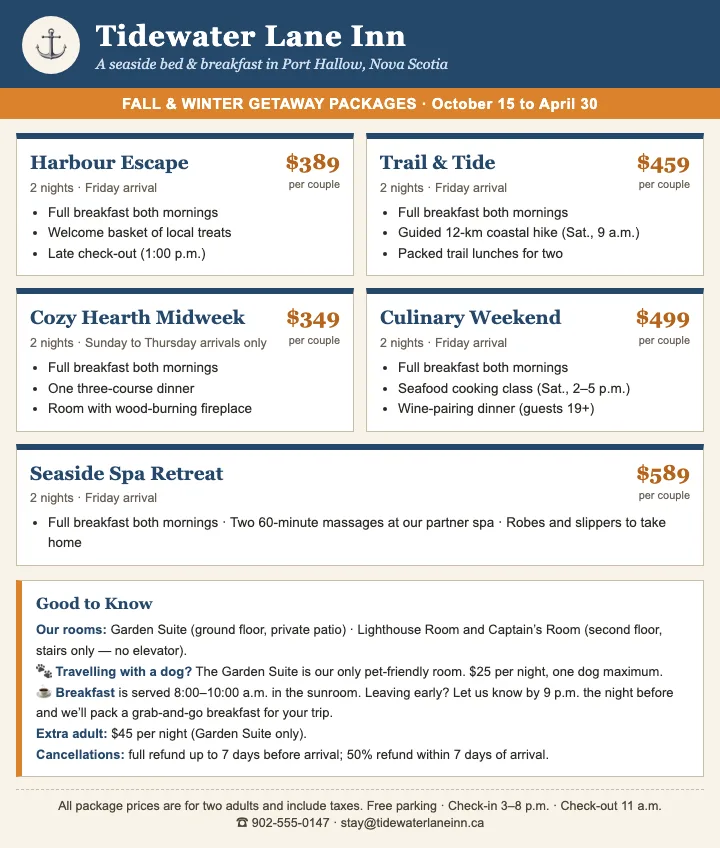
Read the following email message about the diagram on the left. Complete the email by filling in the blanks. Select the best choice for each blank from the drop-down menu.
Subject: Our weekend by the sea
To: Marisol Duarte
From: Lena Kovac
Hi Marisol,
I finally got the package sheet from Tidewater Lane Inn, and I think we’re in luck. Since your knee still can’t handle much more than a short stroll, we can cross off right away. And because we’re both stuck at work until Friday, the Cozy Hearth won’t work either, as . The Spa Retreat looks lovely, but it’s more than I want to spend.
Good news about Biscuit: your dog can come along as long as we book , which also means no stairs for you. With his fee, the Harbour Escape would come to for the two nights, which seems fair to me.
I’m on the fence about the Culinary Weekend. The cooking class sounds like fun, but you’ve given up wine, so we’d be paying extra for a dinner you wouldn’t enjoy.
One more thing: you’re working at ten on Sunday morning, and the drive home takes over two hours, so we’ll be leaving well before breakfast is served. Luckily, the inn will .
I still miss our lunches in the staff room back when we both worked at the clinic. It’s been far too long! Let me know what you think, and I’ll book this weekend.
Lena
Lena and Marisol know each other because
Why does Lena mention Marisol’s Sunday shift?
When Lena says she is “on the fence” about the Culinary Weekend, she means that she
Part 3: Reading for Information
Paragraph A
For people living in Calgary and across southern Alberta, few weather events are as welcome in the middle of winter as a chinook. These warm, dry winds sweep down the eastern slopes of the Rocky Mountains, sometimes turning a bitterly cold morning into a mild afternoon. It is not unusual for temperatures to climb by twenty degrees or more within a few hours, and residents may trade their parkas for light jackets before the day is out. The wind takes its name from the Chinook people of the Pacific Northwest, and it has also earned the nickname “snow eater” for the speed at which it can make snow vanish.
Paragraph B
The science behind a chinook begins over the Pacific Ocean. Moist air carried inland by westerly winds is forced upward when it meets the mountain ranges of British Columbia. As the air rises, it cools, and much of its moisture falls as rain or snow on the western slopes. Losing that moisture is only part of the explanation, however. The main reason for the warmth is what happens as the now-dry air descends the eastern slopes: it is squeezed by the increasing pressure around it, and this compression heats it quickly. Because dry air warms faster on the way down than moist air cools on the way up, the wind that reaches the foothills is noticeably warmer than when it began its climb. Similar winds blow in other mountain regions of the world; in the Alps, for example, they are known as the foehn.
Paragraph C
Long before the wind itself arrives, many Albertans can tell that a chinook is on its way simply by looking west. A broad band of clear blue sky often opens above the mountains, bordered by a sharp edge of cloud. This feature, known as the chinook arch, can stretch across the horizon and produces striking sunrises and sunsets that photographers eagerly wait for. Once the wind arrives, its effect on the snow can be dramatic. In such dry air, some of the snow does not simply melt but turns directly into water vapour, a process called sublimation, leaving bare lawns where deep drifts stood the day before.
Paragraph D
Not everyone welcomes the sudden change. Gusts during a chinook can be strong enough to make driving a high-sided truck on open highways dangerous, and the rapid swings between freezing and thawing help create potholes and icy sidewalks once the cold returns. Trees suffer too. Evergreens lose moisture through their needles in the warm, dry wind while their roots sit in frozen ground, and whole hillsides of them can turn reddish-brown, a sight known as “red belt.” Some residents blame chinooks for their headaches, and researchers in Calgary have found that certain migraine sufferers do report more attacks around chinook days. Even so, most people in the region would agree that a break from the deep cold is worth a few drawbacks.
Decide which paragraph, A to D, has the information given in each statement below. Select E if the information is not given in any of the paragraphs.
- The wind’s warmth owes more to the way it travels downhill than to the moisture it has lost.
- Some of the trouble a chinook causes is not noticed until the warm spell ends.
- Clothing chosen at breakfast may be unsuitable by afternoon.
- Residents can sometimes prepare for a chinook before feeling any change in temperature.
- A chinook usually keeps temperatures mild for several days before the cold returns.
- Not all of the snow that disappears ends up as meltwater.
- The wind is named after a group of people from outside the region where it blows.
- Winds of this kind blow more often in the Alps than in Alberta.
- Research has lent some support to a common complaint about the wind.
Part 4: Reading for Viewpoints
The provincial government wants patients, students and seniors consuming food grown closer to home. A bill introduced last month would oblige hospitals, school cafeterias and publicly funded long-term care homes to source at least 30 percent of their food within the province by 2030. Agriculture Minister Gordon Halvorsen hails it as “a guaranteed customer for our farmers and a fresher plate for the people we serve.” Public institutions spend hundreds of millions on food annually, and redirecting even a fraction, he argues, would sustain rural communities. “Institutions will find savings elsewhere,” he insists; no additional funding is planned.
That last assurance alarms Raj Malhotra, who manages food services for a regional hospital network. “I’d gladly serve local carrots and potatoes, but my kitchens were designed decades ago to reheat prepared meals, not to wash, peel and chop raw vegetables in bulk.” The bill is silent on equipment and staffing. With a fixed daily budget per patient and local produce usually costlier, meeting the target unaided would mean cutting elsewhere, frequently nutrition.
Denise Lavoie, who grows vegetables two hours north of the capital, welcomes the idea warily. Five years ago she expanded her potato fields for a school board pilot, only to watch the district revert to a cheaper supplier midway through the year. “I was left with tonnes I couldn’t sell. A percentage on paper means nothing to me; a three-year contract would justify buying seed and hiring help.” Winter, she acknowledges, imposes genuine limits. “Nobody harvests lettuce here in February.”
Economist Ingrid Sorensen believes provincial farms could benefit but disputes some of the claims. Transportation represents a modest share of most food’s environmental footprint, so a tomato from a heated greenhouse nearby is not necessarily greener than one trucked from the south. “A rigid quota would inflate costs ultimately borne by taxpayers,” she warns. Preferable, in her estimation, would be regional facilities that wash, cut and freeze produce at harvest, alleviating the winter shortage and relieving institutional kitchens.
Halvorsen professes openness to amendments but refuses to postpone the target, predicting that waiting for perfect kitchens would leave the province having this same conversation in twenty years.
Malhotra’s concerns are most similar to those of
Why was Lavoie left with unsold potatoes?
What can reasonably be concluded?
Sorensen would most likely agree that
A suitable title is
The following is a comment by a visitor to the website page. Complete the comment by choosing the best option to fill in each blank.
I spent eighteen years running a high school cafeteria, and I can tell you that the minister is . Telling kitchens to buy local while is like asking a cook to make soup with an empty pot. When our kitchen was renovated, the new equipment was designed for heating trays, not for .
That said, I don’t accept the economist’s argument entirely. Even if trucking is a small part of food’s footprint, buying from nearby farms still , which is exactly what towns like mine need.
Ms. Lavoie’s story should be required reading at the legislature. If the province wants farmers to plant for schools and hospitals, it has to offer , not just a target on paper.
Answer key
Count your correct answers, then find your estimated CLB:
Show all 38 answers
- What is the main purpose of Nathalie’s letter? C. to pass on what Kevin needs to run the event
- What does Nathalie say about the boardroom? B. It is unavailable as well as too small.
- What happened at last year’s event? A. Some students missed part of the program.
- Why does Nathalie suggest a different lunch this year? C. Much of last year’s food was wasted.
- When Nathalie says she wants to make sure nothing “falls through the cracks,” she means that D. no task is forgotten or overlooked.
- What can we infer about Kevin? B. He helped run the event last year.
- A. a few more seats for the students
- D. the right kind of footwear
- B. about a week’s notice
- C. gift cards
- D. forms that haven’t come back yet
- B. the Trail & Tide
- A. it’s only offered for midweek stays
- D. the Garden Suite
- C. $439
- B. have something ready for us to eat on the road
- Lena and Marisol know each other because D. they were once co-workers.
- Why does Lena mention Marisol’s Sunday shift? A. to explain why they must leave early
- When Lena says she is “on the fence” about the Culinary Weekend, she means that she C. has mixed feelings about choosing it.
- The wind’s warmth owes more to the way it travels downhill than to the moisture it has lost. B
- Some of the trouble a chinook causes is not noticed until the warm spell ends. D
- Clothing chosen at breakfast may be unsuitable by afternoon. A
- Residents can sometimes prepare for a chinook before feeling any change in temperature. C
- A chinook usually keeps temperatures mild for several days before the cold returns. E
- Not all of the snow that disappears ends up as meltwater. C
- The wind is named after a group of people from outside the region where it blows. A
- Winds of this kind blow more often in the Alps than in Alberta. E
- Research has lent some support to a common complaint about the wind. D
- Malhotra’s concerns are most similar to those of D. the economist, who favours processing facilities.
- Why was Lavoie left with unsold potatoes? A. The school board pulled out.
- What can reasonably be concluded? C. The bill funds no equipment or staff.
- Sorensen would most likely agree that B. green benefits can be overstated.
- A suitable title is A. “Local Food Rule: Good Intentions, Missing Pieces”
- C. blind to kitchens’ limits
- D. keeping the purse closed
- B. turning raw produce into meals
- A. keeps dollars circulating close to home
- C. a contract that lasts
What does your score mean? See the CELPIP Reading score chart.
Free CELPIP practice test · Free CELPIP Listening practice tests · CELPIP sample tests by part
CELPass is an independent practice platform and is not affiliated with Paragon Testing Enterprises. CELPIP is a trademark of Paragon Testing Enterprises. Check the official CELPIP website and IRCC for current test rules and requirements.