CELPIP Reading Practice Test 94
By Iris
A complete CELPIP Reading practice test: all 4 parts and 38 questions in the real test order. Set a timer for 55–60 minutes and do all four parts in one sitting. Check your answers at the bottom of the page to see your score and an estimated CLB.
Download as PDF with answer key
In this test
- Part 1: Reading Correspondence, “Pausing a Recreation Centre Membership” (questions 1–11) · practise this part alone
- Part 2: Reading to Apply a Diagram, “Museum Programs for Two Neighbourhood Kids” (questions 12–19) · practise this part alone
- Part 3: Reading for Information, “Glenn Gould: The Pianist Who Left the Stage” (questions 20–28) · practise this part alone
- Part 4: Reading for Viewpoints, “Every-Other-Week Garbage Pickup Debate” (questions 29–38) · practise this part alone
Part 1: Reading Correspondence
Dear Mr. Okafor,
I have been a member of the Pinecrest Recreation Centre for six years, and my annual membership comes up for renewal on January 31. Before I renew, I am hoping you can help me with a situation that your current rules don’t seem to cover.
My employer has asked me to lead a project at our Yellowknife office from early February until the end of May. When I explained this at the front desk last week, the staff member politely told me that memberships can only be put on hold for medical reasons, and only with a note from a doctor. I understand why a busy centre needs clear rules, but it seems unfair that someone who has renewed faithfully every year should pay for four months she has no way of using. I would be glad to provide a letter from my manager confirming the dates of my assignment. Travel is part of my job, but this is the first time I will be away for more than a few weeks.
If a hold is truly out of the question, I have two other suggestions. My father moved in with us after he retired last fall, and he has been talking about joining the morning aquafit classes. He is a little shy about joining on his own, and I think a membership that was already paid for would give him the push he needs. Could my membership be transferred to him while I am away? Alternatively, I could let my membership lapse and simply buy a new one when I return. The problem is that I currently receive a 15 percent loyalty discount for members of five years or more, and I have been told that I would lose it if there were any break in my membership.
Please don’t take this letter as a complaint about the centre itself. The renovated weight room is a huge improvement, and the evening instructors are excellent. If anything, the Thursday yoga class has become a victim of its own success; I have been turned away twice this month because every mat was already taken.
I would be grateful for a reply before my membership expires at the end of the month, so that I can make arrangements before I leave.
Sincerely,
Renata Kowalski
What is the main purpose of Renata’s letter?
The staff member at the front desk told Renata that
What do we learn about Renata’s father?
If Renata’s membership lapsed, she would
Why does Renata mention the weight room and the instructors?
What does Renata suggest about the Thursday yoga class?
Here is a response to the message. Complete the response by filling in the blanks. Select the best choice for each blank from the drop-down menu.
Dear Ms. Kowalski,
Thank you for your letter, and for six years of loyal membership. Congratulations on your in the North; it sounds like an exciting few months.
Our staff member was correct that holds are normally limited to members with . However, since you are able to provide , I am happy to make an exception this time and pause your membership from February 1 to May 31.
I’m afraid I can’t approve your other suggestion, as our memberships . Your father is, of course, welcome to try a free aquafit class before deciding whether to join us himself.
Because there will be no break in your membership, your will continue when you return. You may also be glad to hear that we are adding a second Thursday yoga class in the spring.
Best regards,
Daniel Okafor
Membership Services Manager
Part 2: Reading to Apply a Diagram
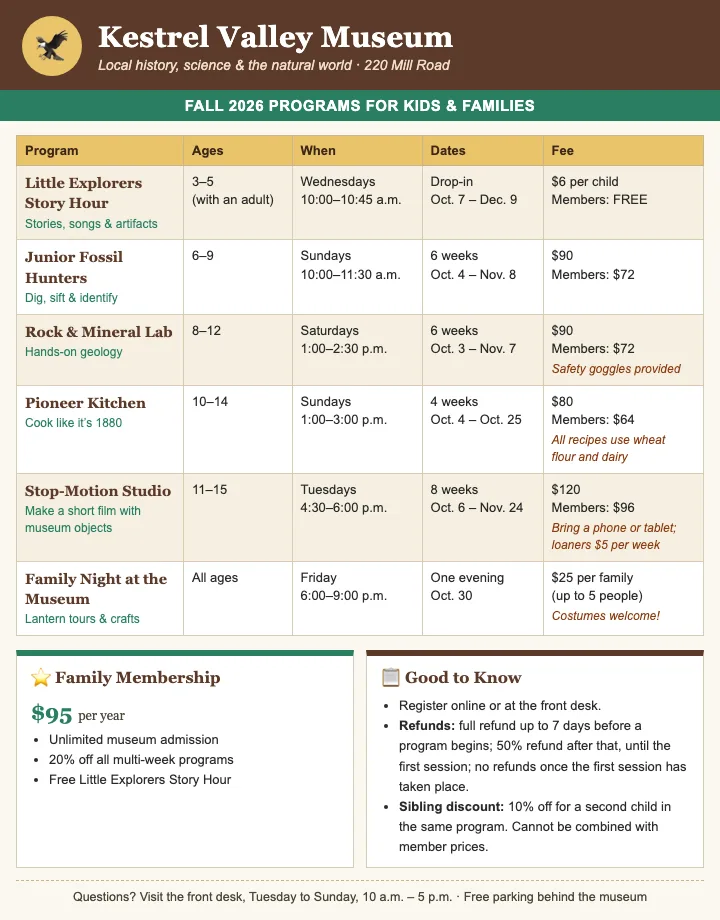
Read the following email message about the diagram on the left. Complete the email by filling in the blanks. Select the best choice for each blank from the drop-down menu.
Subject: Fall programs for Mateo and Nadia
To: Grace Liu
From: Tomás Reyes
Hi Grace,
Thanks again for walking Mateo home on Thursday when my bus broke down. Living three doors down from you has saved me more than once!
I picked up the fall program sheet at the Kestrel Valley Museum, and I think Mateo and Nadia could sign up for something together. That way we could take turns driving. Mateo is 11 and Nadia is 12, so a few programs fit them both. Since Nadia can’t eat wheat, we can cross off . And because I work every Saturday, wouldn’t be fair to you, since you’d end up doing all the driving.
That leaves the Stop-Motion Studio. It runs until , so it would wrap up before my in-laws arrive in December. Mateo can bring his own tablet, so with our family membership, he would pay . Still a good deal, I think.
I know you won’t hear about Nadia’s swim team until after the first session has already taken place. Just keep in mind that if she ends up having to drop out.
I’m happy to take the lion’s share of the driving, since my Tuesdays end early. Let me know what you think!
Tomás
How do Tomás and Grace know each other?
Why does Tomás want Mateo and Nadia in the same program?
When Tomás offers to take “the lion’s share” of the driving, he means he will
Part 3: Reading for Information
Paragraph A
Few classical musicians have fascinated the public as much as Glenn Gould. Born in Toronto in 1932, Gould showed his talent remarkably early. His mother, a music teacher, gave him his first piano lessons, and he is said to have been able to read music before he could read words. At the age of ten, he began studying at the Toronto Conservatory of Music, and by his early teens he was performing in public, including an appearance with the Toronto Symphony Orchestra at fourteen. Even then, his teachers noticed an unusual independence: the young pianist had firm ideas about how music should sound and was rarely persuaded to change them.
Paragraph B
Gould’s international breakthrough came with his first major recording. In 1955, he chose to record Johann Sebastian Bach’s Goldberg Variations, a long keyboard work that was rarely performed at the time and was considered by many to be too dry for a general audience. Some at his record company wondered whether a little-known Canadian making his debut with such a piece could possibly sell. Their doubts proved unfounded. Released in 1956, the album became one of the best-selling classical recordings of its era, and its bright, energetic playing made Gould a celebrity almost overnight. Invitations followed from concert halls across North America and Europe, and in 1957 he toured the Soviet Union.
Paragraph C
Yet Gould never felt at home on the concert stage. In 1964, at the age of 31 and at the height of his fame, he gave his last public performance and devoted himself to recording, broadcasting and writing. In essays and interviews, he argued that the studio allowed a performer to shape an interpretation with a care that was impossible in front of an audience, and he predicted that the public concert would eventually disappear. His personal habits only added to his reputation. He hummed audibly as he played, sat on a battered folding chair that his father had shortened, and was known for wearing a coat, scarf and gloves even in warm weather.
Paragraph D
Away from the concert hall, Gould found new ways to reach listeners. For CBC Radio he created documentaries such as The Idea of North (1967), in which the voices of several speakers overlap like the lines of a piece of music, a technique he called “contrapuntal radio.” Near the end of his life, he returned to the Goldberg Variations, producing a slower, more reflective recording that was released in 1982. He died that same year, shortly after his fiftieth birthday, following a stroke. His influence has outlived him: a recording of his Bach was included on the golden records carried into space by NASA’s Voyager probes in 1977, and a bronze statue of him sitting on a bench greets visitors outside the CBC Broadcasting Centre in Toronto.
Decide which paragraph, A to D, has the information given in each statement below. Select E if the information is not given in any of the paragraphs.
- Some of Gould’s playing has travelled farther than any concert tour could take it.
- Gould’s musical ability was encouraged at home before he received formal training.
- There were concerns that the music Gould selected would not appeal to buyers.
- Gould gave his final public performance in the city where he was born.
- Gould believed that the future of music lay in recordings rather than live performance.
- Gould set out his views on performing in a best-selling book.
- Gould’s early success brought him opportunities to perform overseas.
- Late in life, Gould went back to the work that had first made his name.
- One of Gould’s well-known habits involved a piece of furniture altered by a relative.
Part 4: Reading for Viewpoints
Ashgrove council must soon decide whether to collect household garbage only every second week, with green-bin organics and blue-box recycling still picked up weekly. Supporters expect more conscientious sorting; critics counter that it shifts the burden onto households while ignoring where most waste originates. The town’s only landfill is projected to reach capacity within fifteen years.
Councillor Anita Desrosiers, chair of the environment committee, is the plan’s staunchest proponent. “Put the bin out less often and you start to see how much of your trash belonged in the green bin all along,” she argues. The roughly $1.4 million saved annually she has pledged toward extending organics collection to apartment buildings, which currently have none. “Nobody’s being asked to throw out less, only to put it in the right place,” she insists.
Dr. Paul Whitford, who studies municipal waste systems, grants that diversion rates typically climb in the first year. Whether they stay there depends on residents understanding why they sort, not merely that they must. Collection schedules, moreover, address only the tail end of the problem: much of a garbage bag is packaging no household chose. Until producers bear that cost, cities are “mopping the floor while the tap is still running.”
For Gloria Mbeki, mother of eighteen-month-old twins, the issue is anything but abstract. She recycles diligently, but diapers can’t go in the green bin. “Two weeks of them in a July heat wave isn’t a lesson in responsibility; it’s an unsanitary hazard,” she protests. She has requested extra pickups for families with infants and residents dependent on medical supplies; Desrosiers has promised that staff will “look at options,” committing to nothing.
Rick Lavoie, who manages three downtown rental buildings, doubts that any of their single garbage rooms could hold twice the volume. Overflowing bins would bring bags in the lane, scavenging raccoons and bylaw fines. Still, he acknowledges the plan’s merit: most of his tenants’ refuse is cardboard and plastic wrap from online orders, and “the shipping companies should be paying for its disposal.” He could support the change once apartments receive the promised composting service.
Lavoie and Whitford would agree that
Who gains most from Desrosiers’s pledge?
Whitford’s “mopping the floor” remark means cities are
It is evident from the article that
The most fitting title would be
The following is a comment by a visitor to the website page. Complete the comment by choosing the best option to fill in each blank.
I moved to Ashgrove from a town that switched to every-other-week garbage pickup years ago, and Councillor Desrosiers is right about one thing: once trash day comes less often, you notice how much of your garbage . Still, I’d hold off on the change until the city ; otherwise, managers like Mr. Lavoie will be left with overflowing garbage rooms.
I also think Ms. Mbeki’s request is . My old town offered free extra pickups to families with babies, and nobody abused it. Finally, Dr. Whitford’s warning that the improvement may matches what I saw back home, which is why council should set aside part of the savings for .
Answer key
Count your correct answers, then find your estimated CLB:
Show all 38 answers
- What is the main purpose of Renata’s letter? B. to ask for flexibility on one of the centre’s policies
- The staff member at the front desk told Renata that D. a hold requires proof of a health problem.
- What do we learn about Renata’s father? A. He is interested in a class at the centre.
- If Renata’s membership lapsed, she would C. no longer get a reduced rate she has earned.
- Why does Renata mention the weight room and the instructors? B. to show she is not unhappy with the centre overall
- What does Renata suggest about the Thursday yoga class? D. It is more popular than it has room for.
- A. temporary assignment
- C. documented health reasons
- B. a letter confirming your work dates
- D. can’t be passed to someone else
- A. long-time member discount
- B. the Pioneer Kitchen
- C. the Rock & Mineral Lab
- D. late November
- A. $96
- A. you couldn’t get any money back by then
- How do Tomás and Grace know each other? D. They live on the same street.
- Why does Tomás want Mateo and Nadia in the same program? B. so the parents can share the driving
- When Tomás offers to take “the lion’s share” of the driving, he means he will A. do most of it.
- Some of Gould’s playing has travelled farther than any concert tour could take it. D
- Gould’s musical ability was encouraged at home before he received formal training. A
- There were concerns that the music Gould selected would not appeal to buyers. B
- Gould gave his final public performance in the city where he was born. E
- Gould believed that the future of music lay in recordings rather than live performance. C
- Gould set out his views on performing in a best-selling book. E
- Gould’s early success brought him opportunities to perform overseas. B
- Late in life, Gould went back to the work that had first made his name. D
- One of Gould’s well-known habits involved a piece of furniture altered by a relative. C
- Lavoie and Whitford would agree that C. packagers should pay for disposal.
- Who gains most from Desrosiers’s pledge? A. apartment dwellers
- Whitford’s “mopping the floor” remark means cities are D. treating results, not causes.
- It is evident from the article that B. Mbeki’s extra pickups are still undecided.
- The most fitting title would be C. “Fewer Pickups: Greener Habit or Shifted Burden?”
- D. wasn’t really garbage
- B. keeps its apartment promise
- A. a reasonable ask
- C. prove a flash in the pan
- D. explaining why sorting matters
What does your score mean? See the CELPIP Reading score chart.
Free CELPIP practice test · Free CELPIP Listening practice tests · CELPIP sample tests by part
CELPass is an independent practice platform and is not affiliated with Paragon Testing Enterprises. CELPIP is a trademark of Paragon Testing Enterprises. Check the official CELPIP website and IRCC for current test rules and requirements.