Task 3 vocabulary: Describing a Scene
The words and phrases that lift an answer in Speaking Task 3, each with its meaning, an example, similar words and a CELPIP tip. New to this task? Read the Task 3 format and strategy.
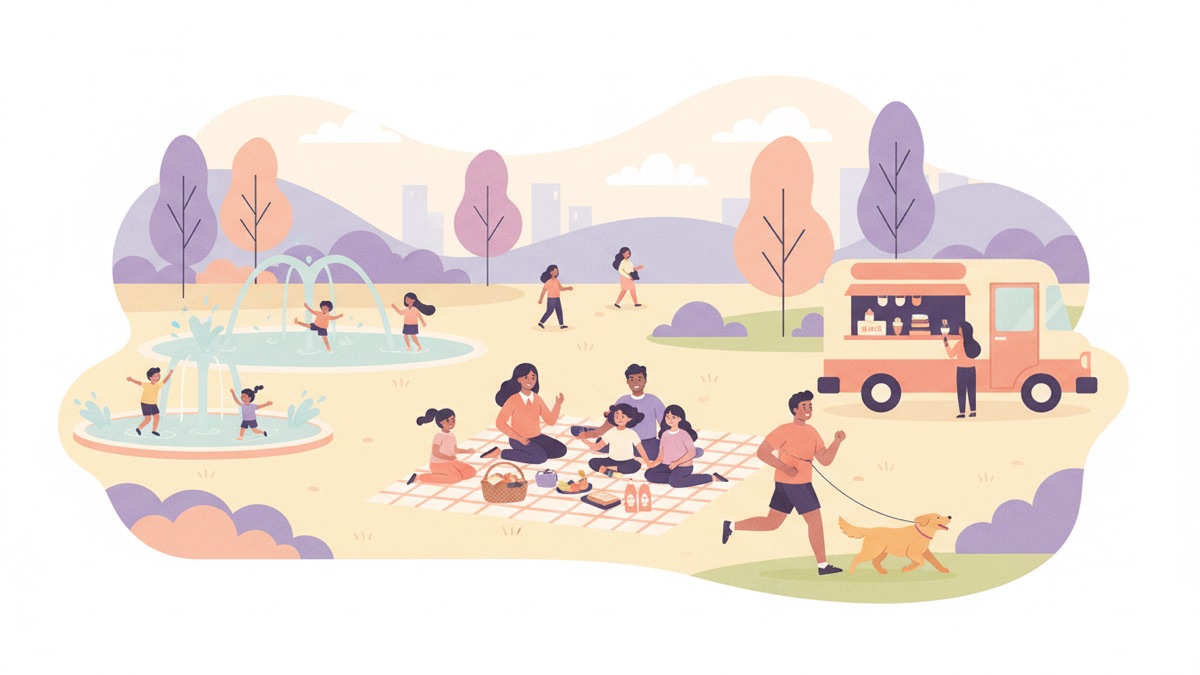
Phrases 23
on the left-hand side
phraseCLB 6In the area to the left of the picture.
“On the left-hand side, there's a man walking his dog.”
Similarto the lefton the leftCELPIP tip Move through the picture in order (left, center, right) for good organization.
on the right-hand side
phraseCLB 6In the area to the right of the picture.
“On the right-hand side, two children are playing on a slide.”
Similarto the righton the rightCELPIP tip Use with 'left-hand side' so the listener can picture the layout.
in the top corner
phraseCLB 6In an upper corner of the picture.
“In the top right corner, I can see some dark clouds.”
Similarat the topin the upper cornerCELPIP tip Shows precise location vocabulary.
next to
phraseCLB 5Beside; very close to.
“Next to the fountain, there's a vendor selling ice cream.”
SimilarbesidealongsidebyCELPIP tip Simple but essential. Vary it with 'beside' and 'close to'.
behind
prepositionCLB 5/bɪˈhaɪnd/At the back of something.
“Behind the bench, there's a row of tall trees.”
Similarin back ofat the rear ofCELPIP tip Helps you describe depth in the scene.
It looks like
phraseCLB 5Used to guess what is happening based on what you see.
“It looks like they're celebrating someone's birthday.”
Similarit seems thatit appearsCELPIP tip Shows you're interpreting, not just listing objects.
There appears to be
phraseCLB 7A formal way to say something is there.
“There appears to be a market set up in the square.”
Similarthere seems to beI can seeCELPIP tip More advanced than 'there is'.
in the distance
phraseCLB 6Far away from the viewer.
“In the distance, I can see some mountains.”
Similarfar awayon the horizonCELPIP tip Pairs well with foreground/background.
in the bottom left corner
phraseCLB 6In the lower left part of the picture.
“In the bottom left corner, there's a bicycle leaning on a pole.”
Similarat the lower leftCELPIP tip Precise location phrases help the listener picture it.
in the middle of
phraseCLB 5In the central part of something.
“In the middle of the room, there's a large table.”
Similarat the center ofCELPIP tip Use it to anchor your description.
towards the back
phraseCLB 6Near the rear of the scene.
“Towards the back, some people are waiting in line.”
Similarat the rearfurther backCELPIP tip Shows depth in the picture. Use it to move your description from front to back.
close to
phraseCLB 5Near.
“Close to the entrance, a man is selling newspapers.”
SimilarnearbyCELPIP tip Vary with 'next to' and 'beside'.
in front of
phraseCLB 5Before something, facing it.
“In front of the store, a woman is unloading boxes.”
Similarbeforeahead ofCELPIP tip Common and essential location phrase.
across from
phraseCLB 6On the opposite side.
“Across from the café, there's a flower shop.”
SimilaroppositefacingCELPIP tip Shows relationships between objects.
surrounded by
phraseCLB 7Having things all around.
“The house is surrounded by tall trees.”
Similarencircled byCELPIP tip Adds detail about the setting.
what stands out is
phraseCLB 7Highlights the most noticeable thing.
“What stands out is the bright red umbrella.”
Similarwhat catches my eyeCELPIP tip Draws attention to a key detail.
I can see
phraseCLB 5Simple way to introduce an object.
“I can see a few children flying kites.”
Similarthere isthere areCELPIP tip Vary it with 'there appears to be'.
it seems like
phraseCLB 5Introduces a guess about the situation.
“It seems like they're getting ready for a picnic.”
Similarit looks likeapparentlyCELPIP tip Mix description with interpretation.
in the foreground
phraseCLB 8In the part of a picture that is closest to the viewer.
“In the foreground, a little boy is chasing a pigeon across the square.”
Similarat the frontnearest to usCELPIP tip Pair it with "in the background" to guide the listener through the picture in order.
in the background
phraseCLB 8In the part of a picture that is furthest from the viewer.
“In the background, I can see a row of food trucks with long lines.”
Similarat the backfurther awayCELPIP tip Describe the foreground first, then the background, so your answer has a clear structure.
Judging by
phraseCLB 9Used to give a guess based on what you can see.
“Judging by their uniforms, the two people at the counter work at the café.”
SimilarBased onFrom the look ofCELPIP tip Lets you make a reasonable guess about the scene instead of only listing things.
at a glance
phraseCLB 9When you look at something quickly.
“At a glance, it looks like an ordinary park, but there's a lot going on.”
Similarat first sighton first lookCELPIP tip A strong opener before you zoom in on details.
The overall atmosphere is
phraseCLB 10Used to describe the general feeling or mood of a place.
“The overall atmosphere is relaxed and festive, like a summer holiday.”
SimilarThe mood isThe scene feelsCELPIP tip A strong closing line: sum up the mood after you have described the details.
Verbs 10
chatting
verbCLB 6/ˈtʃætɪŋ/Talking in a friendly, informal way.
“A group of friends are chatting at a table outside the café.”
SimilartalkingconversingCELPIP tip Use present continuous (are chatting) to describe actions in the picture.
strolling
verbCLB 7/ˈstroʊlɪŋ/Walking slowly and relaxed.
“An elderly couple is strolling along the path.”
SimilarwalkingwanderingCELPIP tip A more descriptive verb than 'walking'.
gazing
verbCLB 8/ˈɡeɪzɪŋ/Looking at something for a long time.
“A little girl is gazing at the balloons in the sky.”
SimilarstaringlookingCELPIP tip Adds rich vocabulary to your description.
holding
verbCLB 5/ˈhoʊldɪŋ/Having something in your hands.
“The man is holding a cup of coffee.”
SimilarcarryinggrippingCELPIP tip Present continuous for actions in the picture.
leaning
verbCLB 6/ˈliːnɪŋ/Resting the body against something.
“A teenager is leaning against the wall.”
SimilarrestingproppedCELPIP tip A precise action verb.
pointing
verbCLB 6/ˈpɔɪntɪŋ/Showing something with your finger.
“A boy is pointing at the airplane.”
SimilarindicatinggesturingCELPIP tip Shows what people are focused on.
browse
verbCLB 8/braʊz/To look at things in a shop or market without a clear plan to buy.
“A couple is browsing the racks of second-hand clothes near the entrance.”
Similarlook aroundcheck outwindow-shopCELPIP tip A precise action verb is better than repeating "looking at".
juggle
verbCLB 8/ˈdʒʌɡəl/To hold or manage several things at once with difficulty.
“A father is juggling two coffee cups and a stroller.”
SimilarbalancemanagehandleCELPIP tip Describing a small funny detail like this makes your answer vivid.
meander
verbCLB 9/miˈændər/To walk or move slowly without a clear direction.
“A few tourists are meandering along the path, taking photos.”
SimilarwanderstrollambleCELPIP tip Use it for slow, relaxed movement; it creates a clear mood.
congregate
verbCLB 10/ˈkɑːŋɡrɪɡeɪt/To come together in a group.
“A group of teenagers has congregated around the fountain.”
SimilargatherassembleclusterCELPIP tip Precise verb for groups; it also works well in Listening and Reading.
Adjectives 15
crowded
adjectiveCLB 6/ˈkraʊdɪd/Full of people.
“The street is quite crowded, probably because it's the weekend.”
SimilarbusypackedbustlingCELPIP tip Use it to describe the overall atmosphere.
cheerful
adjectiveCLB 6/ˈtʃɪərfəl/Happy and positive.
“Everyone seems cheerful and relaxed.”
SimilarhappyjoyfulupbeatCELPIP tip Describing mood makes your answer more complete.
peaceful
adjectiveCLB 6/ˈpiːsfəl/Calm and quiet.
“Overall, it's a peaceful scene in a small park.”
SimilarcalmtranquilsereneCELPIP tip Good for your overall summary sentence.
busy
adjectiveCLB 5/ˈbɪzi/Full of activity.
“It looks like a busy morning at the train station.”
SimilarbustlinglivelyCELPIP tip Describe the atmosphere first.
bustling
adjectiveCLB 8/ˈbʌslɪŋ/Full of busy, energetic activity.
“The market is bustling with shoppers.”
SimilarlivelybusyCELPIP tip More vivid than 'busy'.
sunny
adjectiveCLB 5/ˈsʌni/With a lot of sunshine.
“It's a bright, sunny day.”
SimilarbrightclearCELPIP tip Mention the weather and time of day.
colourful
adjectiveCLB 6/ˈkʌlərfəl/Having many bright colours.
“There are colourful decorations everywhere.”
SimilarvibrantbrightCELPIP tip Colour details make the scene vivid.
messy
adjectiveCLB 5/ˈmɛsi/Untidy.
“The kitchen looks quite messy.”
SimilaruntidyclutteredCELPIP tip Useful for indoor scenes.
relaxed
adjectiveCLB 5/rɪˈlækst/Calm and not worried.
“Everyone looks relaxed and happy.”
Similarcalmlaid-backCELPIP tip Describes people's mood. Add who looks relaxed and why.
elderly
adjectiveCLB 6/ˈɛldərli/Old (polite).
“An elderly woman is feeding pigeons.”
SimilarseniorolderCELPIP tip A polite way to describe older people.
cluttered
adjectiveCLB 8/ˈklʌtərd/Filled with too many things in an untidy way.
“The desk in the corner is cluttered with papers and coffee cups.”
SimilarmessyuntidycrowdedCELPIP tip More precise than "messy", which is already in this list, for a place full of objects.
picturesque
adjectiveCLB 9/ˌpɪktʃəˈresk/Very pretty, especially in an old-fashioned way.
“The scene is set in a picturesque village with stone houses along the river.”
SimilarcharmingscenicprettyCELPIP tip Stress the last syllable: pic-tur-ESQUE.
dishevelled
adjectiveCLB 9/dɪˈʃevəld/Untidy in appearance, especially hair or clothes.
“The man running for the bus looks a bit dishevelled, with his shirt untucked.”
SimilaruntidymessyscruffyCELPIP tip Describing how people look, not only what they do, gives a richer answer.
tranquil
adjectiveCLB 10/ˈtræŋkwɪl/Calm, quiet and peaceful.
“The lake in the background looks completely tranquil compared with the busy beach.”
SimilarserenecalmpeacefulCELPIP tip "Peaceful" is already in this list; use "tranquil" to avoid repeating yourself.
makeshift
adjectiveCLB 10/ˈmeɪkʃɪft/Made quickly from whatever is available, for temporary use.
“The kids have built a makeshift fort out of cardboard boxes.”
SimilarimprovisedtemporaryroughCELPIP tip Shows that you notice detail and explain what things are made of.
Expressions 1
Overall, the scene shows
expressionCLB 7Used to summarize the whole picture.
“Overall, the scene shows a busy afternoon at a farmer's market.”
Similarall in allin generalCELPIP tip Start or end with a summary so the examiner hears clear structure.
Phrasal verbs 2
sit around
phrasal verbCLB 6To sit and relax without doing much.
“A family is sitting around a picnic table.”
Similargather aroundCELPIP tip Describes groups of people.
line up
phrasal verbCLB 6To stand in a row waiting.
“People are lining up to buy tickets.”
Similarqueuewait in lineCELPIP tip Common in public scenes.
Idioms 1
a hive of activity
idiomCLB 9A place where many people are busy.
“The playground is a hive of activity.”
Similarvery busy placeCELPIP tip A vivid, idiomatic summary.
Adverbs 2
clearly
adverbCLB 5/ˈklɪərli/In a way that is easy to see.
“Clearly, they're enjoying themselves.”
SimilarobviouslyevidentlyCELPIP tip Adds confidence to interpretations.
meticulously
adverbCLB 10/məˈtɪkjələsli/In a very careful way, paying attention to every detail.
“One woman is meticulously arranging flowers on her market stall.”
SimilarcarefullypreciselypainstakinglyCELPIP tip Adds precision to an action verb; use it once for a detail worth noticing.
How to learn these words
- Start with words at or just above your target CLB: the badge on each word is our estimate of the level at which learners use it correctly. Pick a level in Any CLB level to see only those words.
- Learn five to ten words a day, not the whole list at once.
- Open Flashcards, say what each word means, then check. Words you mark I know it drop out of the To learn view.
- Use two or three new words in your next Task 3 practice answer. A word you have used yourself is the one you remember in the test.
- Save the words you keep forgetting to your own word bank, which brings each one back just before you would forget it.
More CELPIP Speaking vocabulary
- Task 1: Giving Advice (54 words)
- Task 2: Talking about a Personal Experience (66 words)
- Task 4: Making Predictions (50 words)
- Task 5: Comparing and Persuading (49 words)
- Task 6: Dealing with a Difficult Situation (55 words)
- Task 7: Expressing Opinions (57 words)
- Task 8: Describing an Unusual Situation (58 words)
CELPass is an independent practice platform and is not affiliated with Paragon Testing Enterprises. CELPIP is a trademark of Paragon Testing Enterprises. Check the official CELPIP website and IRCC for current test rules and requirements.