CELPIP Reading Practice Test 102
By Iris
A complete CELPIP Reading practice test: all 4 parts and 38 questions in the real test order. Set a timer for 55–60 minutes and do all four parts in one sitting. Check your answers at the bottom of the page to see your score and an estimated CLB.
Download as PDF with answer key
In this test
- Part 1: Reading Correspondence, “A First-Month Update for a Mentor” (questions 1–11) · practise this part alone
- Part 2: Reading to Apply a Diagram, “Eye Exams and New Glasses at Birchgrove” (questions 12–19) · practise this part alone
- Part 3: Reading for Information, “Pablum and the Hospital for Sick Children” (questions 20–28) · practise this part alone
- Part 4: Reading for Viewpoints, “Cruise Ship Visits to Cape Merrow Debate” (questions 29–38) · practise this part alone
Part 1: Reading Correspondence
Dear Mr. Achebe,
It has been almost a month since I started as an assistant editor at Valley Life magazine, and I owe you a proper update. When we met for coffee in the spring, you told me that the first weeks at any job are mostly about listening. I can report that I have done a great deal of listening and a little less talking than usual, which my sister says is a miracle.
The work itself is more varied than I expected. On a typical day I edit two or three short articles, update the community events calendar and write captions for photographs. The editor, Maureen, has a habit of handing me pieces at four o’clock that must be ready by five, so I am learning to work quickly without panicking.
I have also made my first real mistake. In last week’s issue, I labelled a photo of the Pine Hollow farmers’ market as being in Elk Ridge. A reader wrote in to point it out, and I was mortified. Then I remembered your advice to own a mistake before anyone has to mention it twice, so I went straight to Maureen, explained what had happened and drafted a correction for the website that same afternoon. She seemed more impressed by how I handled it than bothered by the error itself.
Now I have a decision to make, and I would value your opinion. Maureen has offered me two possibilities for the fall. I can take over the arts listings column, which would put my name on a page every month, or I can join the small team checking facts for a special issue on the history of the valley’s orchards. The column is the more visible choice, but the fact-checking would put me beside our most experienced writers for three months, and I suspect I would learn more. The catch is that the special issue will mean several Saturdays in the office, and I have only just started a weekend pottery class.
Finally, the magazine is holding a small reception on Thursday, October 22, to celebrate its twenty-fifth year, and each staff member may bring one guest. Nobody did more than you to help me get here, so I would be honoured if you would come.
With gratitude,
Amara Osei
What is the main purpose of Amara’s letter?
When Amara mentions that her sister calls her quietness “a miracle,” she suggests that she
How did Amara deal with the caption error?
What appeals to Amara about the fact-checking project?
What makes Amara hesitate about the fact-checking project?
Why does Amara invite Mr. Achebe to the reception?
Here is a response to the message. Complete the response by filling in the blanks. Select the best choice for each blank from the drop-down menu.
Dear Amara,
What a treat to find your letter in my mailbox. It sounds as though Maureen’s last-minute requests are . That is a skill no classroom can teach.
Please don’t lose sleep over the caption. Mixing up happens to every editor sooner or later. What readers remember is how quickly , and from what you describe, you handled that part very well.
As for your choice, I would lean toward the orchard issue. A byline is pleasant, but three months working beside will be worth far more in the long run. Your pottery wheel will still be there in January.
Finally, thank you for the invitation. I would be delighted to help celebrate the magazine’s on the 22nd.
Warmly,
Desmond Achebe
Part 2: Reading to Apply a Diagram
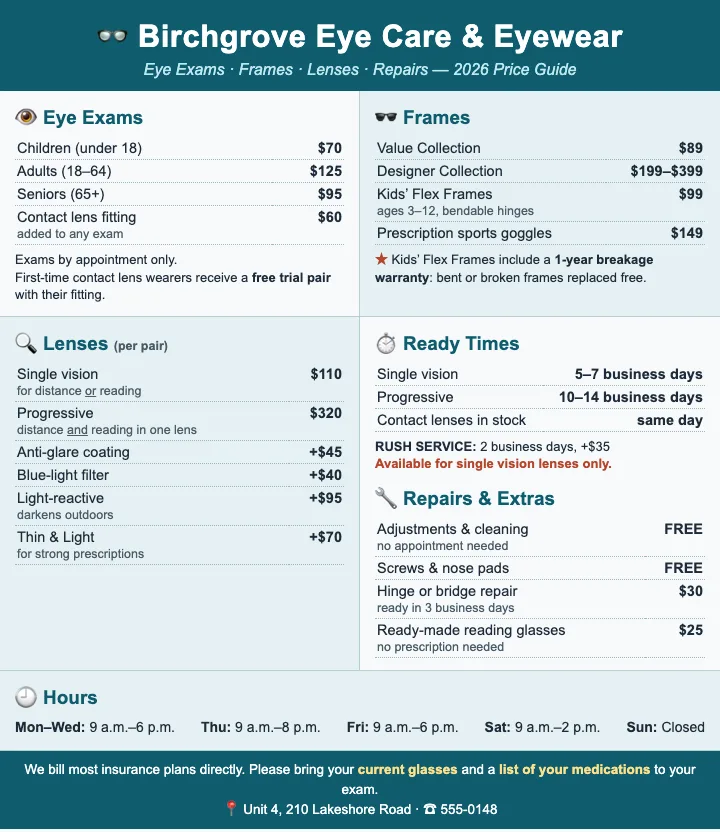
Read the following email message about the diagram on the left. Complete the email by filling in the blanks. Select the best choice for each blank from the drop-down menu.
Subject: Your eye exam at Birchgrove
To: Rafael Reyes
From: Tomás Reyes
Hi Dad,
Mom tells me you’ve been holding the newspaper at arm’s length again, so I picked up a price list from the eye care place beside my office. Since you turned 65 in March, your exam would cost .
Mom also says Dr. Kwan told you last year that you now need help with both reading and distance, so this time you’ll need . I know you think glasses cost an arm and a leg, but the Value frames are under $90, so it won’t be as bad as you fear.
The only problem is timing. You fly to Halifax eight business days after the earliest exam I could get, and that type of lens takes . Their rush service won’t help either. In the meantime, would get you through the trip. Mom is doing all the driving, so you only need to see your crossword on the plane, and I know you’ve always refused to put anything in your eyes.
Leo needs his exam too. He’s nine and has already snapped two pairs playing hockey this year, so I’m going to get him the frames this time.
I’ve booked you both for Thursday at 6:30 p.m., since that’s the only evening they’re open late. Let me know if that works.
Love,
Tomás
Tomás and Rafael are most likely
Why does Tomás suggest the ready-made glasses?
When Tomás says his father thinks glasses “cost an arm and a leg,” he means his father believes they are
Part 3: Reading for Information
Paragraph A
In the 1920s, doctors at the Hospital for Sick Children in Toronto treated a steady stream of young patients whose troubles began not with germs but with what they ate. Rickets, a disease that softens and bends growing bones, was still common in Canadian cities and appeared most often in children who got little sunshine during the long northern winter. Some arrived with bowed legs or other visible signs of the disease. Many babies were fed thin porridges or watered-down milk, and even careful parents had little reliable advice about what a growing child needed. For the hospital’s physician-in-chief, Dr. Alan Brown, poor infant feeding was not simply a private family matter. He considered it a public health problem and believed that doctors had a duty to help solve it.
Paragraph B
Working with two colleagues, Dr. Frederick Tisdall and Dr. Theodore Drake, Brown set out to create a cereal that was nourishing, easy to digest and simple to prepare. The team combined wheat, oat and corn meal with ingredients that sound surprising today, including bone meal, dried brewer’s yeast and alfalfa, in order to supply vitamins and minerals that ordinary cereals lacked. The mixture was cooked and dried before it was packaged, so a parent needed only to stir in milk or water and serve it. At a time when preparing cereal for a baby usually meant a long session at the stove, this was a considerable convenience.
Paragraph C
The cereal reached store shelves in the early 1930s under the name Pablum, from the Latin word pabulum, meaning food. An American company was licensed to manufacture and sell it, and before long it was a familiar sight in kitchens across North America. For many parents, the box on the pantry shelf became a symbol of modern, scientific child care. The doctors did not keep the royalties for themselves. Instead, the payments went to the hospital, where for roughly twenty-five years they helped pay for research into children’s health. Toronto had already drawn international attention a decade earlier, when insulin was discovered at the city’s university, and Pablum gave its medical community a second success that ordinary families could see on their own tables.
Paragraph D
In the decades that followed, Pablum faced competition from many other infant cereals, and the brand passed through the hands of more than one company. Its most lasting influence, however, may be on the English language. Because the cereal was soft, smooth and deliberately mild, the word “pablum” came to describe speeches, writing or ideas that are bland and say nothing challenging. Many people who use the word this way have no idea that it began as a brand name. Yet for the doctors who created it, mildness was entirely the point: a food that any infant could digest and any parent could prepare was exactly what their young patients needed.
Decide which paragraph, A to D, has the information given in each statement below. Select E if the information is not given in any of the paragraphs.
- A senior doctor at the hospital felt that the medical profession should take responsibility for how babies were fed.
- The new product shortened the time parents spent preparing their children’s meals.
- The hospital profited from the cereal’s success for a limited period.
- Like the team that discovered insulin, the cereal’s creators received a Nobel Prize.
- Some ingredients were chosen to provide nutrients that typical grain products did not contain.
- A term that started as a product name is now often used to criticize.
- The cereal was sold in Britain before it became available in North America.
- A childhood illness was more widespread among those who received less daylight.
- The product’s lack of strong flavour was intentional.
Part 4: Reading for Viewpoints
On summer mornings, a white wall of steel dominates the view from the wharf in Cape Merrow, a Nova Scotia fishing village of about 900. On peak days, two ships anchor in the bay and as many as 5,000 passengers are ferried ashore, more than five times the population. A plan before the village’s councillors would limit arrivals to one ship daily and impose a $6 harbour levy on every disembarking passenger.
Mayor Colleen Barteaux denies any antagonism toward tourism. The wharf, washrooms and sewage system, she contends, were engineered for a village, not “a small city that appears at nine in the morning and vanishes by five,” while residents absorb the deterioration through property taxes. The cap concerns safety as much as comfort: on two-ship days, ambulances have struggled along the main street.
Rafi Haddad, whose café and gift shop stand steps from the wharf, derives roughly 40 percent of his summer sales from passengers and expects the cap to cost far more than the levy yields. Yet he concedes the crowding has become difficult to defend, having watched neighbours abandon their own post office in July. “A fee I could tolerate, if it’s earmarked for the wharf and washrooms,” he says. “A cap is different. Cruise lines plan itineraries years ahead, and a village that refuses them on Tuesdays may be dropped altogether.”
Dr. Ingrid Solberg, a Halifax scholar of coastal tourism, has observed comparable disputes elsewhere. Per-passenger charges almost never discourage visitors, she reports, since companies quietly absorb them into ticket prices. Caps can succeed, though only when negotiated with the industry and combined with efforts to distribute visits across the season. Communities announcing limits unilaterally, she cautions, “tend to discover how little bargaining power they actually have.”
For retired fisherman Wendell Price, whose family has occupied the harbour for four generations, the economic reasoning misses the point. He endorses the cap unreservedly but distrusts the levy. “Once each passenger represents six dollars, councillors will start counting them as income, and someone will soon propose a bigger wharf,” he predicts. The village, he fears, could become a stage set: “Pretty to look at, but nobody really lives here anymore.”
Who fears the levy could undermine the cap?
On a cap, Haddad and Solberg would warn that
How would Solberg rate the levy as crowd control?
We may infer that at present
An apt title: “Cape Merrow’s Cruise Plan:
The following is a comment by a visitor to the website page. Complete the comment by choosing the best option to fill in each blank.
After twenty years in Cape Merrow, I can confirm the mayor isn’t exaggerating; on two-ship days I don’t attempt the drive. When , something has to give. Still, I doubt the levy is the answer. If Dr. Solberg is right, the companies will simply , and the crowds won’t thin.
Worse, I share Mr. Price’s fear that council will come to see every passenger as . Mr. Haddad deserves credit for his candour, given that passengers represent . Before voting, council should . Otherwise we may get the worst of both worlds: fewer ships, but no fewer complaints.
Answer key
Count your correct answers, then find your estimated CLB:
Show all 38 answers
- What is the main purpose of Amara’s letter? B. to update her mentor and ask for his advice
- When Amara mentions that her sister calls her quietness “a miracle,” she suggests that she D. is normally a talkative person.
- How did Amara deal with the caption error? A. She reported it to her editor without delay.
- What appeals to Amara about the fact-checking project? C. It would let her learn from senior colleagues.
- What makes Amara hesitate about the fact-checking project? B. It would take up some of her free weekends.
- Why does Amara invite Mr. Achebe to the reception? D. She feels he helped her reach this point.
- A. teaching you to work quickly under pressure
- C. the names of two places
- D. a mistake is admitted and fixed
- B. your most experienced colleagues
- A. quarter-century anniversary
- B. $95
- C. progressive lenses
- D. 10 to 14 business days
- A. a $25 pair of ready-made readers
- C. Kids’ Flex
- Tomás and Rafael are most likely B. father and son.
- Why does Tomás suggest the ready-made glasses? D. They will do until the new pair is ready.
- When Tomás says his father thinks glasses “cost an arm and a leg,” he means his father believes they are A. very expensive.
- A senior doctor at the hospital felt that the medical profession should take responsibility for how babies were fed. A
- The new product shortened the time parents spent preparing their children’s meals. B
- The hospital profited from the cereal’s success for a limited period. C
- Like the team that discovered insulin, the cereal’s creators received a Nobel Prize. E
- Some ingredients were chosen to provide nutrients that typical grain products did not contain. B
- A term that started as a product name is now often used to criticize. D
- The cereal was sold in Britain before it became available in North America. E
- A childhood illness was more widespread among those who received less daylight. A
- The product’s lack of strong flavour was intentional. D
- Who fears the levy could undermine the cap? D. Wendell Price
- On a cap, Haddad and Solberg would warn that C. acting alone could backfire.
- How would Solberg rate the levy as crowd control? A. It would likely prove toothless.
- We may infer that at present B. villagers help pay for visitors’ wear.
- An apt title: “Cape Merrow’s Cruise Plan: C. Relief at What Price?”
- B. emergency vehicles are left crawling
- D. build it into fares
- A. a cash cow
- C. a healthy slice of sales
- D. sit down with cruise lines
What does your score mean? See the CELPIP Reading score chart.
Free CELPIP practice test · Free CELPIP Listening practice tests · CELPIP sample tests by part
CELPass is an independent practice platform and is not affiliated with Paragon Testing Enterprises. CELPIP is a trademark of Paragon Testing Enterprises. Check the official CELPIP website and IRCC for current test rules and requirements.