CELPIP Reading Practice Test 103
By Iris
A complete CELPIP Reading practice test: all 4 parts and 38 questions in the real test order. Set a timer for 55–60 minutes and do all four parts in one sitting. Check your answers at the bottom of the page to see your score and an estimated CLB.
Download as PDF with answer key
In this test
- Part 1: Reading Correspondence, “Thanks to a Former Billet Family” (questions 1–11) · practise this part alone
- Part 2: Reading to Apply a Diagram, “Whale-Watching Plans for a July Visit” (questions 12–19) · practise this part alone
- Part 3: Reading for Information, “Terry Fox and the Marathon of Hope” (questions 20–28) · practise this part alone
- Part 4: Reading for Viewpoints, “Mandatory Wildfire Yard Rules Debate” (questions 29–38) · practise this part alone
Part 1: Reading Correspondence
Dear Karen and Lars,
I’ve started this letter at least three times since August, so please forgive me for taking so long to finally send it. It has been over a year since I carried my hockey bag out of your front hall for the last time, and I still catch myself reaching for a light switch on the wrong side of the door when I wake up at night.
Life in Lethbridge is busy but good. As you know, no professional team came calling after my last junior season, and I’ll admit I sulked about it for most of that summer. Now I can honestly say it was the best thing that could have happened. I’m in my second year of kinesiology, I play for the university team, and I spend Saturday mornings teaching five-year-olds to skate at the local arena. Most of them spend more time lying on the ice than standing on it, but I love it. I also wanted you to know that I was awarded an academic scholarship this fall. I’m quite sure I would never have qualified without all those evenings you made me finish my assignments at the kitchen table before I was allowed near the video games, Karen. I complained at the time, but it paid off.
Lars, I think of you every time it snows. I still don’t know how you stayed so calm driving me to six o’clock practices on roads I wouldn’t have walked on. And thanks to you, I was the only person on our team bus who knew how to change a flat tire when we broke down outside Medicine Hat.
Now I have to confess that this letter also comes with a favour. My cousin Mateo, who is sixteen, has just been picked by the team, and he’ll need a billet family starting in January. The coordinator matches players with families, but she has told my aunt that requests are considered. I know you were planning to take a year off from billeting while Lars recovers from his knee surgery, so please don’t feel any pressure at all. Mateo is quieter than I was and a fussy eater, and I suspect he’ll be homesick at first. I can’t imagine a better place for him to land, though.
If you’re open to the idea, I’d be happy to drive him down over the Thanksgiving weekend so you can meet him before anyone decides anything. Either way, please give Biscuit a scratch behind the ears for me.
Warmly,
Owen
What is the main purpose of Owen’s letter?
Owen knows Karen and Lars because
What does Owen suggest about his scholarship?
Why might Karen and Lars be reluctant to agree to Owen’s request?
What does Owen expect about Mateo?
What does Owen offer to do?
Here is a response to the message. Complete the response by filling in the blanks. Select the best choice for each blank from the drop-down menu.
Dear Owen,
Your letter made our whole week. We were thrilled to hear about the scholarship, and I’ll happily take a little of the credit, although you were the one who . It also sounds as though missing out on the professional teams .
Lars insists he was never as calm on those icy roads as you think, but he is very proud that his roadside lesson .
As for Mateo, Lars’s knee is healing faster than expected, so . Please do bring him down at Thanksgiving. A quiet boy who is particular about food doesn’t worry us one bit, and if he , Biscuit will soon cheer him up.
With love from all of us,
Karen
Part 2: Reading to Apply a Diagram
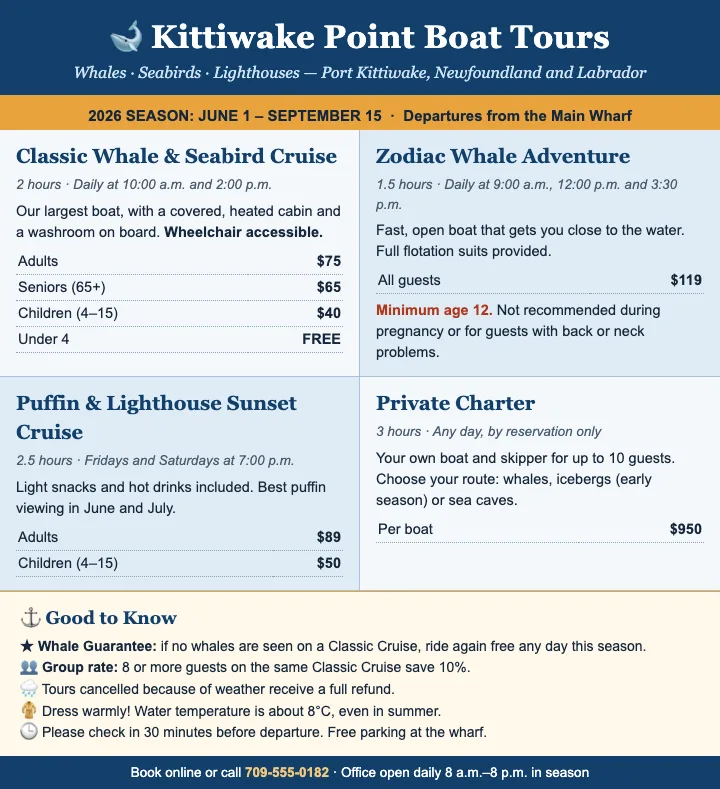
Read the following email message about the diagram on the left. Complete the email by filling in the blanks. Select the best choice for each blank from the drop-down menu.
Subject: Boat tour while you’re here
To: Declan Walsh
From: Siobhan Kearney
Hi Declan,
Now that your flights are booked, I’ve been looking into boat tours for when you’re all here in July. Since Priya is expecting again, the is out of the question, even though the kids would have loved the speed. Noah is only ten anyway, so he wouldn’t be allowed on it for two more years.
I think the Classic Cruise is our best bet. Mom has been using her walker since the spring, so it matters that the boat is , and she’ll be glad of the heated cabin if the wind picks up. There will be seven of us, which unfortunately leaves us one person short of the .
The 10 a.m. sailing would suit everyone best. Fog is common here in July, but if we don’t spot a single whale, , so we have nothing to lose.
I know Ava is mad about puffins. The sunset cruise is the better choice for those in July, but it only sails on , and you land on Saturday night and fly home Thursday morning, so it won’t work this time.
Pack warm layers, even in July. The water is barely eight degrees. I’ll dig out Dad’s old binoculars for the kids.
Let me know what you think before I book.
Siobhan
Siobhan and Declan are most likely
Why does Siobhan rule out the Zodiac tour?
When Siobhan says the Classic Cruise is “our best bet,” she means it is
Part 3: Reading for Information
Paragraph A
Few Canadians are as widely admired as Terry Fox, a young man who never finished the journey that made him famous. Born in Winnipeg in 1958 and raised in Port Coquitlam, British Columbia, Fox was a determined athlete who played basketball for Simon Fraser University. In 1977, at the age of eighteen, he was diagnosed with osteosarcoma, a form of bone cancer, and his right leg was amputated above the knee. Shortly before his operation, he read a magazine article about an amputee who had completed the New York City Marathon. The story stayed with him, and during his treatment he began to imagine a run of his own, one that would raise money for cancer research.
Paragraph B
After more than a year of training on an artificial leg, Fox began what he called the Marathon of Hope on April 12, 1980, by dipping his leg into the Atlantic Ocean at St. John’s, Newfoundland. His aim was ambitious: to cross the country on foot and collect one dollar from every Canadian, roughly $24 million at the time. Each day he set out before dawn and covered close to the length of a full marathon, followed by a van driven by his friend Doug Alward. His younger brother Darrell later joined them. In the early weeks, as he struggled through rain, snow and strong winds in Atlantic Canada, crowds were small and donations were modest.
Paragraph C
Interest grew steadily as Fox moved into Quebec and Ontario. Thousands of people lined the streets to cheer him in Toronto, and money began to arrive from across the country. On September 1, 1980, however, after 143 days and 5,373 kilometres, Fox was forced to stop near Thunder Bay, Ontario. Tests showed that the cancer had spread to his lungs. The news shocked the nation, and a television fundraiser held days later collected millions of dollars. That same month, he became the youngest person ever named a Companion of the Order of Canada. Within months, donations had passed his original goal. Fox died on June 28, 1981, one month before his twenty-third birthday.
Paragraph D
Fox’s influence did not end with his death. In September 1981, the first Terry Fox Run was held, and it has taken place every year since in communities across Canada and in many other countries. The event is not a race: there are no winners and no entry fees, and participants may walk, run, cycle or roll any distance they choose. Schools across the country also hold their own runs each fall. Near Thunder Bay, a bronze statue of Fox overlooks the Trans-Canada Highway, not far from where his run came to an end. Together, these events have raised hundreds of millions of dollars for cancer research.
Decide which paragraph, A to D, has the information given in each statement below. Select E if the information is not given in any of the paragraphs.
- Terry attracted little public attention during the first part of his journey.
- People who join the yearly event do not have to compete or pay to take part.
- Terry’s plan was inspired by the achievement of another athlete.
- Terry’s brother helped him plan the route before the run began.
- Terry had to give up his run because his illness had reached another part of his body.
- Before his illness, Terry played a team sport at the university level.
- A memorial to Terry stands close to the place where he was forced to stop.
- The research paid for by the runs has focused mainly on bone cancer.
- Terry’s fundraising target was linked to the size of the country’s population.
Part 4: Reading for Viewpoints
Two summers ago, a wildfire advanced within four kilometres of Larch Valley, a town of about 7,000 in British Columbia’s southern Interior. No home was lost, but an eleven-day evacuation left its mark. A draft bylaw would convert voluntary advice into obligation: homeowners must clear flammable plants, bark mulch and firewood from the first one and a half metres around their houses and keep roofs and gutters free of needles. Inspectors would reach every property by 2028, with fines of up to $500 for ignored warnings.
Fire Chief Dana Okafor, the bylaw’s author, contends that goodwill has run its course. “Most destroyed homes are ignited not by a wall of flame but by embers landing in a juniper hedge or dry needles,” she points out. “A house is only as safe as the yard next door,” she says, yet despite leaflets, workshops and free chipping days, fewer than a third of owners have complied.
Gord Whitfield, a retired teacher who has cultivated a cedar hedge for thirty years, does not dispute the science; he cleared his own gutters the week the fire started. His grievance concerns expense and compulsion. Removing the hedge would cost over $4,000 against a $300 rebate, and pensioners could be penalized for gardens planted long before such rules existed. “Education and financial assistance should precede any fines,” he insists.
Insurance broker Mira Castellanos believes the matter is already being decided elsewhere. Insurers increasingly question high-risk clients about their surroundings, premiums have climbed steeply across parts of the Interior, and one client was recently told to remove a juniper hedge before renewal. “A bylaw gives you a recognizable standard when you’re shopping for coverage,” she reasons. Absent municipal rules, the market will dictate them, and “it won’t be offering any rebates.”
Dr. Peter Lindqvist, a forest ecologist, endorses clearing the surroundings of homes but warns against mistaking it for a panacea. The adjoining forest has gone unthinned for decades, and spending the entire budget on inspectors, with nothing for fuel breaks, would purchase “a feeling of safety” and not the real thing. He would also phase in penalties, allowing owners two seasons to comply.
Who treats the bylaw as the lesser evil?
Which saying would Whitfield and Lindqvist apply to the fines?
Okafor’s “yard next door” remark shows that
We can reasonably conclude that
Which title best suits the article?
The following is a comment by a visitor to the website page. Complete the comment by choosing the best option to fill in each blank.
My family spent in a motel during that evacuation, so I have little patience with asking nicely. The chief’s logic convinced me: my neighbour’s woodpile leans against our fence, so our careful raking is only as good as .
Mr. Whitfield nevertheless has a fair complaint. That rebate is , and nobody should be fined for an old garden without some help. Dr. Lindqvist deserves a hearing as well: will count for little if the bush at the town’s edge stays untouched. Council should pass the bylaw, delay the fines and earmark money for . Otherwise that motel awaits us again.
Answer key
Count your correct answers, then find your estimated CLB:
Show all 38 answers
- What is the main purpose of Owen’s letter? B. to share his news and raise a request for a relative
- Owen knows Karen and Lars because D. Owen lived with them during his junior seasons.
- What does Owen suggest about his scholarship? A. Karen’s strict homework rule helped him earn it.
- Why might Karen and Lars be reluctant to agree to Owen’s request? C. They had planned to pause hosting players.
- What does Owen expect about Mateo? C. He may struggle with missing his family at first.
- What does Owen offer to do? A. introduce Mateo before any commitment is made
- D. actually put in the hours at that table
- B. turned out to be a blessing in disguise
- A. came in handy on a team trip
- C. we may not need the full year off after all
- B. is missing home in those first weeks
- C. Zodiac Whale Adventure
- A. wheelchair accessible
- D. 10% group rate
- B. we can go out again for free
- D. Friday and Saturday evenings
- Siobhan and Declan are most likely A. brother and sister.
- Why does Siobhan rule out the Zodiac tour? C. It would not suit two members of the family.
- When Siobhan says the Classic Cruise is “our best bet,” she means it is B. the most sensible choice for them.
- Terry attracted little public attention during the first part of his journey. B
- People who join the yearly event do not have to compete or pay to take part. D
- Terry’s plan was inspired by the achievement of another athlete. A
- Terry’s brother helped him plan the route before the run began. E
- Terry had to give up his run because his illness had reached another part of his body. C
- Before his illness, Terry played a team sport at the university level. A
- A memorial to Terry stands close to the place where he was forced to stop. D
- The research paid for by the runs has focused mainly on bone cancer. E
- Terry’s fundraising target was linked to the size of the country’s population. B
- Who treats the bylaw as the lesser evil? D. Mira Castellanos
- Which saying would Whitfield and Lindqvist apply to the fines? B. “Don’t put the cart before the horse.”
- Okafor’s “yard next door” remark shows that A. one owner’s neglect endangers others.
- We can reasonably conclude that C. the rebate covers a fraction of costs.
- Which title best suits the article? D. “Wildfire Bylaw: Who Foots the Bill?”
- A. almost two weeks
- B. my neighbour’s housekeeping
- D. a drop in the bucket
- C. all that clearing
- A. clearing the woods
What does your score mean? See the CELPIP Reading score chart.
Free CELPIP practice test · Free CELPIP Listening practice tests · CELPIP sample tests by part
CELPass is an independent practice platform and is not affiliated with Paragon Testing Enterprises. CELPIP is a trademark of Paragon Testing Enterprises. Check the official CELPIP website and IRCC for current test rules and requirements.