CELPIP Reading Practice Test 104
By Iris
A complete CELPIP Reading practice test: all 4 parts and 38 questions in the real test order. Set a timer for 55–60 minutes and do all four parts in one sitting. Check your answers at the bottom of the page to see your score and an estimated CLB.
Download as PDF with answer key
In this test
- Part 1: Reading Correspondence, “An Offer for Grand-maman’s Cottage” (questions 1–11) · practise this part alone
- Part 2: Reading to Apply a Diagram, “A Fall Farm Outing with the Grandkids” (questions 12–19) · practise this part alone
- Part 3: Reading for Information, “Spirit Bears of the British Columbia Coast” (questions 20–28) · practise this part alone
- Part 4: Reading for Viewpoints, “Corner Stores in Residential Neighbourhoods Debate” (questions 29–38) · practise this part alone
Part 1: Reading Correspondence
Dear Paul,
I hope the move to Calgary has gone smoothly and that the boys are settling into their new school. Aunt Louise tells me Étienne has already made the hockey team, which doesn’t surprise me in the least.
I’m writing about something I’ve been putting off for months: Grand-maman’s cottage. I went over to the Island in June to open it up, and I’m afraid the roof won’t survive another winter. Two contractors have quoted about $14,000 to replace it, and both said the work should be done before November. Under the arrangement we made after Grand-maman passed away, we each pay half of any major repair, but I know things have been tight for you since the move, and I don’t want this to become a burden.
So I’d like to make you an offer, and please read it as exactly that, not as pressure. I would like to buy your half of the cottage. I had it appraised in July at $260,000, so I would pay you $130,000, and I would cover the new roof myself. If you’d like a second opinion on the value, I’ll gladly split the cost of another appraiser. I would need to pay in two instalments, half this fall and the rest by the end of next June, once the sale of my condo in Ottawa goes through.
I should be honest about why I’m asking. Daniel and I plan to retire next year, and we would like to spend May to October at the cottage every year. The rest of the year we’d rent something small in town, closer to the hospital, which matters more to us now than it used to.
None of this would change what the place means to our family. You, Natalie and the boys would always be welcome for two weeks every summer, free of charge, and I’d be happy to put that in writing. The canoe and Grand-papa’s old fishing rods would stay exactly where they are.
Please take your time and talk it over with Natalie. If you’d rather keep your share, I’ll understand completely, and we’ll find a way to deal with the roof together.
With love,
Marguerite
Why is Marguerite writing to Paul?
How did Marguerite and Paul come to own the cottage?
What does Marguerite suggest about Paul’s situation?
If Paul accepts, Marguerite would
Why does Marguerite want the cottage?
What does Marguerite want Paul to understand?
Here is a response to the message. Complete the response by filling in the blanks. Select the best choice for each blank from the drop-down menu.
Dear Marguerite,
Thank you for such a thoughtful letter, and for being so about your reasons. Natalie and I talked it over for most of the weekend. You’re right that money has been tight since we moved, and to be honest, finding my half of would have been very hard this year.
Your price seems fair to us, and I don’t think we need . Paying in two parts is fine, as long as , because we are counting on that money for a down payment on a house here.
I told the boys about your plans, and they were relieved to hear that . They have already started arguing about whose turn it will be to paddle.
Love,
Paul
Part 2: Reading to Apply a Diagram
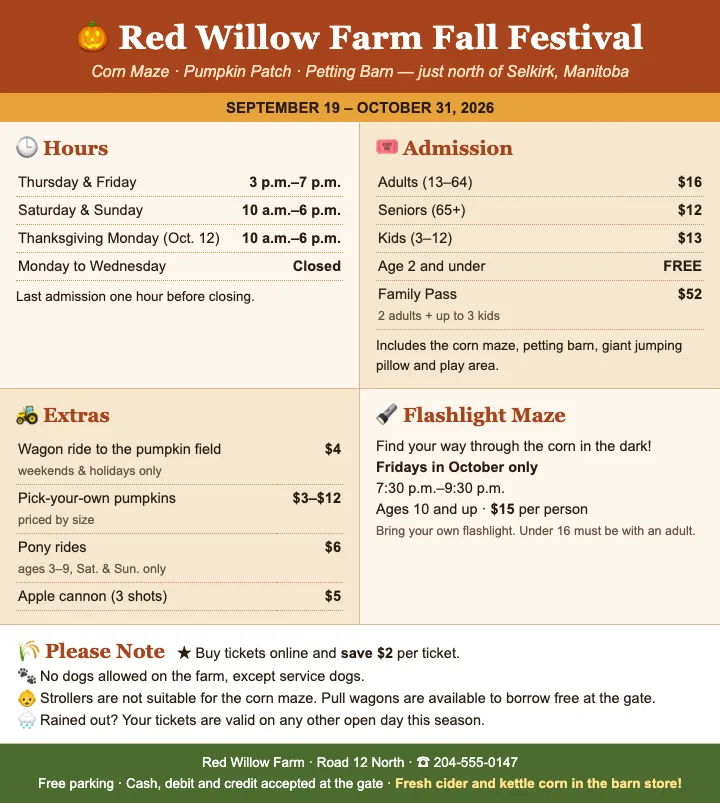
Read the following email message about the diagram on the left. Complete the email by filling in the blanks. Select the best choice for each blank from the drop-down menu.
Subject: Red Willow Farm on the holiday Monday?
To: Gail Thompson
From: Helen Dubois
Hi Gail,
Remember the farm near Selkirk I told you about over the back fence last week? I picked up their flyer at the library, and I’m planning to take Chloé and little Sam on Thanksgiving Monday. They’re normally closed on Mondays, but on the holiday they’re .
Would you and Tyler like to come with us? Sam is only two, so his admission won’t cost a thing, and Chloé just turned eight, so her ticket is . The two of us old-timers get the seniors’ price, of course.
I know Tyler has been begging to try the flashlight maze, but it only runs on , so that will have to wait. The wagon ride out to the pumpkin field does run that day, though, so each of the kids can pick a pumpkin to take home. Since my stroller would never make it through the corn maze, I’ll for Sam instead.
Sadly, you’ll have to leave Pepper at home, because . I know he’ll sulk.
If it rains, we can simply go another weekend. Let me know by Wednesday, and I’ll buy everything at the gate when we get there. I’ll take care of the tickets and the cocoa. You bring your famous butter tarts, and we’ll call it even.
Helen
Helen and Gail are most likely
Why will Tyler not be able to do the flashlight maze on this trip?
When Helen says “we’ll call it even,” she means
Part 3: Reading for Information
Paragraph A
Along the rugged coast of northern British Columbia lives one of the rarest large mammals in North America. The Kermode bear, better known as the spirit bear, is not a separate species but a subspecies of the American black bear, and most members of the subspecies are in fact black. A minority, however, have coats ranging from cream to almost pure white. These bears are not albinos; they have the dark eyes, noses and paw pads of ordinary black bears. Their colour comes from a recessive gene, which means a cub is white only if it inherits a copy from each parent. As a result, two black bears that both carry the gene can produce a white cub, and a white mother may raise black cubs.
Paragraph B
White bears are found mainly on a handful of islands and nearby coastal valleys, where isolation has allowed the gene to become unusually common. On some islands, roughly one bear in ten is white. The English name comes from Francis Kermode, an early director of the provincial museum in Victoria, who helped bring the bear to the attention of scientists in the early 1900s. Coastal First Nations had known the animal for far longer. In one widely shared story, Raven made every tenth black bear white as a reminder of the time when the land was covered in ice and snow. For generations, some communities are said to have kept the bear’s existence quiet to protect it from outsiders.
Paragraph C
Researchers have found that the white coat may be more than a curiosity. In studies of bears fishing for salmon in coastal streams, white bears caught fish more successfully than black bears during the day, probably because a pale shape is harder for fish to detect against a bright sky. At night, the difference disappeared. Salmon are especially important in autumn, when bears must build up fat reserves before their long winter sleep. Like other coastal bears, spirit bears also play an important part in the life of the forest itself. They often carry salmon away from the water to eat in the shelter of the trees, and the remains they leave behind release nutrients that help the surrounding plants grow.
Paragraph D
In 2006, the spirit bear was named British Columbia’s official provincial mammal. A decade later, after years of negotiations involving First Nations, environmental groups, forestry companies and the provincial government, an agreement protected about 85 percent of the forest in the region now known as the Great Bear Rainforest from industrial logging. Today, small groups of visitors travel to the area each autumn hoping to glimpse a white bear, often accompanied by local Indigenous guides who share their knowledge of the land. Scientists and communities continue to monitor both the bears and the salmon runs on which they depend.
Decide which paragraph, A to D, has the information given in each statement below. Select E if the information is not given in any of the paragraphs.
- Some bears’ colouring may help them find food at certain times.
- A white cub can be born to two parents with black fur.
- White bears tend to grow larger than black members of the same subspecies.
- Most of the bears’ forest home is now off limits to large-scale logging.
- The bear’s English name honours a museum official.
- According to a traditional story, the white coat recalls an icy period in the past.
- The number of spirit bears has been falling in recent years.
- By leaving fish remains among the trees, bears help the forest to grow.
- The white coat is not the result of the condition known as albinism.
Part 4: Reading for Viewpoints
For seven decades, anyone hoping to open a shop in Ashbury’s residential neighbourhoods has encountered the same obstacle: the zoning bylaw forbids it. A motion now before city politicians would permit small shops and cafés of up to 150 square metres on corner lots throughout this Ontario city’s residential areas. Businesses would close by 10 p.m., drive-throughs would be prohibited and, unlike commercial-street premises, they would need no parking.
Councillor Priya Raman, the motion’s sponsor, characterizes it as a correction, not a revolution. Pre-war neighbourhoods, she notes, retain houses that were obviously once grocery stores, shops that vanished because regulations changed, not because demand evaporated. “Today a senior who no longer drives needs two buses to purchase a loaf of bread,” she says. Gas stations and supermarkets are not contemplated, she adds; this is “the corner shop your grandparents walked to.”
Doug Feeney, chair of the Glenholme Homeowners’ Association, raises practical objections: customers circling for parking, delivery trucks idling at seven in the morning, and uncertainty over which tenants might materialize. “Everyone imagines a charming café, and I’d probably be one of its regulars,” he remarks, “but zoning can’t distinguish it from an outlet selling lottery tickets and vapes until two in the morning.” Reminded of the 10 p.m. closing, he yielded the point, adding that regulations “have a way of being relaxed.”
Hana Kowalczyk, proprietor of a main-street bakery for twelve years, welcomes the idea while doubting its practical consequences. Insurance, equipment and staffing cost identical amounts anywhere, she calculates, and corners attract a fraction of the passing trade. “In most neighbourhoods, the economics would simply fail.” Her larger apprehension is that the rare successes could divert customers from main streets already afflicted with vacant storefronts.
Dr. Samuel Osei, who teaches urban planning at a nearby university, has examined comparable reforms elsewhere. Corner shops do reduce short car trips, but only where sufficient households live within a brief walk: older wards with narrow lots and garage apartments can sustain one, while a suburban crescent’s store would probably languish. He recommends a two-year trial in the three densest wards before any citywide decision. Mayor Tom Reddick is awaiting the public consultation.
Who is closest to Kowalczyk on the shops’ prospects?
Feeney’s attitude toward a café itself is
Why does Raman mention former grocery stores?
What does the article suggest about the effects?
A fitting title: “Corner Stores in Ashbury:
The following is a comment by a visitor to the website page. Complete the comment by choosing the best option to fill in each blank.
I have lived in the east end for sixty years, and I find Councillor Raman’s own framing persuasive: this motion is . Since surrendering my car, fetching milk consumes most of a morning. Mr. Feeney frets about vapes at two in the morning, but the motion already .
Still, Ms. Kowalczyk raises what supporters ignore: on a side street, running costs . That is why I favour Dr. Osei’s suggestion of . And who knows? Mr. Feeney may discover, as he half admits, that makes a rather pleasant neighbour. I’d be there every morning.
Answer key
Count your correct answers, then find your estimated CLB:
Show all 38 answers
- Why is Marguerite writing to Paul? C. to offer to buy out his share of a property
- How did Marguerite and Paul come to own the cottage? A. They both inherited it from their grandmother.
- What does Marguerite suggest about Paul’s situation? D. His finances have been under strain lately.
- If Paul accepts, Marguerite would B. take on the full cost of the new roof by herself.
- Why does Marguerite want the cottage? B. She hopes to spend half of each year there.
- What does Marguerite want Paul to understand? D. He is free to turn the offer down.
- A. candid
- C. the roof replacement
- D. a second opinion on the value
- B. the rest arrives by the end of June
- A. the canoe isn’t going anywhere
- B. open from 10 to 6
- D. $13
- A. Friday nights in October
- C. borrow one of their pull wagons
- A. only service dogs are allowed
- Helen and Gail are most likely C. neighbours.
- Why will Tyler not be able to do the flashlight maze on this trip? D. It does not run on the day they are visiting.
- When Helen says “we’ll call it even,” she means B. Gail’s baking will make up for what Helen pays.
- Some bears’ colouring may help them find food at certain times. C
- A white cub can be born to two parents with black fur. A
- White bears tend to grow larger than black members of the same subspecies. E
- Most of the bears’ forest home is now off limits to large-scale logging. D
- The bear’s English name honours a museum official. B
- According to a traditional story, the white coat recalls an icy period in the past. B
- The number of spirit bears has been falling in recent years. E
- By leaving fish remains among the trees, bears help the forest to grow. C
- The white coat is not the result of the condition known as albinism. A
- Who is closest to Kowalczyk on the shops’ prospects? A. Samuel Osei
- Feeney’s attitude toward a café itself is C. quietly receptive
- Why does Raman mention former grocery stores? D. to present the motion as restoration
- What does the article suggest about the effects? B. Older wards and suburbs would differ.
- A fitting title: “Corner Stores in Ashbury: A. Welcome Return or Residential Nuisance?”
- B. turning back the clock
- D. bans such hours
- C. swallow any margin
- A. testing the likeliest wards
- C. the café he imagines
What does your score mean? See the CELPIP Reading score chart.
Free CELPIP practice test · Free CELPIP Listening practice tests · CELPIP sample tests by part
CELPass is an independent practice platform and is not affiliated with Paragon Testing Enterprises. CELPIP is a trademark of Paragon Testing Enterprises. Check the official CELPIP website and IRCC for current test rules and requirements.