CELPIP Reading Practice Test 108
By Iris
A complete CELPIP Reading practice test: all 4 parts and 38 questions in the real test order. Set a timer for 55–60 minutes and do all four parts in one sitting. Check your answers at the bottom of the page to see your score and an estimated CLB.
Download as PDF with answer key
In this test
- Part 1: Reading Correspondence, “A Retired Teacher’s Idea for Community Radio” (questions 1–11) · practise this part alone
- Part 2: Reading to Apply a Diagram, “Planning a Summer Sealift Order” (questions 12–19) · practise this part alone
- Part 3: Reading for Information, “Prairie Grain Elevators” (questions 20–28) · practise this part alone
- Part 4: Reading for Viewpoints, “Car-Free Water Street Summer Trial Debate” (questions 29–38) · practise this part alone
Part 1: Reading Correspondence
Dear Ms. Ferreira,
My name is Desmond Clarke, and I have been a faithful listener of Tidewater Community Radio since the station first went on the air. I am writing because I would like to offer my services as a volunteer and, if you would consider it, as the host of a weekly program.
Some background may help. I taught music at Bayview High School here in Moncton for thirty-one years before retiring in June. Over those years I collected more than two thousand jazz and swing records, many of them by Maritime musicians whose work is rarely heard on the radio anymore. My idea is a one-hour Sunday morning show that would play a few of these recordings each week and tell the stories behind them. I have already sketched out the first eight episodes. One of my former students, Tomás Reyes, who reads the news on your station on Saturdays, told me that your Sunday morning slot has been filled with repeats since the summer, and he suggested I write to you.
I should be honest about my weaknesses. I have never operated a sound board, and the last time I used anything more complicated than a record player was when the school bought its first computer. I understand from Tomás that all new hosts take a training course, and I am more than willing to do it. I am also available most weekday afternoons if you need help with tasks that don’t involve a microphone, such as answering phones during your fundraising drive or sorting the music library. The only exception is Wednesdays, when I pick up my grandchildren from school.
Of course, I don’t expect to be handed a show straight away. If you would prefer that I first co-host with someone more experienced, or start by preparing short segments for an existing program, I would be glad to. I simply believe that this music deserves an audience, and that a community station is the right place for it.
I have enclosed a list of the records I would like to start with, along with a sample segment I recorded at home. Please forgive the sound quality; my grandson tells me it sounds as if it was recorded in a tin can.
Thank you for your time. I look forward to hearing from you.
Yours sincerely,
Desmond Clarke
Why is Desmond writing to Ms. Ferreira?
How did Desmond find out about the Sunday morning slot?
What does Desmond admit about himself?
Desmond is not free on Wednesdays because he
What can be inferred about Desmond’s attitude?
What does Desmond say about the sample he has enclosed?
Here is a response to the message. Complete the response by filling in the blanks. Select the best choice for each blank from the drop-down menu.
Dear Mr. Clarke,
Thank you for your kind letter, and for being such a loyal listener. Tomás was quite right that our Sunday mornings have been for months, so your proposal arrives at exactly the right moment.
I listened to your sample segment twice. Your grandson is right that the sound , but the content is wonderful. Your stories about those Maritime musicians are exactly the kind of local history we want on the air.
Before you can go on the air, you will need to . Our next session starts on October 4 and meets on Wednesday evenings, so it shouldn’t . Once you have finished, we can talk about a start date for the show, perhaps with Tomás joining you for the first few weeks.
In the meantime, we would be glad of your help during our fundraising drive in November.
Best regards,
Natalie Ferreira
Volunteer Coordinator
Part 2: Reading to Apply a Diagram
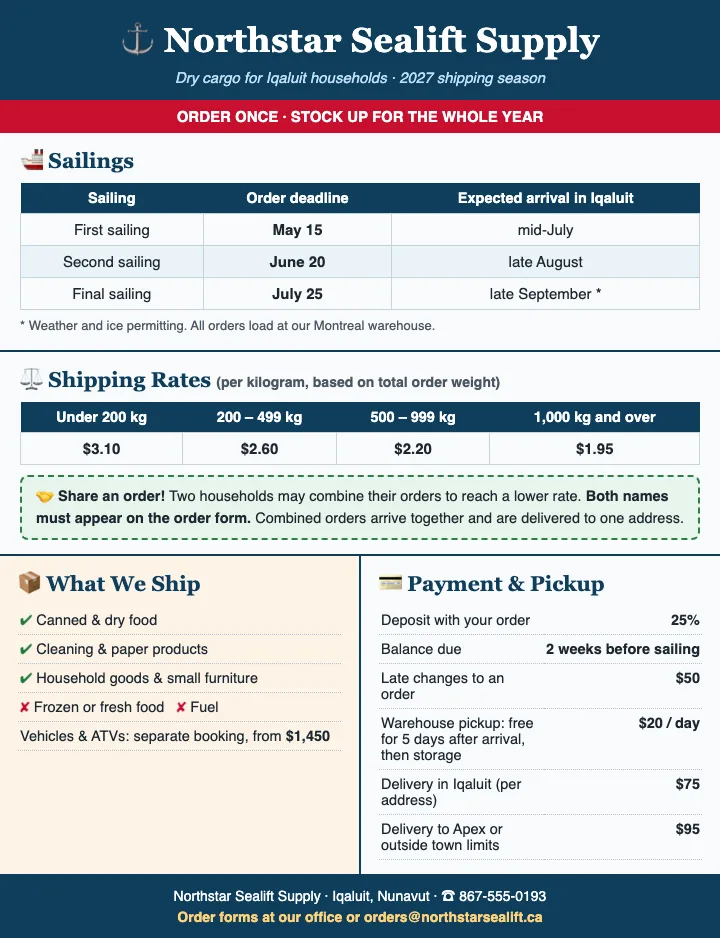
Read the following email message about the diagram on the left. Complete the email by filling in the blanks. Select the best choice for each blank from the drop-down menu.
Subject: Sealift order
To: Paul Tessier
From: Megan Fitzgerald
Hi Paul,
After Tuesday’s staff meeting, you mentioned placing a sealift order this year. I’m planning one too, and I picked up this flyer from Northstar. Last winter the price of a case of pop at the store made my eyes water, so I’m stocking up this time.
My list comes to about 320 kg, and you said yours would be around 250, so if we put our orders together, we’d pay per kilogram for shipping. The flyer says , so I’ll need your full name for the form. Nothing frozen, of course, so it’s mostly canned goods, flour and paper towels.
My parents are flying up at the start of August, and I’d like everything here before they arrive, so we’d need to order by . We’ll have to pay when we place the order, and the rest a couple of weeks before the ship sails.
Since neither of us has a truck and you live across town, I think it’s worth paying to have the whole order brought to my apartment building in town. You can pick up your boxes from my storage room whenever it suits you.
I’ll leave the order form in your mailbox in the staff room on Monday. Let me know what you think!
Megan
Megan and Paul are most likely
Why does Megan want to combine the two orders?
When Megan says the price of pop “made my eyes water,” she means she was
Part 3: Reading for Information
Paragraph A
For much of the twentieth century, the tall wooden grain elevator was the most recognizable building on the Canadian Prairies. In most towns it was by far the tallest structure. Rising high above the flat landscape, usually with the name of a grain company and of the town painted in large letters on its side, an elevator could be seen from many kilometres away, and travellers often used the next one on the horizon to work out how far they still had to go. Some writers called them the “sentinels of the Prairies.” Their purpose, however, was entirely practical. Farmers brought their harvest to the elevator, where it was weighed, graded and stored before being loaded into railway cars and sent on to ports for export.
Paragraph B
The elevators spread with the railways. As rail lines pushed across Manitoba, Saskatchewan and Alberta in the late 1800s and early 1900s, elevators went up beside the tracks, often only 10 to 15 kilometres apart. That distance was no accident: a farmer hauling grain by horse and wagon needed to be able to reach an elevator, unload and return home in a single day. Small towns frequently grew up around these stops, with a general store, a post office and a school, and some of them disappeared again when their rail line later closed. By the 1930s, there were more than 5,000 elevators across the Prairies.
Paragraph C
Inside, the design was simple but clever. Grain tipped from a wagon fell into a pit, where a continuous belt fitted with small buckets, known as the “leg,” carried it to the top of the building. From there, gravity did the rest: the grain slid down a spout into one of many separate bins, so that different kinds and grades never mixed. The walls were often made of wooden planks laid flat and nailed one on top of another, which made them remarkably strong. Running the elevator was a respected job, and the agent usually knew every farmer for miles around. Fire was a constant danger, because grain dust burns easily.
Paragraph D
The decline began in the second half of the twentieth century. Trucks replaced wagons, farms grew larger, and many rail branch lines were abandoned. The end of a long-standing federal subsidy on grain shipping in the 1990s sped up the change. Grain companies replaced hundreds of small wooden elevators with a smaller number of large concrete terminals, each able to load a long train quickly. Many of the old buildings were torn down or lost to fire, and only a small fraction survive today. Some communities, however, have saved theirs as museums or heritage sites, and in Inglis, Manitoba, a row of old elevators has been preserved as a national historic site.
Decide which paragraph, A to D, has the information given in each statement below. Select E if the information is not given in any of the paragraphs.
- Grain was kept sorted partly by letting it fall into different compartments.
- The buildings helped people on the road estimate the distance ahead.
- Fewer but bigger facilities eventually took over the elevators’ work.
- Government officials decided exactly where each elevator would stand.
- Elevators were placed so that a farmer could make the round trip before nightfall.
- The person who ran the elevator was a familiar figure in the area.
- The elevator was where the quality of a farmer’s crop was assessed.
- Several surviving elevators have been rebuilt in concrete to preserve them.
- A change in federal support for moving grain contributed to the elevators’ decline.
Part 4: Reading for Viewpoints
Water Street in Port Cullen, a Georgian Bay community of about 9,000, is an unremarkable main street: two lanes of traffic, angled parking and a row of storefronts facing the harbour. Next summer, a three-block stretch could be transformed. Under a scheme to be debated shortly, the street would be closed to cars from Victoria Day weekend to Labour Day. Restaurant patios would occupy former parking spaces, with benches and planters filling the roadway, all as a one-season experiment.
Councillor Priya Raman, the scheme’s sponsor, accuses Port Cullen of squandering its principal asset: visitors flock to the waterfront, whereupon “we hand the best view in town to parked cars.” Comparable communities with pedestrian streets, she reports, have generally seen people linger downtown longer. “The downside’s negligible, since the street could simply reopen in September,” she says.
Gord McAllister, whose family has operated the Water Street hardware store for three generations, remains unmoved. His ledger is built on contractors and cottage owners, not strolling tourists, and it records paint, lumber and forty-kilo bags of concrete; the nearest alternative parking would be the arena lot. “A bustling patio would be mistaken for overall success while retailers quietly bleed business,” he fears. “A full patio on a sunny Saturday doesn’t pay my rent in October.”
Yvonne Baptiste, a wheelchair user who chairs the accessibility advisory committee, has no objection to the idea; a traffic-free street can be easier to navigate than squeezing between parked vehicles. The obstacle is the distance from the nearest parking, and her committee’s endorsement awaits a plan showing reserved drop-off spaces at both ends of the closed blocks, sufficiently close for people with limited mobility.
Ethan Marsh, who opened a Water Street café two years ago, has already sketched his patio, yet he distrusts the evidence it would supply: “Crowded tables would settle nothing,” he reasons. He therefore proposes that every business on the affected blocks disclose its summer sales, permitting comparison with previous years before any permanent closure. “If the hardware store suffers, we need to know that too.”
Who, like Raman, seems ready for the trial?
What does McAllister’s list of goods imply?
Baptiste’s attitude toward the trial is
What do McAllister and Marsh both expect?
The most suitable title would be
The following is a comment by a visitor to the website page. Complete the comment by choosing the best option to fill in each blank.
A lifelong Port Cullen resident, I cannot recall Water Street ever feeling like somewhere to spend an afternoon. Everyone I know loves that harbour view. Councillor Raman’s assessment of the downside seems sound to me: . Even so, the hardware merchant deserves a hearing. Having survived several home renovations, I know his customers won’t .
The committee chair’s condition, , might help them as much as it helps people with limited mobility.
My real misgiving is how council will . Impressions gathered on a warm weekend make poor evidence. A decision grounded in figures from is one I could accept, whichever way it falls. Let it run for one summer.
Answer key
Count your correct answers, then find your estimated CLB:
Show all 38 answers
- Why is Desmond writing to Ms. Ferreira? C. to offer his time and suggest a program
- How did Desmond find out about the Sunday morning slot? A. A former pupil of his told him.
- What does Desmond admit about himself? D. He is not used to technology.
- Desmond is not free on Wednesdays because he B. has to look after family members.
- What can be inferred about Desmond’s attitude? A. He is willing to begin in a smaller role.
- What does Desmond say about the sample he has enclosed? C. Its audio is not of very good quality.
- B. running old programs again
- D. leaves something to be desired
- A. learn how to run the sound board
- C. clash with your Wednesday pickups
- B. taking calls from donors
- A. $2.20
- C. both households must be named
- D. May 15
- B. a quarter of the cost
- D. $75
- Megan and Paul are most likely B. co-workers.
- Why does Megan want to combine the two orders? A. to qualify for a lower shipping rate
- When Megan says the price of pop “made my eyes water,” she means she was C. shocked at how expensive it was.
- Grain was kept sorted partly by letting it fall into different compartments. C
- The buildings helped people on the road estimate the distance ahead. A
- Fewer but bigger facilities eventually took over the elevators’ work. D
- Government officials decided exactly where each elevator would stand. E
- Elevators were placed so that a farmer could make the round trip before nightfall. B
- The person who ran the elevator was a familiar figure in the area. C
- The elevator was where the quality of a farmer’s crop was assessed. A
- Several surviving elevators have been rebuilt in concrete to preserve them. E
- A change in federal support for moving grain contributed to the elevators’ decline. D
- Who, like Raman, seems ready for the trial? D. Ethan Marsh
- What does McAllister’s list of goods imply? B. Customers couldn’t easily carry such goods.
- Baptiste’s attitude toward the trial is A. conditionally favourable
- What do McAllister and Marsh both expect? C. that restaurant patios would profit
- The most suitable title would be D. “Water Street Without Cars: Worth One Summer’s Try?”
- C. traffic can return by fall
- A. lug bulky supplies a long way
- B. reserved drop-off bays
- D. assess the experiment
- A. every shop there
What does your score mean? See the CELPIP Reading score chart.
Free CELPIP practice test · Free CELPIP Listening practice tests · CELPIP sample tests by part
CELPass is an independent practice platform and is not affiliated with Paragon Testing Enterprises. CELPIP is a trademark of Paragon Testing Enterprises. Check the official CELPIP website and IRCC for current test rules and requirements.