CELPIP Reading Practice Test 109
By Iris
A complete CELPIP Reading practice test: all 4 parts and 38 questions in the real test order. Set a timer for 55–60 minutes and do all four parts in one sitting. Check your answers at the bottom of the page to see your score and an estimated CLB.
Download as PDF with answer key
In this test
- Part 1: Reading Correspondence, “Coming Home After Three Weeks Away” (questions 1–11) · practise this part alone
- Part 2: Reading to Apply a Diagram, “Booking a Party at the Trampoline Park” (questions 12–19) · practise this part alone
- Part 3: Reading for Information, “Atlantic Puffins of Witless Bay” (questions 20–28) · practise this part alone
- Part 4: Reading for Viewpoints, “Self-Checkout Lanes at Brockfield Grocery Stores Debate” (questions 29–38) · practise this part alone
Part 1: Reading Correspondence
Dear Mr. Okafor,
I have started this letter three times, because every version seemed too small for what you did for us. Tomás and I got back from Lisbon on Sunday night, and we are still discovering how much worse things could have been if you had not been keeping an eye on the house.
As you know, we left you our spare key only so that you could bring in the mail and water my plants. I never imagined you would need it for an emergency. The furnace technician who came on Monday told us that our furnace shut down during the cold snap that hit Kamloops in the second week of January, probably because of a worn-out part. With no heat, the pipe under the kitchen sink froze and split. According to the insurance adjuster, if you had not noticed water running out under the garage door that morning and turned off the main valve, the whole basement would have flooded within a day.
I also know that you tried to call my brother-in-law, Rui, three times before you went in, and I’m sorry he didn’t answer. He was working night shifts that week and kept his phone switched off during the day, which is exactly why we should have given you a second number. That mistake was ours, not yours.
You did much more than shut off the water. Grace told me that you spent most of that afternoon carrying our boxes of family photographs from the basement up to the dining room, and that you waited for the plumber in a house without heat. The adjuster says the damage is limited to the kitchen floor and the lower cabinets. Our insurance will cover the repairs, which should be finished by the end of March.
I know you won’t let us pay you back for the plumber’s emergency visit, since you already refused over the phone. So instead, I would like to invite you and Grace to dinner in our new kitchen as soon as it is ready. Tomás also asked me to say that he hasn’t forgotten the raised garden beds you were planning to build this spring, and he would be glad to bring his tools over and help.
Finally, would you be willing to hold on to our spare key? Next time, you will have two numbers to call, though I hope there is never a next time.
With deep gratitude,
Lucia Ferreira
Lucia is writing mainly to
Why did the pipe under the kitchen sink break?
Mr. Okafor had a key to the house because he
What does Lucia admit about the emergency?
We can infer from the letter that the damage to the house
What does Tomás offer to do?
Here is a response to the message. Complete the response by filling in the blanks. Select the best choice for each blank from the drop-down menu.
Dear Lucia,
Your letter made Grace and me smile, though you really didn’t need to write it. Anyone on this street would have done the same after seeing on such a cold morning.
Please don’t be hard on Rui, either. Someone who works needs his sleep, and I would have switched off my phone too.
Dinner in your new kitchen sounds wonderful. We’re happy to wait until , and Grace has already asked whether she can bring dessert.
As for Tomás’s offer, I won’t say no. My back has not been the same since I , so an extra pair of hands will be very welcome when the lumber is delivered in April.
Of course I’ll keep the key, as long as you leave me before your next trip.
Welcome home,
Daniel
Part 2: Reading to Apply a Diagram
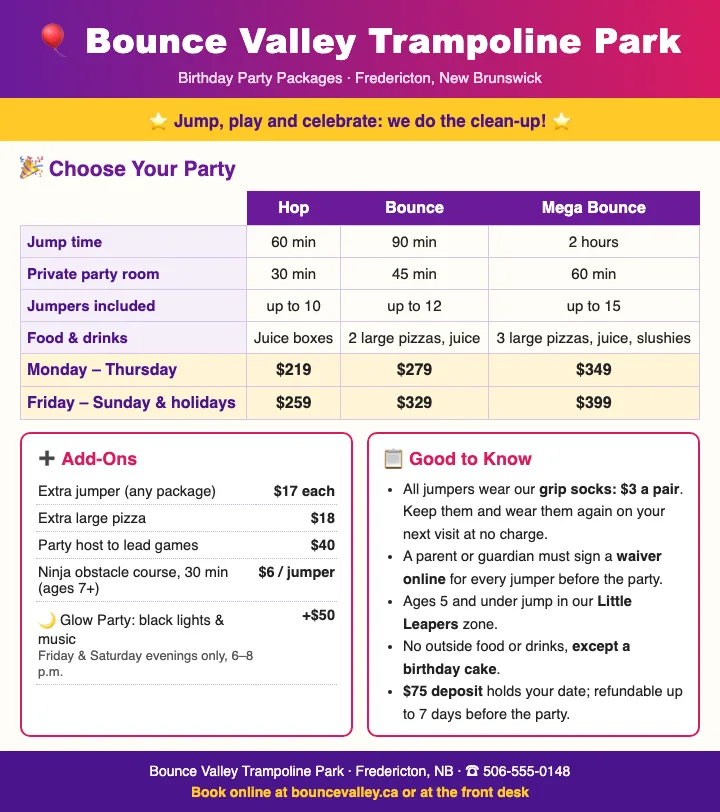
Read the following email message about the diagram on the left. Complete the email by filling in the blanks. Select the best choice for each blank from the drop-down menu.
Subject: Owen’s party
To: Patrick Doiron
From: Julie Arsenault
Hi Patrick,
You asked me to look into a place for Owen’s eighth birthday, so I stopped at Bounce Valley on my way home from work yesterday. I’ll drop the flyer off at your place tonight, but here’s what I found. Since the party is on Saturday the 14th, we’ll be paying the weekend price.
Owen has invited eleven friends, so that makes twelve jumpers with him. Owen’s heart is set on pizza, so I think the package makes the most sense, since it includes food and covers exactly that many kids. That comes to before any extras.
I know he would have loved the glow party, but it only runs , and we’ve already told the other parents it’s an afternoon party.
Mom says she’ll bake one of her chocolate cakes, just like the ones she made for our birthdays when we were little, and luckily the park lets us .
Two more things for the invitations: every parent has to sign a waiver online ahead of time, and the kids will each pay unless they still have theirs from an earlier visit.
The $75 deposit holds the date, and we can get it back if anything changes more than a week before. Should I go ahead and book?
Julie
Julie and Patrick are most likely
Why did Julie visit Bounce Valley?
When Julie says that Owen’s “heart is set on pizza,” she means that he
Part 3: Reading for Information
Paragraph A
With its black back, white chest and large, brightly striped bill, the Atlantic puffin is one of the most recognizable seabirds in the North Atlantic, and its comical appearance has earned it the nickname “clown of the sea.” It is also the official bird of Newfoundland and Labrador. Many visitors are surprised to learn that the bird’s famous orange-and-yellow bill is a seasonal feature: once the breeding season ends, its colourful outer layers are shed, leaving a smaller, duller bill for the winter. Puffins spend most of their lives far out on the open ocean, often well out of sight of land, coming ashore only to raise their young in spring and summer.
Paragraph B
When they do come ashore, a great many of them gather at the Witless Bay Ecological Reserve, a group of small islands off the eastern coast of the Avalon Peninsula, south of St. John’s. The reserve is home to North America’s largest Atlantic puffin colony, and each summer the islands are crowded with hundreds of thousands of nesting seabirds of several different species. Because the colonies are easily disturbed, the islands themselves are protected, and landing on them requires a permit. Most visitors therefore see the birds from tour boats that leave from nearby coastal communities, often with whales feeding in the same waters. These trips run mainly during the summer months, when the birds are busiest.
Paragraph C
Puffins usually breed with the same partner year after year, and many pairs return to the very same nest each spring. Rather than building nests on bare cliffs, they dig burrows into the soft soil of grassy slopes, using their bills to loosen the earth and their feet to push it out. The female lays a single egg, and both parents take turns keeping it warm and, after it hatches, flying back and forth with food for the chick, which is known as a puffling. Puffins are also strong swimmers, using their wings to “fly” underwater in pursuit of prey. A parent can carry several small fish at once, held crosswise in its bill, and capelin, a small silvery fish, makes up much of the diet around Newfoundland.
Paragraph D
In late summer, the young birds leave their burrows, usually under cover of darkness, and head for the sea. Some, however, are drawn toward the lights of nearby towns and end up stranded on roads and in parking lots. In the communities around Witless Bay, volunteers patrol the streets at night during this period, gently gathering the lost pufflings and releasing them at the shore. Scientists also keep a close watch on the colony. Because capelin arrive near the coast at different times depending on ocean conditions, researchers are concerned that warming waters could leave parents without enough food at the very moment their chicks need it most.
Decide which paragraph, A to D, has the information given in each statement below. Select E if the information is not given in any of the paragraphs.
- Both members of a pair share the work of raising their only chick.
- The look of a puffin’s bill changes over the course of a year.
- Local people help young birds that have lost their way.
- The number of puffins nesting in the reserve has fallen sharply in recent years.
- Visitors are not free to walk around on the islands.
- Changes in the sea could affect whether chicks get enough to eat.
- For most of the year, puffins live away from land.
- A pair may come back to the same home for many seasons.
- The puffin was named the province’s official bird because of its colourful bill.
Part 4: Reading for Viewpoints
For years, the checkout area at Harvest Basket on Wellington Road resembled any other grocer’s: eight lanes, each with a cashier. Last spring, self-service machines replaced six of them. Brockfield councillors are now debating a bylaw obliging every grocery store exceeding 1,500 square metres to keep at least two staffed checkouts open throughout its business hours.
Councillor Denise Kowalczyk, its drafter, disclaims any ambition to turn back the clock; she uses the machines herself for a carton of milk. “But groceries aren’t an optional service,” she contends, “and an elderly cash customer abandoned in a twenty-minute queue, or retreating home empty-handed, represents a problem the whole community owns.” Dozens of complaints reached her office following the change, predominantly from residents over seventy.
Arjun Mehra, the franchise owner, dismisses the bylaw as a solution in search of a problem. “Automation enabled me to remain open until eleven without raising prices,” he explains; his payroll has not shrunk, and the online orders now consuming his staff’s shifts were scarcely possible before. Queues at the staffed lane, he concedes, initially ran “longer than they should have been,” hence a second weekend cashier, though he bristles at the notion that legislation was needed to prompt it.
Retail consultant Hélène Gagnon, an adviser to several grocery chains, suspects the controversy may resolve itself. Numerous large North American retailers have scaled back self-checkouts, she notes; what a machine saves in wages, it may give back in goods reaching the parking lot unscanned, whether through carelessness or intent. A bylaw, in her view, would entrench a rule just as stores begin rebalancing voluntarily, although the correction “won’t happen overnight, and some shoppers can’t wait.”
Walter Byrne, 81, who drives a volunteer van for the seniors’ centre, taps through the screens without difficulty. His weekly passengers are another matter: some, with poor eyesight or stiff hands, find them bewildering and are too embarrassed to request assistance. What they crave, he maintains, is “a person who will look them in the eye,” and if legislation alone can guarantee that, he will reluctantly endorse it.
On the bylaw, Mehra would find support from
What does Mehra suggest about his former cashiers?
Gagnon suggests retailers are retreating from machines because
Byrne’s stance is best characterized as
An appropriate headline would be
The following is a comment by a visitor to the website page. Complete the comment by choosing the best option to fill in each blank.
I lost a till job to these machines after eleven years, which gave me a particular interest in this article. I have no wish to return to those tills. The franchise owner deserves some credit: unlike many owners, he .
I still cannot accept that the bylaw is superfluous. Those complaints came mostly from , so dozens of calls signify more than they might from anyone else.
The consultant may be correct that the machines won’t . Her own caveat undercuts her, however: the correction . What struck me most was the volunteer driver’s remark. A guaranteed staffed till would offer his passengers , and councillors should approve it.
Answer key
Count your correct answers, then find your estimated CLB:
Show all 38 answers
- Lucia is writing mainly to C. thank Mr. Okafor and suggest ways to repay him.
- Why did the pipe under the kitchen sink break? B. The house lost its heat during very cold weather.
- Mr. Okafor had a key to the house because he D. had agreed to take care of a few small tasks.
- What does Lucia admit about the emergency? A. She and Tomás had not given Mr. Okafor enough ways to reach them.
- We can infer from the letter that the damage to the house D. was kept small by Mr. Okafor’s quick action.
- What does Tomás offer to do? B. help Mr. Okafor with a building project
- A. a stream of water leaving your garage
- C. through the night
- B. the floor and cabinets are redone
- D. carried all those boxes upstairs
- A. another person’s phone number
- C. Bounce
- A. $329
- D. on Friday and Saturday evenings
- B. bring a homemade birthday cake
- C. $3 for grip socks
- Julie and Patrick are most likely D. sister and brother.
- Why did Julie visit Bounce Valley? A. She was doing a favour for Patrick.
- When Julie says that Owen’s “heart is set on pizza,” she means that he B. really wants pizza at his party.
- Both members of a pair share the work of raising their only chick. C
- The look of a puffin’s bill changes over the course of a year. A
- Local people help young birds that have lost their way. D
- The number of puffins nesting in the reserve has fallen sharply in recent years. E
- Visitors are not free to walk around on the islands. B
- Changes in the sea could affect whether chicks get enough to eat. D
- For most of the year, puffins live away from land. A
- A pair may come back to the same home for many seasons. C
- The puffin was named the province’s official bird because of its colourful bill. E
- On the bylaw, Mehra would find support from B. Hélène Gagnon
- What does Mehra suggest about his former cashiers? C. They were given different duties.
- Gagnon suggests retailers are retreating from machines because A. too many goods go unscanned
- Byrne’s stance is best characterized as D. protective of others, not himself
- An appropriate headline would be C. “Council or Market: Who Decides at the Checkout?”
- A. kept his displaced staff on
- D. residents past seventy
- B. deliver the promised economies
- C. will take a while
- A. a person to deal with
What does your score mean? See the CELPIP Reading score chart.
Free CELPIP practice test · Free CELPIP Listening practice tests · CELPIP sample tests by part
CELPass is an independent practice platform and is not affiliated with Paragon Testing Enterprises. CELPIP is a trademark of Paragon Testing Enterprises. Check the official CELPIP website and IRCC for current test rules and requirements.