CELPIP Reading Practice Test 115
By Iris
A complete CELPIP Reading practice test: all 4 parts and 38 questions in the real test order. Set a timer for 55–60 minutes and do all four parts in one sitting. Check your answers at the bottom of the page to see your score and an estimated CLB.
Download as PDF with answer key
In this test
- Part 1: Reading Correspondence, “A Summer Room for Inês in Ottawa” (questions 1–11) · practise this part alone
- Part 2: Reading to Apply a Diagram, “Ordering Thanksgiving Dinner in Kingston” (questions 12–19) · practise this part alone
- Part 3: Reading for Information, “Marconi’s Signal Across the Atlantic” (questions 20–28) · practise this part alone
- Part 4: Reading for Viewpoints, “Fernhaven Deer Cull Debate” (questions 29–38) · practise this part alone
Part 1: Reading Correspondence
Dear Daniela,
It feels like ages since the reunion in Shediac, and I still laugh when I think of Marc losing the sandcastle contest to a six-year-old. I hope everyone is well. I’m writing partly to catch up, but mostly because I have a favour to ask, and I’d rather you heard it from me than from my mother.
As you may know, Inês is finishing her third year of civil engineering. Last week she was offered a summer placement with a bridge-design firm in Ottawa, from May 12 to August 22. It’s paid, and her professors say it could easily lead to a job offer when she graduates, so she accepted on the spot. The only problem is housing. The rooms she has found online are either far too expensive or more than an hour from the office by bus, and a friend of hers lost a whole month’s deposit last summer to a landlord who never answered the phone again.
Then I remembered that your basement has its own bathroom and that your house is only two bus stops from where she’ll be working. Would you consider letting her stay with you for the summer? She would, of course, pay rent. She suggested $600 a month, but please tell me honestly if that doesn’t seem fair. She has also offered to cook dinner twice a week, which you should accept, because she is a far better cook than I am.
I know having a young adult in the house isn’t always easy, so let me reassure you on a few points. She doesn’t have a car, so she won’t take your parking space. She’s an early riser and is usually in bed before ten, which her roommates at university never stop complaining about. And she’ll be away most weekends in July, because she has promised to help her father at his vegetable stall at the Saturday market back home.
Please don’t feel any pressure. If the timing is wrong, or if you simply value your quiet summers, just say so. Her university has told her about a student residence downtown that rents rooms for the summer, and she can apply there instead. The rooms are usually gone by spring, though, so she would need to send in an application by April 1.
Either way, I’d love to see you in August when I drive up to bring her home. It would be good to have a proper conversation for once, instead of a few rushed messages on the family group chat.
With love,
Rosa
Rosa is writing mainly
Why did Inês accept the placement immediately?
What is the problem with the rooms Inês has found?
Why does Rosa advise Daniela to accept Inês’s offer to make dinner?
According to Rosa, Inês will be away on many weekends in July because she
What can we infer about the student residence?
Here is a response to the message. Complete the response by filling in the blanks. Select the best choice for each blank from the drop-down menu.
Dear Rosa,
What a lovely surprise! And please don’t remind Marc about that sandcastle; he still claims the judging was unfair.
Of course Inês can stay with us. I’m so pleased that she’ll be spending the summer at , and the basement will be ready for her on May 12.
As for rent, $600 is more than fair, but I would much rather she . Two home-cooked dinners a week would be worth far more to us than money.
You don’t need to worry about her habits either. If she really is asleep before ten, she’ll be in this house! I can also drive her to the bus station on the Friday evenings when she .
So please tell her there’s no need to . We’ll expect you in August, and this time we’ll talk properly.
Love,
Daniela
Part 2: Reading to Apply a Diagram
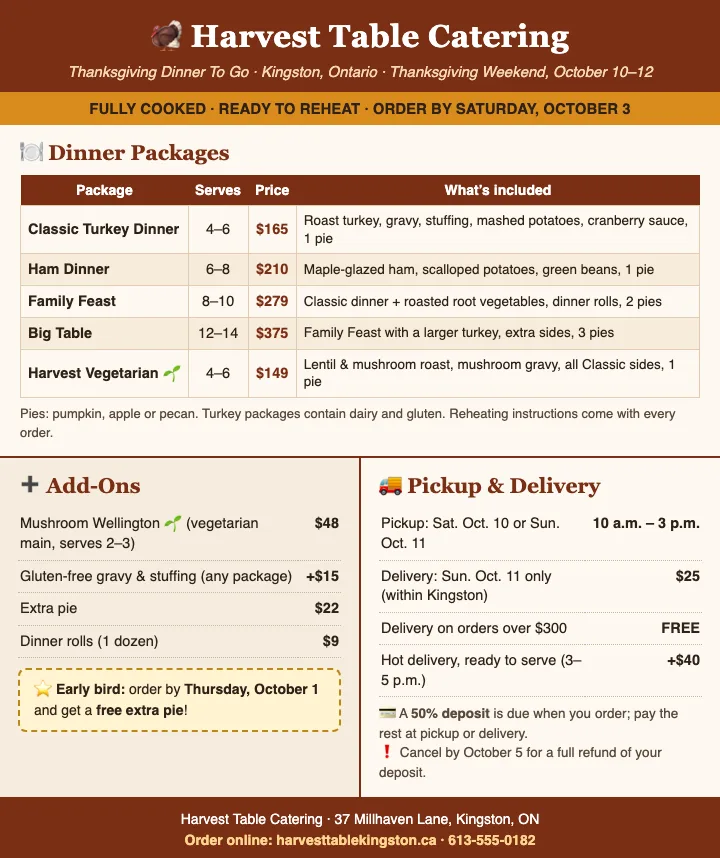
Read the following email message about the diagram on the left. Complete the email by filling in the blanks. Select the best choice for each blank from the drop-down menu.
Subject: Thanksgiving this year
To: Grace Moreau
From: Owen Petrakis
Hi Grace,
Bad news: my oven is still broken, and the repair person can’t come until the end of the month. Rather than squeeze eleven people into your tiny kitchen, why don’t we order dinner from Harvest Table this year? I’ve been through their flyer.
With Mom and Dad, your four and my five, the is the only package that will feed us all. Leo has gone vegetarian, but rather than paying for a whole second meal, we could just add for him.
Neither of us wants to drive across town with a hot turkey on the back seat, so let’s have it delivered on Sunday. Because our order will be well over $300, delivery is .
The catch is that we have to order by , and they want when we place the order. I can pay that part today if you send me your half later.
Mom will insist on bringing her cranberry relish anyway, of course. Remember the year she set the tea towel on fire making it? Dad still tells that story every Thanksgiving.
Honestly, with this many people and no oven, ordering is a no-brainer. Let me know tonight.
Owen
Grace and Owen are most likely
Why does Owen suggest ordering dinner?
When Owen says ordering is “a no-brainer,” he means that
Part 3: Reading for Information
Paragraph A
At the end of the nineteenth century, a young Italian inventor named Guglielmo Marconi was working on a way to send telegraph messages without wires, using radio waves. By 1899, his equipment had carried signals across the English Channel, but his ambition was far greater: he wanted to send a message from Europe to North America. Many respected scientists believed this was impossible. Radio waves, they argued, travelled in straight lines, so they would continue out into space instead of following the curve of the Earth. Marconi went ahead anyway and built a powerful transmitting station at Poldhu, on the coast of Cornwall in England. In September 1901, however, a storm wrecked the station’s huge ring of masts, and he had to replace it with a smaller, simpler antenna.
Paragraph B
In December 1901, Marconi arrived in St. John’s, Newfoundland, with two assistants and set up his receiving equipment in a building on Signal Hill, overlooking the harbour. Because there was no time to build tall masts, he planned to lift a long wire antenna into the sky. The weather was against him. On the first attempt, strong winds tore a balloon carrying the wire loose, and it disappeared over the sea. The team turned to kites instead. On December 12, holding a telephone earpiece to his ear, Marconi heard three faint clicks: the letter “S” in Morse code. Operators in Poldhu, more than 3,000 kilometres away, had been tapping out that letter again and again at times agreed on beforehand.
Paragraph C
Not everyone believed him. The signal had been extremely weak, it had not been recorded on paper, and the only people who heard it were Marconi and one of his assistants. Some experts suggested that he had mistaken ordinary electrical noise for the clicks he hoped to hear. Marconi also faced a more practical problem. A cable company that held exclusive rights to telegraph communication in Newfoundland threatened to take him to court, and he was forced to stop his experiments there. The Canadian government quickly offered him financial support to continue in Nova Scotia, and he built a new station at Glace Bay, on Cape Breton Island. In December 1902, complete messages were sent from there across the Atlantic.
Paragraph D
Within a few years, Marconi’s wireless system was being used on ships around the world, and a regular transatlantic message service began in 1907. In 1909, he shared the Nobel Prize in Physics for his work on wireless telegraphy. Scientists later explained what his critics had missed: a layer of the upper atmosphere reflects certain radio waves back toward the ground, allowing them to travel much farther than anyone had expected. Today, Signal Hill is a national historic site, and visitors to Cabot Tower at its summit can learn about the experiment that, for many people, marked the beginning of global communication.
Decide which paragraph, A to D, has the information given in each statement below. Select E if the information is not given in any of the paragraphs.
- Experts doubted that a signal could follow the shape of the planet over a long distance.
- Within a short time, Marconi’s invention was in use at sea.
- The signal Marconi listened for had been arranged in advance.
- The lack of a written record led some people to question his claim.
- Marconi’s assistants were unsure whether the signal had really come from England.
- A government helped pay for Marconi’s work after he left Newfoundland.
- The Newfoundland government ordered Marconi to leave the colony.
- A later discovery showed why the critics had been wrong about distance.
- Marconi’s first attempt to raise an antenna on Signal Hill ended in loss.
Part 4: Reading for Viewpoints
For years, Fernhaven residents have complained about deer that strip their gardens and wander across Ridge Road, where collisions have doubled in five years. Council now contemplates what it has always avoided: a controlled cull. Licensed bow hunters would remove up to sixty animals each winter from woodlots on the outskirts of town, with the venison processed for the local food bank.
Councillor Neil Ostrowski, who tabled the motion, points to what the town has already tried. “We’ve put up warning signs, installed reflectors and handed out brochures on fencing. Softer solutions have run their course,” he contends. A recent survey counted roughly 280 deer within municipal limits, more than triple what biologists consider sustainable.
Dr. Aisha Rahimi, the wildlife biologist who conducted that survey, finds the numbers alarming but warns against mistaking a cull for a cure. Thinning a herd leaves more forage for the survivors, and well-nourished does typically bear more fawns. “Unless people stop feeding deer and the town protects its remaining woodland, we’ll be having this same argument in 2030,” she predicts. Her endorsement extends only to a cull embedded in a long-term strategy.
Mireille Thibodeau of the Fernhaven Humane Society rejects any killing, while acknowledging that the status quo is untenable. Her organization favours fertility control: veterinarians would capture does and administer a contraceptive vaccine effective for several years. Comparable programs have reduced herds in a handful of communities, she maintains, without stray arrows near walking trails. Municipal staff put the expense at roughly $1,000 per animal, a figure Thibodeau disputes. “Patience is the program’s true price,” she allows.
Gord Haldane, who has operated a market garden on the edge of town for thirty years, has lost patience with deliberation. Deer consumed approximately $8,000 of his produce last season, his electric fence notwithstanding. He has no objection to contraception in principle but doubts the town could ever finance it, and he dismisses woodland protection as “another study for the shelf.” His verdict: “Whatever reduces the herd this year, I’m for it.”
Mayor Colleen Barr has yet to declare where she stands.
Gord Haldane would most likely side with
Why does Dr. Rahimi mention 2030?
By mentioning patience, Thibodeau concedes that
It can be inferred that
An appropriate title would be
The following is a comment by a visitor to the website page. Complete the comment by choosing the best option to fill in each blank.
Having narrowly missed a doe on Ridge Road last fall, I welcome this debate, though not every argument in it. Councillor Ostrowski is right that the town has exhausted ; nobody can call a cull a first resort.
I respect the humane society, but by the town’s arithmetic and her own admission, Ms. Thibodeau’s plan would be .
Dr. Rahimi raises the point council can least afford to ignore: the survivors may simply . So alongside any cull, council should tackle and the sale of our last woodlots.
A cull is no pleasure, whatever the numbers. What reconciles me to the killing is where the carcasses end up: with .
Answer key
Count your correct answers, then find your estimated CLB:
Show all 38 answers
- Rosa is writing mainly A. to ask if her daughter could live with Daniela.
- Why did Inês accept the placement immediately? C. It could help her find work after her studies.
- What is the problem with the rooms Inês has found? A. They cost too much or are too far from work.
- Why does Rosa advise Daniela to accept Inês’s offer to make dinner? D. Inês cooks better than Rosa does.
- According to Rosa, Inês will be away on many weekends in July because she C. will be helping her father at work.
- What can we infer about the student residence? D. Inês may not get a room if she applies late.
- B. a company that designs bridges
- C. made us supper instead of paying
- A. the first one to bed
- A. heads home for the market
- D. apply for a room downtown
- D. Big Table
- B. a mushroom Wellington
- C. free
- B. Saturday, October 3
- C. half the total
- Grace and Owen are most likely D. sister and brother.
- Why does Owen suggest ordering dinner? B. His own oven is not working.
- When Owen says ordering is “a no-brainer,” he means that A. the decision is obvious.
- Experts doubted that a signal could follow the shape of the planet over a long distance. A
- Within a short time, Marconi’s invention was in use at sea. D
- The signal Marconi listened for had been arranged in advance. B
- The lack of a written record led some people to question his claim. C
- Marconi’s assistants were unsure whether the signal had really come from England. E
- A government helped pay for Marconi’s work after he left Newfoundland. C
- The Newfoundland government ordered Marconi to leave the colony. E
- A later discovery showed why the critics had been wrong about distance. D
- Marconi’s first attempt to raise an antenna on Signal Hill ended in loss. B
- Gord Haldane would most likely side with D. Neil Ostrowski
- Why does Dr. Rahimi mention 2030? A. to suggest the herd may rebound
- By mentioning patience, Thibodeau concedes that C. results would take years
- It can be inferred that A. earlier steps did little for road safety.
- An appropriate title would be B. “No Consensus in Fernhaven on Its Deer”
- B. a string of half-measures
- C. neither cheap nor quick
- D. breed their way back
- A. residents feeding the deer
- C. households relying on food donations
What does your score mean? See the CELPIP Reading score chart.
Free CELPIP practice test · Free CELPIP Listening practice tests · CELPIP sample tests by part
CELPass is an independent practice platform and is not affiliated with Paragon Testing Enterprises. CELPIP is a trademark of Paragon Testing Enterprises. Check the official CELPIP website and IRCC for current test rules and requirements.