CELPIP Reading Practice Test 114
By Iris
A complete CELPIP Reading practice test: all 4 parts and 38 questions in the real test order. Set a timer for 55–60 minutes and do all four parts in one sitting. Check your answers at the bottom of the page to see your score and an estimated CLB.
Download as PDF with answer key
In this test
- Part 1: Reading Correspondence, “An Offer to Share a Sailboat” (questions 1–11) · practise this part alone
- Part 2: Reading to Apply a Diagram, “Finding a Shared Workspace in Moncton” (questions 12–19) · practise this part alone
- Part 3: Reading for Information, “Nunavut: Canada’s Newest Territory” (questions 20–28) · practise this part alone
- Part 4: Reading for Viewpoints, “School Street Closures in Ashby Debate” (questions 29–38) · practise this part alone
Part 1: Reading Correspondence
Dear Rhonda,
It was such a treat to run into you at the farmers’ market last Saturday. After all those years of sharing an office at the hospital, it felt strange to have only ten minutes to catch up, especially with your grandson tugging at your sleeve the whole time. You mentioned that you’d love to get back on the water now that you’re retired, and I haven’t been able to stop thinking about it since.
Here’s my idea. My brother-in-law, Clifford, is selling his sailboat, a twenty-six-foot sloop called the Kittiwake. He had a knee replacement last year, and his doctor has told him his sailing days are over. He’s asking $14,000, which is well below what boats like her usually sell for, because he wants her to go to someone he knows. I can’t manage that on my own, but if we bought her together, we would each pay $7,000 and split the yearly costs as well. Clifford says mooring, insurance and the winter haul-out come to roughly $3,800 a year.
I know what you’re thinking: partnerships can ruin friendships. My cousin once shared a cottage with a friend, and they haven’t spoken since. That’s why I think we should put everything in writing before we buy, including how we would divide the weekends, who pays for repairs and what happens if one of us wants to sell. I would suggest alternating weekends, with each of us taking the boat for one full week in the summer.
You were always a better sailor than I am. I’ve only taken a basic course, while you raced for years, so I’d be counting on you to teach me how to handle her in rough weather. In return, I’m happy to take care of the varnishing and small repairs, since you’ve told me more than once that you can’t stand that kind of work.
Clifford has promised to give me until the end of the month before he advertises the boat. He’s also offered to take us out on her next Sunday afternoon if the weather cooperates, so you can see how she sails before deciding anything.
Please think it over. I won’t be offended if the answer is no, but I would love to have a sailing partner again.
All the best,
Bernard
How do Bernard and Rhonda know each other?
Why is Clifford selling his boat?
The Kittiwake’s price is low because Clifford
Why does Bernard mention his cousin?
What does Bernard offer to do in return for sailing lessons?
Next Sunday, Rhonda will probably have the chance to
Here is a response to the message. Complete the response by filling in the blanks. Select the best choice for each blank from the drop-down menu.
Dear Bernard,
What a lovely letter, and thank you for thinking of me! I’m sorry that cut our chat so short at the market.
I’ve looked at a few boats like the Kittiwake online, and you’re right: half of her at that price is . It would be foolish to pass it up.
I also agree about putting everything in writing. Your plan to sounds fair to me, and we can work out the rest together.
I’ll happily teach you how to handle her in rough weather, and I’m delighted to leave to you. You know me too well.
Please tell Clifford I’d love to , weather permitting. I’ll bring the sandwiches. It’s been far too long since I felt salt spray on my face.
Fondly,
Rhonda
Part 2: Reading to Apply a Diagram
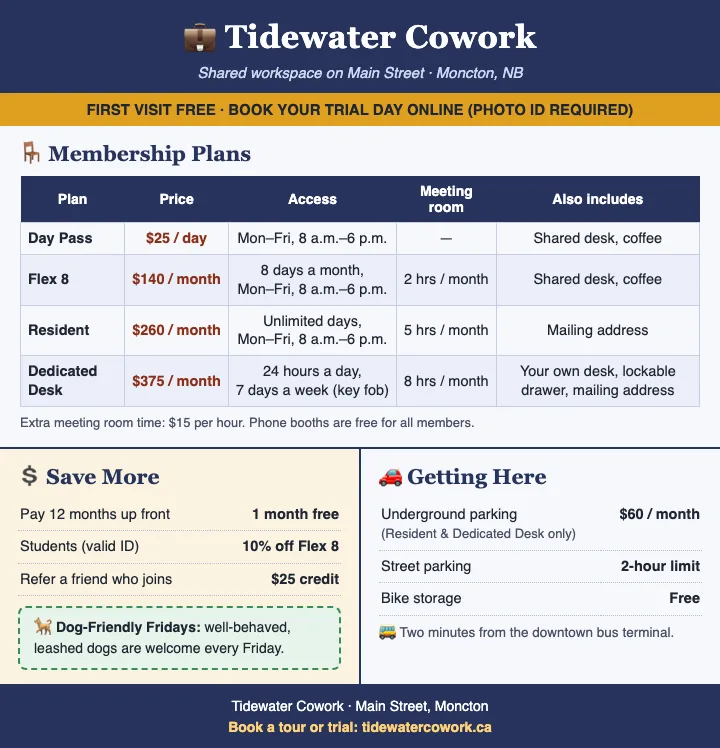
Read the following email message about the diagram on the left. Complete the email by filling in the blanks. Select the best choice for each blank from the drop-down menu.
Subject: Escaping the kitchen table
To: Joel Arsenault
From: Nadia Haddad
Hi Joel,
Remember how we used to grumble at the agency about the noisy open office? Funny how I miss it now. Six months of freelancing at my kitchen table has been plenty, so I’ve been looking at Tidewater Cowork on Main Street.
I’d only need a desk about eight days a month, so for me the plan makes the most sense. You, on the other hand, would be there every day, and you often work late into the night when a deadline is coming, so you’d need a plan with . It also comes with of meeting room time each month, which should cover your client calls. And if you paid for a whole year at once, you’d .
Parking could be a nuisance for me, though. Since my plan doesn’t give me access to the garage, I’ll have to move my car every couple of hours.
Before either of us signs up, why don’t we ? I’m thinking next Friday, so Pepper could come along too.
Honestly, after all those years of trading ideas over coffee, having you at the next desk might be just the ticket.
Talk soon,
Nadia
Nadia and Joel know each other because they
Why is Nadia looking for a workspace?
When Nadia says that sharing the space “might be just the ticket,” she means it could be
Part 3: Reading for Information
Paragraph A
On April 1, 1999, the map of Canada changed for the first time in fifty years when Nunavut officially became the country’s third territory. Carved out of the eastern part of the Northwest Territories, it is by far the largest of Canada’s provinces and territories, covering about one-fifth of the country’s land. Yet it has fewer people than any of them, with a population of under 40,000. The great majority of its residents are Inuit, and the territory’s name means “our land” in Inuktitut. Before 1999, these communities had been governed from Yellowknife, the capital of the Northwest Territories, far to the west.
Paragraph B
The new territory was the result of decades of effort by Inuit leaders, who wanted a government that reflected the people of the eastern Arctic. In 1982, voters across the Northwest Territories approved the idea of dividing the territory, and ten years later a second vote settled where the new boundary would run. In 1993, Inuit representatives and the federal government signed the Nunavut Land Claims Agreement, the largest land claim settlement in Canadian history. The talks leading to it had begun in the 1970s. Under it, Inuit gained ownership of a large area of land and a share of the money earned from resource development on public lands, and Ottawa committed to creating the new territory.
Paragraph C
Nunavut’s government works differently from those in most of Canada. Its legislature has no political parties. Members are elected as independents, and after each election they choose the premier and cabinet ministers from among themselves by secret ballot. Elections are held every four years, as in most provinces. The territory has four official languages: Inuktitut, Inuinnaqtun, English and French. The government also aims to be guided by Inuit traditional knowledge, known as Inuit Qaujimajatuqangit, which values ideas such as working together for a common purpose and respecting the land. The capital is Iqaluit, on Baffin Island, a city that was called Frobisher Bay until 1987.
Paragraph D
Life in Nunavut’s twenty-five communities involves challenges that most Canadians never face. No road links any of them to the rest of the country or to one another, so people and most goods arrive by air, while heavy supplies such as fuel, building materials and vehicles come by ship during the short summer season. As a result, food and housing cost far more than in southern cities. Many residents still hunt and fish, and country food such as caribou, seal and Arctic char remains an important part of the diet. Nunavut also has the youngest population in Canada, with a median age well below the national figure. Its flag reflects the territory’s identity: an inuksuk, a stone landmark built by Inuit, stands at its centre, beside a blue star representing the North Star.
Decide which paragraph, A to D, has the information given in each statement below. Select E if the information is not given in any of the paragraphs.
- Elected members, rather than voters, decide who leads the territory’s government.
- Some large deliveries can reach the territory only at certain times of year.
- Most debates in Nunavut’s legislature are held in Inuktitut.
- Nunavut has the smallest population of any province or territory.
- Inuit were promised part of the income from developing natural resources.
- The territory’s capital has not always had the same name.
- Nunavut’s population has grown quickly since the territory was created.
- Residents had a say in where the territory’s borders would be drawn.
- Nunavut’s median age is considerably lower than that of Canada as a whole.
Part 4: Reading for Viewpoints
For thirty minutes every school morning, Larch Street in Ashby falls quiet. Orange barriers seal both ends of the block outside Riverside Elementary, leaving the roadway to children on foot, bicycles and scooters while parents linger and a crossing guard waves at familiar faces. This “school streets” pilot, conducted at two schools this year, may be extended to all eleven of Ashby’s elementary schools.
Harjit Sandhu, the municipality’s active transportation planner, finds the evidence persuasive. At the pilot schools, the proportion of students arriving under their own power rose from 38 to 51 percent, with no collisions recorded during closures. “Parents have long wanted their kids to walk, but they balked at forty cars converging at once,” he reports. Closures would cover the half hour before the morning bell and another after dismissal, and residents holding permits could still drive slowly in and out.
Melanie Corbeil, whose two children attend Riverside, is less effusive. Her shift at a care home begins at 8:30, and the school lies on her way. “Families like mine aren’t driving out of laziness,” she protests. Since the barriers appeared, she parks two blocks away and escorts the children in, frequently arriving late. Her verdict: “Go around that corner and you’ll see the same cars as before.”
Victor Mendes, a retired electrician on Poplar Crescent, one block from the school, reports that his formerly tranquil street now accumulates idling cars every morning. “Twice this spring I couldn’t back out of my own driveway.” Disavowing any hostility to the concept, he wants the surrounding streets studied before further barriers appear.
Dr. Fiona Lachance, a public health professor who researches children’s activity, endorses the program while tempering expectations. Walkers tend to arrive more alert, and distancing engines from entrances diminishes the exhaust children inhale. “But closing one block doesn’t do much for a child facing a busy road ten minutes from home,” she says, and her research ranks distance and dangerous intersections above congestion at the gate in parents’ reckoning. She advocates pairing closures with crossing guards and new sidewalks on principal routes.
Corbeil’s remark about the cars is supported by
What would Sandhu cite to show traffic deterred parents?
Which saying best sums up Dr. Lachance’s caution?
What can be inferred about the proposal?
A fitting headline would be
The following is a comment by a visitor to the website page. Complete the comment by choosing the best option to fill in each blank.
A grandmother walking two grandchildren to Riverside each morning, I hope council says yes. The pilot’s figures are difficult to dismiss: . I do sympathize with the care-home worker, who ; those rushed mornings remain vivid to me. My two now chat the whole way instead of staring at screens. Still, a few more steps seem a modest price for a safer entrance.
The retired electrician rightly points out that , and that deserves study. Above all, I side with the professor. Her plea for answers the fear that every walking grandparent knows.
Should council both approve the plan and , families will wonder why we waited.
Answer key
Count your correct answers, then find your estimated CLB:
Show all 38 answers
- How do Bernard and Rhonda know each other? B. They used to work together.
- Why is Clifford selling his boat? A. A health problem has ended his sailing.
- The Kittiwake’s price is low because Clifford D. wants someone he knows to have her.
- Why does Bernard mention his cousin? C. to explain the need for a written deal
- What does Bernard offer to do in return for sailing lessons? B. take care of upkeep on the sailboat
- Next Sunday, Rhonda will probably have the chance to D. see how the Kittiwake handles on the water.
- C. my grandson’s impatience
- A. a real bargain
- D. take turns on weekends and each get a summer week
- B. the maintenance chores I dislike
- C. come out sailing on Sunday
- A. Flex 8
- C. access at any hour
- D. eight hours
- B. get one month free
- D. book a free trial day
- Nadia and Joel know each other because they C. once worked for the same agency.
- Why is Nadia looking for a workspace? A. She has had enough of working at home.
- When Nadia says that sharing the space “might be just the ticket,” she means it could be B. exactly what they need.
- Elected members, rather than voters, decide who leads the territory’s government. C
- Some large deliveries can reach the territory only at certain times of year. D
- Most debates in Nunavut’s legislature are held in Inuktitut. E
- Nunavut has the smallest population of any province or territory. A
- Inuit were promised part of the income from developing natural resources. B
- The territory’s capital has not always had the same name. C
- Nunavut’s population has grown quickly since the territory was created. E
- Residents had a say in where the territory’s borders would be drawn. B
- Nunavut’s median age is considerably lower than that of Canada as a whole. D
- Corbeil’s remark about the cars is supported by C. Victor Mendes
- What would Sandhu cite to show traffic deterred parents? D. more students walk or cycle
- Which saying best sums up Dr. Lachance’s caution? A. “A chain is only as strong as its weakest link.”
- What can be inferred about the proposal? B. Traffic could pass most hours.
- A fitting headline would be C. “School Streets: Should Ashby Go Citywide?”
- B. more children got moving
- A. walks her children in before work
- D. congestion has merely moved
- C. crossing guards and sidewalks
- D. make routes safer too
What does your score mean? See the CELPIP Reading score chart.
Free CELPIP practice test · Free CELPIP Listening practice tests · CELPIP sample tests by part
CELPass is an independent practice platform and is not affiliated with Paragon Testing Enterprises. CELPIP is a trademark of Paragon Testing Enterprises. Check the official CELPIP website and IRCC for current test rules and requirements.