CELPIP Reading Practice Test 123
By Iris
A complete CELPIP Reading practice test: all 4 parts and 38 questions in the real test order. Set a timer for 55–60 minutes and do all four parts in one sitting. Check your answers at the bottom of the page to see your score and an estimated CLB.
Download as PDF with answer key
In this test
- Part 1: Reading Correspondence, “Back to School at Forty-Six” (questions 1–11) · practise this part alone
- Part 2: Reading to Apply a Diagram, “Firewood for the Camp” (questions 12–19) · practise this part alone
- Part 3: Reading for Information, “Wood Buffalo: Canada’s Largest National Park” (questions 20–28) · practise this part alone
- Part 4: Reading for Viewpoints, “Capping Cruise Ships in Port Averill Debate” (questions 29–38) · practise this part alone
Part 1: Reading Correspondence
Dear Helen,
I hope the move to the lake has been everything you and Tom wanted. I’ve owed you a letter since Christmas, and I’m afraid that by the end of this one you’ll see it’s more a request for advice than a proper catch-up.
As you know, I’ve been driving long-haul for Kessler Freight for twenty-two years. Last spring, I hurt my back unloading a trailer in Thunder Bay, and although it has mostly healed, my doctor has made it plain that another ten years behind the wheel would likely undo all the physiotherapy. Kessler has offered me a desk job in dispatch at about the same pay, and Anita thinks I’d be crazy to turn it down. She may be right. We still have one child in university, and the mortgage has six years left to run.
The trouble is that I spent three weeks in dispatch this winter while the regular clerk was away, and I came home every night with a headache and nothing to show for the day. What I keep thinking about instead is my physiotherapist, a cheerful young woman named Priya who got me walking properly again. I asked her one day how a person gets into that line of work, and she told me about the physiotherapist assistant diploma at the college here. It takes two years, or three in the evening version, which would let me keep working part-time. Applicants need Grade 12 biology, which I never took, so I’ve signed up for an online course that starts in May, mostly to see whether my brain still works. I’ve told only Anita, and now you.
This is why I’m writing to you rather than to anyone else. You were forty-four when you left the bank to train as a dental hygienist, and everyone, including me, I’m ashamed to say, told you that you were making a mistake. I’d like to know what you didn’t tell people at the time. Was it hard to study alongside classmates young enough to be your children? Did the money ever frighten you? Was there a moment when you wished you had stayed at the bank?
Please don’t feel you have to encourage me. I have plenty of people who’d be polite about it. I would much rather have your honest view, even if it’s a discouraging one. Applications are due at the end of June, so there’s no rush, but I’d be glad of a phone call some weekend if that’s easier than writing.
Say hello to Tom, and tell him I haven’t forgotten that I still have his fishing rod.
All the best,
Marek
Marek is writing mainly to
Why is Marek thinking about leaving long-haul driving?
What did Marek’s three weeks in dispatch show him?
Marek’s online biology course is mainly
We can reasonably conclude that when Helen changed careers,
When Marek says he has “plenty of people who’d be polite about it,” he means that
Here is a response to the message. Complete the response by filling in the blanks. Select the best choice for each blank from the drop-down menu.
Dear Marek,
You asked for honesty, so here it is. I understand why the doesn’t appeal to you after those three weeks, but please don’t dismiss it lightly. With still ahead of you, a steady salary matters, and I remember lying awake over money more than once.
Still, I’ve never regretted leaving the bank. Being the oldest in the class turned out to be easier than I expected; the younger students came to me whenever they were worried about an exam.
Before you decide anything, see how you get on with . If you can keep up, you’ll have your answer about your brain. I’d also talk again to , since she works alongside such assistants and can tell you what the work is really like. And remember that the slower program would let you , which would ease some of the worry.
Call me any Sunday. Tom says you can keep the rod until you’ve caught something with it.
Warmly,
Helen
Part 2: Reading to Apply a Diagram
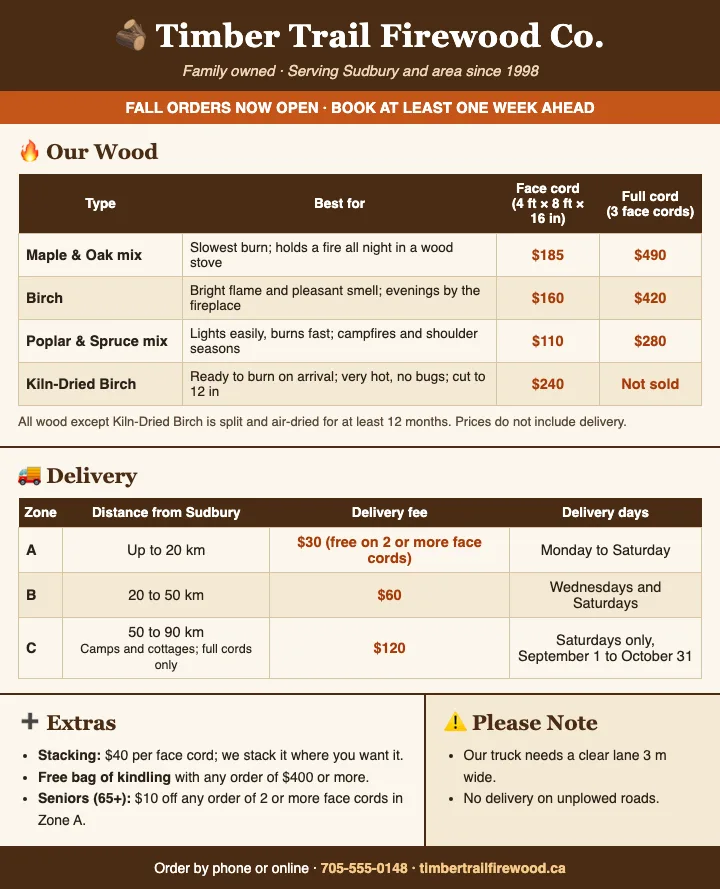
Read the following email message about the diagram on the left. Complete the email by filling in the blanks. Select the best choice for each blank from the drop-down menu.
Subject: Wood for the camp this winter
To: Renée Lalonde
From: Darcy Gauthier
Hi Renée,
Now that Dad has handed us the keys to the camp, one of us has to deal with the wood, so I went through this flyer from Timber Trail. You’ll remember how he got up at 3 a.m. all winter to feed that old stove when we were kids. I’d rather sleep, so we want something that keeps burning until morning, which means the .
We’ll be up most weekends until March, and I figure a full cord will get us through. That comes to before delivery. The camp is about 70 km out of town, so the truck will add . They only go that far on , so let’s not put this off until the last minute the way we did with the roof.
One small bonus: with an order this size, we’ll get . That should save us from chopping any ourselves for the first few fires.
I’ll foot the bill for now, and you can send me your half when you get paid. We can stack it ourselves on Thanksgiving weekend, since I’m not paying extra for that. Let me know if you’re okay with all this.
Darcy
Darcy and Renée know each other because
Why does Darcy want to order soon?
When Darcy says “I’ll foot the bill for now,” he means that he will
Part 3: Reading for Information
Paragraph A
Straddling the border between northern Alberta and the Northwest Territories, Wood Buffalo National Park covers nearly 45,000 square kilometres, which makes it the largest national park in Canada and bigger than Switzerland. Yet despite its size and its status as a UNESCO World Heritage Site since 1983, it receives only a small fraction of the visitors who crowd the Rocky Mountain parks. Few roads enter it, and the gateway community of Fort Smith is a long drive from any major city. Those who make the journey find boreal forest, vast wetlands and broad salt plains, where springs carry up minerals left behind by ancient seas, along with sinkholes that formed as underground rock dissolved.
Paragraph B
The park was created in 1922 to protect the last large herd of wood bison, the bigger northern relative of the plains bison. Its early managers soon made a decision that later generations would regret. Between 1925 and 1928, more than 6,000 plains bison were shipped north from an overcrowded park in central Alberta and released there. The newcomers interbred with the wood bison and brought tuberculosis and brucellosis, diseases that still affect the herds today. For years, it was feared that pure wood bison had disappeared altogether, until a small, isolated group was found in a remote corner of the park in 1957. Animals from that group later helped to establish herds elsewhere in Canada, while the park itself remains home to one of the world’s largest free-roaming bison herds.
Paragraph C
The park is just as important to birds. Whooping cranes had been in steep decline for decades, and no one could say where the survivors raised their young until 1954, when their nesting grounds were spotted in the park’s remote northern wetlands. It remains the breeding area of the only self-sustaining wild flock in the world, which flies roughly 4,000 kilometres to the Texas coast each fall. Farther south, the Peace-Athabasca Delta, one of the largest inland freshwater deltas in the world, lies where all four of North America’s major flyways cross, and millions of ducks, geese and other waterfowl stop there each year.
Paragraph D
The health of that delta is now the park’s most serious concern. Its wetlands depend on seasonal flooding, and hydroelectric dams and industrial development upstream, in British Columbia and northern Alberta, have raised fears about changes in the flow and quality of the water. In 2014, the Mikisew Cree First Nation, whose people have long relied on the delta, petitioned UNESCO to list the park as a World Heritage Site in Danger. A monitoring mission followed, and in 2019 the federal government released an action plan prepared with Indigenous partners and provincial and territorial governments. Whether it will be enough remains a matter of debate.
Decide which paragraph, A to D, has the information given in each statement below. Select E if the information is not given in any of the paragraphs.
- The park draws far fewer tourists than its international standing might lead one to expect.
- An attempt to relieve pressure on land elsewhere ended up harming the animals the park was meant to protect.
- Diseased bison in the park are being removed to protect healthy herds elsewhere.
- Researchers once had no idea where a rare bird produced its offspring.
- Some of the park’s terrain owes its character to waters that vanished long ago.
- The park’s most pressing problem may have causes that lie far beyond its boundaries.
- Birds following different routes across the continent all pass through one part of the park.
- An Indigenous community appealed to an international body about the park’s condition.
- A population thought to be lost turned out to have survived in an out-of-the-way place.
Part 4: Reading for Viewpoints
Each summer, the harbour town of Port Averill, population 9,000, receives as many as 110 cruise ship calls, sometimes two daily, discharging up to 6,000 passengers onto a waterfront built for a fraction of that number. Council has commissioned a study of a cap: one large ship a day and 80 calling days per season. The prospect has divided a town that for two decades regarded the cruise trade as its economic salvation.
Mayor Joanne Fitzgerald, who requested the study, protests that she is no enemy of the industry, crediting cruise revenue with rebuilding the waterfront after the cannery closed. “But there’s a difference between hosting visitors and being overrun by them.” “A cap would protect the character that attracts people here,” she contends, although its price, she admits, remains incalculable.
Theo Anagnos, who owns two Harbour Street gift shops and chairs the business association, finds that admission revealing. Passengers furnish over 60 per cent of his summer sales, and he doubts anyone would replace them. “Council is proposing to fix an irritation with a recession,” he charges. Still, the crush on two-ship days is undeniable, which is why he champions staggered arrivals and wider sidewalks, remedies that turn away no customer.
Tourism researcher Mireille Ouellet, who has studied ports in Canada and Norway, is skeptical of both camps. “Passengers spend little and eat aboard, and much of what they do spend flows to tour operators based elsewhere,” she reports, and wider sidewalks would only move the same crush down the street. Yet towns that restricted ships without courting overnight visitors merely acquired “quieter streets and emptier tills.” The decisive question, she argues, is whether anyone has a reason to stay the night.
For Callum Reid, a ferry engineer now retired and living two blocks from the pier, the argument over spending misses the point. He describes it plainly: “Idling ships foul our air on still days, and tour buses start before seven each morning.” His residents’ group demands a 50-day limit and mandatory shore power, an upgrade the port authority prices at $30 million, which Fitzgerald considers unattainable without federal assistance.
The consultants report in February. Meanwhile, the cruise lines are booking the season after next, and at least one is examining ports farther up the coast.
Who thinks the ships enrich the town less than assumed?
Fitzgerald and Anagnos would both accept that
Which saying sums up Anagnos’s view of the cap?
What does the closing paragraph imply?
The most accurate headline would be
The following is a comment by a visitor to the website page. Complete the comment by choosing the best option to fill in each blank.
I have run a Harbour Street bed and breakfast for eleven years, and I tire of hearing that this town would collapse without the ships. Mr. Anagnos talks as though every passenger were a customer, whereas Ms. Ouellet’s research suggests that much of the money .
His sales might suffer, I grant, but, like Ms. Ouellet, I see wider sidewalks as . Nor would I follow Mr. Reid, whose carries a price the mayor says is unattainable without .
A cap seems a sensible start, but only alongside what Ms. Ouellet recommends: . My guests book rooms, not deck chairs. Port towns that think past the next docking tend to do better.
Answer key
Count your correct answers, then find your estimated CLB:
Show all 38 answers
- Marek is writing mainly to C. get a frank opinion from someone who changed careers.
- Why is Marek thinking about leaving long-haul driving? A. More years on the road could undo his recovery.
- What did Marek’s three weeks in dispatch show him? D. The work left him tired and unsatisfied.
- Marek’s online biology course is mainly B. a test of whether he can still learn.
- We can reasonably conclude that when Helen changed careers, D. few people thought it was a wise move.
- When Marek says he has “plenty of people who’d be polite about it,” he means that B. he does not want Helen just to say nice things.
- C. office work you were offered
- A. a mortgage and tuition bills
- B. the biology class this spring
- D. the woman who treated you
- A. hold on to some hours at work
- C. Maple & Oak mix
- B. $490
- D. $120
- A. Saturdays until the end of October
- C. a free bag of kindling
- Darcy and Renée know each other because A. they are brother and sister.
- Why does Darcy want to order soon? C. The truck stops serving the camp’s area after October.
- When Darcy says “I’ll foot the bill for now,” he means that he will B. pay the full amount first.
- The park draws far fewer tourists than its international standing might lead one to expect. A
- An attempt to relieve pressure on land elsewhere ended up harming the animals the park was meant to protect. B
- Diseased bison in the park are being removed to protect healthy herds elsewhere. E
- Researchers once had no idea where a rare bird produced its offspring. C
- Some of the park’s terrain owes its character to waters that vanished long ago. A
- The park’s most pressing problem may have causes that lie far beyond its boundaries. D
- Birds following different routes across the continent all pass through one part of the park. C
- An Indigenous community appealed to an international body about the park’s condition. D
- A population thought to be lost turned out to have survived in an out-of-the-way place. B
- Who thinks the ships enrich the town less than assumed? D. Mireille Ouellet
- Fitzgerald and Anagnos would both accept that A. ship-day crowds are a problem.
- Which saying sums up Anagnos’s view of the cap? C. “a sledgehammer to crack a nut”
- What does the closing paragraph imply? B. Cruise lines might go elsewhere.
- The most accurate headline would be D. “Port Averill Counts Its Cruise Boom’s Cost”
- A. never reaches the town
- C. merely shifting the crowd
- D. plug-in rule for ships
- B. money from Ottawa
- C. keeping visitors overnight
What does your score mean? See the CELPIP Reading score chart.
Free CELPIP practice test · Free CELPIP Listening practice tests · CELPIP sample tests by part
CELPass is an independent practice platform and is not affiliated with Paragon Testing Enterprises. CELPIP is a trademark of Paragon Testing Enterprises. Check the official CELPIP website and IRCC for current test rules and requirements.