CELPIP Reading Practice Test 124
By Iris
A complete CELPIP Reading practice test: all 4 parts and 38 questions in the real test order. Set a timer for 55–60 minutes and do all four parts in one sitting. Check your answers at the bottom of the page to see your score and an estimated CLB.
Download as PDF with answer key
In this test
- Part 1: Reading Correspondence, “A Shared Driveway in Need of Repair” (questions 1–11) · practise this part alone
- Part 2: Reading to Apply a Diagram, “A First Bank Account in Red Deer” (questions 12–19) · practise this part alone
- Part 3: Reading for Information, “Emily Carr: Recognition Late in Life” (questions 20–28) · practise this part alone
- Part 4: Reading for Viewpoints, “Online Voting in Dunmore Debate” (questions 29–38) · practise this part alone
Part 1: Reading Correspondence
Dear Mr. Petrakis,
I hope you and Mrs. Petrakis have settled in comfortably since the spring. We haven’t had much chance to talk beyond a wave over the fence, so I apologize for raising a practical matter in a letter. I thought you might like to have the details in writing, and some time to think them over before we speak.
As your lawyer may have told you, the driveway between our houses is shared. Under an agreement registered when the houses were built in 1962, each owner may use its full width, and we are jointly responsible for its upkeep, with the cost split equally. In the twenty-six years I’ve lived here, that arrangement has worked without difficulty. Mr. Dhillon, who owned your house before you, and I resurfaced it together in 2003.
As you have probably noticed, that surface is now near the end of its life. The frost has opened several long cracks, and the section near the street has sunk to the point that water collects there and freezes in winter. In January, my wife slipped on that ice and, though she wasn’t seriously hurt, she has been nervous about walking to the car ever since. I asked three paving companies for estimates this summer, and I’ve enclosed them all. Two recommend tearing out the old asphalt entirely, at $9,400 and $11,200. The third, Lakeview Paving, proposes a cheaper overlay at $5,800, but its own estimate notes that this wouldn’t correct the sunken section and may last only five to seven years. I lean toward the $9,400 quote, which includes new drainage and a ten-year guarantee, but I haven’t committed to anything and wouldn’t without your agreement.
I appreciate that this may be an unwelcome expense so soon after your move, and I don’t want to put you in a difficult position. If paying your half all at once would be a problem, I’d be willing to cover the full amount now and let you pay me back over a year or so. The one thing I would ask is that we have the work done before the ground freezes, as the company can’t start after mid-October and its price is good only until the end of September.
My wife and I are home most evenings, and you’d be welcome to come over for coffee to look through the estimates together. You can also reach me at the number below.
Yours truly,
Gordon Whitlock
Gordon put this matter in a letter because he
Under the agreement made when the houses were built, the owners
Why has Gordon’s wife become uneasy about walking to the car?
Gordon seems to favour the $9,400 estimate partly because it
What does Gordon offer to do for Mr. Petrakis?
We can reasonably conclude that Mr. Petrakis
Here is a response to the message. Complete the response by filling in the blanks. Select the best choice for each blank from the drop-down menu.
Dear Mr. Whitlock,
Thank you for your letter, and please call me Dimitri. I was so sorry to hear about , and I hope she feels steadier on her feet soon.
To be honest, I had not realized that . Our lawyer must have mentioned it, but it slipped past me during the move, and I’m grateful you took the trouble to explain.
Having read the estimates, I agree that . It would be money spent on a problem we would face again in a few years, and the low spot by the street would still be there.
It is generous of you to , but there’s no need, as the sale of our last house left us with a little cushion. Since the price you were quoted holds only , why don’t I come by on Thursday evening with my chequebook?
With thanks,
Dimitri Petrakis
Part 2: Reading to Apply a Diagram
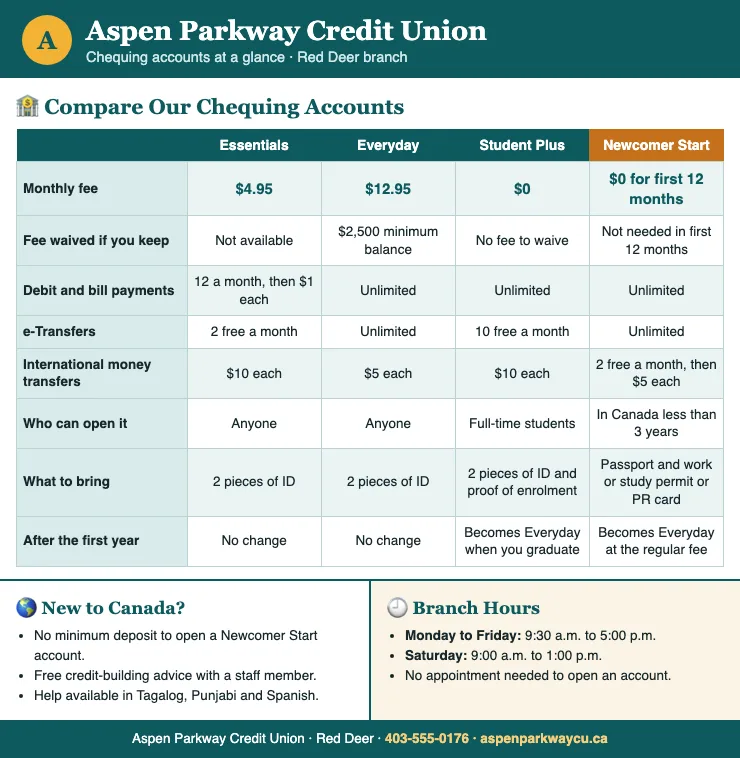
Read the following email message about the diagram on the left. Complete the email by filling in the blanks. Select the best choice for each blank from the drop-down menu.
Subject: Your bank account when you get here
To: Liza Ramos
From: Ana Villanueva
Hi Liza,
Only five weeks until you land! I can hardly believe it’s been twelve years since we shared that tiny dorm room in nursing school, and now you’ll be working ten minutes from my house.
You asked about banking, so I picked up this chart from my credit union. The Student Plus account looks tempting, but you’re coming here to work, not to study. Since you’ll be arriving on a work permit and want to send money to your mom every month, I’d go with . There’s no monthly fee , and after that it switches to . You won’t pay anything to send money overseas, as long as you stick to .
When you go in, make sure you bring , as they won’t open the account without them. I’m off on Saturdays, so I can come with you on your first weekend here. The staff are lovely, and they’ll walk you through everything. Don’t worry about bringing a lot of cash, since there’s no minimum deposit.
I’ve already cleared out the spare room for you. Bring a real winter coat!
Ana
Ana and Liza know each other because they
Why does Ana suggest going to the branch on a Saturday?
When Ana says the staff will “walk you through everything,” she means they will
Part 3: Reading for Information
Paragraph A
Emily Carr, now regarded as one of Canada’s most important painters, was born in Victoria, British Columbia, in 1871, when the city was still a small colonial outpost. Orphaned as a teenager, she persuaded her guardian to let her study art in San Francisco, and later training took her to England, where she spent several years, and then to France. Her early work, mostly careful watercolours, gave little hint of what was to come. In France, she absorbed the bright colours and bold forms of modern European painting. The new style set her apart when she returned home, where it earned her more puzzlement than praise.
Paragraph B
Carr’s chief subject emerged on her visits to Indigenous villages along the coast. In 1912, she made an extensive journey north to Haida Gwaii and the Skeena River, sketching totem poles and village sites that she believed were disappearing, a view that historians have since questioned. The following year, she showed the work in Vancouver and offered the collection to the provincial government, which declined to buy it. Unable to live by her art, she built a small apartment house in Victoria and for many years earned her income as a landlady, making pottery and raising sheepdogs on the side. She painted very little during this period.
Paragraph C
The turning point came in 1927, when Carr was in her mid-fifties and the National Gallery of Canada invited her to take part in an exhibition of West Coast art. Travelling east for the show, she met members of the Group of Seven, among them Lawren Harris, whose encouragement restored her confidence. She returned home determined to paint again, turning increasingly from villages to the forests and skies of British Columbia. She developed a method of thinning oil paint with gasoline and working on paper, which was cheap and allowed her to record the movement of trees quickly in the open air. In the 1930s, she even bought an old caravan, which she called the Elephant, so that she could live and work in the woods for weeks at a time. Solo exhibitions followed during that decade.
Paragraph D
In her final years, a series of heart attacks limited her ability to go out and paint, so she turned to writing, with the help of a friend and editor, Ira Dilworth. Her first book, Klee Wyck, a collection of stories drawn from her time in the coastal villages, won the Governor General’s Award for non-fiction in 1941. Other books followed before her death in Victoria in 1945, including an account of her years as a landlady, The House of All Sorts. Today, a Vancouver art university bears her name, and her paintings have sold for millions of dollars at auction, although her portrayals of Indigenous subjects are now viewed more critically than they once were.
Decide which paragraph, A to D, has the information given in each statement below. Select E if the information is not given in any of the paragraphs.
- A change of materials allowed Carr to paint more rapidly outdoors.
- Carr’s family encouraged her from childhood to become a painter.
- For a long period, Carr supported herself through work that had little to do with painting.
- Declining health led Carr to take up a different creative outlet.
- The unfamiliar style Carr brought back from abroad did not win her much admiration at first.
- Members of the Group of Seven helped Carr to sell her first paintings in Eastern Canada.
- Carr’s hopes for a public purchase of her work came to nothing.
- An invitation from a national institution revived a career that had stalled.
- Carr’s first published book grew out of what she experienced on the coast.
Part 4: Reading for Viewpoints
When Dunmore tallied its ballots after the last municipal election, turnout stood at 27%. Town staff have been told to prepare a change some consider an obvious remedy and others a reckless gamble: replacing paper ballots with internet voting next fall. Residents would receive personal codes by mail and could vote from any device during a ten-day window; two help centres would open on the final day, and all other polling stations would close. A private vendor would operate the system for about $85,000.
Town clerk Marguerite Doyle presents the change as a question of access, not ideology. Her office regularly hears from shift workers, people with disabilities and students who found the polls unreachable. “Turnout gains elsewhere have been modest,” she acknowledges, and she would retain paper as an option for an election or two before phasing it out.
Computer science professor Ravi Menon has testified against the plan. “My objection isn’t that an attack is probable, but that one could never be excluded retrospectively,” he stresses. “With a paper ballot, you can recount,” he explains, whereas a server obliges voters to trust a company’s account of its own software. Menon grants that too many residents find the polls inaccessible, and has no quarrel with mail-in ballots, which would widen access while preserving a physical record.
Councillor Beth Arsenault, who moved the motion, accuses critics of imposing an impossible standard. Paper elections have suffered lost ballot boxes and counting errors without anyone demanding abolition. “Security experts are paid to imagine the worst.” The genuine peril, in her view, is a council elected by barely a quarter of voters, its legitimacy eroding with each election. She sees no justification for financing two systems.
Walter Nkemelu, 78, who drives older neighbours to the polls for the seniors’ association, is unmoved by appeals to convenience. Many acquaintances lack home internet and would depend on relatives, compromising the secrecy of the ballot. “You take away the polling stations and then call it access,” he remarks. Still, the current arrangements fail people too, including housebound friends he cannot transport; internet voting would be welcome as a supplement, never a replacement.
Who would accept losing paper ballots, though not yet?
Menon and Nkemelu would both acknowledge that
Arsenault thinks Menon is
Doyle’s stance is best described as
An apt headline would be
The following is a comment by a visitor to the website page. Complete the comment by choosing the best option to fill in each blank.
A poll clerk for three elections, I have seen this debate from inside. Councillor Arsenault is right that paper is imperfect, but she misses Professor Menon’s point: when something goes wrong on paper, . No company’s assurance can replace that.
It is also peculiar to and then describe this as widening access. , and I cannot call that a free vote.
None of this means I am satisfied with ; that should embarrass us all. But to reach shift workers and students, why not try ? That would offer the same convenience while leaving something checkable by hand. Turnout matters to me as much as to anyone.
Answer key
Count your correct answers, then find your estimated CLB:
Show all 38 answers
- Gordon put this matter in a letter because he B. wanted Mr. Petrakis to have time to consider it.
- Under the agreement made when the houses were built, the owners D. are equally liable for keeping the driveway up.
- Why has Gordon’s wife become uneasy about walking to the car? A. She lost her footing on a frozen patch.
- Gordon seems to favour the $9,400 estimate partly because it C. would deal with the water and come with a guarantee.
- What does Gordon offer to do for Mr. Petrakis? B. Cover the whole bill and accept repayment later.
- We can reasonably conclude that Mr. Petrakis D. has not lived next door for very long.
- A. the fall your wife had
- D. the driveway’s upkeep was a shared cost
- C. a thin layer on top would be poor value
- B. carry my half for a while
- C. until October begins
- D. Newcomer Start
- A. for your first 12 months
- C. the Everyday plan at $12.95
- B. two transfers a month
- A. your passport and work permit
- Ana and Liza know each other because they C. lived together as nursing students.
- Why does Ana suggest going to the branch on a Saturday? B. She is free to go along with Liza.
- When Ana says the staff will “walk you through everything,” she means they will D. explain each step of the process.
- A change of materials allowed Carr to paint more rapidly outdoors. C
- Carr’s family encouraged her from childhood to become a painter. E
- For a long period, Carr supported herself through work that had little to do with painting. B
- Declining health led Carr to take up a different creative outlet. D
- The unfamiliar style Carr brought back from abroad did not win her much admiration at first. A
- Members of the Group of Seven helped Carr to sell her first paintings in Eastern Canada. E
- Carr’s hopes for a public purchase of her work came to nothing. B
- An invitation from a national institution revived a career that had stalled. C
- Carr’s first published book grew out of what she experienced on the coast. D
- Who would accept losing paper ballots, though not yet? A. Marguerite Doyle
- Menon and Nkemelu would both acknowledge that C. the polls shut some out.
- Arsenault thinks Menon is B. “making a mountain out of a molehill”
- Doyle’s stance is best described as D. supportive but doubtful
- An apt headline would be C. “Can Dunmore Trust an Easier Ballot?”
- A. the ballots can be recounted
- D. close all but two sites
- B. As Mr. Nkemelu warns, many would vote through relatives
- C. a council so few chose
- A. ballots sent by post
What does your score mean? See the CELPIP Reading score chart.
Free CELPIP practice test · Free CELPIP Listening practice tests · CELPIP sample tests by part
CELPass is an independent practice platform and is not affiliated with Paragon Testing Enterprises. CELPIP is a trademark of Paragon Testing Enterprises. Check the official CELPIP website and IRCC for current test rules and requirements.