CELPIP Reading Practice Test 128
By Iris
A complete CELPIP Reading practice test: all 4 parts and 38 questions in the real test order. Set a timer for 55–60 minutes and do all four parts in one sitting. Check your answers at the bottom of the page to see your score and an estimated CLB.
Download as PDF with answer key
In this test
- Part 1: Reading Correspondence, “An Offer to Take Over the Hardware Store” (questions 1–11) · practise this part alone
- Part 2: Reading to Apply a Diagram, “Booking an Escape Room for Ten” (questions 12–19) · practise this part alone
- Part 3: Reading for Information, “Montreal’s Biosphère: From Expo 67 to Museum” (questions 20–28) · practise this part alone
- Part 4: Reading for Viewpoints, “A Visitor Tax for Port Sable Debate” (questions 29–38) · practise this part alone
Part 1: Reading Correspondence
Dear Danny,
After forty-one years behind the counter at Brandt’s Hardware, I have decided that this winter will be my last. My knees have been telling me so for a while, and Ruth would like to see more of our grandchildren in Halifax before they are too grown up to want to see us. I wanted you to hear it from me first, and in writing, so that you have time to think before we talk.
You have worked here for nine years now, and in that time you have become the person customers ask for by name. When old Mr. Tierney needed to fix his well pump last spring, he waited forty minutes for you to come back from lunch rather than let me help him. I pretended to be offended, but I wasn’t.
My children have their own careers and have made it clear that they don’t want the store. I could sell to the chain that opened out by the highway; their manager has called twice. But I expect they would close us within a year and use the building as a warehouse. I would much rather the store stay what it is, and I believe you are the right person to run it.
I know you couldn’t pay the full price up front, and I wouldn’t expect you to. My accountant suggests that you pay a portion now and the rest over ten years out of the store’s earnings. I would also stay on for the first six months, two days a week, to introduce you to our suppliers and help with the books, which I know are not your favourite part of the job.
Please don’t feel any pressure. If you decide that owning a business isn’t for you, I will understand completely, and I will give you the strongest reference I can wherever you go. I would only ask that you let me know by the end of February, as the chain wants an answer by spring.
Talk it over with Priya, and then let’s have lunch at the Elm Street Diner. My treat.
Your friend,
Walter Brandt
Walter is writing mainly to
Why is Walter retiring?
What does the story about Mr. Tierney show?
What does Walter think would happen if he sold to the chain?
How does Walter suggest that Danny could pay for the store?
We can reasonably conclude that Danny
Here is a response to the message. Complete the response by filling in the blanks. Select the best choice for each blank from the drop-down menu.
Dear Walter,
I had to read your letter twice. It’s hard to imagine Brandt’s without you behind the counter, but you’ve more than earned some time with .
Priya and I talked it over last night, and we were both surprised by how possible it seems. We could never have come up with , so your accountant’s plan is what makes this work. I’m also very grateful that you’ll . You know how I feel about the paperwork.
Mostly, though, I’d hate to see the store turned into , and I think Mr. Tierney would agree with me. So my answer, well before your deadline, is yes.
Lunch at the diner sounds perfect, but this time it’s on me.
Danny
Part 2: Reading to Apply a Diagram
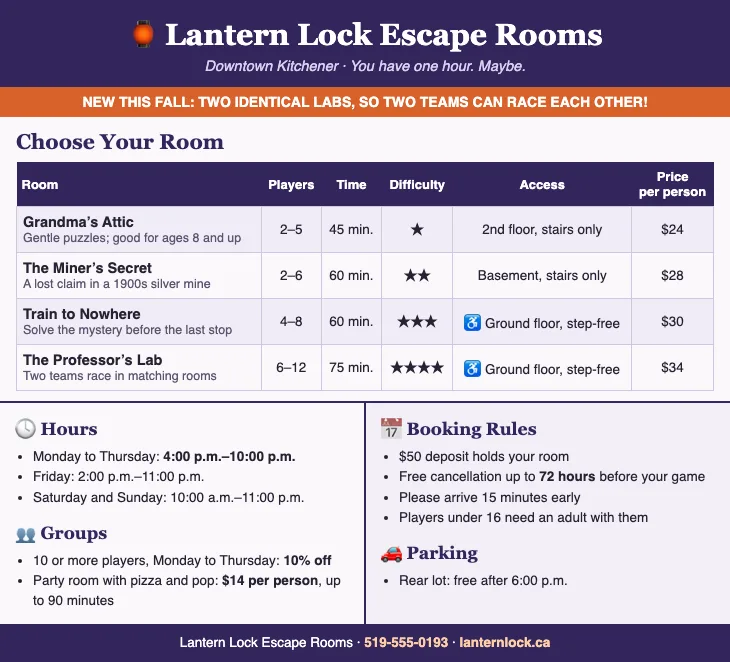
Read the following email message about the diagram on the left. Complete the email by filling in the blanks. Select the best choice for each blank from the drop-down menu.
Subject: Thank-you night for the Tuesday crew
To: Ken Adebayo
From: Marisol Reyes
Hi Ken,
Thanks again for offering to help me plan something for the Tuesday sorting crew. After a whole year of giving up their evenings at the food bank without a cent in return, they deserve a treat. I found a flyer for Lantern Lock downtown, and I think it could be just the thing.
There will be ten of us, including Farid, who uses a wheelchair, and I’d like everyone to play at the same time. That means the is our best bet. It’s the priciest room at a person, but because there are ten of us and we’d go on a Tuesday, we’d get off.
Our shift wraps up at 5:30, and the parking at the back is free after six. Since they want us there 15 minutes early, if we , nobody will have to pay for parking. I’ll put down the deposit, but please let me know if the date is a problem. We can cancel for free up to ahead, and I’d hate to lose the money.
Talk soon,
Marisol
Marisol and Ken know each other because they
Why is Marisol planning this outing?
When Marisol says the room is “our best bet,” she means that it is
Part 3: Reading for Information
Paragraph A
In 1967, Canada celebrated its hundredth birthday, and Montreal marked the occasion by hosting a world’s fair, Expo 67. The fair was held on islands in the St. Lawrence River, including Île Sainte-Hélène, which was enlarged for the event, and Île Notre-Dame, which was built largely from rock dug out during the construction of the city’s new metro. Dozens of countries put up pavilions, and over six months the fair recorded more than 50 million visits. Among the most popular buildings was the pavilion of the United States: a huge, see-through sphere that seemed almost to float above the trees. Another landmark of the fair, the Habitat 67 housing complex, still stands across the water from the islands.
Paragraph B
The pavilion was designed by the American inventor and architect R. Buckminster Fuller, who was known for his geodesic domes. He had spent years promoting them as an efficient way to cover large spaces using very little material. Such a dome is made of a network of triangles, a shape that spreads weight evenly, so the structure can be both very light and very strong. The Montreal dome was built from thousands of steel tubes and covered with clear acrylic panels. Inside, visitors found displays of American art, film and space exploration, and the fair’s elevated Minirail train passed right through the building, giving passengers a view of the exhibits from above.
Paragraph C
After Expo closed, many of its pavilions stayed open for several summers as part of an exhibition called Man and His World, and the sphere remained one of its attractions. Over time, however, some of the other pavilions were closed or taken down. Then, in 1976, a fire broke out during repair work. The acrylic covering caught fire and was destroyed in a short time, but the steel frame survived largely undamaged. Photographs of the blackened skeleton standing against the sky became a sad symbol of how far the site had fallen since the great days of the fair.
Paragraph D
For years afterward, the bare frame stood empty on the island while people debated what to do with it. Proposals came and went, and some feared that the structure would eventually be torn down. In the end, the federal government chose to give it a new life, and the building reopened in 1995 as a museum devoted to the environment. Today, it is known as the Biosphère, a name taken from the word for the part of the Earth where life exists, and its exhibits help visitors understand issues such as climate change, water and biodiversity, while the steel frame itself remains one of Montreal’s best-known landmarks. Visitors can still walk beneath it, and on a clear day the views across the river toward downtown are striking.
Decide which paragraph, A to D, has the information given in each statement below. Select E if the information is not given in any of the paragraphs.
- Part of the fair was held on land made specially for it.
- The shape used in the dome allowed it to be light without being weak.
- Buckminster Fuller returned to Montreal to oversee the dome’s repairs.
- Visitors could ride through the pavilion on a raised train.
- The building lost its outer skin but kept its structure.
- The structure went unused for a long period while its future was uncertain.
- The site now aims to teach the public about the natural world.
- The United States pavilion drew more visitors than any other at the fair.
- The fair was held to mark an important national anniversary.
Part 4: Reading for Viewpoints
Each summer, Port Sable’s population of 4,000 roughly triples as tourists descend on its beaches, lighthouse and seafood restaurants. Council now contemplates a municipal accommodation tax adding 3 percent to every night in a hotel, inn, campground or short-term rental, or just over five dollars on a $180 room. Staff project annual revenue of about $600,000. Several larger Canadian cities already impose such a charge, and revised provincial rules now permit smaller towns to follow.
Mayor Elaine Cormier regards the tax as correcting an imbalance. Property taxes finance the public washrooms, additional garbage collection and lifeguards on which visitors depend. “Our year-round residents are subsidizing everyone else’s vacation,” she contends. She would allocate half the proceeds to spring and fall promotion, when local businesses languish, and half to heavily used services.
Gilles Arsenault, proprietor of the six-room Gull Point Inn, remains skeptical. Families booking in July are financially stretched, he maintains, and scrutinize prices to the dollar. “If Port Sable costs more than Cape Morrow up the road, some of them will drive the extra twenty minutes.” A regional tax collected along the entire coast, he admits, would dissolve most of his objection. He would also feel easier seeing the revenue materialize “in a new boardwalk, not in a line of a budget nobody reads.”
Dr. Nadia Rahman, a provincial university specialist in tourism economics, considers anxieties about lost bookings largely overblown. Comparable taxes, the research suggests, seldom redirect travellers, for whom scenery, beaches and restaurants weigh far more than several dollars. The genuine hazard, she cautions, comes afterward: “Once the money arrives, there is always pressure to use it to plug holes in the general budget.” Her remedy is a bylaw that legally reserves the revenue for tourism and mandates a published report annually.
Bev Doucette, a Front Street resident for over fifty years, welcomes the tax yet sees no reason to advertise a community whose streets already congest every August. “Visitors should instead contribute toward the wear and tear,” she insists, citing cracked sidewalks and a rental housing shortage she attributes partly to short-term rentals. Every dollar, in her estimation, belongs in roads and residents’ housing.
Arsenault and Rahman would likely agree that
What does Arsenault assume in mentioning Cape Morrow?
Why would Dr. Rahman want a spending bylaw?
Where do Doucette and Cormier part ways?
What can be inferred from the article?
The following is a comment by a visitor to the website page. Complete the comment by choosing the best option to fill in each blank.
For twelve years I have rented a Port Sable cottage every July, so this tax is aimed squarely at people like me. Contrary to Mr. Arsenault’s fears, , at least if my family is typical. And awkward as it is to admit, the mayor’s case is hard to rebut: .
What worries me is Ms. Doucette’s plan to . Here I’m with the innkeeper: what I want to see is . And the economist’s second safeguard, , would cost next to nothing. A tax I can see at work is a tax I will gladly pay.
Answer key
Count your correct answers, then find your estimated CLB:
Show all 38 answers
- Walter is writing mainly to C. give Danny the chance to buy the business.
- Why is Walter retiring? A. His health and his family are pulling him away.
- What does the story about Mr. Tierney show? D. Customers have come to rely on Danny.
- What does Walter think would happen if he sold to the chain? B. The store would soon be shut down.
- How does Walter suggest that Danny could pay for the store? C. partly now and the rest over time
- We can reasonably conclude that Danny B. is not very fond of keeping accounts.
- D. the grandkids out east
- A. the full amount at once
- B. stay on part-time for the first months
- D. a storage space for a big company
- A. end-of-February
- D. Professor’s Lab
- B. $34
- A. 10%
- C. book a game for 6:30
- A. three days
- Marisol and Ken know each other because they B. volunteer on the same team.
- Why is Marisol planning this outing? D. to thank people for a year of help
- When Marisol says the room is “our best bet,” she means that it is C. the most suitable choice.
- Part of the fair was held on land made specially for it. A
- The shape used in the dome allowed it to be light without being weak. B
- Buckminster Fuller returned to Montreal to oversee the dome’s repairs. E
- Visitors could ride through the pavilion on a raised train. B
- The building lost its outer skin but kept its structure. C
- The structure went unused for a long period while its future was uncertain. D
- The site now aims to teach the public about the natural world. D
- The United States pavilion drew more visitors than any other at the fair. E
- The fair was held to mark an important national anniversary. A
- Arsenault and Rahman would likely agree that B. the spending should be visible.
- What does Arsenault assume in mentioning Cape Morrow? C. small price gaps move families
- Why would Dr. Rahman want a spending bylaw? A. Council could divert the money.
- Where do Doucette and Cormier part ways? D. where the revenue should go
- What can be inferred from the article? C. Supporters disagree on the tax’s purpose.
- A. a minor charge seldom changes plans
- D. residents pay for my vacation
- B. spend it all on residents
- C. something you can walk on
- A. a yearly report
What does your score mean? See the CELPIP Reading score chart.
Free CELPIP practice test · Free CELPIP Listening practice tests · CELPIP sample tests by part
CELPass is an independent practice platform and is not affiliated with Paragon Testing Enterprises. CELPIP is a trademark of Paragon Testing Enterprises. Check the official CELPIP website and IRCC for current test rules and requirements.