CELPIP Reading Practice Test 129
By Iris
A complete CELPIP Reading practice test: all 4 parts and 38 questions in the real test order. Set a timer for 55–60 minutes and do all four parts in one sitting. Check your answers at the bottom of the page to see your score and an estimated CLB.
Download as PDF with answer key
In this test
- Part 1: Reading Correspondence, “An Invitation to Ride the Train West” (questions 1–11) · practise this part alone
- Part 2: Reading to Apply a Diagram, “A Balloon Flight for a Sixtieth Birthday” (questions 12–19) · practise this part alone
- Part 3: Reading for Information, “Snowy Owls: Hunters of the Tundra” (questions 20–28) · practise this part alone
- Part 4: Reading for Viewpoints, “Dogs on Restaurant Patios in Wexley Debate” (questions 29–38) · practise this part alone
Part 1: Reading Correspondence
Dear Celeste,
I hope your first term of teaching is going well. Your mother tells me you have twenty-eight Grade 4 students and a principal who actually answers emails, which sounds like a promising start.
I am writing with a proposal, and I want you to take your time before answering. For as long as I can remember, your Uncle Doug and I talked about taking the train across the country to Vancouver. We kept putting it off: first it was the mortgage, then the children, then his knee. Now that he is gone, I have realized that if I keep waiting for the perfect moment, I will never go. So I have decided to go next summer, and I would love for you to come with me.
The trip takes nearly four days, and I am thinking of leaving Toronto in the second week of July, once your school year is over. I would pay for both tickets and for a sleeper cabin, and I would book you a flight home whenever you are ready to leave. I know a first-year teacher’s salary doesn’t leave much room for holidays, and honestly, I would be getting the better end of the deal. My eyesight isn’t what it used to be, and I would feel far more confident with someone to help me with the luggage and the changes of platform.
Once we arrive, I would like to spend a week in Vancouver. My old friend Marguerite has offered us her guest suite in Kitsilano, and she has promised to take us to Granville Island and over to the gardens in Victoria. You would be free to explore on your own whenever you like. I won’t need company every minute, and I suspect you will want a break from your old aunt after four days in a small cabin.
There is one more thing I should mention. The cabin price I was quoted is only available if I book before the end of January, so I would need your answer by the middle of the month. If the timing doesn’t suit you, please don’t feel guilty. I would simply ask your cousin Hugo, although, between us, I expect he would spend the whole trip looking at his phone.
With love,
Aunt Mira
Mira is writing mainly to
Why did Mira and Doug never take the trip together?
Why does Mira say she “would be getting the better end of the deal”?
What does Mira say about their week in Vancouver?
By when does Mira need Celeste’s answer?
We can reasonably conclude that Hugo
Here is a response to the message. Complete the response by filling in the blanks. Select the best choice for each blank from the drop-down menu.
Dear Aunt Mira,
Your letter made my whole week. I know how many years you and Uncle Doug , and I’m honoured that you would want me to share it with you.
I’ve checked my calendar, and the timing is perfect: , so leaving in the second week of July is no problem at all. I do have one condition, though. Please let me pay for . I would feel much better contributing something.
I’ll happily look after the suitcases and make sure we don’t miss . And once we reach Vancouver, I promise to give you plenty of time with Marguerite, and to spend less time on my phone than would.
So my answer, well before your deadline, is yes!
Love,
Celeste
Part 2: Reading to Apply a Diagram
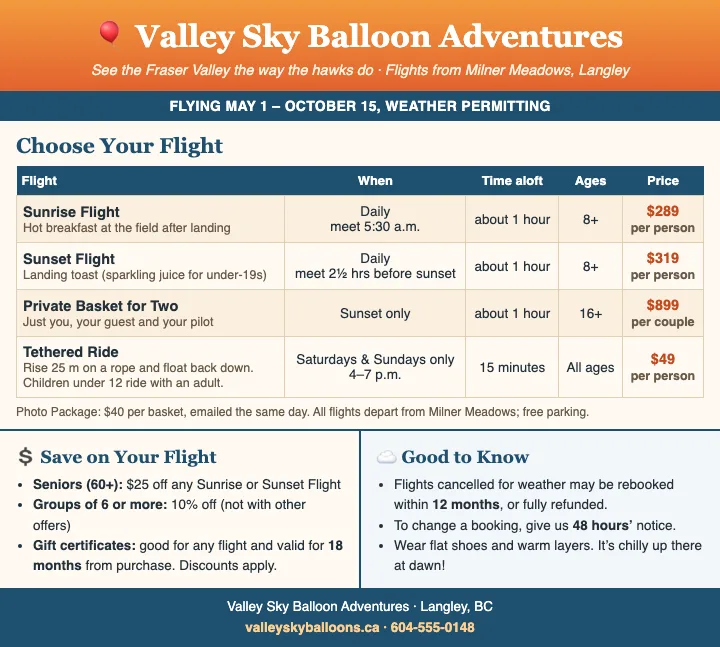
Read the following email message about the diagram on the left. Complete the email by filling in the blanks. Select the best choice for each blank from the drop-down menu.
Subject: An idea for Mom’s birthday
To: Theo Lindqvist
From: Nadia Okafor
Hi Theo,
I think I’ve finally found the perfect present for Mom’s sixtieth. Remember how she’s always said she’d love to see the valley from the air? This flyer came in the mail last week.
Mom’s an early riser, and she’ll never say no to a meal she doesn’t have to cook, so I’m leaning towards the . Dad says he’d rather keep his feet on the ground, so it would be just you, Mom and me in the basket. And since Mom is turning sixty, she qualifies for the seniors’ discount, which brings her ticket down to .
Your boys could still join in. At five and seven, they’re too young for a real flight, but the is open to all ages. The only catch is that it runs , so we’d have to plan around their Saturday hockey games.
Since the weather can be so unpredictable, I’d rather buy a gift certificate than choose a date now. That way, Mom will have to pick a day that suits her.
Shall we split the cost with Jenna, the way we did for Dad’s new bike?
Nadia
Nadia and Theo are
Why does Nadia want to buy a gift certificate?
When Nadia says that Dad would “rather keep his feet on the ground,” she means that he
Part 3: Reading for Information
Paragraph A
With its bright yellow eyes and thick white feathers, the snowy owl is one of the most recognizable birds in North America, and in 1987 it was named the official bird of Quebec. It is also one of the continent’s largest owls, with wings that can stretch about one and a half metres from tip to tip, and it is generally considered the heaviest. Adult males are often almost pure white, while females and young birds are marked with dark bars and spots, a difference that allows experienced birdwatchers to tell them apart from a distance. The owl’s feathers are unusually dense and cover even its legs and toes, which helps it survive temperatures far below freezing.
Paragraph B
Snowy owls nest on the open Arctic tundra, well beyond the tree line. The female chooses a slight rise in the ground, from which she can watch for danger, and scrapes a shallow hollow there; she does not build a nest of sticks or grass as many birds do. During the breeding season, the sun barely sets in the far north, so unlike most owls, snowy owls do much of their hunting in daylight. Their main prey in summer is the lemming, a small rodent whose numbers rise and fall dramatically from year to year. When lemmings are plentiful, a pair may raise a large family, but when they are scarce, the owls may lay only a few eggs or not breed at all.
Paragraph C
Most snowy owls move south for the winter, although how far they travel varies greatly. Some remain surprisingly far north, while others reach the southern Prairies, the Great Lakes region and beyond. In certain winters, unusually large numbers appear well south of their normal range, an event known as an irruption. For many years, it was assumed that hunger drove the owls south after lemming populations crashed. More recent research, however, suggests that irruptions often follow a very successful breeding season, when many young owls must spread out to find territories of their own. Indeed, most of the snowy owls seen in the south during these winters are young birds, and scientists have begun fitting some of them with small tracking devices to learn more about where they go.
Paragraph D
Once they arrive in the south, snowy owls are drawn to wide, open spaces that resemble the tundra, such as farm fields, shorelines and, more surprisingly, airports. Large airports offer flat ground, few trees and plenty of small animals to hunt, but owls near runways can be a danger to aircraft. Several airports in Canada and the United States have therefore trapped owls and released them in safer areas far away. Wildlife experts also urge the public to watch owls from a distance. A bird that is repeatedly disturbed uses up energy it needs to survive the winter, and photographers who put out food to attract owls can teach them to approach people and vehicles.
Decide which paragraph, A to D, has the information given in each statement below. Select E if the information is not given in any of the paragraphs.
- The pattern of a snowy owl’s feathers can help observers identify its sex.
- Snowy owls hunt mostly at night once they reach their winter range.
- An older explanation of why owls sometimes travel far south has been called into question.
- Long hours of sunlight help explain an unusual habit of the snowy owl.
- Feeding owls to get a better picture can change the way they behave.
- Owls moved away from airports usually find their way back within a few weeks.
- How many young a pair raises depends partly on the food available.
- Birds in their first years make up most of the owls seen in the south during an irruption.
- No other owl in North America is heavier on average.
Part 4: Reading for Viewpoints
Wexley’s dog owners have long tethered their pets to lampposts or left them at home while enjoying a downtown coffee. Councillor Dana Whitcombe now asks council to permit leashed dogs on the sidewalk patios restaurants rent from the town each summer, though never inside the premises. Each establishment would decide independently, with a sign at the entrance announcing its policy.
Whitcombe presents this as overdue catching up. Visitors from the city, she recounts, arrive with their animals, discover nowhere to sit, and continue to the next town, taking their spending with them. She considers objections overwrought, given that dogs already occupy the adjoining sidewalk: “We’re not talking about dogs in kitchens.” “A further year of study would merely revive identical arguments next spring,” she warns.
Luis Ferreira, owner of the Lantern Café on Main Street, is cautiously sympathetic but suspects the councillor underestimates the logistics. His patio accommodates only eight tables, and servers manoeuvre hot plates through narrow gaps. “One dog asleep under a table is charming. Three dogs who don’t get along is a disaster.” He favours beginning with weekday afternoons, and wants council to state unequivocally that owners, not restaurants, answer for any bite.
Priya Natarajan, who chairs the town’s accessibility committee, displays considerably less enthusiasm. “Those most affected haven’t been consulted,” she contends: residents with serious allergies, others frightened of dogs, people for whom a downtown patio represents a rare comfortable place to eat outdoors. Service animals, already permitted everywhere, concern her too, since an excited pet at a neighbouring table can distract one and thereby endanger its handler. She insists on a survey of residents preceding any vote.
Dog trainer Grant Holloway, with fifteen years’ experience among Wexley families, finds merit in the idea while noting how much depends on temperament. “Plenty of dogs are perfectly calm in public. Plenty aren’t, and their owners are usually the last to admit it.” Instead of restaurant-by-restaurant discretion, he recommends that council establish simple regulations, such as short leashes and no dogs on chairs, applicable wherever customers go. A trial season, he adds, would reveal whether complaints materialize.
Which two people hold the most similar positions?
What lies behind Natarajan’s opposition?
How does Holloway’s suggestion differ from Whitcombe’s plan?
If the motion passes, what can we conclude?
The most suitable title would be
The following is a comment by a visitor to the website page. Complete the comment by choosing the best option to fill in each blank.
As someone who walks a large retriever downtown most mornings, I welcome this motion, though the councillor makes it sound easier than it is. Mr. Ferreira is right that a crowded patio is no place for a nervous animal.
Not unlike , I suspect that some dogs should simply stay home, and that too many people misjudge their own animals.
Nor am I convinced by the argument that visitors if they can’t bring a dog to lunch. People choose a town for its shops and scenery.
Still, Ms. Natarajan alone has noticed that an excited pet can . So before any vote, council should .
Martin Desjardins, Wexley
Answer key
Count your correct answers, then find your estimated CLB:
Show all 38 answers
- Mira is writing mainly to B. invite Celeste on a trip she will pay for.
- Why did Mira and Doug never take the trip together? D. Other concerns kept getting in the way.
- Why does Mira say she “would be getting the better end of the deal”? A. Celeste’s help would mean more to her than the cost.
- What does Mira say about their week in Vancouver? C. Celeste can spend some of the time on her own.
- By when does Mira need Celeste’s answer? B. the middle of January
- We can reasonably conclude that Hugo D. would not be Mira’s first choice of companion.
- C. kept postponing this trip
- A. my classes end in late June
- D. my own flight home
- B. any of our changes of platform
- C. Hugo
- A. Sunrise Flight
- B. $264
- C. Tethered Ride
- B. on weekends only
- D. a year and a half
- Nadia and Theo are C. brother and sister.
- Why does Nadia want to buy a gift certificate? A. The weather makes it hard to choose a date now.
- When Nadia says that Dad would “rather keep his feet on the ground,” she means that he D. prefers not to go up in the balloon.
- The pattern of a snowy owl’s feathers can help observers identify its sex. A
- Snowy owls hunt mostly at night once they reach their winter range. E
- An older explanation of why owls sometimes travel far south has been called into question. C
- Long hours of sunlight help explain an unusual habit of the snowy owl. B
- Feeding owls to get a better picture can change the way they behave. D
- Owls moved away from airports usually find their way back within a few weeks. E
- How many young a pair raises depends partly on the food available. B
- Birds in their first years make up most of the owls seen in the south during an irruption. C
- No other owl in North America is heavier on average. A
- Which two people hold the most similar positions? C. Ferreira and Holloway
- What lies behind Natarajan’s opposition? B. Residents at risk weren’t heard.
- How does Holloway’s suggestion differ from Whitcombe’s plan? A. He favours common rules everywhere.
- If the motion passes, what can we conclude? D. Some patios might refuse dogs.
- The most suitable title would be B. “Patio Dogs: Worth a Careful Try”
- A. where servers squeeze by
- D. Mr. Holloway
- C. will keep on driving
- A. unsettle an animal on duty
- B. canvass those she speaks for
What does your score mean? See the CELPIP Reading score chart.
Free CELPIP practice test · Free CELPIP Listening practice tests · CELPIP sample tests by part
CELPass is an independent practice platform and is not affiliated with Paragon Testing Enterprises. CELPIP is a trademark of Paragon Testing Enterprises. Check the official CELPIP website and IRCC for current test rules and requirements.