CELPIP Reading Practice Test 132
By Iris
A complete CELPIP Reading practice test: all 4 parts and 38 questions in the real test order. Set a timer for 55–60 minutes and do all four parts in one sitting. Check your answers at the bottom of the page to see your score and an estimated CLB.
Download as PDF with answer key
In this test
- Part 1: Reading Correspondence, “A Request for a Crossing on Birch Avenue” (questions 1–11) · practise this part alone
- Part 2: Reading to Apply a Diagram, “Renting a Tent for a Backyard Graduation Party” (questions 12–19) · practise this part alone
- Part 3: Reading for Information, “The Athabasca Glacier and the Columbia Icefield” (questions 20–28) · practise this part alone
- Part 4: Reading for Viewpoints, “A Cellphone Ban in Larkfield’s High Schools Debate” (questions 29–38) · practise this part alone
Part 1: Reading Correspondence
Dear Councillor Okoro,
My name is Rebecca Lindsay, and I have lived on Birch Avenue, in your ward, for eleven years. I am writing to ask for your help in getting a pedestrian crossing installed at the corner of Birch Avenue and Carlton Street, beside Westview Elementary School.
When we moved here, Birch Avenue was a quiet residential street. Since the new shopping plaza opened on Route 9 two years ago, however, many drivers have started using it as a shortcut, and morning traffic has become heavy. Drivers in a hurry rarely slow down for the school zone signs, either. The nearest traffic light is at Main Street, more than four hundred metres away, so most children and parents simply cross at Carlton, dodging cars as they go. Last month, my neighbour’s eight-year-old son was nearly struck by a delivery van whose driver had not seen him step off the curb. Thankfully, he was only badly shaken.
The school does have a crossing guard, Mr. Fournier, but he is on duty only from 8:15 to 8:45 in the morning and from 3:00 to 3:30 in the afternoon. Many older students stay for clubs and sports until five o’clock, and they cross with no help at all. In winter, when it is already getting dark by then, the situation is even more worrying.
I raised this issue with the city’s transportation department last spring and was told that a crossing could not be considered until a traffic study had been completed. I was promised that the study would be done in the fall, but as far as I can tell, nothing has happened.
Since then, several parents and I have collected more than two hundred signatures in support of a crossing with flashing lights, and the school’s parent council has voted unanimously to back our request. Several shop owners on Carlton Street have also offered to display our posters. We would be grateful for the chance to present our petition at the next council meeting, or to meet you at the corner some morning so that you can see the traffic for yourself.
Thank you for taking the time to consider this matter. I look forward to hearing from you.
Sincerely,
Rebecca Lindsay
Rebecca is writing mainly to
Why has traffic on Birch Avenue increased?
What happened to the neighbour’s son?
Rebecca is worried about the older students because they
What did the transportation department tell Rebecca?
We can reasonably conclude that Rebecca
Here is a response to the message. Complete the response by filling in the blanks. Select the best choice for each blank from the drop-down menu.
Dear Ms. Lindsay,
Thank you for your letter about the corner of Birch Avenue and Carlton Street. I was concerned to hear about the boy who was nearly hit by last month.
I have checked with the transportation department, and I am sorry to say that the traffic study you were promised . I have asked staff to complete it before the end of this month, and to count traffic in the late afternoon as well, since many students stay for .
I would also be glad to accept your invitation to . Would next Tuesday at 8:15 suit you?
Finally, please bring your to the council meeting on November 18. I have added your group to the agenda.
Yours sincerely,
Daniel Okoro
Councillor, Ward 4
Part 2: Reading to Apply a Diagram
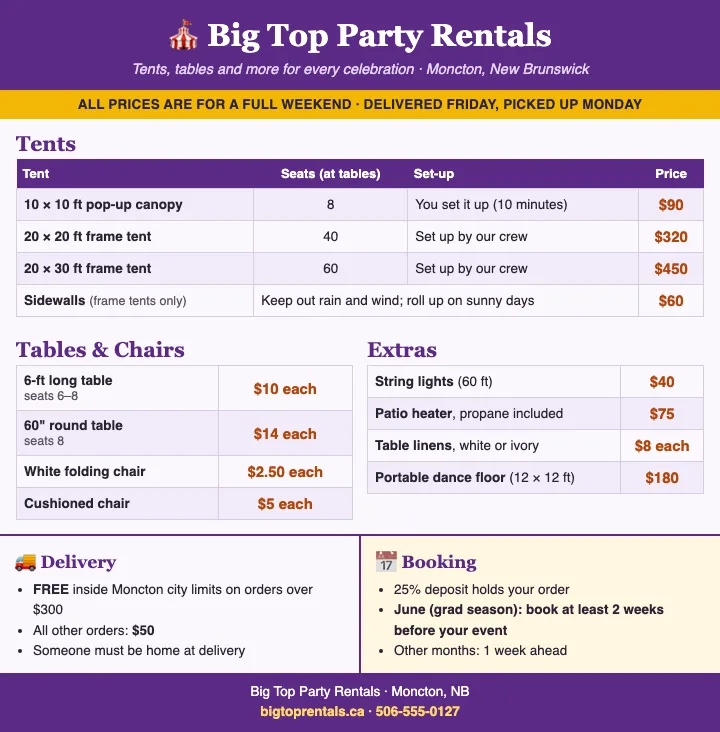
Read the following email message about the diagram on the left. Complete the email by filling in the blanks. Select the best choice for each blank from the drop-down menu.
Subject: Grad party rentals
To: Marco Bellini
From: Grace Thibodeau
Hi Marco,
Now that Ella and Josh have both finished their exams, I think it’s time we booked everything for their party. Since we took down the fence between our backyards last summer, there’s plenty of room for one big tent across both yards. I’ve attached the flyer from Big Top Rentals.
With both our families, the kids’ friends and all four grandparents, we’re looking at about forty-five people, so we’ll need the . The forecast for late June looks unsettled, so I’d also add , just in case it rains.
I know you liked the long tables, but I think round ones are friendlier for conversation. We’d need six of them, which would come to . That won’t break the bank, especially split between us.
Our order will easily be over $300, and we both live inside the city limits, so . Best of all, their crew sets up the bigger tents, so you won’t have to spend Friday evening reading instructions!
The party is on Saturday, June 27, and since it’s grad season, we’ll need to book by at the latest.
Talk soon,
Grace
Grace and Marco are
What does Grace say about the round tables?
When Grace says the tables “won’t break the bank,” she means the cost
Part 3: Reading for Information
Paragraph A
High in the Canadian Rockies, near the boundary between Banff and Jasper national parks, lies the Columbia Icefield, the largest body of ice in the Rocky Mountains, covering more than two hundred square kilometres. An icefield forms where more snow falls each winter than melts each summer. Over centuries, the snow is pressed into thick layers of ice, which slowly flow outward and downhill. Because the icefield sits on high ground, its meltwater drains in different directions, eventually reaching three oceans: the Pacific, the Atlantic and the Arctic. Few places anywhere in the world can make the same claim.
Paragraph B
Several glaciers flow down from the edges of the icefield like fingers from a hand, but one is far better known than the others. The Athabasca Glacier ends only a short walk from the Icefields Parkway, the scenic highway that links Lake Louise and Jasper. Running for more than two hundred kilometres past lakes, waterfalls and rugged peaks, the parkway is often described as one of the most beautiful drives in the world. As a result, it is one of the most visited glaciers in North America. Travellers driving the parkway can pull into a parking area, follow a trail to the foot of the glacier and stand within metres of ice that may have fallen as snow hundreds of years ago.
Paragraph C
The trail itself tells a story. Along the way, small signs mark where the edge of the glacier stood in particular years, and the distance between the oldest markers and today’s ice is striking. Over the past century and more, the Athabasca Glacier has retreated well over a kilometre and lost a large share of its volume. A glacier shrinks when more ice melts at its lower end each summer than arrives from higher up, and that has been the case here for a long time. On average, its edge moves back several metres every year. Scientists study the glacier closely because changes there offer a visible measure of how warming temperatures are affecting mountain ice across western Canada.
Paragraph D
For all its accessibility, the glacier can be dangerous. Its surface is crossed by deep cracks called crevasses, which may be hidden beneath a thin layer of snow, and people who walk onto the ice without proper equipment have fallen into them. Visitors are therefore urged to stay behind the barriers unless they are with a trained guide. Even at the edge of the ice, meltwater streams are fast and extremely cold. Those who want to go farther can join a guided walk or ride one of the large all-terrain buses built specially for travel on ice, which carry passengers onto the glacier during the warmer months of the year. Across the highway, a visitor centre offers views of the glacier and exhibits about the icefield.
Decide which paragraph, A to D, has the information given in each statement below. Select E if the information is not given in any of the paragraphs.
- Water melting from the icefield ends up in more than one ocean.
- Hidden openings in the ice make walking on it without a guide risky.
- Signs show visitors how far the ice has pulled back over time.
- The glacier has been melting more slowly in recent years.
- The glacier is easy to reach for people travelling by car.
- Some ways of exploring the glacier are offered only at certain times of year.
- Visitors must pay a separate fee to walk to the foot of the glacier.
- The icefield feeds more than one glacier.
- Researchers see the glacier as a sign of wider changes in the region.
Part 4: Reading for Viewpoints
Students returning to Larkfield’s three public high schools next September may find their phones unwelcome. A policy before the school board, scheduled for a vote six months beforehand, would require devices to remain switched off in lockers throughout the day, lunch and breaks included. Trustees report receiving more correspondence on this issue than on any other in recent memory.
Trustee Sandra Kwan, the motion’s sponsor, contends that teachers have sought assistance for years. Existing regulations prohibit phones in class “unless a teacher allows them,” a formula applied so inconsistently that it has become meaningless, with the opening minutes of lessons squandered on negotiation. She also invokes the board’s own survey, in which over sixty percent of students acknowledged feeling obliged to answer messages during school hours.
Vice-principal Martin Leclerc, a fifteen-year veteran of Larkfield Secondary, endorses prohibition during lessons but considers the lunch-hour restriction excessive. Adolescents, he argues, acquire self-management only through practice, “and they won’t learn that if we simply lock them away.” He further wonders who would monitor hallways and cafeterias, where adults are comparatively scarce, and fears that staff would end up confiscating devices all day.
Parent Olivia Mensah objects on different grounds. Her daughter, who has diabetes, monitors her blood sugar through a phone app. The draft does provide medical exemptions, but only once a family has explained a child’s condition to the school; some, Mensah predicts, will simply go without. “In any emergency at the school, I expect direct contact, not a belated email from the office,” she says.
Grade 12 student Ravi Bhatt, the board’s student trustee, readily admits that phones distract many classmates and accepts keeping them invisible during lessons. “A lunch-hour ban, though, would chiefly penalize responsible students arranging rides, checking work shifts or finding a bus,” he says. His compromise: a strict classroom prohibition, applied identically everywhere, with phones permitted at lunch and between periods.
Kwan professes herself receptive to amendments, while remaining convinced that half-measures have already failed. “We’ve tried leaving it up to individual teachers,” she observes. “The result is the situation we have now.”
On what do Leclerc and Bhatt agree?
Leclerc suggests a classroom ban is more workable because of
Why might some families skip the medical exemption?
What does Trustee Kwan’s closing position suggest?
An appropriate title would be
The following is a comment by a visitor to the website page. Complete the comment by choosing the best option to fill in each blank.
I teach math at a Larkfield high school, and Trustee Kwan isn’t exaggerating. The present rule, which lets , has turned my first ten minutes into a daily argument.
Mr. Leclerc’s anxiety about deserves a hearing, though anxiety alone is no policy. Ms. Mensah raises a fair point too, yet the draft already allows for , and the board can handle such matters sensitively.
As for Ravi Bhatt’s compromise, lunch would simply become the new battleground. Most students, after all, have told the board that they . A break would do them good. Trustees who pass the full-day ban in will give families a whole summer to prepare.
Noah Pelletier, Larkfield
Answer key
Count your correct answers, then find your estimated CLB:
Show all 38 answers
- Rebecca is writing mainly to C. ask for a safer place for people to cross.
- Why has traffic on Birch Avenue increased? A. Drivers cut through it since the plaza opened.
- What happened to the neighbour’s son? A. He was frightened but not hurt.
- Rebecca is worried about the older students because they D. often cross after the guard has left.
- What did the transportation department tell Rebecca? D. A crossing would have to wait for a study.
- We can reasonably conclude that Rebecca D. doubts that the promised study was carried out.
- A. a delivery vehicle
- C. was never actually done
- D. after-school activities
- A. see the morning traffic myself
- B. list of signatures
- A. 20 × 30 ft frame tent
- B. sidewalls
- D. $84
- B. delivery will be free
- C. June 13
- Grace and Marco are D. neighbours.
- What does Grace say about the round tables? C. They make it easier for guests to talk.
- When Grace says the tables “won’t break the bank,” she means the cost B. is not too high.
- Water melting from the icefield ends up in more than one ocean. A
- Hidden openings in the ice make walking on it without a guide risky. D
- Signs show visitors how far the ice has pulled back over time. C
- The glacier has been melting more slowly in recent years. E
- The glacier is easy to reach for people travelling by car. B
- Some ways of exploring the glacier are offered only at certain times of year. D
- Visitors must pay a separate fee to walk to the foot of the glacier. E
- The icefield feeds more than one glacier. B
- Researchers see the glacier as a sign of wider changes in the region. C
- On what do Leclerc and Bhatt agree? B. the lunch ban is excessive
- Leclerc suggests a classroom ban is more workable because of A. the number of adults present
- Why might some families skip the medical exemption? D. They value privacy.
- What does Trustee Kwan’s closing position suggest? D. The draft may change.
- An appropriate title would be A. “Larkfield’s Phone Ban: How Far Is Too Far?”
- C. each teacher set the terms
- B. policing the lunch hour
- C. cases like her daughter’s
- A. can’t ignore their messages
- C. March
What does your score mean? See the CELPIP Reading score chart.
Free CELPIP practice test · Free CELPIP Listening practice tests · CELPIP sample tests by part
CELPass is an independent practice platform and is not affiliated with Paragon Testing Enterprises. CELPIP is a trademark of Paragon Testing Enterprises. Check the official CELPIP website and IRCC for current test rules and requirements.