CELPIP Reading Practice Test 64
By Iris
A complete CELPIP Reading practice test: all 4 parts and 38 questions in the real test order. Set a timer for 55–60 minutes and do all four parts in one sitting. Check your answers at the bottom of the page to see your score and an estimated CLB.
Download as PDF with answer key
In this test
- Part 1: Reading Correspondence, “Pothole Damage Compensation Request” (questions 1–11) · practise this part alone
- Part 2: Reading to Apply a Diagram, “Choosing an Apartment Near Campus” (questions 12–19) · practise this part alone
- Part 3: Reading for Information, “The Group of Seven And Their Influence” (questions 20–28) · practise this part alone
- Part 4: Reading for Viewpoints, “Fast Fashion And Clothing Waste Rules” (questions 29–38) · practise this part alone
Part 1: Reading Correspondence
Dear Councillor Beaulieu,
I am writing to you as a resident of Ward 6 to ask for your help with a claim that I believe the city has handled unfairly. On the evening of March 18, I was driving home along Kildare Avenue when my car hit a deep pothole just east of the Lindsay Road intersection. The hole was almost impossible to see because it was filled with water from melting snow. The impact burst my front tire, bent the wheel rim and damaged the suspension. A tow truck took the car to a garage, where the repairs came to $1,870.
This pothole was not new. My neighbour, Mrs. Osei, reported it through the city’s 311 line on March 4, two full weeks before my accident, and she still has the confirmation number. Several other drivers on our street have told me their cars were damaged at the same spot. Despite this, the hole was only filled on March 22, four days after my accident.
I submitted a claim to the city’s Risk Management office on March 25, along with my repair invoice, the towing receipt and photographs of the pothole. Last week I received a letter rejecting it. According to the letter, the city is responsible only if it fails to repair a pothole within a reasonable time after being told about it, and the office could find no record of any complaint before my accident. I find this hard to accept. I have since sent them Mrs. Osei’s confirmation number, but I have not received a reply.
I understand that the city cannot fix every pothole the moment it appears, especially after a hard winter like this one. However, I do not think it is fair to expect residents to pay for damage that could have been prevented if the city had acted on a report it had already received. My insurance company has told me I could make a claim, but I would have to pay a $1,000 deductible, and my premiums would likely go up.
I would be grateful if you could ask the Risk Management office to look at my file again in light of the earlier complaint. I am not asking for anything beyond the actual cost of the repairs and the tow. I would also urge you to look into how 311 reports are tracked, as it seems that some of them are being lost.
I can be reached at 204-555-0193 at any time. Thank you for your attention to this matter.
Sincerely,
Gordon Achebe
Why is Gordon writing to Councillor Beaulieu?
Why did Gordon fail to notice the pothole?
Gordon mentions that Mrs. Osei
Why was Gordon’s claim rejected?
Gordon does not want to use his insurance because it
Gordon’s attitude toward the city is best described as
Here is a response to the message. Complete the response by filling in the blanks. Select the best choice for each blank from the drop-down menu.
Dear Mr. Achebe,
Thank you for your letter, and I am sorry to hear about the damage to your car. I have spoken with staff in the Risk Management office, and they have agreed to now that Mrs. Osei’s report has been found. It appears it was , which is why it did not come up when they searched their records.
If the review confirms that the city was told about the pothole on March 4, you should be reimbursed for . Please keep your original receipts in case staff ask to see them.
I share your concern about . I have asked for a report on how complaints are recorded and will raise the issue at the next council meeting.
Thank you for your patience. I understand how frustrating it is to for a problem that was reported well in advance.
Sincerely,
Anne Beaulieu
Part 2: Reading to Apply a Diagram
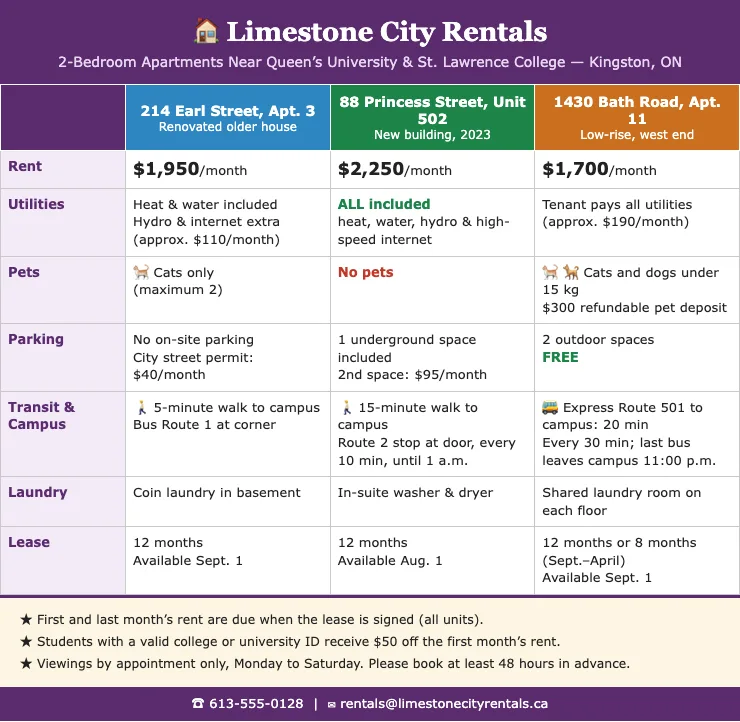
Read the following email message about the diagram on the left. Complete the email by filling in the blanks. Select the best choice for each blank from the drop-down menu.
Subject: Apartments for September
To: Hannah Kowal
From: Anjali Rao
Hi Hannah,
I’m so glad we’ll be sharing a place this fall! I’ve narrowed my search down to three listings and wanted your thoughts before I book anything.
The Princess Street unit looks the nicest, and since all the utilities are included, we’d never have to deal with . The bad news is that the building , so Mochi would have to stay with my parents in Winnipeg, and I really don’t want that.
That leaves Earl Street and Bath Road. Bath Road is the cheapest, and it’s the only place where you could park your car for free. But my evening labs finish at 11:30, so I’d worry about . Earl Street is so close that I could walk to class in five minutes. The only catch is that you’d have to to park your car on the street.
Also, don’t forget that we’ll need to pay when we sign, so start saving now!
Let me know which one you prefer, and I’ll call the company to set up viewings.
Anjali
Anjali and Hannah are most likely
Why does Anjali rule out the Princess Street apartment?
After Hannah replies, Anjali will probably
Part 3: Reading for Information
Paragraph A
In May 1920, seven painters held an exhibition at the Art Gallery of Toronto under a new name: the Group of Seven. The founders were Lawren Harris, J. E. H. MacDonald, Arthur Lismer, Frederick Varley, Frank Johnston, Franklin Carmichael and A. Y. Jackson. Several of them had met years earlier while working as commercial artists at Grip Limited, a Toronto design firm, where they produced advertisements and illustrations to pay the bills. They shared a conviction that Canadian art should stop imitating European landscapes and instead capture the rugged character of Canada itself. Their thinking was shaped strongly by their friend Tom Thomson, whose bold paintings of Algonquin Park inspired them. Thomson, however, never became an official member; he drowned in Canoe Lake in 1917, three years before the group was formed.
Paragraph B
The painters developed a distinctive way of working. On trips into the northern Ontario wilderness, they made small, quick oil sketches on wooden panels, often in freezing conditions. Back in their Toronto studios, the best of these sketches were turned into large canvases. Many of the small sketches are now valued as highly as the finished works. Lawren Harris, who came from a wealthy family, even arranged for a railway boxcar to be fitted out as a mobile studio, allowing the artists to live and work along the rail line in the Algoma region. Their bright colours and heavy brushstrokes shocked some viewers at first, and one critic famously dismissed their style as the “Hot Mush School.”
Paragraph C
The membership did not stay fixed. Frank Johnston left early, and A. J. Casson joined in 1926. Later, Edwin Holgate of Montreal and Lionel LeMoine FitzGerald of Winnipeg were invited in, which helped the group claim to represent more than one province. The painters also influenced artists outside their circle. When Emily Carr travelled east from British Columbia in 1927, Harris encouraged her to return to painting after years of working mainly as a landlady, and the two exchanged letters for years. In 1933, the group disbanded and was replaced by the larger Canadian Group of Painters, which welcomed artists from across the country.
Paragraph D
Today the Group of Seven is often described as Canada’s first national art movement. Their paintings appear in textbooks, on postage stamps and in major galleries, and some have sold for millions of dollars. The McMichael Canadian Art Collection in Kleinburg, Ontario, holds hundreds of their works, and six of the members are buried on its grounds. Not everyone, however, views their legacy uncritically. Some historians argue that by showing the North as an empty wilderness, the paintings ignored the Indigenous peoples who had lived there for thousands of years. Several galleries now display the group’s work alongside that of Indigenous artists to tell a fuller story.
Decide which paragraph, A to D, has the information given in each statement below. Select E if the information is not given in any of the paragraphs.
- Early viewers did not all appreciate the painters’ style.
- Several members earned money from advertising work before becoming famous.
- A woman painter was urged by a group member to take up her art again.
- The railway company paid for the artists’ trips to the Algoma region.
- The large paintings were often developed from small studies made outdoors.
- Some people believe the group’s paintings left out the land’s original inhabitants.
- An artist who greatly influenced the group died before it was officially formed.
- The group tried to include painters from beyond a single province.
- Most members of the group chose to be buried in Algonquin Park.
Part 4: Reading for Viewpoints
Canadians are buying more clothing than ever and discarding it just as quickly. The average British Columbian sends about 12 kilograms of textiles to landfill annually, much of it inexpensive apparel worn a handful of times. The province is now contemplating an extended producer responsibility program that would shift the cost of disposal from taxpayers to clothing brands. Any company selling more than $2 million worth of clothing in B.C. each year would pay a fee on every item, financing collection bins, sorting centres and recycling.
Environment Minister Paul Dufresne notes that comparable schemes already govern electronics, paint and beverage containers. Currently, he observes, a brand can sell a six-dollar T-shirt that disintegrates after three washes while the municipality pays to bury it. “That isn’t a free market,” he contends. “That’s a subsidy.” Reduced fees for durable or easily recycled garments would nudge manufacturers toward better designs.
Sandra Kim, a spokesperson for the Canadian Apparel Retailers Association, predicts trouble. “Those costs will migrate onto price tags,” she warns, “and families on limited budgets will feel it.” Many of her members already operate voluntary take-back programs, which she would prefer be given time to expand.
Tariq Hussain, who researches textile recycling at the University of British Columbia, considers collection the straightforward part. Most garments are now cotton-polyester blends, which are notoriously difficult to separate, and few facilities in North America can convert them into new fibre. Without investment in such plants, he warns, much of what is gathered will be exported or incinerated. He nonetheless endorses the program, provided a portion of the fees funds research.
Monique Lavoie, who manages a charity thrift store in Nanaimo, confronts the problem daily. Her volunteers sort hundreds of bags weekly, and nearly half the clothing is too worn or shoddy to resell, so the charity pays to landfill it. Brand-funded collection appeals to her, though she fears that new bins in shopping-mall parking lots could intercept the better-quality clothing that keeps her shelves stocked.
Jasmine Cho, a nineteen-year-old Surrey student, buys most of her wardrobe online from budget brands. “It hardly helps the planet, I know,” she admits, “and if prices rose slightly, I’d probably just buy less.”
By “a subsidy,” Dufresne means that
Kim and Cho would likely agree that
Lavoie has doubts about the plan because
What can we conclude from Hussain’s comments?
Which is the best headline?
The following is a comment by a visitor to the website page. Complete the comment by choosing the best option to fill in each blank.
I’ve waited years for a policy like this. Ms. Kim warns that the fees will , yet families already pay through their property taxes every time the city buries a flimsy T-shirt. For decades her members have enjoyed without anyone calling it that.
That said, Dr. Hussain’s warning deserves attention. With able to turn old garments into new fibre, the province must invest in them or we will simply export our waste. I would also design the program so that charities like Ms. Lavoie’s instead of losing their best donations. And if a slightly higher price leads to , the planet wins.
Answer key
Count your correct answers, then find your estimated CLB:
Show all 38 answers
- Why is Gordon writing to Councillor Beaulieu? C. to ask for help getting a decision reconsidered
- Why did Gordon fail to notice the pothole? A. It was hidden by water.
- Gordon mentions that Mrs. Osei D. had reported the pothole before his accident.
- Why was Gordon’s claim rejected? B. The city found no record of an earlier complaint.
- Gordon does not want to use his insurance because it C. would cost him money and raise his rates.
- Gordon’s attitude toward the city is best described as B. reasonable but firm.
- D. review your claim again
- A. filed under the wrong location
- C. your repair and towing costs
- B. 311 reports going missing
- D. pay out of your own pocket
- B. separate hydro and internet bills
- A. does not allow pets
- C. the last bus leaving before I finish
- D. pay $40 a month for a permit
- A. first and last month’s rent
- Anjali and Hannah are most likely C. students who plan to live together.
- Why does Anjali rule out the Princess Street apartment? B. She would have to give up her cat.
- After Hannah replies, Anjali will probably D. arrange visits to the apartments.
- Early viewers did not all appreciate the painters’ style. B
- Several members earned money from advertising work before becoming famous. A
- A woman painter was urged by a group member to take up her art again. C
- The railway company paid for the artists’ trips to the Algoma region. E
- The large paintings were often developed from small studies made outdoors. B
- Some people believe the group’s paintings left out the land’s original inhabitants. D
- An artist who greatly influenced the group died before it was officially formed. A
- The group tried to include painters from beyond a single province. C
- Most members of the group chose to be buried in Algonquin Park. E
- By “a subsidy,” Dufresne means that A. the municipality pays for brands’ waste.
- Kim and Cho would likely agree that D. many shoppers care about cost.
- Lavoie has doubts about the plan because B. it could intercept her best donations.
- What can we conclude from Hussain’s comments? C. Collection alone will achieve little.
- Which is the best headline? A. “Making Brands Pay for Discarded Clothes”
- B. show up in what families pay
- D. a hidden subsidy
- A. barely a handful of plants
- C. gain from the program
- A. fewer impulse purchases
What does your score mean? See the CELPIP Reading score chart.
Free CELPIP practice test · Free CELPIP Listening practice tests · CELPIP sample tests by part
CELPass is an independent practice platform and is not affiliated with Paragon Testing Enterprises. CELPIP is a trademark of Paragon Testing Enterprises. Check the official CELPIP website and IRCC for current test rules and requirements.