CELPIP Reading Practice Test 65
By Iris
A complete CELPIP Reading practice test: all 4 parts and 38 questions in the real test order. Set a timer for 55–60 minutes and do all four parts in one sitting. Check your answers at the bottom of the page to see your score and an estimated CLB.
Download as PDF with answer key
In this test
- Part 1: Reading Correspondence, “Conference Shift Coverage Request” (questions 1–11) · practise this part alone
- Part 2: Reading to Apply a Diagram, “Weekend Farmers’ Market Shopping Plan” (questions 12–19) · practise this part alone
- Part 3: Reading for Information, “Hudson’s Bay Company From Fur Trade To Retail” (questions 20–28) · practise this part alone
- Part 4: Reading for Viewpoints, “Permanent Daylight Time Debate In Manitoba” (questions 29–38) · practise this part alone
Part 1: Reading Correspondence
Dear Marcus,
I hope your week is off to a better start than mine! I’m writing to ask a rather large favour. As you may have heard at Monday’s staff meeting, my request to attend the Prairie Libraries Conference in Saskatoon was finally approved. The conference runs from Wednesday, March 11, to Friday, March 13, and I’ll be flying out on the Tuesday evening, so I’ll miss three working days. Denise suggested I ask you first, since you’ve filled in for me at the front desk before and know the branch’s routines better than anyone.
My regular shifts on those days are 9:00 to 5:00 on Wednesday and Thursday, and 12:00 to 8:00 on Friday. I realize Friday would mean a late night for you, so if that doesn’t work, Denise said she could ask Tomás from the Eastview branch to cover that one shift. Please don’t feel obliged to say yes to all three days.
Beyond the desk hours, there are two duties that can’t wait until I’m back. The first is Thursday morning’s Storytime for preschoolers at 10:30. The books are already chosen and sitting in the blue bin under my desk, along with the song sheets, so you would only need to read aloud and keep about fifteen energetic four-year-olds reasonably seated. Honestly, the parents do most of the crowd control. The second is the delivery of new materials arriving Wednesday afternoon. The boxes just need to be checked against the packing list and signed for; the actual cataloguing can wait for me.
I’m also expecting a call from the school board about the summer reading partnership. If they call, please just take a message and let them know I’ll be in touch the following Monday. There’s no need to discuss any details with them, since nothing has been agreed yet.
I know this is a lot to ask during what is already a busy month for you. To make it up to you, I’d be happy to take your Saturday shift on the 28th, which I know you were hoping to have off for your sister’s wedding. I’ll also bring back notes from the sessions on digital literacy programs, since you mentioned wanting to start a workshop for seniors.
Could you let me know by Friday whether this works for you? I need to confirm the arrangements with Denise before I book my flight.
Thanks so much,
Priya Desai
What is the main purpose of Priya’s email?
Denise suggested that Priya ask Marcus because
What does Priya say about her Friday shift?
What does Priya suggest about Storytime?
If the school board calls, Marcus should
What does Priya offer Marcus in return?
Here is a response to the message. Complete the response by filling in the blanks. Select the best choice for each blank from the drop-down menu.
Hi Priya,
Congratulations on getting approved for the conference! You’ve earned it. I’m happy to cover your Wednesday and Thursday shifts, but I’m afraid would be difficult, since I have my evening course on Fridays. Please let Denise know so she can get in touch with Tomás.
As for Storytime, I’ll do my best, although I’m a little about keeping fifteen preschoolers entertained. I’ll practise the songs beforehand! I’ll also make sure the new materials are when they arrive, and I’ll leave the rest for you.
If the school board calls, I’ll simply without getting into any details.
Your offer to take my Saturday shift is very kind, and it means I can go to the wedding after all. I’d also really appreciate the , since I’m hoping to start the seniors’ workshop this spring.
Have a great trip,
Marcus
Part 2: Reading to Apply a Diagram
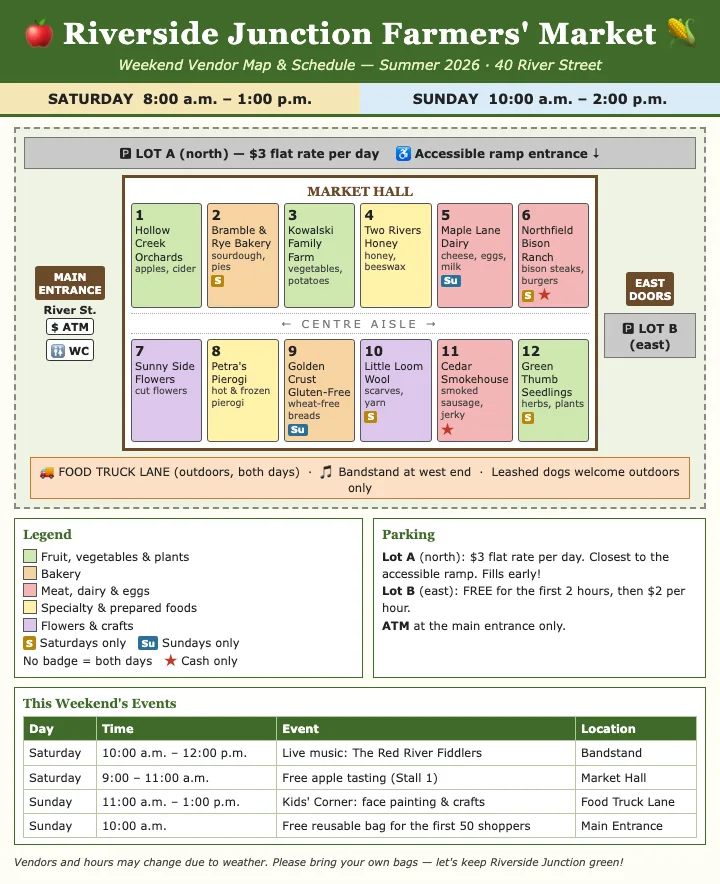
Read the following email message about the diagram on the left. Complete the email by filling in the blanks. Select the best choice for each blank from the drop-down menu.
Subject: Market run this weekend?
To: Gord Bellamy
From: Helen Okafor
Hi Gord,
Thanks again for clearing my driveway all last winter. I still owe you one! I picked up the new map for the Riverside Junction Farmers’ Market and thought we could go together this weekend. Saturday morning is out for me because of Amara’s swimming lesson, so how about ?
That works out well anyway, since you mentioned you’re out of eggs and cheese, and only comes on Sundays. I’d like to pick up a loaf for my son-in-law, who can’t eat wheat, so I’ll head straight to stall before they sell out.
You said you wanted some smoked sausage for your barbecue. Just remember that Cedar Smokehouse , so you might need to stop at the machine by the main entrance first.
As for parking, Lot A is usually packed, so let’s use Lot B, where we can . That should give us plenty of time to browse.
I’m happy to drive. I’ll knock on your door at quarter to ten.
Helen
Helen and Gord know each other because
Why can’t Helen go to the market on Saturday morning?
When Helen says “I still owe you one,” she means that she
Part 3: Reading for Information
Paragraph A
Few companies can claim a history as long as that of the Hudson’s Bay Company. On May 2, 1670, King Charles II of England granted a royal charter to a group of investors, giving them exclusive trading rights over all the lands whose rivers drained into Hudson Bay. This enormous territory, named Rupert’s Land after the king’s cousin, covered roughly a third of what is now Canada. Curiously, the idea for the venture came not from the English but from two French traders, Pierre-Esprit Radisson and Médard Chouart des Groseilliers, who had failed to win support for their plans in New France and took them to London instead.
Paragraph B
For nearly two centuries, the company’s business was fur, above all beaver. In Europe, beaver fur was pressed into felt to make fashionable, waterproof hats, and demand seemed endless. Rather than sending its own men deep into the interior, the company built trading posts such as York Factory on the shores of the bay and waited for Indigenous trappers to paddle in with their furs. In exchange, the trappers received metal kettles, tools, firearms and the striped wool “point blankets” that are still associated with the company today. This approach was later challenged by the Montreal-based North West Company, whose traders travelled inland to meet suppliers directly. After years of bitter and sometimes violent competition, the two rivals merged in 1821 under the Hudson’s Bay name. The combined company now controlled trade across a vast stretch of the continent.
Paragraph C
By the mid-nineteenth century, silk hats had replaced beaver in European fashion, and the fur trade began a slow decline. At the same time, the newly formed Dominion of Canada was eager to expand westward. In 1870, the company transferred Rupert’s Land to Canada in return for £300,000, land around its trading posts and a share of the farmland in the West. Settlers soon followed, and the company adapted by turning its trading posts into general stores that sold groceries, clothing and hardware to new arrivals. In the early 1900s, it began opening large department stores in growing cities such as Winnipeg, Calgary, Edmonton and Vancouver.
Paragraph D
Throughout the twentieth century, retail became the heart of the business. The company bought rival chains, including Simpsons and Zellers, and in 1987 it sold off its remaining northern stores and fur-trading operations. Ownership changed hands several times, and in 2006 the company was purchased by an American businessman, ending more than three centuries of British and Canadian control. However, it struggled to compete with online shopping and large discount retailers. In 2025, after years of falling sales, the company sought protection from its creditors and closed its remaining stores. Its name, coat of arms and famous multicoloured stripes were later sold to another Canadian retailer.
Decide which paragraph, A to D, has the information given in each statement below. Select E if the information is not given in any of the paragraphs.
- The company’s founding was inspired by people from outside England.
- A change in fashion reduced the demand for the company’s main product.
- The company preferred to let suppliers come to it rather than travel inland.
- The company’s stores eventually could not keep up with changing shopping habits.
- The original investors became very rich within the company’s first ten years.
- Competition between two trading firms ended when they joined together.
- The company’s original territory included all of present-day Canada.
- The company changed the purpose of its posts to serve newcomers.
- The company eventually gave up the line of business it was founded on.
Part 4: Reading for Viewpoints
Twice a year Manitobans grumble as they adjust their clocks. A private member’s bill now before the legislature would eliminate the ritual by keeping Manitoba on daylight saving time permanently. Its sponsor, Brandon-area MLA Corinne Lavallée, considers the change overdue. “Each spring costs us an hour of sleep,” she complains, “and each autumn an hour of afternoon sunshine.” She cites studies documenting a temporary rise in traffic collisions after the spring change. An online survey by her office drew more than 40,000 responses, nearly three-quarters favouring an end to the switch.
Consensus on abolishing the switch, however, is not consensus on which hour to retain. Dr. Anand Mehra, a Winnipeg sleep specialist, welcomes abolition but considers Lavallée’s choice misguided. Under her proposal the sun would not rise in Winnipeg until almost 9:30 a.m. in late December, leaving bodies misaligned with daylight all winter. “Morning light calibrates our internal clocks,” he explains. “Deprive people of it and you get groggy students and drowsy drivers.” Standard time, in his judgment, is preferable.
Marlene Gustafson, a school trustee in the Interlake region, observes that numerous pupils in her division board buses before 7:30 a.m. “Picture children waiting at the ends of country roads in pitch darkness, for months,” she urges. Her board has asked the government to consider later school start times should the bill pass.
Duncan Firth, who runs a golf course and patio restaurant near Selkirk, is ambivalent about the extra hour of winter light. What exasperates him is the disruption: staff rotas, tee times and deliveries are thrown into disarray twice yearly. “Either permanent option suits me,” he shrugs, “as long as the government commits to it.”
Prairie Policy Institute economist Paul Okonjo stresses timing. Because time zones fall under provincial jurisdiction, not Ottawa’s, Manitoba could move unilaterally, but it would then spend every winter an hour out of step with Minnesota and North Dakota, inconveniencing trucking firms, airlines and cross-border commerce. He recommends legislating now but delaying implementation until neighbours follow suit, as British Columbia and Ontario have done.
Lavallée says she is receptive to amendments when the bill reaches committee this fall.
Mehra’s worries are closest to those of
How did Lavallée’s office gauge public opinion?
What matters most to Duncan Firth?
We can infer that
An appropriate title would be “Ending the Clock Change:
The following is a comment by a visitor to the website page. Complete the comment by choosing the best option to fill in each blank.
I support ending the switch, but I think Ms. Lavallée is . As a nurse on early shifts I already drive to work in darkness all winter; under her version I would still be at my mid-morning break. Dr. Mehra is right that is what keeps us alert, and I notice how hard it is to concentrate on those black December mornings.
If the bill passes as written, the least the province can do for rural families is grant Ms. Gustafson’s board its request to . Finally, Mr. Okonjo is right that Manitoba shouldn’t ; let’s make the move together with our neighbours.
Answer key
Count your correct answers, then find your estimated CLB:
Show all 38 answers
- What is the main purpose of Priya’s email? B. to ask Marcus to fill in for her while she is away
- Denise suggested that Priya ask Marcus because D. he has covered for Priya in the past
- What does Priya say about her Friday shift? A. Another employee might be able to cover it.
- What does Priya suggest about Storytime? C. The parents help to keep the children in order.
- If the school board calls, Marcus should B. say that Priya will contact them after she returns
- What does Priya offer Marcus in return? D. to work one of Marcus’s weekend shifts
- A. the late shift on Friday
- C. nervous
- D. checked against the packing list
- B. take a message for you
- A. notes from the conference sessions
- C. Sunday, right when the doors open at 10
- A. Maple Lane Dairy
- D. 9
- B. only accepts cash
- C. park for free for the first two hours
- Helen and Gord know each other because D. they live close to each other
- Why can’t Helen go to the market on Saturday morning? A. She has a family commitment.
- When Helen says “I still owe you one,” she means that she B. wants to repay him for his help
- The company’s founding was inspired by people from outside England. A
- A change in fashion reduced the demand for the company’s main product. C
- The company preferred to let suppliers come to it rather than travel inland. B
- The company’s stores eventually could not keep up with changing shopping habits. D
- The original investors became very rich within the company’s first ten years. E
- Competition between two trading firms ended when they joined together. B
- The company’s original territory included all of present-day Canada. E
- The company changed the purpose of its posts to serve newcomers. C
- The company eventually gave up the line of business it was founded on. D
- Mehra’s worries are closest to those of C. Marlene Gustafson
- How did Lavallée’s office gauge public opinion? A. by inviting residents to respond online
- What matters most to Duncan Firth? D. committing to one permanent option
- We can infer that B. Manitoba can change its clocks without Ottawa.
- An appropriate title would be “Ending the Clock Change: C. Agreed in Principle, Divided in Practice.”
- C. picking the wrong time to retain
- A. waiting for daybreak
- D. early daylight
- B. push back the school day
- C. go it alone
What does your score mean? See the CELPIP Reading score chart.
Free CELPIP practice test · Free CELPIP Listening practice tests · CELPIP sample tests by part
CELPass is an independent practice platform and is not affiliated with Paragon Testing Enterprises. CELPIP is a trademark of Paragon Testing Enterprises. Check the official CELPIP website and IRCC for current test rules and requirements.