CELPIP Reading Practice Test 69
By Iris
A complete CELPIP Reading practice test: all 4 parts and 38 questions in the real test order. Set a timer for 55–60 minutes and do all four parts in one sitting. Check your answers at the bottom of the page to see your score and an estimated CLB.
Download as PDF with answer key
In this test
- Part 1: Reading Correspondence, “Arranging Care for Mom After Her Fall” (questions 1–11) · practise this part alone
- Part 2: Reading to Apply a Diagram, “Choosing a Tax Service for a Freelancer” (questions 12–19) · practise this part alone
- Part 3: Reading for Information, “The Canadian Shield” (questions 20–28) · practise this part alone
- Part 4: Reading for Viewpoints, “Lowering the Provincial Voting Age to 16” (questions 29–38) · practise this part alone
Part 1: Reading Correspondence
Hi Marisa,
I wanted to put everything in writing after our rushed phone call on Sunday, so here goes. As you know, Mom came home from Frontenac General on Thursday. The surgeon says her hip is healing better than expected for someone who is eighty-one, but she still can’t manage the stairs on her own, and the physiotherapist was firm that she shouldn’t take a bath unless someone is nearby, at least for the next couple of months.
I spent most of Monday on the phone with the regional home care office. Because of the fall, Mom qualifies for a personal support worker through the provincial program, but only for an hour each weekday morning. The worker will help her wash and get dressed and will make sure she takes her medication. That still leaves the evenings and weekends, which is where we come in.
Here’s what I’m proposing. The plant is only ten minutes from Mom’s place, so I can stop by after my shift on Mondays, Wednesdays and Fridays. If you could drive down on Saturdays, I’ll take Sundays. I know Tuesday and Thursday evenings are impossible for you with Olivia’s swim practices, so I asked Mrs. Kowalski next door whether she would look in on Mom those nights. She was delighted and wouldn’t hear of being paid, although I suspect a tin of Mom’s famous shortbread will be expected once Mom is back in the kitchen.
The trickier part is money. The provincial program costs nothing, but it doesn’t cover equipment. Mom’s occupational therapist recommended grab bars, a raised toilet seat and a stairlift. The bars and seat came to about $300, and I’ve already taken care of those, so don’t give them a second thought. The stairlift is another story: the best quote I got was $4,800 installed. Mom insists on paying for it out of her savings, but she’s been stretching every dollar since Dad passed away, and I’d much rather the two of us split it. Could you let me know what you think before I call the installer back on Friday?
One last thing. Mom keeps telling everyone she’s “perfectly fine” and doesn’t want a fuss. Please don’t take that at face value. On Saturday she tried to carry the laundry basket down to the basement and nearly lost her balance, and I only found out because I spotted the basket at the bottom of the stairs. Until I can get the washer and dryer moved upstairs, one of us will have to do her laundry.
Love,
Daniel
What is the main purpose of Daniel’s email?
The personal support worker will
Who will check on their mother on Thursday evenings?
Daniel suggests that Mrs. Kowalski
Why does Daniel want to share the cost of the stairlift with Marisa?
What can we infer about Daniel’s mother?
Here is a response to the message. Complete the response by filling in the blanks. Select the best choice for each blank from the drop-down menu.
Hi Danny,
Thank you for sorting all of this out. You’ve clearly spent hours on the phone, and I feel terrible that you’ve been while I’m an hour away.
Saturdays are no problem, and I’ll bring Olivia along, since Mom always perks up when she sees her. I’m also so grateful that Mrs. Kowalski is willing to cover . I’ll drop off some flowers to thank her.
As for the stairlift, of course we should . Mom has watched every penny since Dad died, and the last thing she needs is to see her savings shrink. I’ll send you my $2,400 before , so you can give them the go-ahead.
Thanks, too, for the warning about Mom’s “perfectly fine” routine. I’ll take care of every Saturday so she won’t be tempted to tackle the basement stairs again.
Love,
Marisa
Part 2: Reading to Apply a Diagram
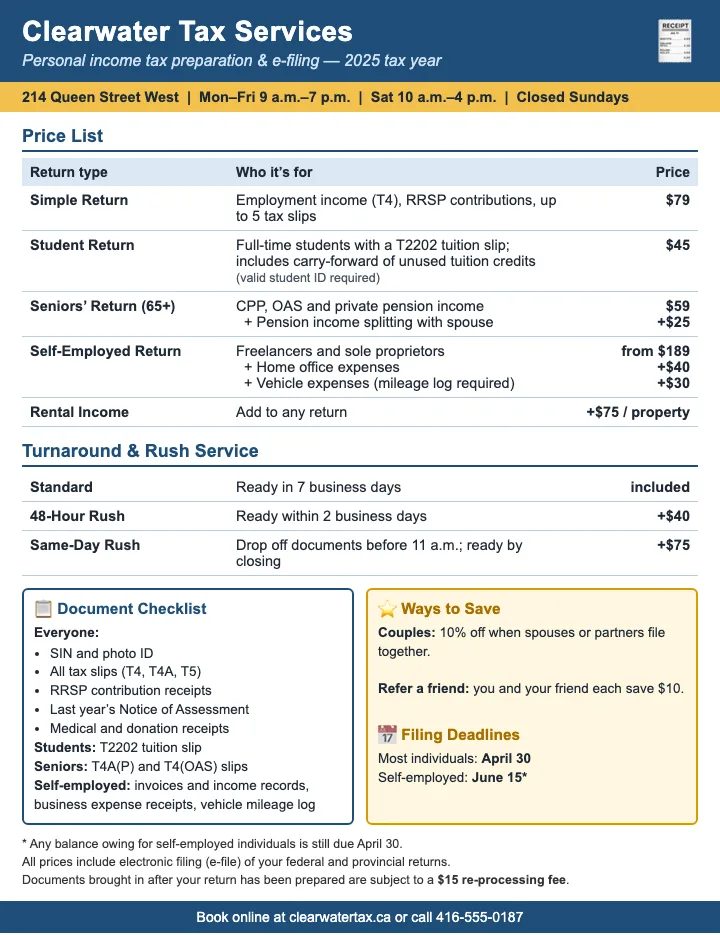
Read the following email message about the diagram on the left. Complete the email by filling in the blanks. Select the best choice for each blank from the drop-down menu.
Subject: Re: Where do you get your taxes done?
To: Kenji Watanabe
From: Priya Raman
Hi Kenji,
Funny you should ask! I’ve been going to Clearwater Tax Services on Queen Street for years, ever since we shared that tiny apartment above the bakery and you talked me out of doing my own return. I’ve attached their price list. Since you started freelancing last year, you’ll be paying , not the simple-return price you paid when you were on salary. And because you work out of your spare room, add on top of that.
The good news is that self-employed people have until June 15 to file, so there’s no reason to pay . Just don’t leave it until the eleventh hour like I did two years ago!
Make sure you bring everything on their checklist, especially your , since you’ll be claiming those costs for the first time. Last year I forgot my donation receipts, had to drop them off afterwards and was charged extra for it.
Oh, and when you book, tell them I sent you; that way . They’re open Saturdays too, which should suit your schedule.
Good luck with it,
Priya
How do Priya and Kenji know each other?
Why is Priya writing to Kenji?
When Priya tells Kenji not to leave it “until the eleventh hour,” she means he should not
Part 3: Reading for Information
Paragraph A
Stretching in a vast horseshoe around Hudson Bay, the Canadian Shield covers roughly eight million square kilometres and makes up nearly half of Canada’s land area. It reaches from Labrador and northern Quebec across much of Ontario and Manitoba into Saskatchewan, Nunavut and the Northwest Territories, and it even extends south of the border into states such as Minnesota and New York. Geologists describe the Shield as the exposed core of the North American continent: a massive slab of ancient rock onto which younger layers were later added. Across much of the region, this bedrock lies at or just below the surface, giving the landscape its familiar look of pink and grey outcrops, low rounded hills and scattered boulders.
Paragraph B
The Shield contains some of the oldest rock on the planet. Near Great Slave Lake in the Northwest Territories, a formation known as the Acasta Gneiss has been dated at about four billion years old, almost as old as Earth itself. It is hard to imagine today, but the region was once crossed by mountain ranges that may have rivalled the Himalayas. Over hundreds of millions of years, wind, rain and frost wore those peaks down to stumps. The final reshaping came during the last ice age, when sheets of ice up to three kilometres thick ground across the land, scraping away loose soil and carrying it south. When the glaciers melted roughly ten thousand years ago, they left behind a scoured surface with only a thin covering of sand and gravel.
Paragraph C
The retreating ice also gave the Shield its countless lakes. Glaciers gouged hollows into weaker rock, and because the hard bedrock does not absorb water, these basins filled and stayed full. Rivers wander from one lake to the next, and low-lying areas become soggy muskeg. Most of the region is covered by boreal forest, dominated by black spruce, jack pine, balsam fir and white birch, trees that tolerate cold winters and thin, acidic soil. That same soil has always made large-scale farming nearly impossible, which helps explain why so few people live on the Shield. Yet the maze of connected waterways was a highway long before roads existed: Indigenous peoples travelled it by canoe for thousands of years, and fur traders later followed the same routes.
Paragraph D
What the Shield lacks in farmland, it makes up for in minerals. The region holds rich deposits of nickel, copper, gold, silver, iron, uranium and, more recently, diamonds. Its mining history is closely tied to the railway: in 1883, workers blasting a path for the Canadian Pacific line near Sudbury, Ontario, uncovered a band of copper-nickel ore that grew into one of the world’s great mining districts. Twenty years later, another railway project sparked a silver rush in the town of Cobalt. Mining brought jobs and towns to the north, but at a cost. Decades of smelter emissions around Sudbury left the surrounding hills nearly bare and blackened. Since the late 1970s, a community regreening program has spread lime on the acidic ground and planted millions of seedlings, gradually returning green to the landscape.
Decide which paragraph, A to D, has the information given in each statement below. Select E if the information is not given in any of the paragraphs.
- The Shield is not limited to Canadian territory.
- Few people have settled in the region, partly because the land is poorly suited to agriculture.
- The region was once considerably more mountainous than it is today.
- Mining companies are now legally required to replant the areas they have damaged.
- Construction work led to the discovery of valuable minerals.
- In many places, bare rock can be seen at the surface.
- Much of the soil that once covered the Shield was carried away by ice.
- Some of the environmental harm caused by mining has been reversed.
- Water routes through the region were in use well before European traders arrived.
Part 4: Reading for Viewpoints
When Nova Scotia’s legislature reconvenes, members will deliberate over whether 16- and 17-year-olds should vote in provincial elections. The question arrives through a private member’s bill from Hannah Okafor, a Halifax-area MLA who would lower the voting age from 18. Scotland, Wales and Austria have already done so, though a comparable bill in Canada’s Parliament was defeated some time back.
Okafor contends that sixteen-year-olds who drive, work and pay taxes have earned the franchise, and that many follow current affairs more attentively than their parents. Before drafting the legislation she toured fourteen high schools, and “their questions about housing and climate,” she remarks, “were sharper than anything I hear in the legislature.”
Dr. Graham Thibault, a political scientist at Chebucto University, arrives at the same position by a different route. His research indicates that citizens who vote in their first eligible election are far likelier to keep voting for life. Eighteen, unfortunately, is when many young people have just relocated for school or work and are not registered at their new address; sixteen-year-olds are still at home and in a classroom, and considerably more accessible.
Ray Desrosiers, the Opposition critic for democratic institutions, observes that the law otherwise treats sixteen-year-olds as minors: they cannot sign a lease, buy a lottery ticket or serve on a jury. “Why should voting be the exception?” he asks. He would prefer the province to prioritize civic education and revisit the idea in a decade.
Colin Mercer, who teaches social studies in Truro, has repeatedly observed that most teenagers uncritically reproduce their parents’ opinions. “And the moment my students can vote,” he anticipates, “every lesson on current events will be scrutinized by someone searching for partisanship.”
Maya Lindqvist, sixteen, works twenty hours a week at a Bridgewater grocery store. Income tax is deducted from every paycheque, and the provincial government sets the minimum wage. “I’m not asking for special treatment,” she insists. “I just want a say in the rules I already live by.”
The governing party remains noncommittal, and members will vote according to conscience.
Who shares Desrosiers’s doubts about the bill?
What does preparing the bill reveal about Okafor?
Thibault would blame missed first votes on
What can be inferred about the bill’s prospects?
A fitting headline would be
The following is a comment by a visitor to the website page. Complete the comment by choosing the best option to fill in each blank.
Before reading this, I would have sided with Mr. Desrosiers; Dr. Thibault’s research has . Mr. Desrosiers stresses that sixteen-year-olds remain minors in law, yet we already let them , which is surely riskier than marking a ballot. Mr. Mercer’s fear that teenagers parrot their parents hardly persuades me: countless adults vote as their spouses do, and nobody proposes . The clincher is timing, since a first ballot cast while tends to become a lifelong habit. And Ms. Lindqvist’s paycheque is her best argument: she deserves a voice in . Stronger civics classes, certainly, but starting now, not in a decade.
Answer key
Count your correct answers, then find your estimated CLB:
Show all 38 answers
- What is the main purpose of Daniel’s email? B. to propose a plan for their mother’s care
- The personal support worker will A. help their mother wash and dress.
- Who will check on their mother on Thursday evenings? D. a neighbour
- Daniel suggests that Mrs. Kowalski C. would welcome some of their mother’s baking.
- Why does Daniel want to share the cost of the stairlift with Marisa? B. He doesn’t want their mother to spend her savings.
- What can we infer about Daniel’s mother? D. She tends to play down her difficulties.
- A. carrying most of the load
- D. the nights I can’t get there
- B. split the cost
- C. you call the installer on Friday
- A. her laundry
- D. the self-employed rate
- B. $40 for a home office
- A. a rush fee
- C. business expense receipts
- C. we’ll both save $10
- How do Priya and Kenji know each other? D. They used to live together.
- Why is Priya writing to Kenji? C. to answer a question he asked her
- When Priya tells Kenji not to leave it “until the eleventh hour,” she means he should not A. wait until just before the deadline.
- The Shield is not limited to Canadian territory. A
- Few people have settled in the region, partly because the land is poorly suited to agriculture. C
- The region was once considerably more mountainous than it is today. B
- Mining companies are now legally required to replant the areas they have damaged. E
- Construction work led to the discovery of valuable minerals. D
- In many places, bare rock can be seen at the surface. A
- Much of the soil that once covered the Shield was carried away by ice. B
- Some of the environmental harm caused by mining has been reversed. D
- Water routes through the region were in use well before European traders arrived. C
- Who shares Desrosiers’s doubts about the bill? B. Colin Mercer
- What does preparing the bill reveal about Okafor? C. She heard from young people directly.
- Thibault would blame missed first votes on D. the difficulty of reaching relocated people.
- What can be inferred about the bill’s prospects? A. Its passage is far from assured.
- A fitting headline would be C. “Should Sixteen-Year-Olds Have a Vote?”
- C. won me over
- D. get behind the wheel
- B. disenfranchising them
- B. anchored to home and school
- A. the policies setting her pay
What does your score mean? See the CELPIP Reading score chart.
Free CELPIP practice test · Free CELPIP Listening practice tests · CELPIP sample tests by part
CELPass is an independent practice platform and is not affiliated with Paragon Testing Enterprises. CELPIP is a trademark of Paragon Testing Enterprises. Check the official CELPIP website and IRCC for current test rules and requirements.