CELPIP Reading Practice Test 70
By Iris
A complete CELPIP Reading practice test: all 4 parts and 38 questions in the real test order. Set a timer for 55–60 minutes and do all four parts in one sitting. Check your answers at the bottom of the page to see your score and an estimated CLB.
Download as PDF with answer key
In this test
- Part 1: Reading Correspondence, “Summer Festival Sponsorship Invitation” (questions 1–11) · practise this part alone
- Part 2: Reading to Apply a Diagram, “Planning a Family Day Hike” (questions 12–19) · practise this part alone
- Part 3: Reading for Information, “Bombardier and the Snowmobile” (questions 20–28) · practise this part alone
- Part 4: Reading for Viewpoints, “Capping Food-Delivery App Commissions” (questions 29–38) · practise this part alone
Part 1: Reading Correspondence
Dear Mr. Halvorsen,
On behalf of the Willowbrook Community Association, I am writing to invite Halvorsen Hardware to become a sponsor of our sixth annual Willowbrook Summer Festival, which will take place on Saturday, July 18, in Cedar Grove Park. Many of our volunteers have been loyal customers of your store for years, and the association has not forgotten that you lent us ladders and tools free of charge when we rebuilt the park’s gazebo two summers ago.
The festival has grown far beyond what its founders imagined. What began as a potluck for a few dozen neighbours drew close to four thousand people last year. Visitors enjoy live music on the bandstand, a children’s zone with face painting and a bouncy castle, a vendors’ market and, new this year, an outdoor movie after sunset. Admission has always been free, and we intend to keep it that way, which is why we depend on the generosity of local businesses.
We offer three levels of sponsorship. Gold sponsors ($1,000) receive their logo on the main stage banner, a free booth in the vendors’ market and a thank-you announcement from the stage every hour. Silver sponsors ($500) have their logo printed on our posters and in the festival program. Community Friends ($150) are listed on our website and on the thank-you board at the park entrance. We also welcome in-kind donations, such as equipment or supplies, which are recognized at the Community Friend level.
Any money raised beyond the cost of the festival goes directly into our Playground Renewal Fund. The play equipment at Cedar Grove Park is more than twenty-five years old, and last fall the city removed the slide for safety reasons. Our goal is to replace the whole structure by next summer.
Please note that posters and programs go to the printer on May 29, so we would need to hear from you by then for your logo to be included. Sponsorships received after that date are still most welcome and will be recognized on our website and at the event. I would be happy to drop by the store to discuss the options in person; you can reach me at 306-555-0142 most evenings.
Warm regards,
Gwen Abernathy
President, Willowbrook Community Association
Why did Gwen write this letter?
Why did Gwen approach Halvorsen Hardware in particular?
How has the festival changed over the years?
A business that donates equipment instead of money would
Money left over after the festival’s costs will go toward
If Mr. Halvorsen agrees to sponsor the festival in June, his store
Here is a response to the message. Complete the response by filling in the blanks. Select the best choice for each blank from the drop-down menu.
Dear Ms. Abernathy,
Thank you for your kind letter, and for remembering the gazebo project. Lending a few ladders was , and I was glad to see the work turn out so well. I took my grandchildren to the festival last summer, and I can hardly believe how much it has since the early potluck days.
Halvorsen Hardware would be happy to come on board as a sponsor. Having our logo on the posters and in the program is all we need; we couldn’t staff a booth on a busy summer Saturday anyway. I’ll make sure our cheque and logo reach you before .
I was also sorry to hear about the slide. My grandchildren were disappointed when it disappeared, so I am especially pleased that the extra funds will . There’s no need to drop by unless you’d like to, though the coffee here is always on.
Sincerely,
Tomas Halvorsen
Part 2: Reading to Apply a Diagram
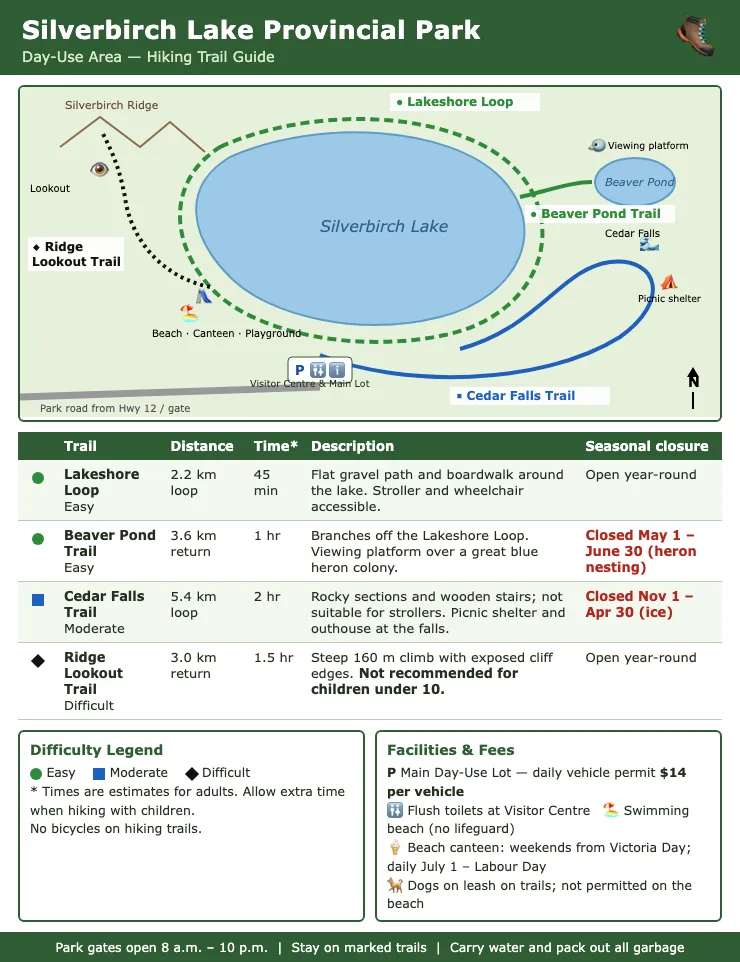
Read the following email message about the diagram on the left. Complete the email by filling in the blanks. Select the best choice for each blank from the drop-down menu.
Subject: Day hike at Silverbirch Lake?
To: Rob Delaney
From: Jenna Kowal
Hi Rob,
Now that school is almost out, how about that day hike our families keep talking about? I picked up a trail map at Silverbirch Lake last weekend, and I think Saturday, June 13, could work for all of us.
My first thought was the lookout, but with Lily only five, the is out. I’d also love to show the kids the herons, but the until the end of the month, so we’ll save that for later in the summer.
Here’s my plan: we start with the in the morning. It’s a bit rocky in places, but Noah and Ava can handle it, and we can have our picnic at the shelter. You’d have to carry Max in the backpack, though. After lunch, we can finish with the Lakeshore Loop, which is flat enough for , so he can nap while we walk.
Since it’s a Saturday, the beach canteen , so the kids can have ice cream at the end. Let’s go in one car; that way we only have to buy one vehicle permit. The kids will be dead on their feet by the time we get home!
Let me know what you think,
Jenna
Jenna and Rob are most likely
Why does Jenna suggest that they take only one car?
When Jenna says the kids will be “dead on their feet,” she means they will be
Part 3: Reading for Information
Paragraph A
For much of Canada’s history, winter meant isolation. In rural Quebec in the early twentieth century, snow-covered roads were rarely ploughed, and families could be cut off from the nearest town for weeks at a time. Doctors, priests and merchants often could not reach the people who needed them. Horses and dog sleds were slow, and early automobiles were useless once the snow got deep. Joseph-Armand Bombardier, born in 1907 in the village of Valcourt, grew up with this problem. A gifted mechanic from a young age, he built his first motorized sled at fifteen by mounting a car engine and a wooden propeller on a frame with runners. The machine ran, but his father, alarmed by the danger, ordered him to take it apart.
Paragraph B
Bombardier opened a garage in Valcourt and spent years experimenting in his spare time. His determination grew after a personal tragedy: in the winter of 1934, his two-year-old son fell gravely ill, and because the roads were blocked by snow, the boy could not be taken to hospital in time. Three years later, Bombardier received a patent for a sprocket wheel and track system that gripped the snow far better than anything before it. His first commercial vehicle, the B7, could carry seven passengers and looked like a small bus on skis and tracks. Larger models followed, and soon these machines were serving as school buses, ambulances and mail carriers across rural Quebec.
Paragraph C
Business boomed until the 1950s, when the Quebec government began ploughing rural roads in winter, sharply reducing the demand for large snow vehicles. Bombardier turned his attention to a much older dream: a light machine for one or two riders. In 1959, he introduced a small, open vehicle that he intended to call the Ski-Dog, since he saw it as a replacement for dog teams. A printing error turned the name into Ski-Doo, and Bombardier decided to keep it. The first buyers were missionaries, trappers and prospectors who worked in remote areas, but before long, the Ski-Doo was being bought by people who simply enjoyed racing across frozen lakes on weekends.
Paragraph D
Nowhere was the snowmobile’s impact greater than in the Far North. Within a decade of the Ski-Doo’s launch, many Inuit communities had largely replaced their dog teams with snowmobiles. Hunters could travel much farther in a day, reaching distant hunting grounds and returning the same evening. The change was not without costs. Snowmobiles depend on expensive gasoline and spare parts that must be shipped north, and a breakdown far from home can be life-threatening in a way that a tired dog team rarely was. Some elders also worried that traditional knowledge of dog handling and sled building was being lost. Today, many communities hold dog-sled races and youth programs to keep those skills alive, while snowmobile trails and long-distance races have also brought winter visitors to the region.
Decide which paragraph, A to D, has the information given in each statement below. Select E if the information is not given in any of the paragraphs.
- Bombardier’s earliest snow vehicle was not allowed to remain in use.
- Improved winter road maintenance hurt sales of Bombardier’s larger vehicles.
- A family loss strengthened Bombardier’s commitment to his work.
- Bombardier’s company later went on to build aircraft and trains.
- The snowmobile allowed northern hunters to cover greater distances.
- Bombardier’s early vehicles were used to provide public services.
- Bad weather could leave rural families isolated for long periods.
- Efforts are being made to preserve an older form of northern travel.
- The name of Bombardier’s small vehicle was the result of a mistake.
Part 4: Reading for Viewpoints
During the pandemic, food-delivery apps were a lifeline for many restaurants; some owners now regard them as a millstone. The platforms typically retain 25 to 30 percent of every order, and Manitoba’s government is contemplating legislation capping commissions at 15 percent, making permanent an idea several provinces tried temporarily during the pandemic.
Luis Carvalho, whose Portuguese grill in Winnipeg’s West End now earns nearly 40 percent of its sales through delivery, calculates that on a $50 order the app keeps up to $15, leaving him less than a dollar after food and wages. When he raised his menu prices on the apps, customers noticed and grumbled in online reviews. Abandoning the platforms is unthinkable, since that is where the customers are. “That’s not a partnership,” he remarks. “That’s a toll booth.”
Diane Fontaine, the minister responsible, casts the cap as a matter of equity. “Independent restaurants have no leverage against multinational platforms,” she argues, and the largest apps posted record profits last year even as dozens of local establishments closed. Her bill would also oblige apps to show customers an itemized breakdown of where their money goes.
Megan Aldridge of the Canadian Delivery Platforms Association counters that commissions finance marketing, customer service and the couriers themselves. “Cap them and those costs merely land on customers through higher delivery fees,” she warns, “or apps curtail service in smaller towns.” Restaurants, she notes, can already select lower-commission plans offering fewer features, and many would never reach these customers otherwise.
Economist Raymond Oduya of Assiniboine Valley University recalls that where temporary caps were imposed, some apps appended new “service fees” to customers’ bills within weeks. Price controls, in his judgment, rarely succeed in markets with so many moving parts; he would rather foster competition, for instance by supporting delivery co-operatives owned by restaurants. He also questions the 15 percent figure, given that rural deliveries are substantially pricier.
Jasmin Toor, who delivers for two apps in Brandon, earns about $18 an hour before gas and has watched tips dwindle as customers tire of escalating surcharges. She knows that “whenever the companies lose money, couriers suffer first.” Yet she supports the cap, reasoning that if restaurants close, nothing remains to deliver.
Aldridge’s strongest ally would be
How did Carvalho first try to cope?
Why does Oduya mention earlier caps?
Which saying sums up Carvalho’s position?
Which would be the best title?
The following is a comment by a visitor to the website page. Complete the comment by choosing the best option to fill in each blank.
Ordering takeout twice a week, I consider this cap . Ms. Fontaine’s sympathy for neighbourhood restaurants is admirable, but Dr. Oduya’s evidence suggests the apps would simply , leaving to absorb the cap. A pizza already arrives burdened with a delivery fee, a service fee and a tip, and my patience for further surcharges is exhausted. Mr. Carvalho has my sympathy, yet as Ms. Aldridge observes, owners are not obliged to accept the priciest arrangement; they could . If the province genuinely wants to help, it should nurture instead of dictating what private companies may charge.
Answer key
Count your correct answers, then find your estimated CLB:
Show all 38 answers
- Why did Gwen write this letter? B. to ask Mr. Halvorsen to support an event
- Why did Gwen approach Halvorsen Hardware in particular? C. The store has helped the association before.
- How has the festival changed over the years? A. It has become much larger.
- A business that donates equipment instead of money would D. be named on the thank-you board.
- Money left over after the festival’s costs will go toward A. replacing old play equipment.
- If Mr. Halvorsen agrees to sponsor the festival in June, his store D. will not appear on the posters.
- A. the least we could do
- C. grown
- B. Silver
- D. the printing deadline
- B. help pay for new play equipment
- C. Ridge Lookout Trail
- B. Beaver Pond Trail is closed
- D. Cedar Falls Trail
- C. Max’s stroller
- A. will be open
- Jenna and Rob are most likely A. friends who both have young children.
- Why does Jenna suggest that they take only one car? D. to avoid paying for two vehicle permits
- When Jenna says the kids will be “dead on their feet,” she means they will be B. completely worn out.
- Bombardier’s earliest snow vehicle was not allowed to remain in use. A
- Improved winter road maintenance hurt sales of Bombardier’s larger vehicles. C
- A family loss strengthened Bombardier’s commitment to his work. B
- Bombardier’s company later went on to build aircraft and trains. E
- The snowmobile allowed northern hunters to cover greater distances. D
- Bombardier’s early vehicles were used to provide public services. B
- Bad weather could leave rural families isolated for long periods. A
- Efforts are being made to preserve an older form of northern travel. D
- The name of Bombardier’s small vehicle was the result of a mistake. C
- Aldridge’s strongest ally would be C. Raymond Oduya
- How did Carvalho first try to cope? D. He charged diners more on the apps.
- Why does Oduya mention earlier caps? C. to show that customers paid more
- Which saying sums up Carvalho’s position? A. Beggars can’t be choosers.
- Which would be the best title? B. “Restaurants and Apps Clash over Commission Cap”
- B. a well-meaning mistake
- A. pass the cost on to diners
- C. people like me
- D. settle for fewer features
- B. competition from restaurant-owned services
What does your score mean? See the CELPIP Reading score chart.
Free CELPIP practice test · Free CELPIP Listening practice tests · CELPIP sample tests by part
CELPass is an independent practice platform and is not affiliated with Paragon Testing Enterprises. CELPIP is a trademark of Paragon Testing Enterprises. Check the official CELPIP website and IRCC for current test rules and requirements.