CELPIP Reading Practice Test 74
By Iris
A complete CELPIP Reading practice test: all 4 parts and 38 questions in the real test order. Set a timer for 55–60 minutes and do all four parts in one sitting. Check your answers at the bottom of the page to see your score and an estimated CLB.
Download as PDF with answer key
In this test
- Part 1: Reading Correspondence, “Finding a Home for Grandma’s Piano” (questions 1–11) · practise this part alone
- Part 2: Reading to Apply a Diagram, “Storage Unit for a Summer Abroad” (questions 12–19) · practise this part alone
- Part 3: Reading for Information, “Canadian Ice Wine and the Winter Harvest” (questions 20–28) · practise this part alone
- Part 4: Reading for Viewpoints, “Backyard Chickens Bylaw Debate” (questions 29–38) · practise this part alone
Part 1: Reading Correspondence
Dear Adam,
I hope you, Jen and the kids are all well and that Halifax hasn’t been buried in snow yet this winter. I’m writing with some family news and a question I’d like you to think about.
As you may have heard from your mom, Grandma has finally decided to leave the house on Church Street. After her fall in November, she admitted that the stairs had become too much for her, and she has taken a one-bedroom apartment at a seniors’ residence here in Moncton. She moves in on March 15. The buyers don’t take possession of the house until April 1, so we will have a couple of weeks after that to empty it.
Most of the furniture has already found new homes, but there is one thing Grandma can’t bear to part with: her old upright piano. As you know, she bought it in 1962 with her first paycheques as a music teacher, and she taught half the neighbourhood to play on it. Unfortunately, her new apartment is barely big enough for her bed and an armchair.
A dealer told us the piano would sell for only a few hundred dollars, but money isn’t the point. Grandma would much rather give it to someone in the family than see it go to a stranger. I would take it in a heartbeat, but my apartment is on the third floor of a building with no elevator, and the movers I called just laughed. Luc, of course, is all the way out in Vancouver.
That’s where you come in. Your mom mentioned that Nora started piano lessons last fall and has been practising on a small electronic keyboard. Would you like the piano for her? Grandma has insisted on paying the movers herself, and she already has a quote of $650 to bring it to Halifax. I should warn you that it hasn’t been tuned in about four years, and one of the low keys sticks. The movers also told us that a long trip almost always puts a piano out of tune, so you would want a tuner to look at it once it has settled in.
Grandma has only one request: that she be allowed to sit down and play it whenever she visits you.
The movers are booked weeks ahead, so could you let me know by the end of February? If you can’t take it, the choir director at Grandma’s church has said they would be happy to have it.
Love,
Sophie
What is the main purpose of Sophie’s letter?
Why doesn’t Sophie take the piano herself?
What can we conclude about the piano?
Who will pay to move the piano to Halifax?
Before he decides, Sophie wants Adam to know that the piano
If Adam cannot take the piano, it will most likely
Here is a response to the message. Complete the response by filling in the blanks. Select the best choice for each blank from the drop-down menu.
Dear Sophie,
Thank you for your letter, and please tell Grandma how sorry we were to hear about her fall. Nora has been making do with since she started lessons, so when I read your letter out at dinner, she nearly jumped out of her chair.
We would love to take the piano. I’ve already found a tuner here in Halifax, and I’ll book him for a couple of weeks after it arrives, since I understand the trip . I’ll also ask him to have a look at while he’s here.
Please tell Grandma that we accept her one condition with pleasure: she can . Nora is already practising a duet for her first visit.
As for timing, the movers can come on any day that suits them, as long as the piano is out of the house before .
With love to you both,
Adam
Part 2: Reading to Apply a Diagram
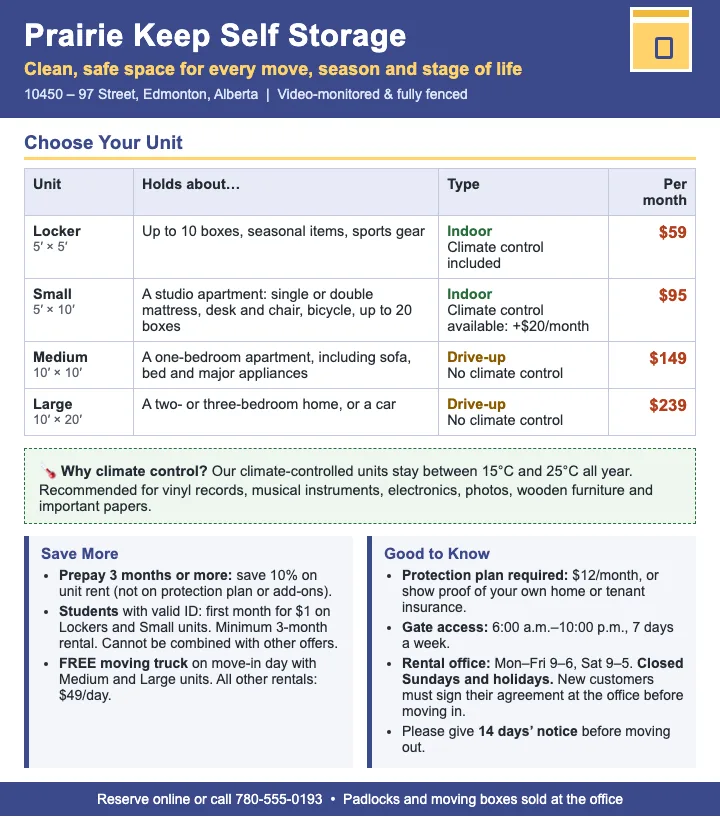
Read the following email message about the diagram on the left. Complete the email by filling in the blanks. Select the best choice for each blank from the drop-down menu.
Subject: My stuff for the summer
To: Marcus Bell
From: Jun Park
Hi Marcus,
Since our lease is up at the end of April and you’re moving in with Dana, I’ve been looking for somewhere to keep my things while I’m in Seoul until the end of August. I found a place on 97 Street called Prairie Keep. I don’t have much: my mattress, my desk and chair, my bike and about fifteen boxes. The one thing I’m nervous about is my record collection. It’s my pride and joy, and I don’t want it warping in a hot metal box all summer. So I think is the best choice for me.
With the extra charge for that, plus the protection plan (my tenant insurance ends with our lease), I’ll be paying a month. I finished my program in December, so the student deal is out, but if I pay for all four months at once, I can .
The only catch is that the free truck is just for , so could I borrow your van? I fly out early on Sunday, April 30, and because the office , we’d have to do it the day before. Pizza is on me!
Thanks,
Jun
Jun and Marcus are most likely
What is the main purpose of Jun’s email?
When Jun calls his record collection his “pride and joy,” he means that
Part 3: Reading for Information
Paragraph A
Canada is one of the world’s leading producers of ice wine, a sweet dessert wine made from grapes that have frozen naturally while still on the vine. The drink is not a Canadian invention. It is said to have been discovered in Germany in the late 1700s, when an early frost caught growers by surprise and they pressed their frozen grapes rather than lose the harvest. For centuries afterward, European winemakers could produce it only in the occasional year when the weather happened to cooperate. What Canada offers is reliability. In southern Ontario and in parts of British Columbia, winters are cold enough almost every year for the grapes to freeze solid, while the summers are warm enough to ripen them properly first.
Paragraph B
Making ice wine requires patience and nerve. Healthy grapes are left hanging long after the regular harvest in the fall, often into December or January. During those extra weeks, growers stretch nets over the vines to keep hungry birds away, and they risk losing the whole crop to rot, hail or a sudden thaw. Under Canadian rules, the grapes may be picked only once the temperature has dropped to −8°C or lower, so crews are often called out in the middle of the night, when it is coldest. The frozen grapes are pressed immediately, before they can soften. Because most of the water stays behind as ice, each grape gives up only a few drops of thick, very sweet juice.
Paragraph C
These conditions explain why ice wine is so expensive. A vineyard that would normally produce many bottles of table wine yields only a small fraction of that amount as ice wine. For this reason, it is usually sold in slim 375 mL bottles, half the size of a standard wine bottle, and a single bottle can easily cost $50 or more. A large share of Canada’s production is exported, especially to Asia, where it is a popular gift. Its success abroad has also attracted fraud. Fake bottles, sometimes made by adding sugar to ordinary wine, have been discovered in several countries, and Canadian producers have called for stricter labelling to protect their reputation.
Paragraph D
In recent years, ice wine has also become a reason to visit wine country in the off-season. Each January, wineries in Ontario hold festivals where visitors sample ice wine at outdoor bars carved from ice and taste it alongside foods ranging from cheese to chocolate. A few wineries even invite guests to join a night-time harvest. Growers, however, are increasingly worried about milder winters. Some have had to wait until February for a cold enough night, and in a few seasons certain vineyards could not harvest at all. Some researchers expect that the best places for ice wine may gradually move northward or to higher ground as the climate warms.
Decide which paragraph, A to D, has the information given in each statement below. Select E if the information is not given in any of the paragraphs.
- The first ice wine is said to have resulted from unexpected weather.
- Workers often pick the grapes at an hour chosen for its temperature.
- Some products sold abroad as Canadian ice wine are not genuine.
- Guests are sometimes given the chance to help with the harvest.
- Ice wine costs less in Canada than in the countries that import it.
- Growers must protect the fruit from wildlife while they wait for the cold.
- Ice wine is usually sold in a smaller container than most other wines.
- The regions best suited to making ice wine may shift in the future.
- Canada’s weather allows ice wine to be made far more regularly than in Europe.
Part 4: Reading for Viewpoints
Elmdale, Saskatchewan, is considering a bylaw amendment allowing residents to keep up to four hens in their backyards; roosters would remain prohibited. Owners would register their birds for $25 annually, house them in a coop at least three metres from any property line, and refrain from selling the eggs. The amendment follows an eighteen-month pilot involving 40 households in two neighbourhoods.
Councillor Dana Whitford, the amendment’s author, deems the pilot a success. “We had three complaints in eighteen months, and two concerned a single coop that’s since been relocated. Parents tell me their kids finally understand where food comes from.” With grocery bills soaring, hens offer families a modest measure of control.
“The hens are tolerably quiet,” says Gerald Haines, who lives beside a pilot household. “It’s what they attract.” Since his neighbour acquired chickens, rats have colonized his garage for the first time in twenty years. He professes no hostility toward hens as such. “But who’ll enforce these rules? We’re a city of 60,000 with two bylaw officers.”
Dr. Anita Sharma, a local veterinarian, has mixed feelings. Hens can be rewarding, but newcomers underestimate the work. The rats are drawn not to the birds but to spilled grain and open feed bags, the owner’s responsibility. A coop must stay above freezing throughout a prairie winter, and although hens can live eight years or more, laying declines sharply after the third or fourth. Each spring, shelters in cities permitting backyard flocks absorb birds whose owners have lost interest. She wants new owners to complete a short course before registering.
Ben Toews, whose family has operated an egg farm outside Elmdale for three generations, laughs when asked about backyard competition. Four hens yield perhaps two dozen eggs weekly in summer and scarcely any in winter. “Tally up feed, a heated coop and the registration fee, and those are the costliest eggs in town.” Few enthusiasts, he adds, picture cleaning a coop at twenty below. His genuine concern is disease: careless hygiene could transmit illnesses such as avian influenza to wild birds and eventually to commercial farms.
A public hearing is set for May 14.
Sharma and Toews would both agree that
Haines mentions “twenty years” to suggest that
Toews’s egg figures are meant to show that
Why does Dr. Sharma mention animal shelters?
The article could best be titled
The following is a comment by a visitor to the website page. Complete the comment by choosing the best option to fill in each blank.
Having kept three hens through the pilot, I find most of the worries in this article . Mr. Haines blames chickens for his rats, yet as Dr. Sharma explains, the remedy is , something any conscientious owner already practises.
Mr. Toews is right about one thing: these are hardly bargain eggs. Between feed and , my winter months cost more than any supermarket carton, and I pay gladly.
I also endorse Dr. Sharma’s call for owners to ; my first winter taught me plenty the hard way. Above all, newcomers must accept that their birds . A hen is a long commitment, not a breakfast plan.
Answer key
Count your correct answers, then find your estimated CLB:
Show all 38 answers
- What is the main purpose of Sophie’s letter? B. to offer Grandma’s piano to Adam’s daughter
- Why doesn’t Sophie take the piano herself? C. It would be very hard to get it into her home.
- What can we conclude about the piano? A. It means more to Grandma than its price suggests.
- Who will pay to move the piano to Halifax? D. Grandma
- Before he decides, Sophie wants Adam to know that the piano B. needs some work before it will play well.
- If Adam cannot take the piano, it will most likely D. be given to Grandma’s church.
- C. a lightweight plug-in instrument
- D. will probably put it out of tune
- B. one bass key that gets stuck
- C. play it every time she visits
- A. April 1
- C. the Small unit
- A. $127
- D. save 10% on the rent
- B. Medium and Large units
- C. is closed on Sundays
- Jun and Marcus are most likely D. roommates whose lease is ending.
- What is the main purpose of Jun’s email? B. to ask for help moving his things into storage
- When Jun calls his record collection his “pride and joy,” he means that C. he values it very highly.
- The first ice wine is said to have resulted from unexpected weather. A
- Workers often pick the grapes at an hour chosen for its temperature. B
- Some products sold abroad as Canadian ice wine are not genuine. C
- Guests are sometimes given the chance to help with the harvest. D
- Ice wine costs less in Canada than in the countries that import it. E
- Growers must protect the fruit from wildlife while they wait for the cold. B
- Ice wine is usually sold in a smaller container than most other wines. C
- The regions best suited to making ice wine may shift in the future. D
- Canada’s weather allows ice wine to be made far more regularly than in Europe. A
- Sharma and Toews would both agree that A. hens are more work than expected.
- Haines mentions “twenty years” to suggest that C. the hens brought the rats.
- Toews’s egg figures are meant to show that A. backyard flocks are no rivals.
- Why does Dr. Sharma mention animal shelters? D. to warn of abandoned hens
- The article could best be titled B. “Elmdale Weighs Letting Hens into Backyards”
- B. overblown
- B. tidy, sealed feed storage
- C. keeping the coop above freezing
- D. learn the basics first
- A. will outlive their laying years
What does your score mean? See the CELPIP Reading score chart.
Free CELPIP practice test · Free CELPIP Listening practice tests · CELPIP sample tests by part
CELPass is an independent practice platform and is not affiliated with Paragon Testing Enterprises. CELPIP is a trademark of Paragon Testing Enterprises. Check the official CELPIP website and IRCC for current test rules and requirements.