CELPIP Reading Practice Test 75
By Iris
A complete CELPIP Reading practice test: all 4 parts and 38 questions in the real test order. Set a timer for 55–60 minutes and do all four parts in one sitting. Check your answers at the bottom of the page to see your score and an estimated CLB.
Download as PDF with answer key
In this test
- Part 1: Reading Correspondence, “Stepping Down as a Youth Soccer Coach” (questions 1–11) · practise this part alone
- Part 2: Reading to Apply a Diagram, “Sharing a Snow Clearing Plan with a Neighbour” (questions 12–19) · practise this part alone
- Part 3: Reading for Information, “The Polar Bears of Churchill, Manitoba” (questions 20–28) · practise this part alone
- Part 4: Reading for Viewpoints, “Hospital Parking Fees Debate” (questions 29–38) · practise this part alone
Part 1: Reading Correspondence
Dear Ms. Desjardins,
I hope the spring registration rush has calmed down a little at the office. I’m writing with news I’ve been putting off for a few weeks: I won’t be able to continue as head coach of the Under-10 Hornets after this season ends in June.
As you may know, I’ve accepted a position as an operator at the county water treatment plant. It’s a job I’ve wanted for years, but it comes with rotating twelve-hour shifts, and roughly half of my weekday evenings will now be spent at the plant. Since the Hornets practise on Tuesday and Thursday evenings, I simply can’t promise to be there, and the kids deserve a coach who shows up every week.
Stepping away is harder than I expected. I’ve coached this age group for six seasons, long after my own son moved up to the older division, and a few of my former players now help out as referees. Still, I think the timing is right, because the team will be in good hands. My assistant, Farah Qureshi, has been at nearly every practice for two years, and the players adore her. She is interested in taking over, but she’s nervous because she has never been in charge on game day. I’ve told her I’d be glad to stand on the sidelines with her for the first few Saturdays in the fall, whenever my shifts allow it. She also asked me whether the association would cover the $85 fee for the coaching certification course. I wasn’t sure, so I said I’d check with you.
There are also a few practical matters. I still have the team’s equipment bag in my garage: twelve balls, two sets of pinnies, the cones, and the first-aid kit. I’ll drop everything off at the clubhouse after our final game, but you should know that the kit is nearly out of ice packs and bandages after a season of scraped knees. Also, if at all possible, I’d ask that the Hornets keep their practice slot at Lindgren Park. Most of the families walk there from the surrounding streets, and a field across town would make things difficult for them.
Finally, please don’t worry about the end-of-season barbecue on June 14. My wife and I will still host it in our backyard, as we have every year.
Thank you for all your support over the years. It has been a privilege to work with the association.
Warm regards,
Gord Halvorsen
What is the main purpose of Gord’s letter?
Why can’t Gord continue as head coach?
What can we conclude about Gord’s son?
Farah is worried about taking over because she
Why does Gord want the Hornets to keep their field?
Gord mentions the first-aid kit because
Here is a response to the message. Complete the response by filling in the blanks. Select the best choice for each blank from the drop-down menu.
Dear Gord,
Thank you for letting me know, and congratulations on the new position! I completely understand that makes weekday evenings impossible to plan around. You will be missed, but I’m relieved to hear that the Hornets won’t be left without a coach.
I’m happy to say that the association does , so please let Farah know she can go ahead and register. Your offer to is very generous and will surely help her feel more confident.
As for the field, I’ll do my best to keep the Hornets at Lindgren Park, since I know how many families . When you bring the equipment back, just leave it with the clubhouse staff, and I’ll make sure the first-aid kit is before the fall season.
Enjoy the barbecue, and thank you again for six wonderful seasons.
Best wishes,
Hélène Desjardins
Part 2: Reading to Apply a Diagram
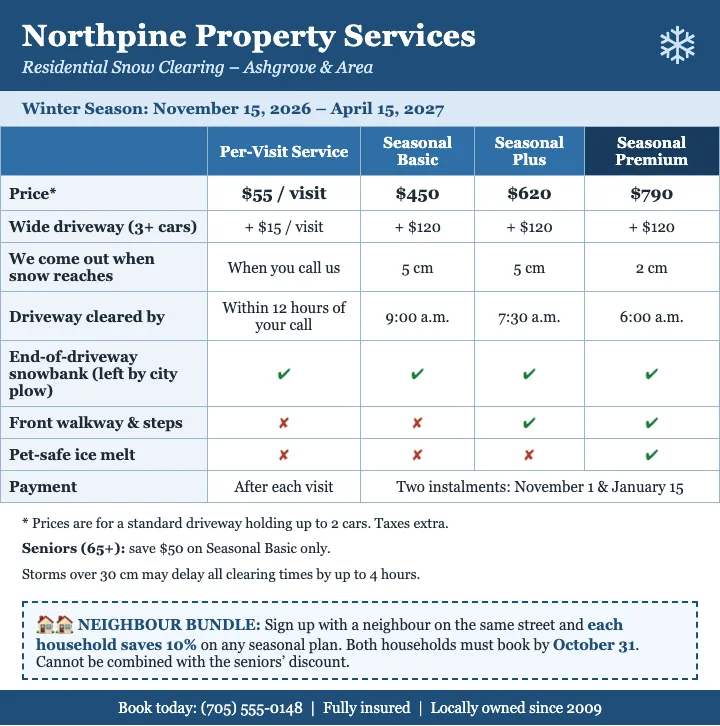
Read the following email message about the diagram on the left. Complete the email by filling in the blanks. Select the best choice for each blank from the drop-down menu.
Subject: Snow clearing this winter
To: Dev Patel
From: Marta Kowalski
Hi Dev,
I found a flyer from Northpine in my mailbox yesterday and thought of you right away. Last winter I just phoned them whenever it snowed, and paying really nickel-and-dimed me. By March, I’d spent far more than any of their seasonal plans would have cost.
This year I’m signing up for the whole season. My shift at the hospital starts at 6:30, so I’m out the door by 6:15, which means the only plan that works for me is .
I know you don’t have to be anywhere early these days, but you mentioned that Rita finds the front steps tricky once the ice comes. You might like Seasonal Plus, since it . Unfortunately, the seniors’ discount wouldn’t apply to that one.
Here’s the best part: since our houses are only three doors apart, if we sign up together we would . We’d have to book before , though, so let me know soon if you’re interested. I can drop the flyer off this weekend if you’d like to take a look.
Cheers,
Marta
Marta and Dev know each other because
Why is Marta writing to Dev?
When Marta says paying per visit “nickel-and-dimed” her, she means that
Part 3: Reading for Information
Paragraph A
Each autumn, the small town of Churchill, home to fewer than a thousand people, on the western shore of Hudson Bay in northern Manitoba, receives visitors who outnumber its residents. Some arrive from across the world; others simply wander in from the tundra. Churchill lies along a stretch of coast where polar bears gather while they wait for the bay to freeze, and this has earned the town the nickname “Polar Bear Capital of the World.” Because no highway reaches Churchill, travellers must arrive by train or by plane, which adds both cost and a sense of adventure to the trip.
Paragraph B
The bears’ movements are governed by sea ice. Polar bears feed mainly on seals, and they need a frozen platform from which to hunt them. When the ice on Hudson Bay melts in early summer, the bears are forced ashore, where they live largely off the fat they built up over the winter, eating very little for months. By October, many have gathered along the coast near Churchill, where the ice tends to form early, waiting for freeze-up. Researchers have found that the ice-free season on the bay has grown longer over recent decades, which means the bears must go longer without a proper meal.
Paragraph C
Sharing a town with such powerful animals requires careful planning. Provincial wildlife officers run the Polar Bear Alert Program, and residents can call its line at any hour to report a bear in town. Officers first try to scare bears away with loud noises; bears that keep coming back may be captured and kept in a holding facility, nicknamed the “polar bear jail,” before being released far from town, sometimes by helicopter. Signs around town remind visitors never to walk alone after dark or along the shoreline. Many residents leave their car doors unlocked during bear season so that anyone surprised on the street has somewhere to take shelter. On Halloween, officers and volunteers patrol the streets so that children can go trick-or-treating safely.
Paragraph D
The bears have also shaped Churchill’s economy. Every October and November, thousands of tourists climb aboard large tundra vehicles, built high off the ground on oversized tires, to watch the bears from a safe distance. Wildlife photographers and film crews are regular visitors, and local guides, hotels, and restaurants depend heavily on this short season. Most tourists stay only a few days, but a guided bear-watching trip can cost thousands of dollars per person, so even a short season brings in a great deal of money. Some residents worry that the town relies too much on a single attraction. If shrinking sea ice eventually means fewer bears, Churchill may have to lean more on its other draws, such as beluga whale watching in summer and the northern lights in winter.
Decide which paragraph, A to D, has the information given in each statement below. Select E if the information is not given in any of the paragraphs.
- Getting to Churchill is less straightforward than reaching most Canadian towns.
- Bears that repeatedly enter the town may be moved to a more remote area.
- During the summer months, the bears depend mostly on their own stored energy.
- Many local businesses earn much of their income during a few autumn months.
- Not all of the town’s autumn visitors are human.
- The number of polar bears near Churchill has already dropped sharply.
- Residents can report a bear sighting at any time of the day or night.
- The period that the bears must go without proper food has been growing.
- Some locals fear that the town depends too heavily on one kind of tourism.
Part 4: Reading for Viewpoints
When Larkfield General Hospital raised its parking rates this spring, few anticipated that the increase would preoccupy city hall for months. Visitors now pay $4 per half hour, to a daily maximum of $26, while employees pay $140 for a monthly pass.
Colin Marchetti, the hospital’s vice-president of finance, defends the increase as regrettable but unavoidable. Parking generates roughly $3 million annually, revenue earmarked for equipment and patient programs that provincial funding leaves uncovered. “If that income vanished, something inside the building would have to give,” he reasons. “Better to inconvenience motorists than lengthen the wait for a diagnostic scan.” Pressed on whether a flat rate is equitable for people who return day after day, he acknowledges that the structure is “a blunt instrument.”
Patient advocate Deborah Ogunleye brands the fees “a levy on misfortune.” The heaviest burden, she contends, lands on those with the least choice: parents of newborns in the neonatal unit, or relatives accompanying a cancer patient through weeks of treatment. Yet she refrains from vilifying administrators, reserving her criticism for a funding model that bills families at their most vulnerable. Her remedy is for the province to cover the shortfall so that the charge disappears entirely.
Councillor Raj Bhandari campaigned on free hospital parking four years ago. A neighbouring municipality cured him of that ambition: within weeks of its hospital scrapping fees, the lot was clogged with downtown office workers, and patients were left circling for spaces. He now advocates a tiered arrangement offering frequent visitors a discounted weekly pass. “The genuine injustice is charging someone who comes daily the same rate as someone who comes annually.”
Nurse Tamsin Leclair, who represents the hospital’s staff, resents a debate framed almost exclusively around visitors. “Many of our nurses work overnight, when the buses have stopped, and that pass consumes a conspicuous share of their take-home pay.” The expense, as she sees it, is landing on precisely the wrong shoulders, although free parking for everyone strikes her as unworkable. She proposes a staff rate scaled to income.
A review is promised for the fall. Marchetti has signalled openness to relief for long-term visitors, provided any discount is offset elsewhere.
On what would Leclair and Ogunleye concur?
Which saying best sums up Bhandari’s reversal?
Marchetti’s attitude to the rates is
If Bhandari’s weekly pass were adopted, Marchetti would insist on
Which headline best suits the article?
The following is a comment by a visitor to the website page. Complete the comment by choosing the best option to fill in each blank.
Having spent three weeks beside my daughter’s incubator last year, I found this article painfully familiar. Ms. Ogunleye is right that the families who end up paying the most; my own bill passed $400. Even so, I now side with Councillor Bhandari. If a free lot nearby became , free parking merely trades one problem for another. What galled me was never paying as such but ; the councillor, at least, has grasped that. Mr. Marchetti’s admission that the system is gives me hope for the fall review. And with no buses at three in the morning, nurses deserve what Ms. Leclair seeks: a pass whose price .
Answer key
Count your correct answers, then find your estimated CLB:
Show all 38 answers
- What is the main purpose of Gord’s letter? B. to explain that he will stop coaching the team
- Why can’t Gord continue as head coach? D. His new work schedule will clash with many practices.
- What can we conclude about Gord’s son? A. He is no longer on the Under-10 Hornets.
- Farah is worried about taking over because she C. has never run the team in a real match.
- Why does Gord want the Hornets to keep their field? A. It is close to where most of the families live.
- Gord mentions the first-aid kit because B. it is running low on its basic supplies.
- C. a timetable that changes from week to week
- D. pay for its coaches to become certified
- A. help her out during her first few games
- B. make their way there on foot
- C. refilled with fresh supplies
- D. $55 for every single visit
- C. Seasonal Premium
- A. takes care of your front walk and steps
- B. each save ten percent
- D. the end of October
- Marta and Dev know each other because C. they live on the same street.
- Why is Marta writing to Dev? A. to suggest that they book snow clearing together
- When Marta says paying per visit “nickel-and-dimed” her, she means that B. many small charges added up to a lot.
- Getting to Churchill is less straightforward than reaching most Canadian towns. A
- Bears that repeatedly enter the town may be moved to a more remote area. C
- During the summer months, the bears depend mostly on their own stored energy. B
- Many local businesses earn much of their income during a few autumn months. D
- Not all of the town’s autumn visitors are human. A
- The number of polar bears near Churchill has already dropped sharply. E
- Residents can report a bear sighting at any time of the day or night. C
- The period that the bears must go without proper food has been growing. B
- Some locals fear that the town depends too heavily on one kind of tourism. D
- On what would Leclair and Ogunleye concur? B. The fees hit the wrong people.
- Which saying best sums up Bhandari’s reversal? D. “Learn from the mistakes of others.”
- Marchetti’s attitude to the rates is A. grudgingly supportive.
- If Bhandari’s weekly pass were adopted, Marchetti would insist on C. recouping the income elsewhere
- Which headline best suits the article? D. “Hospital Parking: Who Should Foot the Bill?”
- C. must return daily
- A. a perk for other workers
- D. paying like a casual visitor
- B. a rough-and-ready tool
- A. rises and falls with the paycheque
What does your score mean? See the CELPIP Reading score chart.
Free CELPIP practice test · Free CELPIP Listening practice tests · CELPIP sample tests by part
CELPass is an independent practice platform and is not affiliated with Paragon Testing Enterprises. CELPIP is a trademark of Paragon Testing Enterprises. Check the official CELPIP website and IRCC for current test rules and requirements.