CELPIP Reading Practice Test 77
By Iris
A complete CELPIP Reading practice test: all 4 parts and 38 questions in the real test order. Set a timer for 55–60 minutes and do all four parts in one sitting. Check your answers at the bottom of the page to see your score and an estimated CLB.
Download as PDF with answer key
In this test
- Part 1: Reading Correspondence, “Organizing a Twenty-Year Class Reunion” (questions 1–11) · practise this part alone
- Part 2: Reading to Apply a Diagram, “Booking a Room for a Retirement Party” (questions 12–19) · practise this part alone
- Part 3: Reading for Information, “The Canadarm and Canada’s Role in Space” (questions 20–28) · practise this part alone
- Part 4: Reading for Viewpoints, “Housing on a City Golf Course Debate” (questions 29–38) · practise this part alone
Part 1: Reading Correspondence
Dear Kevin,
It was such a surprise to run into your sister at the grocery store last month. She gave me your email address, and I was thrilled to hear that you’ve moved back to the area after all those years in Halifax. I hope the new job at the hospital is treating you well.
I’m actually writing with a proposal. Next June marks twenty years since our class graduated from Harwood Secondary, and as far as I can tell, nobody has organized anything. You may remember that our ten-year reunion fell apart when the hotel cancelled our booking two weeks before the date. People were so disappointed that no one wanted to try again. I’d like to change that, but I know I can’t do it alone.
You were always the one who knew everybody, from the hockey team to the drama club, so I immediately thought of you. What I’m hoping is that you could take charge of tracking people down. I’ve already set up a group page online, and about forty of our classmates have joined, but that leaves well over a hundred we haven’t found. Many people in our year have changed their names since high school, which makes searching more difficult. I suspect a few phone calls from you would do more than all my posts combined.
I would handle the venue and the budget. My first choice is the old curling club on Water Street, which has a kitchen and holds about two hundred people. The manager has told me that a $500 deposit would hold the date, and I’m willing to put that down myself so we don’t lose it to a wedding. We could then set the ticket price so that I’m paid back once people start buying.
I’ve also had an idea I’d love your opinion on. Instead of a formal dinner, which always ends up costing a fortune, what about a barbecue with a slideshow of old photos? Mr. Lindqvist, our former yearbook adviser, still has boxes of pictures that never made it into print, and he’s offered to lend them to us. I think more people would come if they didn’t have to buy a new outfit and pay eighty dollars a plate.
There’s no pressure at all, of course. I know you’re still settling in, and if you don’t have the time, I completely understand. Either way, it would be lovely to meet for coffee and catch up properly.
Warmly,
Marisol Ferreira
What is the main purpose of Marisol’s letter?
According to Marisol, why did the ten-year reunion not take place?
Why does Marisol want Kevin to look for their former classmates?
What can we conclude about the curling club?
Marisol suggests a barbecue instead of a formal dinner because
How does Marisol seem to feel about asking Kevin for help?
Here is a response to the message. Complete the response by filling in the blanks. Select the best choice for each blank from the drop-down menu.
Dear Marisol,
It was great to hear from you! My sister told me she’d bumped into you, and I’m glad she passed along my address. I can hardly believe it’s been twenty years.
Count me in. I still remember how let down everyone felt when the hotel , so I’d love to help make this one happen. Tracking people down sounds like a fun challenge, and I already have a head start: I’m still in touch with , and I’m sure they can help me reach a lot of people.
I’m happy to leave the venue to you, but please don’t pay the deposit on your own. Let’s split it, and we can both once tickets go on sale.
I love the barbecue idea. Nobody wants to spend a fortune, and would be the perfect way to get everyone talking. Do you think Mr. Lindqvist would ? It would be nice to thank him in person.
Coffee next Saturday?
Kevin
Part 2: Reading to Apply a Diagram
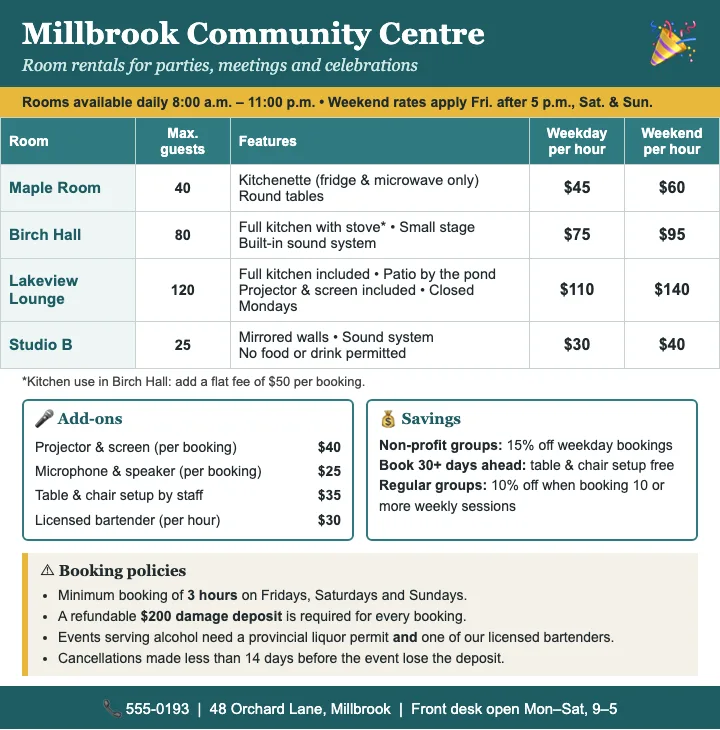
Read the following email message about the diagram on the left. Complete the email by filling in the blanks. Select the best choice for each blank from the drop-down menu.
Subject: Gloria’s retirement party – room booking
To: Hannah Kowal
From: Derek Osei
Hi Hannah,
I finally got the rental sheet from the Millbrook Community Centre, and I think I’ve found the right space for Gloria’s send-off. With the whole department and partners, we’re looking at about 45 people. Our caterer has told me she needs a proper stove to keep the dishes hot, so I’m leaning toward . The Lakeview Lounge would be lovely, but it’s simply out of our price range.
The party is on Friday, June 19, from 6:00 to 10:00, so we’ll be charged . Ahmed has really gone above and beyond with his slideshow of Gloria’s thirty years here. The room already has its own speakers, so the only extra we’ll need is . With the kitchen fee, that brings us to , which keeps us under the $500 we were given. We’ll also have to leave a damage deposit, but we’ll get that back.
Since Gloria doesn’t drink and most of the team prefers it that way, I suggest we skip the wine. That way, we won’t have to arrange .
Could you let me know by Thursday if you’re happy with this? I’d like to book before someone else grabs the date.
Thanks,
Derek
Derek and Hannah know each other because
Why is Derek writing to Hannah?
When Derek says Ahmed has “gone above and beyond,” he means that Ahmed
Part 3: Reading for Information
Paragraph A
When the American space shuttle Columbia lifted off on its second flight in November 1981, it carried a piece of equipment that would make Canada a respected name in space exploration. The Shuttle Remote Manipulator System, better known as the Canadarm, was a robotic arm about fifteen metres long, designed and built in Canada. Mounted along the edge of the shuttle’s cargo bay, it was controlled by an astronaut working from a station at the back of the cockpit. Its main tasks were to lift satellites out of the bay and release them into orbit, and to capture satellites in space so that they could be repaired or brought back to Earth. Although its official name was long and technical, the nickname quickly caught on.
Paragraph B
The arm grew out of an agreement reached between Canada and NASA in the mid-1970s, under which the Canadian government paid to develop it. A team of Canadian companies, led by Spar Aerospace, carried out the work. Building the arm posed an unusual challenge: because it had been designed for the weightlessness of space, it could not support its own weight on Earth. Engineers therefore had to rely on special supports and computer simulations to test it. Like a human arm, it had a shoulder, an elbow and a wrist, and its joints allowed operators to handle large objects with remarkable precision. The project also gave Canadian engineers valuable experience in space robotics that would prove useful for decades.
Paragraph C
Over the next three decades, the Canadarm flew on 90 shuttle missions. It was used to release the Hubble Space Telescope into orbit and later to grab hold of it during repair missions, and it played an important part in assembling the International Space Station. In 2001, a larger successor, Canadarm2, was attached to the station itself, and Canadian astronaut Chris Hadfield made spacewalks to help install it. Unlike the original, which stayed fixed to the shuttle, Canadarm2 can move from place to place on the station, flipping end over end between special fixtures. It has also been used to catch cargo spacecraft arriving from Earth and guide them into position.
Paragraph D
When the shuttle program ended in 2011, the Canadarm was retired, and one of the arms that flew in space is now on display at the Canada Aviation and Space Museum in Ottawa, where visitors can see it up close. Its influence reaches far beyond space, however. Technology developed for the arm has been adapted for uses on Earth, including robotic systems that assist surgeons. The arm has also become a national symbol: Canadarm2 and its robotic partner, Dextre, appear on Canada’s polymer five-dollar bill. The tradition is set to continue, as Canada is now contributing a new arm, Canadarm3, to a proposed space station that would orbit the Moon.
Decide which paragraph, A to D, has the information given in each statement below. Select E if the information is not given in any of the paragraphs.
- Because of what it was built for, the arm could not be tested in the usual way on the ground.
- People preferred a simpler name for the arm to its formal title.
- A Canadian astronaut operated the original arm on its first flight.
- The original arm handled the same telescope on more than one occasion.
- Canada’s work in space robotics is expected to reach beyond Earth’s orbit.
- The arm was paid for by the country that built it rather than by the American space agency.
- Unlike its predecessor, the later arm is not tied to a single attachment point.
- The company that led work on the first arm also built its successor.
- A flown arm can now be seen by the public in the national capital.
Part 4: Reading for Viewpoints
When the City of Port Ellery purchased the Cedar Hollow golf course in 1974, few residents imagined its fairways would one day anchor a housing debate. Yet with rental vacancies hovering below one percent and the course losing money for six consecutive seasons, councillors are contemplating a plan to rezone roughly half its 60 hectares for about 1,400 homes, a third renting below market rates. The remainder would become a public park with walking trails.
Mayor Léonie Dufresne, the plan’s principal champion, frames it as a question of fairness: taxpayers are subsidizing a facility used by a few thousand members while young families abandon the city for want of affordable accommodation. “Golfers would forfeit something genuinely valuable, and I won’t pretend otherwise,” she grants. “But this land belongs to everyone, not merely club members.” Covering the course’s deficits has drained the general budget, money that might otherwise fund libraries or snow clearing.
Gordon Achterberg, who leads the Cedar Hollow Golfers’ Association, disputes that characterization. “Those losses stem from years of postponed maintenance, not waning interest,” he insists. Membership has actually grown since 2020. Nor does he reject construction outright. Vacant parking lots and half-empty office towers downtown, in his view, should be exhausted before any green space is paved.
Urban planner Ravindra Sandhu, who reviewed the scheme, accepts that homes are urgently needed but questions the location. The site lies at the municipal fringe, forty minutes by bus from most jobs, and without a new transit line the development could merely exchange a housing problem for a traffic one. “Density succeeds near where people already work and shop,” he observes. “Otherwise, you’re trading affordable rents for unaffordable car payments.”
Ecologist Marguerite Oyelaran raises another objection. The course’s creek and wetland absorb runoff during heavy storms and have spared neighbouring streets serious flooding. Redevelopment would not trouble her, provided the wetland survived intact, but she doubts a park consisting mostly of lawn could perform the same function.
For renter Tomasz Wiśniewski, three years into a waiting list, such arguments feel abstract. “Everybody endorses new homes, provided they go somewhere else,” he remarks wryly. “Eventually, somewhere else has to be somewhere.”
On location, Achterberg’s thinking is closest to
Why does Achterberg mention membership growth?
Oyelaran’s attitude toward redevelopment is best described as
What can be inferred about the new residents?
Which headline would be best?
The following is a comment by a visitor to the website page. Complete the comment by choosing the best option to fill in each blank.
I live two streets from Cedar Hollow, and I resent hearing that anyone who questions this plan simply dislikes neighbours. I know young people who left Port Ellery because , so I want homes built. But the mayor’s fairness argument overlooks the fact that . On Birch Crescent, that creek is why our basements stay dry, and a lawn won’t . Nor can a course that has fairly be blamed for running a deficit. If council truly cares about affordability, it should heed Mr. Sandhu and , or new tenants will spend their rent savings on gas. Build homes, by all means, but build them in the right place.
Answer key
Count your correct answers, then find your estimated CLB:
Show all 38 answers
- What is the main purpose of Marisol’s letter? C. to seek Kevin’s help in planning a class event
- According to Marisol, why did the ten-year reunion not take place? A. The venue backed out just before the date.
- Why does Marisol want Kevin to look for their former classmates? B. He was friendly with many different groups.
- What can we conclude about the curling club? D. It might be booked by others if she waits.
- Marisol suggests a barbecue instead of a formal dinner because A. guests would spend far less on it.
- How does Marisol seem to feel about asking Kevin for help? C. hopeful, but careful not to make him feel obliged
- D. pulled the plug two weeks ahead
- B. old teammates and drama friends
- A. recover what we put in
- C. pictures nobody has seen before
- B. come and see his photos on screen
- B. Birch Hall
- D. the weekend rate
- A. a projector and screen
- C. $470
- B. a permit or a bartender
- Derek and Hannah know each other because C. they work for the same insurance company.
- Why is Derek writing to Hannah? D. to check that she agrees with his plan
- When Derek says Ahmed has “gone above and beyond,” he means that Ahmed A. has put in more effort than was expected.
- Because of what it was built for, the arm could not be tested in the usual way on the ground. B
- People preferred a simpler name for the arm to its formal title. A
- A Canadian astronaut operated the original arm on its first flight. E
- The original arm handled the same telescope on more than one occasion. C
- Canada’s work in space robotics is expected to reach beyond Earth’s orbit. D
- The arm was paid for by the country that built it rather than by the American space agency. B
- Unlike its predecessor, the later arm is not tied to a single attachment point. C
- The company that led work on the first arm also built its successor. E
- A flown arm can now be seen by the public in the national capital. D
- On location, Achterberg’s thinking is closest to C. Ravindra Sandhu.
- Why does Achterberg mention membership growth? B. to blame maintenance, not interest
- Oyelaran’s attitude toward redevelopment is best described as D. conditionally accepting.
- What can be inferred about the new residents? B. Car costs could burden them.
- Which headline would be best? A. “Homes or Fairways? The Fight Over Cedar Hollow”
- A. rental vacancies had dried up
- D. the fairways do more than host golf
- B. perform the creek’s function
- C. been starved of maintenance
- D. put homes near existing jobs
What does your score mean? See the CELPIP Reading score chart.
Free CELPIP practice test · Free CELPIP Listening practice tests · CELPIP sample tests by part
CELPass is an independent practice platform and is not affiliated with Paragon Testing Enterprises. CELPIP is a trademark of Paragon Testing Enterprises. Check the official CELPIP website and IRCC for current test rules and requirements.