CELPIP Reading Practice Test 76
By Iris
A complete CELPIP Reading practice test: all 4 parts and 38 questions in the real test order. Set a timer for 55–60 minutes and do all four parts in one sitting. Check your answers at the bottom of the page to see your score and an estimated CLB.
Download as PDF with answer key
In this test
- Part 1: Reading Correspondence, “Planning a Gradual Return from Parental Leave” (questions 1–11) · practise this part alone
- Part 2: Reading to Apply a Diagram, “Driving Lessons for a Teenage Nephew” (questions 12–19) · practise this part alone
- Part 3: Reading for Information, “The Great Canadian Flag Debate” (questions 20–28) · practise this part alone
- Part 4: Reading for Viewpoints, “Fine-Free Library Debate” (questions 29–38) · practise this part alone
Part 1: Reading Correspondence
Dear Mr. Okafor,
I hope things at the office have settled down since the move to the new floor. Benjamin is now ten months old, and I’m writing to confirm that I’ll be returning to work on March 3, as we discussed before my leave began. I’m looking forward to it more than I expected, although I’ll admit that the thought of leaving him for a full day still makes me a little anxious.
That brings me to my main request. I was hoping to ease back in gradually by working three days a week, Tuesday to Thursday, for the month of March, before returning to my regular five-day schedule in April. Benjamin will be starting at a daycare near our home, and the director has recommended shorter weeks at first so that new children have time to adjust. My husband’s employer can’t offer him any flexibility until the spring, so this arrangement would make a real difference to our family. I understand that my pay for March would be reduced, and I’m comfortable with that.
I realize the timing isn’t ideal, since the quarterly reports are due at the end of March. To make the transition easier, I’d be glad to come in for a half-day in late February, unpaid, so that Priya can bring me up to speed on the Henley account before she hands it back. She has done a wonderful job of covering for me, and I don’t want her to feel rushed.
There’s one more thing I should raise. The daycare closes at 5:30 sharp and charges parents a fee for every minute they are late, so I’ll need to leave the office by 4:30 each day. I’d like to make up the hour by starting at 8:00 instead of 9:00. I know the front doors aren’t unlocked until 8:30, so my key card may need to be set up to work earlier.
Finally, please thank everyone for the lovely card and the gift basket they sent when Benjamin was born. I still use the baby carrier that was tucked inside it almost every day.
Please let me know whether this plan works for you, or if you’d prefer to meet and discuss it. I could come by any afternoon next week, as long as you don’t mind Benjamin coming along.
Kind regards,
Daniela Ruiz
What is the main purpose of Daniela’s letter?
Why does Daniela want to work only three days a week at first?
What can we conclude about Priya?
Daniela offers to come in for a half-day in February so that she can
Why does Daniela want to begin her workday at 8:00?
How does Daniela seem to feel about going back to work?
Here is a response to the message. Complete the response by filling in the blanks. Select the best choice for each blank from the drop-down menu.
Dear Daniela,
What lovely news! It’s hard to believe Benjamin is already ten months old. We have all missed you, and I’m delighted that you’ll be back on March 3.
HR has approved your request to , and the change to your March pay will be handled automatically. I’ll also gladly take you up on your offer of a half-day in late February. Priya is eager to before she hands it back to you, and I know she’ll appreciate having the time.
An 8:00 start is no problem at all. I’ve asked building security to , so you won’t be left waiting outside. I understand how important that 4:30 departure is when .
Finally, I’ll pass your thanks along to the team. They’ll be thrilled to hear that is getting so much use.
See you soon,
Samuel Okafor
Part 2: Reading to Apply a Diagram
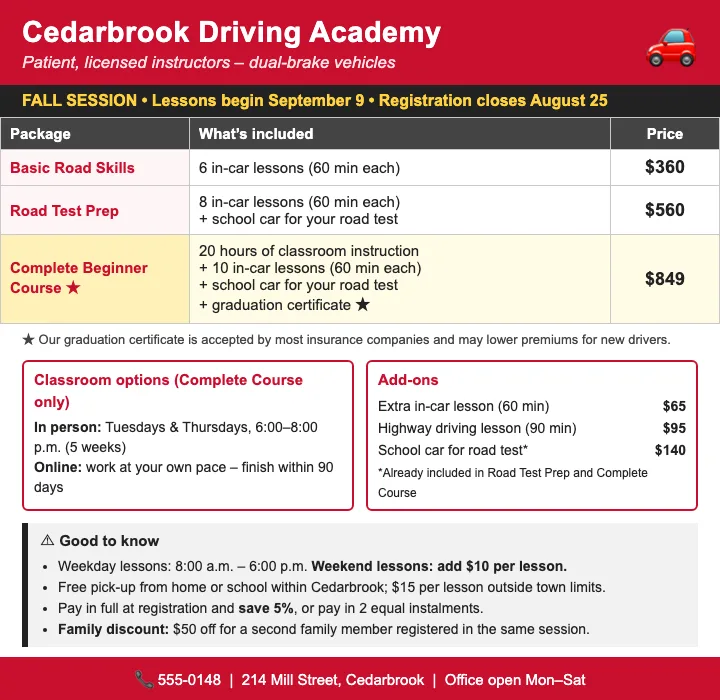
Read the following email message about the diagram on the left. Complete the email by filling in the blanks. Select the best choice for each blank from the drop-down menu.
Subject: Tyler’s driving lessons
To: Joanne Pires
From: Angela Moretti
Hi Jo,
Thanks again for offering to put Tyler’s birthday money toward driving lessons. Your nephew is over the moon! I picked up a flyer from Cedarbrook Driving Academy and wanted to run my plan by you before I sign him up.
When I asked our insurance company what it would cost to add Tyler to our policy, the quote made my jaw drop. The agent told me that a certificate from a recognized driving course could bring it down considerably, so the sensible choice is .
Tyler has hockey practice on Tuesday and Thursday evenings, so he would have to do the classroom part . He’s in school until 3:30 and works at the arena snack bar on weekdays from 4:00 to 7:00, so his in-car lessons will have to be on Saturdays. That adds . At least the instructor will pick him up from our place at no charge.
Our mom has offered to cover the highway lesson. If you’re still happy to put in $300, I can pay the rest at registration and . It’s a shame Maya won’t be sixteen until the spring, or we could have used the family discount, too.
Registration closes on , so could you let me know by Sunday?
Love,
Angela
Angela and Joanne know each other because
Why is Angela writing to Joanne?
When Angela says the insurance quote “made my jaw drop,” she means that
Part 3: Reading for Information
Paragraph A
For nearly a century after Confederation, Canada had no official flag of its own. The Royal Union Flag, commonly called the Union Jack, was still the country’s official flag, while the Canadian Red Ensign, a red banner with the Union Jack in its upper corner and a shield bearing Canadian symbols, flew over federal buildings and was widely treated as the national emblem. Canadian soldiers had carried the Red Ensign in the later years of the Second World War, and many veterans were deeply attached to it. Others, however, felt that a flag dominated by British imagery spoke to only part of the population, particularly French Canadians and the growing number of immigrants from other countries. Calls for a distinctive design surfaced repeatedly, but successive governments judged the issue too divisive to take on.
Paragraph B
That changed after Lester B. Pearson became prime minister in 1963. Pearson wanted a new flag in place before the country’s hundredth birthday in 1967, and in May 1964 he presented his plan to a convention of the Royal Canadian Legion, the country’s largest veterans’ organization. Many in the audience booed him. Undeterred, Pearson brought his favoured design to Parliament: three red maple leaves joined on a single stem against a white background, with a blue bar on each side. Critics soon nicknamed it the “Pearson Pennant.” Opposition leader John Diefenbaker, a firm defender of the Red Ensign, led a fierce resistance, and the debate in the House of Commons dragged on for weeks without a resolution.
Paragraph C
To break the deadlock, Parliament handed the question to a special committee of fifteen members drawn from several parties. Over the following weeks, the committee examined thousands of suggestions sent in by the public, featuring everything from beavers to sheaves of wheat. The design that eventually won owed much to historian George Stanley, who pointed to the flag of the Royal Military College in Kingston, where he taught: red at either side with white in the middle. Stanley proposed placing a single red maple leaf in that white centre. The leaf itself was later simplified to eleven points so that it would remain recognizable even when the flag was whipping about in a strong wind. In the committee’s final vote, the single-leaf design was chosen unanimously.
Paragraph D
The House of Commons approved the new flag in the early hours of December 15, 1964, and the Senate followed two days later. Queen Elizabeth II proclaimed it in January 1965, and on February 15 of that year the red-and-white Maple Leaf was raised over Parliament Hill for the first time. Not everyone let go of the old symbol: within about two years, Ontario and Manitoba had adopted provincial flags based on the Red Ensign, and both still fly them today. Since 1996, February 15 has been marked as National Flag of Canada Day. The flag that once divided Parliament has become one of the most recognized national symbols in the world, often seen sewn onto the backpacks of Canadian travellers.
Decide which paragraph, A to D, has the information given in each statement below. Select E if the information is not given in any of the paragraphs.
- Canadian troops once served under a flag that featured British symbols.
- The prime minister met with open hostility when he first explained his plan to former soldiers.
- The winning design drew on a flag already used by a school.
- Most Canadians who sent in ideas favoured a single maple leaf over Pearson’s design.
- Two provinces chose to keep part of the earlier flag in their own designs.
- Some people felt that the existing flag did not represent all Canadians.
- The appearance of the leaf was altered with weather conditions in mind.
- There was a target date for introducing a new flag that was linked to a national celebration.
- Each year, a particular date is set aside to honour the flag.
Part 4: Reading for Viewpoints
A year after the Fernwood Public Library abolished overdue fines, a policy intended to welcome readers back quietly has become one of the more contentious items in the municipal budget. Borrowers formerly paid 25 cents a day per late item, and a balance exceeding $10 froze their cards. The fines yielded roughly $160,000 annually: modest, but not a sum that vanishes without consequences.
Chief librarian Simone Archambault considers abolition the best decision of her tenure. Within twelve months, more than 2,000 previously blocked cards were reactivated, many belonging to children whose families had stopped coming sooner than confront a debt. “Fines never taught responsibility,” she maintains. “They taught poorer households that the library wasn’t meant for them.” She is candid about one side effect: popular new releases return more slowly, and wait lists for some titles have roughly doubled.
Councillor Warren Fitzgerald is unmoved by circulation statistics. To offset the lost revenue, the library board eliminated Sunday hours at two of its four branches, a trade-off he deems indefensible. “A free service behind a locked door isn’t free,” he argues. Even so, he stops short of advocating a return to the old regime, proposing instead to reinstate daily charges only on high-demand items such as bestsellers and museum passes.
Economist Elspeth Morrow suspects both camps exaggerate the stakes. Her research indicates that fines barely influence how promptly materials come back, and the revenue figures, she cautions, are misleading: once staff time spent processing payments and adjudicating disputes is subtracted, the net gain was perhaps half what appeared on paper. “The Sunday closures reflect the board’s priorities more than any financial necessity.”
At the main branch, circulation supervisor Nadia Kowalczyk has watched quarrels over a few dollars, once a drain on her staff’s day, all but disappear. Reverting to fining everyone holds no appeal for her. “But when forty patrons are queued for a single novel,” she allows, “a modest charge on that copy might be the lesser evil.”
Parent Omar Haddad, whose three children rejoined last spring, had simply stopped bringing them once the family owed $38. “Reintroduce fines on anything and the families who most need the library will assume they apply to everything,” he warns.
Fitzgerald’s closest ally would be
What does Fitzgerald’s “locked door” refer to?
Elspeth Morrow implies that
What do Archambault’s figures and Haddad’s story suggest?
The article could most aptly be titled
The following is a comment by a visitor to the website page. Complete the comment by choosing the best option to fill in each blank.
As a volunteer with the library’s homework club, I consider the fine-free policy a quiet triumph. Children who once hung back at the desk because they now borrow every week. Councillor Fitzgerald’s compromise therefore worries me: Mr. Haddad is right that even a narrow charge would . Still, the councillor’s anger about Sundays is justified, since that is when working parents can actually . And if Dr. Morrow is correct, half of what the fines brought in merely paid for . As for the wait lists, Ms. Kowalczyk would charge for the queued copy; I would sooner , at far less than the price of a locked branch.
Answer key
Count your correct answers, then find your estimated CLB:
Show all 38 answers
- What is the main purpose of Daniela’s letter? B. to propose an arrangement for her first weeks back
- Why does Daniela want to work only three days a week at first? C. Her son’s daycare has advised a gentler start.
- What can we conclude about Priya? A. She has been looking after some of Daniela’s work.
- Daniela offers to come in for a half-day in February so that she can D. be briefed on a client before taking it back.
- Why does Daniela want to begin her workday at 8:00? B. to be able to collect her son on time
- How does Daniela seem to feel about going back to work? A. keen, although somewhat uneasy
- B. keep to a shorter week until April
- C. brief you on the account she ran
- D. make sure your pass works before 8:30
- C. the daycare bills parents for lateness
- A. the carrier from their basket
- C. the Complete Beginner Course
- B. online at his own pace
- B. $10 to each lesson
- D. knock 5% off the total
- A. August 25
- Angela and Joanne know each other because D. they are members of the same family.
- Why is Angela writing to Joanne? B. to get Joanne’s view before registering Tyler
- When Angela says the insurance quote “made my jaw drop,” she means that A. it was much more costly than she had expected.
- Canadian troops once served under a flag that featured British symbols. A
- The prime minister met with open hostility when he first explained his plan to former soldiers. B
- The winning design drew on a flag already used by a school. C
- Most Canadians who sent in ideas favoured a single maple leaf over Pearson’s design. E
- Two provinces chose to keep part of the earlier flag in their own designs. D
- Some people felt that the existing flag did not represent all Canadians. A
- The appearance of the leaf was altered with weather conditions in mind. C
- There was a target date for introducing a new flag that was linked to a national celebration. B
- Each year, a particular date is set aside to honour the flag. D
- Fitzgerald’s closest ally would be C. Nadia Kowalczyk.
- What does Fitzgerald’s “locked door” refer to? A. the Sunday closures
- Elspeth Morrow implies that D. fine revenue was overstated.
- What do Archambault’s figures and Haddad’s story suggest? C. Debts kept some families away.
- The article could most aptly be titled D. “A Fine-Free Library, but at What Cost?”
- C. owed over the limit
- A. send families the wrong signal
- B. bring their children along
- D. collecting them
- C. stock up on what people want
What does your score mean? See the CELPIP Reading score chart.
Free CELPIP practice test · Free CELPIP Listening practice tests · CELPIP sample tests by part
CELPass is an independent practice platform and is not affiliated with Paragon Testing Enterprises. CELPIP is a trademark of Paragon Testing Enterprises. Check the official CELPIP website and IRCC for current test rules and requirements.