CELPIP Reading Practice Test 79
By Iris
A complete CELPIP Reading practice test: all 4 parts and 38 questions in the real test order. Set a timer for 55–60 minutes and do all four parts in one sitting. Check your answers at the bottom of the page to see your score and an estimated CLB.
Download as PDF with answer key
In this test
- Part 1: Reading Correspondence, “Drum Practice and a Night-Shift Neighbour” (questions 1–11) · practise this part alone
- Part 2: Reading to Apply a Diagram, “Joining a Curling League with a Friend” (questions 12–19) · practise this part alone
- Part 3: Reading for Information, “The Bluenose: Nova Scotia’s Famous Schooner” (questions 20–28) · practise this part alone
- Part 4: Reading for Viewpoints, “Scrapping Parking Rules for New Apartments” (questions 29–38) · practise this part alone
Part 1: Reading Correspondence
Dear Mrs. Okafor,
I hope you and your family are settling in well. Apart from a wave over the hedge now and then, we haven’t really had a chance to talk since you moved in next door in June, so I’m sorry that my first proper note to you is about a problem. I’ve been wondering for a couple of weeks how best to raise it, and writing seemed kinder than stopping you on the driveway with your arms full of groceries.
As you may know, I work as a paramedic. Since September, I’ve been on a rotation that puts me on four night shifts in a row every second week. On those weeks, I get home at about eight in the morning and try to sleep until five in the afternoon. Tobi seems to practise his drums in your garage right after school, from roughly half past three until five, and my bedroom window is only a few metres from your garage door. Even with earplugs, I’m usually wide awake by four.
Please don’t take this as a complaint about Tobi. He’s obviously putting in the effort, and he’s improved a great deal since the summer. I played the drums all through high school myself, and our neighbours put up with far more noise from me than I ever deserved. The last thing I want is for him to give up something he clearly enjoys.
I have two ideas. The simplest would be for him to practise a little later on my night-shift weeks, say after half past five. I’d happily give you a copy of my schedule so you know which weeks those are; the rest of the time, he can play whenever he likes. The other idea is that I have an electronic drum kit sitting in my basement, unused since I moved here. With headphones on, it makes hardly any sound, and Tobi would be welcome to borrow it for as long as he wants. Then he could practise at any hour without bothering anyone, including you.
I’m home this Saturday, so if you’d rather talk it over in person, please come by for a coffee. I’d much prefer to sort this out as friends.
Sincerely,
Daniel Kowalczyk
What is the main purpose of Daniel’s letter?
Before this letter, Daniel and Mrs. Okafor had
Why is Daniel’s sleep disturbed only on certain weeks?
What does Daniel reveal about himself?
The electronic kit would allow Tobi to
What does Daniel suggest at the end of his letter?
Here is a response to the message. Complete the response by filling in the blanks. Select the best choice for each blank from the drop-down menu.
Dear Daniel,
Thank you for such a thoughtful letter, and I’m mortified to learn we’ve been for weeks without realizing it. Tobi had no idea anyone next door was at that time of day, and he felt terrible when I told him.
He was also delighted to hear that you ; he’s already asking whether you’d listen to him play sometime. As for your offer of the , it’s very generous, and we’d gladly accept. To be honest, it might give my own ears a rest as well!
Until then, he’ll stick to during your night-shift weeks, so please do send me that schedule. I’ll take you up on the coffee, too. Would Saturday at ten work?
Warm regards,
Grace Okafor
Part 2: Reading to Apply a Diagram
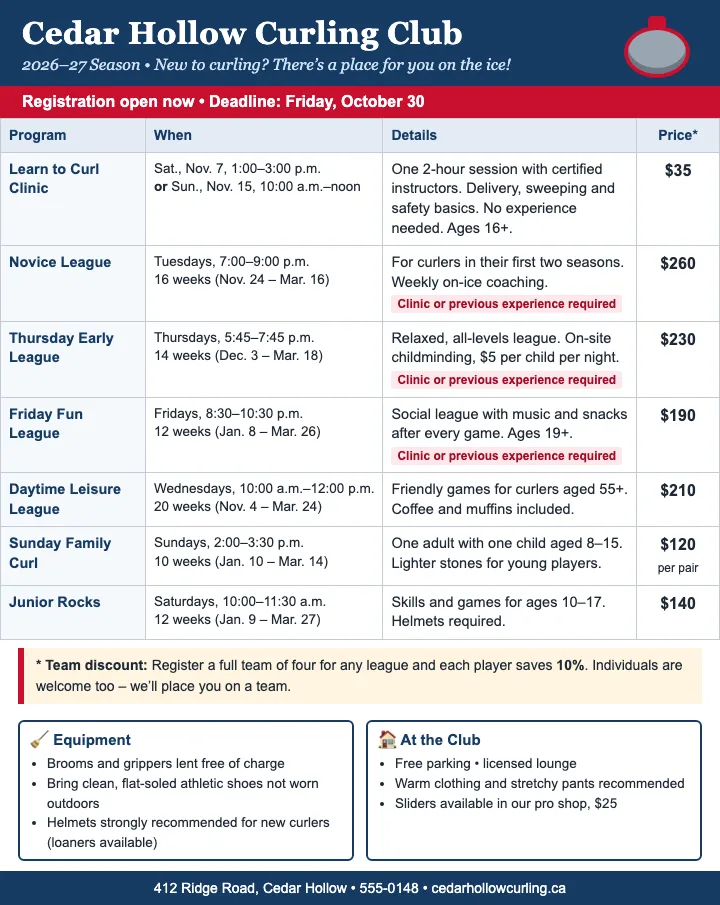
Read the following email message about the diagram on the left. Complete the email by filling in the blanks. Select the best choice for each blank from the drop-down menu.
Subject: Curling this winter?
To: Dana Whitford
From: Kevin Osei
Hi Dana,
We never get more than two minutes to talk at daycare pickup, so I thought I’d write instead. Remember when we said we needed something to get us out of the house this winter? The curling club on Ridge Road just put out its schedule, and I think we should give it a try!
Neither of us has ever thrown a stone, so we’d be in the same boat. That means we’d have to start with before we could join a league. I’m at my brother’s in Moncton the weekend of the 7th, so we’d have to go to .
As for a league, I know Tuesdays are your choir night, and Fridays are out for me because I open the bakery at six on Saturday mornings. And since we both work weekdays until five, that leaves . The best part is that we could bring the kids along, since that league offers . If we can talk Marco and Priya into joining us as a full team, we’d each pay for the season.
Registration closes at the end of the month, so let me know soon!
Kevin
Kevin and Dana know each other because
Why is Kevin suggesting curling?
When Kevin says they would be “in the same boat,” he means that they would
Part 3: Reading for Information
Paragraph A
Most Canadians carry a picture of the Bluenose without giving it a second thought. The schooner has sailed across the back of the ten-cent coin since 1937, and its image has also appeared on postage stamps and other symbols of Nova Scotia. Yet the real vessel was no decorative ornament. Launched in Lunenburg, Nova Scotia, in 1921, it was a hard-working fishing boat that also became the most celebrated racing schooner of its time. Even its name carried local pride, since “Bluenose” had long been a nickname for Nova Scotians themselves.
Paragraph B
The Bluenose was born out of rivalry. In the early twentieth century, fleets of wooden schooners from Nova Scotia and New England sailed to the offshore banks of the North Atlantic to fish for cod, and crews on both sides of the border took great pride in the speed of their vessels. In 1920, a Halifax newspaper created a trophy for a race between genuine working schooners. The idea came partly in response to a well-known yacht race that had been called off because the wind was judged too strong, conditions that fishermen faced as a matter of routine. When a schooner from Gloucester, Massachusetts, won that first contest, Nova Scotian backers set out to build a vessel that could bring the trophy home. The design was entrusted to William Roué of Halifax, and the hull was built at the Smith and Rhuland shipyard in Lunenburg.
Paragraph C
Under Captain Angus Walters, the Bluenose did exactly what its owners had hoped. Because the race rules required entrants to be real fishing vessels, the schooner first spent a season on the banks, bringing in catches like any other boat in the fleet. It then won the International Fishermen’s Trophy in the autumn of 1921 and never lost a series for that trophy in the years that followed, the last of which took place in 1938. Not every contest ended smoothly, as disputes over rules and courses sometimes overshadowed the sailing, but the schooner’s reputation for speed only grew. For many Canadians, its victories became a source of national as well as regional pride.
Paragraph D
Ironically, the Bluenose could not outrun changes in the fishing industry itself. As motor-powered vessels replaced sail, schooners became increasingly difficult to operate at a profit. Despite efforts by Walters to keep the ship in Nova Scotia, it was sold in 1942 and put to work carrying cargo in the Caribbean. In 1946, it struck a reef off Haiti and was lost. The story did not end there, however. In 1963, a first replica, Bluenose II, was launched from the same Lunenburg shipyard that had built the original. Today, in rebuilt form, Bluenose II sails as a goodwill ambassador for the province, welcoming visitors on board and appearing at waterfront festivals.
Decide which paragraph, A to D, has the information given in each statement below. Select E if the information is not given in any of the paragraphs.
- Many people handle an image of the vessel in their daily lives.
- A loss to an American competitor led directly to the schooner’s construction.
- The schooner had to prove itself as a working boat before it was allowed to race.
- The schooner’s designer had previously created several winning racing yachts.
- New technology made sailing vessels less practical for commercial fishing.
- The fishermen’s race was partly a reaction to a contest seen as unsuited to harsh weather.
- Some of the competitions were marred by disagreements that distracted from the racing.
- The replica was paid for by the federal government to attract tourists.
- The original vessel ended its career far from the province where it was built.
Part 4: Reading for Viewpoints
Halbrook councillors are debating scrapping minimum parking requirements for new apartment buildings within 800 metres of a rapid-transit station. The current bylaw obliges developers to provide at least one stall per unit, whether or not tenants own cars. Critics contend the rule inflates rents and devours land that could hold homes; defenders regard it as the only barrier between established neighbourhoods and streets choked with parked vehicles.
“An underground stall can cost tens of thousands of dollars to build, and that’s folded into every unit,” says Councillor Amara Delgado, who tabled the motion. Tenants who take the bus, she points out, effectively subsidize parking they never use. She is careful to clarify one thing: “Nothing’s being prohibited. Builders can still include as many spaces as they believe the market demands.”
Rajiv Sethi, whose firm has three mid-rise projects in the planning stage, welcomes the flexibility but tempers expectations. “Lenders still insist on parking before they’ll finance a building, and many buyers won’t consider a unit without a stall,” he explains. On some sites his firm might eliminate half the spaces; on others, none. Forecasts of a fixed drop in rents strike him as premature.
Margaret Fennimore, who chairs the Eastgate Residents’ Association near Eastgate station, anticipates newcomers without designated spaces commandeering residential roads. “We’ve got no quarrel with apartments,” she insists. “But seniors, shift workers and tradespeople hauling equipment will keep driving whether or not their building has a garage.” She would endorse the reform only alongside a residential permit system, which council has so far declined to fund.
Dr. Lionel Achterberg, who teaches urban planning at the local university, considers both camps partly correct. Cities that abandon parking minimums rarely experience the spillover residents dread, he observes, but only because they simultaneously manage on-street parking firmly. “Removing the requirement without pricing or permitting curb space is like opening a tap without a drain.” Nor does he anticipate housing becoming cheaper across the board, since any savings hinge on whether builders actually omit stalls, which will vary considerably from site to site.
Sethi’s caution about savings is echoed by
How would Delgado rebut talk of a garage ban?
Fennimore’s objection rests mainly on the belief that
Which conclusion does the article best support?
The most fitting headline would be
The following is a comment by a visitor to the website page. Complete the comment by choosing the best option to fill in each blank.
As a renter without a car, I pay every month for a stall I never use, so I was glad to see Councillor Delgado . Still, Mr. Sethi’s remarks were sobering. As long as , buildings near our stations will look much like the old ones, and the savings will be modest.
I also sympathize with Ms. Fennimore more than I expected: she is right that , and a resident circling her own block has every reason to be annoyed. Dr. Achterberg’s made the danger vivid.
My advice to council is simple: . Done properly, this reform could give renters a fairer deal without turning Eastgate’s streets into one long parking lot.
Answer key
Count your correct answers, then find your estimated CLB:
Show all 38 answers
- What is the main purpose of Daniel’s letter? B. to ask for a change to a practice routine
- Before this letter, Daniel and Mrs. Okafor had D. exchanged little more than friendly greetings.
- Why is Daniel’s sleep disturbed only on certain weeks? A. He works overnight only every other week.
- What does Daniel reveal about himself? C. He was once a noisy young musician.
- The electronic kit would allow Tobi to D. play whenever he chooses, whatever Daniel’s shifts are.
- What does Daniel suggest at the end of his letter? A. a relaxed chat over coffee at his home
- C. interrupting your sleep
- B. trying to rest
- D. used to drum in high school
- A. electronic practice kit
- C. evenings once you’re up
- D. a Learn to Curl clinic
- B. the Sunday morning session
- C. the Thursday Early League
- A. childminding for a small fee
- B. $207
- Kevin and Dana know each other because C. their kids go to the same daycare.
- Why is Kevin suggesting curling? D. They had agreed to find a winter activity.
- When Kevin says they would be “in the same boat,” he means that they would A. both be complete beginners.
- Many people handle an image of the vessel in their daily lives. A
- A loss to an American competitor led directly to the schooner’s construction. B
- The schooner had to prove itself as a working boat before it was allowed to race. C
- The schooner’s designer had previously created several winning racing yachts. E
- New technology made sailing vessels less practical for commercial fishing. D
- The fishermen’s race was partly a reaction to a contest seen as unsuited to harsh weather. B
- Some of the competitions were marred by disagreements that distracted from the racing. C
- The replica was paid for by the federal government to attract tourists. E
- The original vessel ended its career far from the province where it was built. D
- Sethi’s caution about savings is echoed by C. Lionel Achterberg.
- How would Delgado rebut talk of a garage ban? A. Developers would set the number.
- Fennimore’s objection rests mainly on the belief that D. people will keep driving regardless.
- Which conclusion does the article best support? B. Funding for permits may prove decisive.
- The most fitting headline would be A. “Fewer Stalls, Cheaper Homes? Halbrook Isn’t Sure”
- B. expose what tenants subsidize
- D. financing hinges on stalls
- C. cars don’t vanish with garages
- A. plumbing metaphor
- D. put its money where its motion is
What does your score mean? See the CELPIP Reading score chart.
Free CELPIP practice test · Free CELPIP Listening practice tests · CELPIP sample tests by part
CELPass is an independent practice platform and is not affiliated with Paragon Testing Enterprises. CELPIP is a trademark of Paragon Testing Enterprises. Check the official CELPIP website and IRCC for current test rules and requirements.