CELPIP Reading Practice Test 80
By Iris
A complete CELPIP Reading practice test: all 4 parts and 38 questions in the real test order. Set a timer for 55–60 minutes and do all four parts in one sitting. Check your answers at the bottom of the page to see your score and an estimated CLB.
Download as PDF with answer key
In this test
- Part 1: Reading Correspondence, “Repeated Refrigerator Repair Complaint” (questions 1–11) · practise this part alone
- Part 2: Reading to Apply a Diagram, “Ferry Plans for a Long Weekend on the Island” (questions 12–19) · practise this part alone
- Part 3: Reading for Information, “Pacific Salmon And Their Journey Home” (questions 20–28) · practise this part alone
- Part 4: Reading for Viewpoints, “Right To Disconnect Debate At City Hall” (questions 29–38) · practise this part alone
Part 1: Reading Correspondence
Dear Ms. Bergeron,
I am writing about the Frostline French-door refrigerator I bought from your Elm Street store fourteen months ago. At the time, the salesperson strongly recommended your three-year Northgate Care protection plan, explaining that models with built-in ice makers sometimes need service. I took his advice and paid an extra $249 for the plan. Unfortunately, I have needed it far more than either of us expected.
In March, the freezer stopped holding its temperature, and a technician replaced the fan motor. In June, the same problem returned. This time the technician replaced the control board, but the part was back-ordered, and I waited nine days for it. Although my neighbour kindly lent me space in her chest freezer, she had little room to spare, and I had to throw out roughly $200 worth of food, including meat I had bought in bulk. Last week, for the third time, the freezer began to warm up again.
I should say that Luis, the technician who has come on all three visits, has been courteous and thorough, and I don’t hold him responsible. In fact, he quietly told me that this model has a known problem with its temperature sensor and that I should ask the store about a replacement. When I phoned your service line, however, I was told that the plan only replaces an appliance after four failed repairs to the same part. Since a different part was replaced each time, the agent explained, the count starts over with every visit. Frankly, this rule seems designed to make sure no customer ever qualifies. I should also mention that each visit has cost me an unpaid half day of work, as your service windows are four hours long.
I am therefore asking you to replace the refrigerator with a comparable model. If you no longer trust this Frostline model either, I would be happy to have the full purchase price applied to another brand and pay any difference myself. I would also like to be reimbursed for the spoiled food; copies of my receipts are attached.
I have been a loyal Northgate customer for years. My washer and dryer came from your store, and I recommended you to my sister when she renovated her kitchen. I would much prefer to settle this with you directly, but if I have not heard back within ten business days, I will take my complaint further.
Sincerely,
Rebecca Holloway
What is the main purpose of Rebecca’s letter?
Rebecca bought the protection plan because
What made the June repair especially difficult for Rebecca?
What did Luis suggest Rebecca do?
According to the service line, Rebecca does not yet qualify for a replacement because
If the store does not reply in time, Rebecca will probably
Here is a response to the message. Complete the response by filling in the blanks. Select the best choice for each blank from the drop-down menu.
Dear Ms. Holloway,
Thank you for taking the time to write, and please accept my sincere apologies. Three service calls on a refrigerator that is only a little over is simply not acceptable, and I also recognize that each visit has meant for you.
I have reviewed your file. Our agent applied the policy as written, but treating your three repairs as unrelated misses the point: each time, the underlying problem was .
I have therefore arranged a replacement. We can deliver a comparable Frostline model at no charge, or, as you proposed, credit the full purchase price toward . Your protection plan will transfer to the new appliance.
I have also approved reimbursement for the food you lost when , and a cheque will be mailed this week. Thank you for your patience and for your loyalty to Northgate.
Sincerely,
Claire Bergeron
Customer Relations Manager
Part 2: Reading to Apply a Diagram
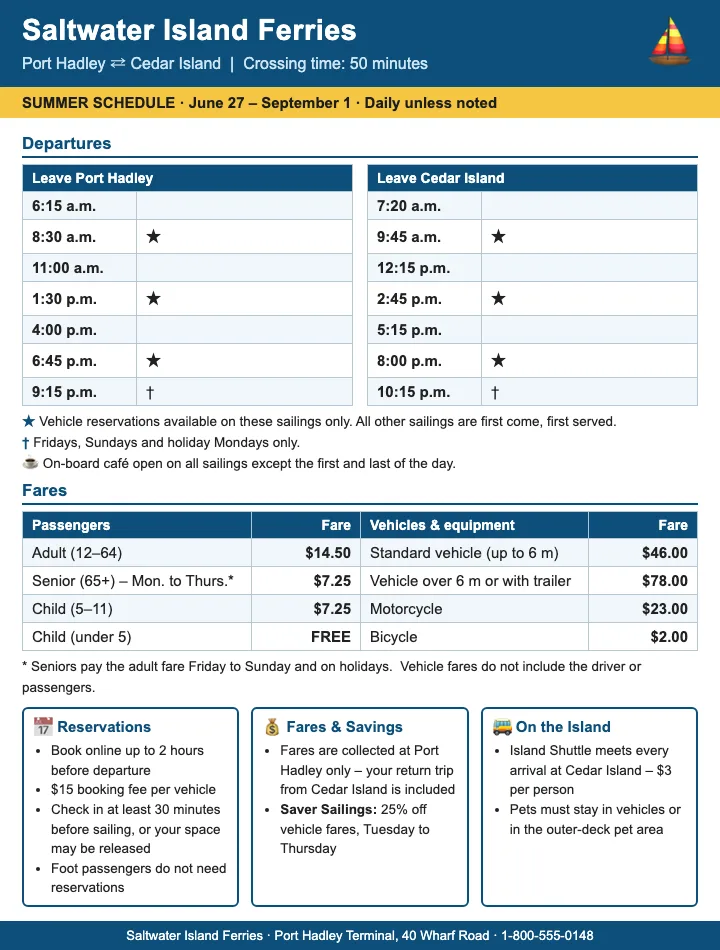
Read the following email message about the diagram on the left. Complete the email by filling in the blanks. Select the best choice for each blank from the drop-down menu.
Subject: Getting everyone to Cedar Island
To: Carla Mendes
From: Tom Ashdown
Hi Carla,
Mia and I are so glad you’re all coming out for the long weekend! She keeps saying she hasn’t had a proper visit with her big sister in years. I’ve been studying the ferry schedule, so here’s what I suggest.
Since you’re leaving Kamloops on Friday morning, you probably won’t reach Port Hadley until around two. Friday sailings fill up quickly in summer, and with the boat trailer you’ll want a guaranteed spot, so I’d book the sailing. Just keep in mind that because of the trailer, the vehicle fare will be , plus the booking fee and everyone’s passenger fares. The good news is that , so you won’t pay a thing on Monday.
We’re heading over on Thursday as foot passengers. Our cabin is a good twenty minutes’ drive from the dock, but we won’t need the car on the island, since , and our bikes only cost a couple of dollars each.
Your dad is coming over with us, which works out nicely, since . I’ve told him to catch the early bus to the terminal so he doesn’t cut it too close – you know how he hates rushing.
Let me know tonight and I’ll make your reservation.
Cheers,
Tom
Tom and Carla know each other because
What is the main purpose of Tom’s email?
When Tom says Carla’s dad shouldn’t “cut it too close,” he means her dad should not
Part 3: Reading for Information
Paragraph A
Each autumn, rivers and streams across British Columbia fill with one of nature’s great spectacles: the return of the Pacific salmon. Five species of Pacific salmon spawn in Canadian waters – chinook, coho, sockeye, pink and chum – and all of them begin life in the same way, as eggs buried in the gravel of a freshwater stream. What happens next depends on the species. Pink and chum salmon head for the ocean almost as soon as they emerge, while young coho and sockeye may remain in rivers or lakes for a year or more. Once at sea, salmon feed and grow for one to several years before a powerful instinct draws them back to the very stream where they hatched. Scientists believe that, after reaching the coast, salmon rely largely on their sense of smell to pick out the distinctive scent of their home waters.
Paragraph B
The journey upstream is exhausting. Once salmon enter fresh water, they stop eating altogether and must survive on the fat reserves they built up at sea. Some Fraser River sockeye swim more than 1,000 kilometres inland, battling rapids and leaping small waterfalls along the way. As they travel, their bodies transform. Sockeye, silver in the ocean, turn a brilliant red with green heads, and the males of several species develop a hooked jaw and, in some cases, a humped back. When a female reaches the spawning grounds, she uses her tail to dig a shallow nest in the gravel, where she lays her eggs and a male fertilizes them. Within days or weeks, both parents die, their energy completely spent.
Paragraph C
Yet the death of the adults is far from the end of their usefulness. Salmon carcasses provide a feast for bears, eagles, gulls and many other animals at a time of year when they are preparing for winter. Bears often carry fish well away from the riverbank, eating only the richest parts and leaving the rest on the forest floor. As those remains break down, nutrients the fish gathered in the ocean are released into the soil, and researchers have found traces of these ocean-derived nutrients in trees and plants growing along salmon streams. Decaying carcasses also support the insects that young salmon later feed on, so each generation helps to nourish the next.
Paragraph D
For people, too, salmon have long been vital. Indigenous peoples along the Pacific coast and in the interior have fished salmon for thousands of years, and the fish remain central to their diets, economies and ceremonies. Salmon runs have also suffered at human hands. In the early twentieth century, rock blasted during railway construction in the Fraser Canyon contributed to a massive slide at Hell’s Gate, narrowing the river so severely that huge numbers of fish could not get past. Decades later, concrete fishways were built to help salmon through the narrow passage. Today, warming rivers and the loss of stream habitat pose new challenges, and many communities are working to restore the streams that salmon depend on.
Decide which paragraph, A to D, has the information given in each statement below. Select E if the information is not given in any of the paragraphs.
- Young salmon do not all leave fresh water at the same stage of life.
- Salmon heading upstream depend on energy they stored before the journey.
- Most salmon eggs are eaten by other animals before they can hatch.
- Fish that die after spawning can end up helping trees to grow.
- An obstacle in one river was partly the result of human activity.
- Salmon are thought to use scent to find their way back to where they began life.
- Salmon that die after spawning end up benefiting the fish that hatch later in the same waters.
- Fraser River salmon numbers have returned to what they were before the slide.
- Salmon look very different by the time they are ready to spawn.
Part 4: Reading for Viewpoints
Lakeport city council is weighing a motion that sounds straightforward yet has divided opinion. Under the so-called “right to disconnect,” the city’s 1,400 non-emergency employees would no longer be expected to read or answer work emails, texts or calls between 7 p.m. and 7 a.m., or on weekends. Emergency services, already organized around scheduled shifts, would be exempt.
Councillor Dana Whitfield traces the idea to last year’s exit interviews, in which nearly a third of departing employees cited after-hours messages as a reason for leaving, each replacement costing thousands in recruitment. “We’ve been tacitly rewarding whoever answers at eleven at night, then expressing surprise when they burn out,” she argues. Ambition would not be curtailed; anyone may still work late, but nobody could be penalized for waiting until morning.
Marcus Oyelaran, head of the union local representing municipal workers, welcomes the motion while doubting it goes far enough. Removing the expectation of a reply, in his view, leaves the underlying problem untouched. “Members told they needn’t answer have found their files reassigned to colleagues who did.” Staff who genuinely must remain reachable, he argues, belong on paid standby. “Availability is work.”
Priya Nanjiani, an organizational psychologist at Lakeport College who has studied comparable European policies, describes their results as mixed. She accepts that constant connectivity contributes to exhaustion. “But blanket cut-off times can penalize the very employees they’re meant to protect, such as a parent who logs off at three to collect the kids and catches up after bedtime.” She favours letting each team negotiate its own agreement, reviewed annually.
Gordon Tessier, chair of the Lakeport Chamber of Commerce, raises a different concern. Contractors on city projects often discover problems in the evening, and a permit question left until Monday can halt a job for days. Even so, he stops short of outright opposition, acknowledging that City Hall is stretched thin and admitting that he switches off his own phone on Sundays. “Let each department determine what the people it serves actually need,” he suggests.
Whitfield remains unperturbed, dismissing every objection she has heard as a quibble over details.
Which pair would favour the same rule-setting approach?
Why does Oyelaran mention reassigned files?
Why does Whitfield cite the exit interviews?
What do Nanjiani and Tessier both accept?
Which title best captures the article?
The following is a comment by a visitor to the website page. Complete the comment by choosing the best option to fill in each blank.
I spent twelve years in a municipal planning office before a phone that never stopped buzzing wore me down, so I welcome this motion. Councillor Whitfield has diagnosed the problem precisely: the current culture . Mr. Oyelaran is also right that anyone the city truly needs in the evening should . Ms. Nanjiani’s worry leaves me cold; parents could still work after bedtime, and everyone else would gain . As for Mr. Tessier, a permit query is hardly , and the departments that work scheduled shifts are anyway. Pass the motion and refine the details later; perfection should not be the enemy of progress.
Answer key
Count your correct answers, then find your estimated CLB:
Show all 38 answers
- What is the main purpose of Rebecca’s letter? C. to ask the store to replace her faulty refrigerator
- Rebecca bought the protection plan because B. a salesperson told her it was a good idea.
- What made the June repair especially difficult for Rebecca? D. She had to wait more than a week for a part.
- What did Luis suggest Rebecca do? A. request a new refrigerator from the store
- According to the service line, Rebecca does not yet qualify for a replacement because C. a different part was replaced on each visit.
- If the store does not reply in time, Rebecca will probably A. take her complaint beyond the store.
- D. a year old
- A. losing half a day’s pay
- C. a freezer that would not stay cold
- B. another brand, with you paying any extra
- D. the replacement part was on back order
- C. 6:45 p.m.
- D. $78.00
- A. your trip back is already included
- B. an island shuttle meets every ferry
- D. the senior rate applies that day
- Tom and Carla know each other because B. Tom is married to Carla’s sister.
- What is the main purpose of Tom’s email? A. to sort out everyone’s travel plans
- When Tom says Carla’s dad shouldn’t “cut it too close,” he means her dad should not C. leave himself too little time.
- Young salmon do not all leave fresh water at the same stage of life. A
- Salmon heading upstream depend on energy they stored before the journey. B
- Most salmon eggs are eaten by other animals before they can hatch. E
- Fish that die after spawning can end up helping trees to grow. C
- An obstacle in one river was partly the result of human activity. D
- Salmon are thought to use scent to find their way back to where they began life. A
- Salmon that die after spawning end up benefiting the fish that hatch later in the same waters. C
- Fraser River salmon numbers have returned to what they were before the slide. E
- Salmon look very different by the time they are ready to spawn. B
- Which pair would favour the same rule-setting approach? D. Nanjiani and Tessier
- Why does Oyelaran mention reassigned files? B. to show not replying is still penalized
- Why does Whitfield cite the exit interviews? C. to show what moved her
- What do Nanjiani and Tessier both accept? A. City staff are under strain.
- Which title best captures the article? B. “Right to Disconnect: A Straightforward Rule Divides Lakeport”
- A. quietly favours the always available
- C. be on the clock
- B. a guilt-free wait until morning
- D. a matter of life and death
- A. a case apart
What does your score mean? See the CELPIP Reading score chart.
Free CELPIP practice test · Free CELPIP Listening practice tests · CELPIP sample tests by part
CELPass is an independent practice platform and is not affiliated with Paragon Testing Enterprises. CELPIP is a trademark of Paragon Testing Enterprises. Check the official CELPIP website and IRCC for current test rules and requirements.