CELPIP Reading Practice Test 84
By Iris
A complete CELPIP Reading practice test: all 4 parts and 38 questions in the real test order. Set a timer for 55–60 minutes and do all four parts in one sitting. Check your answers at the bottom of the page to see your score and an estimated CLB.
Download as PDF with answer key
In this test
- Part 1: Reading Correspondence, “Disputing an Estimated Electricity Bill” (questions 1–11) · practise this part alone
- Part 2: Reading to Apply a Diagram, “Theatre Subscription for Two Old Friends” (questions 12–19) · practise this part alone
- Part 3: Reading for Information, “Canola: A Canadian Crop Invention” (questions 20–28) · practise this part alone
- Part 4: Reading for Viewpoints, “Presumed Consent For Organ Donation Debate” (questions 29–38) · practise this part alone
Part 1: Reading Correspondence
Dear Customer Care Team,
I am writing about my electricity account (number 4471-2290) for the house at 19 Birchwood Crescent, which I have owned since 2019. My most recent bill, covering September and October, came to $412.36. For comparison, my bill for the same two months last year was $138.50, and nothing about the way my household uses electricity has changed. If anything, we have been using less, since my son left for university at the end of August.
When I looked at the bill more closely, I noticed a small letter “E” beside the meter reading. According to the back of the statement, this means the reading was estimated rather than taken from the meter itself. I then went out to the side of the house and checked the meter myself. The number on it is almost 2,000 kilowatt-hours lower than the figure printed on my bill. I have attached a photo of the meter, taken this morning with the date showing, so that you can compare the two numbers yourselves.
I believe I know how this happened. In July, I replaced the old wooden gate beside my house with one that locks, because raccoons kept getting into my garbage bins. It simply did not occur to me that your meter reader needs to pass through that gate. That was my oversight, and I apologize for it. I have since left a key with my neighbour at number 21, who is retired and home most days, and I would ask you to add her phone number to my account notes so that your staff can contact her.
What I cannot accept, however, is being asked to pay for electricity I have not used. I would therefore ask you to correct the bill using my actual reading and to send me a revised statement. Since payment is due on November 20, I would also appreciate confirmation that no late fee will be charged while the matter is being reviewed. In the meantime, I am happy to pay my usual amount in good faith and settle any difference once the corrected bill arrives.
Finally, I understand that some customers can now submit their own meter readings online. If that option is available in my area, I would be glad to sign up.
You can reach me at 613-555-0148 on weekday evenings, or by email at any time.
Sincerely,
Delphine Arsenault
What is the main purpose of Delphine’s letter?
Why was Delphine’s meter not read in person?
Delphine mentions her bill from the previous year in order to
What does Delphine admit in her letter?
To show good faith while the bill is reviewed, Delphine offers to
According to her letter, Delphine
Here is a response to the message. Complete the response by filling in the blanks. Select the best choice for each blank from the drop-down menu.
Dear Ms. Arsenault,
Thank you for writing to us and for sending the dated photo of your meter. I’m sorry for the stress this bill has caused. Our records show that your reading was estimated because our reader was on his last two visits.
Using the number in your photo, we have recalculated your charges. Your revised bill is $131.84, which is much closer to . Since your account was under review, if your payment arrives after November 20.
I have also updated your file to show that , so this should not happen again.
As for your final question, I’m pleased to confirm that . You can register on the “My Account” page of our website.
Kind regards,
Priya Halvorsen
Customer Care, Ridgeline Power
Part 2: Reading to Apply a Diagram
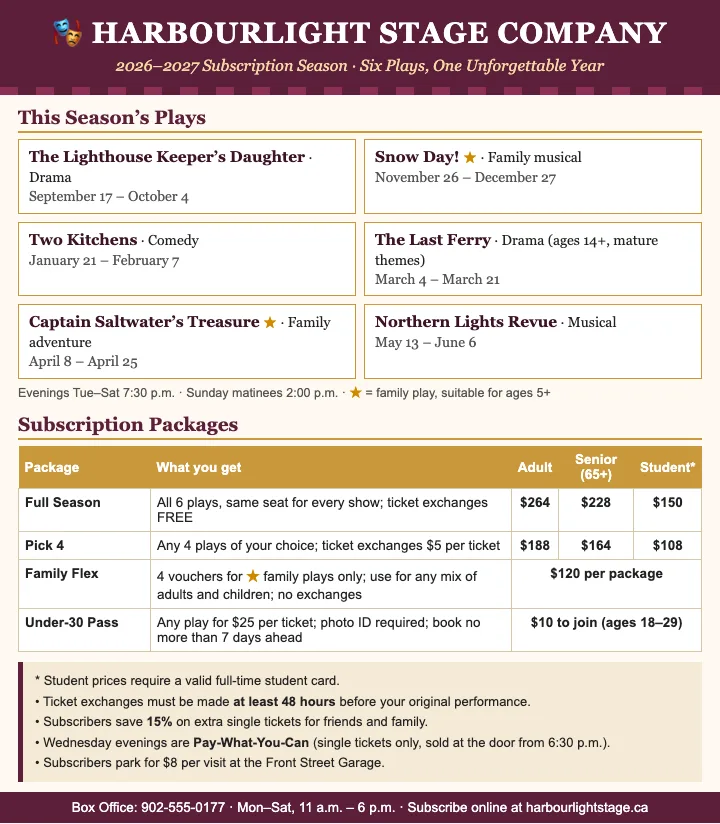
Read the following email message about the diagram on the left. Complete the email by filling in the blanks. Select the best choice for each blank from the drop-down menu.
Subject: Theatre this season?
To: Teresa Moreau
From: Nadia Rahimi
Hi Teresa,
Now that you’re back in the city, we have no excuse not to go to the theatre together, the way we used to when we shared that tiny room in residence twenty years ago. I picked up the Harbourlight brochure on my way home, and the season looks fantastic.
I doubt either of us could manage all six plays, so I think the is our best bet. I’ll be away for work for most of March, so let’s leave out . On the other hand, “Two Kitchens” sounds right up your alley, so that one’s a must!
You also said you’d like to take your nephew to one of the family plays. Since we’ll be subscribers, we could when we buy his ticket. And with my shifts changing every week, it’s good to know we can switch dates, as long as we .
Best of all, now that you’re back at school full-time, your package would only cost . Mine will be a bit more, but it’s still a good deal.
Let me know what you think, and I’ll call the box office on Saturday.
Nadia
Nadia and Teresa know each other because
Why does Nadia suggest leaving out one of the plays?
When Nadia says “Two Kitchens” is “right up your alley,” she means that Teresa
Part 3: Reading for Information
Paragraph A
Drive across the Prairies in July and you will see fields of brilliant yellow stretching to the horizon. These are canola fields, and the crop they produce has become one of the most valuable in Canadian agriculture. Most of it is grown in Saskatchewan, Alberta and Manitoba, and Canada ranks among the world’s leading producers and exporters. Yet many Canadians who cook with canola oil every day do not realize that the plant is a homegrown invention. Its name, adopted in the late 1970s, blends “Canada” with “ola,” a reference to an oil that is low in acid.
Paragraph B
Canola’s story begins with rapeseed, an older relative that had been grown for centuries in Europe and Asia. Canadian farmers began planting it on a large scale during the Second World War, when its oil was in demand as a lubricant for the steam engines of naval and merchant ships, because it clung well to metal surfaces exposed to water and steam. Once the war ended, much of that demand disappeared. The crop also had two serious drawbacks. Its oil contained high levels of erucic acid, which raised health concerns about using it in food, and the protein-rich meal left over after pressing contained bitter compounds called glucosinolates, which limited how much of it livestock were willing to eat.
Paragraph C
In the 1960s and 1970s, plant scientists at the University of Manitoba and at a federal research station in Saskatoon set out to solve both problems, in work that is still regarded as one of Canada’s great agricultural achievements. Baldur Stefansson led the Manitoba program and Keith Downey the one in Saskatoon; the two groups worked separately but shared their findings. They tested thousands of seeds, searching for rare plants that naturally contained less of the unwanted substances, and then crossed them over many generations. The work relied entirely on conventional breeding rather than on transferring genes in a laboratory. Reducing erucic acid came first; lowering glucosinolates took several more years. By the mid-1970s, the first variety low in both had been released, and the improved crop soon needed a name of its own to set it apart from ordinary rapeseed.
Paragraph D
Today, canola oil is valued for being low in saturated fat, and it appears in everything from cooking oil and margarine to salad dressings. Very little of the harvested seed goes to waste: after the oil is pressed out, the remaining meal is sold as a high-protein feed for cattle, pigs and poultry. Since the 1990s, varieties that can tolerate particular herbicides have been widely planted, and they now make up the great majority of the Canadian crop. Much of the harvest is shipped abroad, either as raw seed or as oil and meal, making canola an important source of income for the country’s farmers. Many growers also plant it in rotation with wheat and other cereals, which helps to break the cycle of crop diseases.
Decide which paragraph, A to D, has the information given in each statement below. Select E if the information is not given in any of the paragraphs.
- The crop’s name was chosen partly to point to a healthier quality of its oil.
- The plant first became an important crop in Canada because of the needs of wartime shipping.
- The researchers did not achieve both of their goals at the same time.
- Canola needs less rainfall than most other crops grown on the Prairies.
- These days, even the part of the seed left over after pressing has a market.
- Farm animals were reluctant to eat feed made from the older plant because of its flavour.
- Most canola grown in Canada today can survive certain weed-killing chemicals.
- Canola is the only major crop ever developed by Canadian plant scientists.
- The researchers worked with traits that already existed in some plants.
Part 4: Reading for Viewpoints
Opinion surveys consistently find that most Canadians support organ donation, yet only a fraction have formally registered their intentions. The provincial government believes a simple legislative change can close that discrepancy. Under a bill introduced last week, every adult resident would be presumed a willing donor unless he or she had opted out. Nova Scotia pioneered such a system in 2021.
Health Minister Rachel Ostrowski considers the reform long overdue. Hundreds of residents languish on waiting lists, some destined to die before an organ becomes available, and the existing arrangement places the onus on individuals who rarely act. “Their inaction doesn’t reflect objection. It reflects preoccupation with everyday responsibilities,” she maintains. Anyone could withdraw online at any time.
Dr. Kwame Asante, a transplant program director, supports the bill while cautioning that its promise is oversold. “Legislation alters the default, not what happens at the bedside.” Relatively few deaths occur in circumstances permitting donation, and there a missed referral or a shortage of intensive care beds can matter far more than any registry. Countries with the strongest records, he contends, owe their achievements to specially trained professionals in every hospital who identify potential donors and approach grieving families. Without funding for those positions, the government will have “bought itself a headline, not more organs.”
Bioethicist Lorraine Beaudet objects that interpreting silence as consent undermines the very notion of a gift. Recent immigrants, people who disregard the news and those without dependable internet access could be enrolled unknowingly. “The status quo’s unsatisfactory, I grant you, but this new default is a nudge being marketed as a cure.” She would prefer that every adult be required to answer the question, perhaps when renewing a health card, instead of having the government answer it for them.
Darren Fikre, whose teenage son waited nearly two years for a kidney, has little patience for such reservations, having repeatedly been told the system needed further investigation. “Families would retain the final word, since physicians won’t override a refusal,” he stresses. “This legislation simply starts the conversation from yes.”
Which two speakers voice no doubts about the bill?
On what do Asante and Beaudet converge?
Why does Asante cite the top-performing countries?
What is suggested about the bill’s impact?
The article could be headlined “Donation by Default:
The following is a comment by a visitor to the website page. Complete the comment by choosing the best option to fill in each blank.
As an intensive care nurse, I agree with the minister that most people who never register , yet Dr. Asante has identified the real bottleneck. In my hospital, possible donors slip through simply because . No new default will fix that.
Ms. Beaudet’s strikes me as a sensible compromise that respects choice while tackling low registration. Mr. Fikre is right that, in practice, . But if the province genuinely wants to , it must open its wallet, not merely pass a law. Otherwise, we will be having this same debate in five years.
Answer key
Count your correct answers, then find your estimated CLB:
Show all 38 answers
- What is the main purpose of Delphine’s letter? B. to have a charge recalculated using a real reading
- Why was Delphine’s meter not read in person? A. The reader could not get past a newly locked gate.
- Delphine mentions her bill from the previous year in order to D. show that this bill is far out of line.
- What does Delphine admit in her letter? C. She caused the problem without meaning to.
- To show good faith while the bill is reviewed, Delphine offers to D. pay what she would normally pay for now.
- According to her letter, Delphine A. is open to reporting her own meter readings.
- C. not able to get to your meter
- B. your charges for the same months last year
- D. no penalty will be added
- A. your neighbour can now let our reader in
- C. this service is offered where you live
- B. Pick 4 package
- C. “The Last Ferry”
- A. get 15 percent off
- B. pay $5 and give two days’ notice
- D. $108
- Nadia and Teresa know each other because A. they lived together as students.
- Why does Nadia suggest leaving out one of the plays? C. She will be travelling for her job.
- When Nadia says “Two Kitchens” is “right up your alley,” she means that Teresa D. would very likely enjoy watching it.
- The crop’s name was chosen partly to point to a healthier quality of its oil. A
- The plant first became an important crop in Canada because of the needs of wartime shipping. B
- The researchers did not achieve both of their goals at the same time. C
- Canola needs less rainfall than most other crops grown on the Prairies. E
- These days, even the part of the seed left over after pressing has a market. D
- Farm animals were reluctant to eat feed made from the older plant because of its flavour. B
- Most canola grown in Canada today can survive certain weed-killing chemicals. D
- Canola is the only major crop ever developed by Canadian plant scientists. E
- The researchers worked with traits that already existed in some plants. C
- Which two speakers voice no doubts about the bill? B. Ostrowski and Fikre
- On what do Asante and Beaudet converge? C. The bill’s promise is exaggerated.
- Why does Asante cite the top-performing countries? D. to show expertise beats legislation
- What is suggested about the bill’s impact? A. It may hinge on staff funding.
- The article could be headlined “Donation by Default: B. A Simple Fix for a Complex Problem?”
- B. never act on good intentions
- C. no trained eye identifies them
- D. “ask, don’t presume” alternative
- A. families still hold the veto
- D. turn headlines into transplants
What does your score mean? See the CELPIP Reading score chart.
Free CELPIP practice test · Free CELPIP Listening practice tests · CELPIP sample tests by part
CELPass is an independent practice platform and is not affiliated with Paragon Testing Enterprises. CELPIP is a trademark of Paragon Testing Enterprises. Check the official CELPIP website and IRCC for current test rules and requirements.