CELPIP Reading Practice Test 85
By Iris
A complete CELPIP Reading practice test: all 4 parts and 38 questions in the real test order. Set a timer for 55–60 minutes and do all four parts in one sitting. Check your answers at the bottom of the page to see your score and an estimated CLB.
Download as PDF with answer key
In this test
- Part 1: Reading Correspondence, “Feedback After the Hospice Charity Walk” (questions 1–11) · practise this part alone
- Part 2: Reading to Apply a Diagram, “Booking a Senior Groom for Mom’s Dog” (questions 12–19) · practise this part alone
- Part 3: Reading for Information, “The Halifax Explosion of 1917” (questions 20–28) · practise this part alone
- Part 4: Reading for Viewpoints, “Neighbourhood Pools Or One Aquatic Centre Debate” (questions 29–38) · practise this part alone
Part 1: Reading Correspondence
Dear Mr. Novak,
Now that the dust has settled on this year’s Lakeshore Walk for Hospice Care, I wanted to write to you while the details are still fresh in my mind. First of all, congratulations. When you announced at the volunteer briefing that our goal was $60,000, I privately thought you were being far too optimistic, so I was thrilled to read in the newsletter that we raised just over $71,000. I know how many evenings you gave up to make that happen.
As you know, this was my third year at the registration table and my first as its lead. Overall, things went smoothly, but I want to pass along two problems before they are forgotten. The first was the line at check-in. Between 8:00 and 8:30, some walkers waited nearly forty minutes, and a few gave up and went home without collecting their T-shirts. Most of the delay came from people who had gathered pledges on paper and needed us to count their cash and write receipts on the spot. If walkers could drop off their pledge envelopes at the hospice office during the week before the event, I believe the morning line would shrink by half.
The second problem was water. The forecast had promised a cool, cloudy morning, but by eleven it was over 28 degrees, and the station at the halfway point ran dry. To their credit, two of our teenage volunteers ran to the corner store and bought several cases with their own money. I have attached their names, as I think they deserve to be reimbursed and, frankly, thanked in the next newsletter.
You also asked whether I would consider taking over as volunteer coordinator next year, now that Doreen is stepping down. I was honoured to be asked, and my answer is a cautious yes. My only hesitation is timing: my son is getting married in Winnipeg the weekend before the walk, so I will be away for most of the final week, which I understand is the busiest. Would you be open to having the role shared? Ahmed Rahimi, who managed the parking lot this year, has told me he would be glad to cover the last-minute work if I handle recruitment and training over the winter.
Please let me know what you think. I would be happy to meet for coffee any weekday afternoon once my shift at the pharmacy ends at three.
Warm regards,
Harriet Bélanger
What is the main purpose of Harriet’s letter?
How did Harriet first react to the $60,000 goal?
According to Harriet, check-in was slow mainly because
What does Harriet suggest about the teenage volunteers?
When Harriet calls her answer “a cautious yes,” she means that she
It can be inferred that Ahmed Rahimi
Here is a response to the message. Complete the response by filling in the blanks. Select the best choice for each blank from the drop-down menu.
Dear Harriet,
Thank you for your thoughtful letter, and for keeping the registration table running so calmly under pressure. Your idea of having walkers makes a lot of sense, and I’ll ask the hospice office whether someone there can look after it that week.
I was sorry to hear about the halfway station. Clearly we , so next year we’ll order extra water whatever the weather looks like. I have already given the two students’ names to our treasurer so that they can , and they’ll certainly get a mention in the spring newsletter.
As for the coordinator position, I’m delighted. I have no objection at all to , especially since Ahmed has already offered to look after the final week. Would work for our coffee?
With gratitude,
Tomas Novak
Part 2: Reading to Apply a Diagram
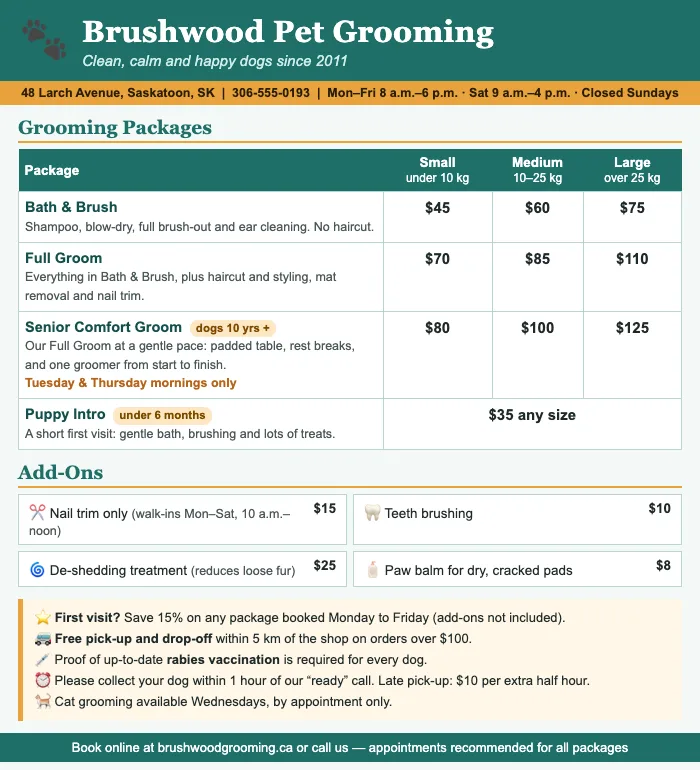
Read the following email message about the diagram on the left. Complete the email by filling in the blanks. Select the best choice for each blank from the drop-down menu.
Subject: Biscuit’s grooming
To: Owen Fairbairn
From: Nadia Cho
Hi Owen,
Thanks again for offering to help until Mom is back on her feet. Brushwood looks like our best option for grooming.
Biscuit badly needs a haircut; his coat is far too tangled for a bath alone. But since he turned twelve last spring, he gets anxious and his back legs give out if he stands for too long, so I’d like to book him for the . That means it will have to be morning, since you said you can do any weekday except Tuesday.
He weighs about 18 kilograms, so the package will cost . Sadly, we won’t get the new-client discount, because Mom has taken him there before. She’d like his teeth done, and I’d add the as well, since he’s been leaving clumps of fur all over her couch. Mom’s house is only about three kilometres from the shop, and with the extras we’re well past their minimum, so they’ll . You’d just need to hand him over at Mom’s, since she can’t manage his leash yet.
Please make sure Mom finds his rabies certificate before then. I know she thinks grooming is throwing money down the drain, but Biscuit is her whole world right now, and seeing him looking smart might cheer her up. As Dad used to tell us, a little kindness goes a long way.
Love,
Nadia
Nadia and Owen are most likely
Why is Nadia arranging Biscuit’s grooming?
When Nadia says Mom thinks grooming is “throwing money down the drain,” she means Mom thinks it is
Part 3: Reading for Information
Paragraph A
In the early twentieth century, Halifax was a busy but fairly modest port city. That changed with the outbreak of the First World War. Its deep harbour, which stays free of ice through the winter, made Halifax a vital link between North America and Europe. Merchant ships gathered in the sheltered Bedford Basin, at the top of the harbour, before crossing the Atlantic together under naval escort. Soldiers, food and weapons flowed through the city, and both its population and its economy grew quickly. Yet the same traffic that brought prosperity also brought risk, since vessels carrying dangerous cargo regularly passed close to crowded neighbourhoods.
Paragraph B
On the morning of December 6, 1917, the French cargo ship Mont-Blanc, loaded with explosives bound for the war in Europe, was making its way into the harbour when it collided with the Norwegian vessel Imo, which was heading out to sea, in the Narrows, the slim channel that links the basin to the outer harbour. The collision started a fire on board. Knowing exactly what they were carrying, the Mont-Blanc’s crew quickly abandoned ship and rowed to the opposite shore, while the burning vessel drifted toward a pier in Richmond, a working-class district in the city’s north end. Most residents did not realize the danger, and many stopped to watch the smoke from the streets and from their windows. Shortly after nine o’clock, the ship blew up.
Paragraph C
The blast flattened much of Richmond and was felt many kilometres away. Roughly 2,000 people were killed and about 9,000 were injured, a large number of them by flying glass. Many of these injuries were to the eyes, and the city’s hospitals were quickly overwhelmed. Among those who died was Vince Coleman, a railway dispatcher who, rather than run, stayed at his post to send a telegraph message warning an approaching passenger train to stop. The following day, a heavy snowstorm struck the city, slowing rescue efforts and leaving thousands of homeless survivors exposed to the cold. Help soon arrived from across Canada and beyond, most famously from Boston, whose relief train brought doctors, nurses and supplies.
Paragraph D
Rebuilding took years, and many survivors spent the winter in temporary shelters while new housing was planned. A relief commission was created to manage aid and reconstruction, and in the north end it oversaw the construction of the Hydrostone, a planned neighbourhood of homes made from fire-resistant concrete blocks and laid out along tree-lined boulevards. The first inquiry blamed the Mont-Blanc, but later court rulings found both ships equally at fault for the collision. Today, the disaster is remembered each December 6 at a memorial bell tower in Fort Needham Park, which overlooks the area that was destroyed. To thank Boston for its help, Nova Scotia sent the city a Christmas tree in 1918, and it has sent one every year since 1971.
Decide which paragraph, A to D, has the information given in each statement below. Select E if the information is not given in any of the paragraphs.
- The war boosted the local economy while exposing residents to new hazards.
- One victim lost his life because he chose to protect others.
- Residents had asked officials to keep ships with dangerous cargo away from their neighbourhoods.
- Weather conditions added to the hardship of people who had lost their homes.
- One ship’s crew left because they understood how dangerous their cargo was.
- A residential area was rebuilt using materials chosen to resist fire.
- Some survivors chose to leave Halifax rather than wait for new housing.
- Vessels assembled near the city before travelling across the ocean in protected groups.
- A gesture of thanks toward another city has become a yearly tradition.
Part 4: Reading for Viewpoints
Two of Ashgrove’s four outdoor pools opened a month behind schedule last June, their cracked basins patched for the third consecutive summer. Council is now deliberating over a plan to close all four by 2029 and channel the savings, supplemented by a provincial grant, into a single indoor aquatic centre beside the new transit hub on Garrison Road.
“The arithmetic leaves scant room for nostalgia,” says Councillor Brenda Yeung, who chairs the parks committee. Restoring the four pools, all constructed in the 1960s, to current safety standards would cost an estimated $14 million, and they would still sit idle ten months annually. The centre, comprising lap, teaching and warm-water therapy pools, would operate year-round. Families losing a pool within walking distance would receive a complimentary summer shuttle.
Kofi Mensah of the Eastview Community Association dismisses that shuttle as “a bandage on a wound the city inflicted on itself.” “Decades of trimmed maintenance budgets produced the very deterioration now presented as an unavoidable crisis,” he contends. “Neighbourhood pools are where children learn to swim and strangers become neighbours.” Nevertheless, he grants that a year-round facility is long overdue, provided it is not financed by shuttering every local pool.
Urban health researcher Dr. Samir Haddad finds that the evidence vindicates Mensah’s instinct, if not all his reasoning. Children living within a short walk of a pool swim considerably more often, whereas centralized facilities draw predominantly on families with cars. Haddad nonetheless declines to romanticize the existing pools. “A ten-week season’s too brief to teach a child properly.” His compromise would renovate the two busiest pools and add a more modest indoor centre.
For Lorraine Bouchard, who leads a seniors’ aquafit group, the therapy pool is decisive. Since the city’s only warm-water pool disappeared with the Marlow Street community centre, her members have driven forty minutes to a neighbouring town weekly, hardly an indulgence for arthritis sufferers. Her enthusiasm carries a caveat, however: should admission resemble private-club rates, the city will have erected “a beautiful building for the people who needed it least.”
A decision is expected in March.
Haddad and Mensah would agree that
By calling the shuttle “a bandage,” Mensah suggests that council
Bouchard’s support for the centre is
It is reasonable to conclude that
An appropriate title would be
The following is a comment by a visitor to the website page. Complete the comment by choosing the best option to fill in each blank.
Having grown up three blocks from the Eastview pool, I can hardly claim neutrality, but I can’t accept Councillor Yeung’s view that this is purely a matter of . Mr. Mensah is right that the city is now paying for , and no free bus replaces ; try herding three children onto a shuttle with towels and snacks.
Still, Dr. Haddad has a point about : my children took lessons for three summers and still cannot swim a length. And if the new centre turns out to be , the residents with the most to gain will simply stay home. My advice: build smaller, and keep the two busiest pools open.
Answer key
Count your correct answers, then find your estimated CLB:
Show all 38 answers
- What is the main purpose of Harriet’s letter? B. to share feedback and respond to a request
- How did Harriet first react to the $60,000 goal? D. She doubted it could be reached.
- According to Harriet, check-in was slow mainly because C. donations were handled on the spot.
- What does Harriet suggest about the teenage volunteers? A. They deserve to be thanked publicly.
- When Harriet calls her answer “a cautious yes,” she means that she B. agrees, but with one condition.
- It can be inferred that Ahmed Rahimi D. can cover the busiest stretch.
- C. hand in their pledges in advance
- A. relied too much on the forecast
- D. get back the money they spent
- B. sharing the role between two people
- A. a weekday around four o’clock
- C. Senior Comfort Groom
- B. a Thursday
- C. $100
- A. de-shedding treatment
- D. pick him up and drop him off
- Nadia and Owen are most likely B. brother and sister.
- Why is Nadia arranging Biscuit’s grooming? A. Their mother can’t handle him alone yet.
- When Nadia says Mom thinks grooming is “throwing money down the drain,” she means Mom thinks it is D. not worth what it costs.
- The war boosted the local economy while exposing residents to new hazards. A
- One victim lost his life because he chose to protect others. C
- Residents had asked officials to keep ships with dangerous cargo away from their neighbourhoods. E
- Weather conditions added to the hardship of people who had lost their homes. C
- One ship’s crew left because they understood how dangerous their cargo was. B
- A residential area was rebuilt using materials chosen to resist fire. D
- Some survivors chose to leave Halifax rather than wait for new housing. E
- Vessels assembled near the city before travelling across the ocean in protected groups. A
- A gesture of thanks toward another city has become a yearly tradition. D
- Haddad and Mensah would agree that C. nearby pools mean more swimming.
- By calling the shuttle “a bandage,” Mensah suggests that council D. is patching deterioration it caused.
- Bouchard’s support for the centre is A. conditional on affordable admission.
- It is reasonable to conclude that B. no speaker rejects a year-round pool.
- An appropriate title would be C. “Walkable or Year-Round? The Choice Facing Ashgrove’s Swimmers”
- A. budget arithmetic
- D. its own false economies
- B. strolling to the pool
- C. how long a season lasts
- D. a club in all but name
What does your score mean? See the CELPIP Reading score chart.
Free CELPIP practice test · Free CELPIP Listening practice tests · CELPIP sample tests by part
CELPass is an independent practice platform and is not affiliated with Paragon Testing Enterprises. CELPIP is a trademark of Paragon Testing Enterprises. Check the official CELPIP website and IRCC for current test rules and requirements.