CELPIP Reading Practice Test 90
By Iris
A complete CELPIP Reading practice test: all 4 parts and 38 questions in the real test order. Set a timer for 55–60 minutes and do all four parts in one sitting. Check your answers at the bottom of the page to see your score and an estimated CLB.
Download as PDF with answer key
In this test
- Part 1: Reading Correspondence, “Planning Grandma Rosa’s 90th Birthday” (questions 1–11) · practise this part alone
- Part 2: Reading to Apply a Diagram, “Internet Plan for the Family Cottage” (questions 12–19) · practise this part alone
- Part 3: Reading for Information, “The Alaska Highway: A Wartime Road North” (questions 20–28) · practise this part alone
- Part 4: Reading for Viewpoints, “Pay-to-Play Fees for School Sports Teams” (questions 29–38) · practise this part alone
Part 1: Reading Correspondence
Dear Daniel,
It was lovely to hear your voice on Sunday, even if the connection kept cutting out every few minutes. I’m writing instead of calling again because there is a lot to explain, and I’d like you to have all the details in front of you.
As you know, Grandma Rosa turns ninety on March 14. Aunt Lucia originally wanted a big dinner at the Portuguese hall, but Grandma made it very clear at Christmas that she doesn’t want “a fuss with speeches and strangers.” After a rather heated discussion, the family settled on something smaller: an open house at Uncle Tony’s place on Saturday the 15th, from two to six, so that people can drop by without Grandma having to sit through a formal meal. Tony’s house also has no steps at the front entrance, which matters now that she uses a walker.
Here is where you come in. I’ve been collecting old photographs from everyone, and I’d like to turn them into a slideshow to play on the television in Tony’s living room. The trouble is that most of the pictures from before 1970 are in Grandma’s albums, and the only person she lets anywhere near those albums is you. Could you borrow them during one of your Sunday visits and scan them? I can lend you my scanner, which is much faster than photographing each page with a phone. I need the files by March 1 so I have time to put everything to music.
I also have a favour to ask about the cake. Mrs. Ferreira, who baked for the church for thirty years, has offered to make Grandma’s favourite orange cake, but she gave up driving last year. Since you pass her street on your way to Tony’s, would you mind picking it up that morning? She asked that nobody come for it before ten, because she wants to ice it at the last minute.
One last thing: please keep all of this to yourself. Grandma thinks we are only having a quiet family supper, and if she hears about the open house too early, she’ll lie awake worrying about the state of her hair and how much everyone is spending. Tony has promised to tell her exactly one week before the open house, which should give her time to book the hairdresser without fretting for a month.
Let me know as soon as you can whether the albums and the cake will work for you. If not, I’ll come up with another plan, but I would much rather it were you.
Love,
Carmen
What is the main purpose of Carmen’s letter?
Why did the family decide against a dinner at the Portuguese hall?
Why does Carmen want Daniel to deal with Grandma Rosa’s albums?
Why can’t Mrs. Ferreira deliver the cake herself?
It can be inferred that Daniel
When will Grandma Rosa most likely learn about the open house?
Here is a response to the message. Complete the response by filling in the blanks. Select the best choice for each blank from the drop-down menu.
Dear Carmen,
Thanks for your letter, and for doing so much of the organizing. An open house sounds far more like Grandma than a would have been, so I think the family made the right call in the end.
I’d be glad to take care of the albums. I’ll ask to borrow them next Sunday and tell her I’d like to . That way she won’t suspect a thing. I’ll gladly accept the loan of your scanner, too, since it’s than my phone.
The cake is no problem either. I’ll be at Mrs. Ferreira’s door on the 15th, and I promise to take the corners slowly.
Don’t worry, my lips are sealed. I know Grandma would be if she found out now, so I won’t say a word, not even to Mom, who has never kept a secret in her life.
See you soon,
Daniel
Part 2: Reading to Apply a Diagram
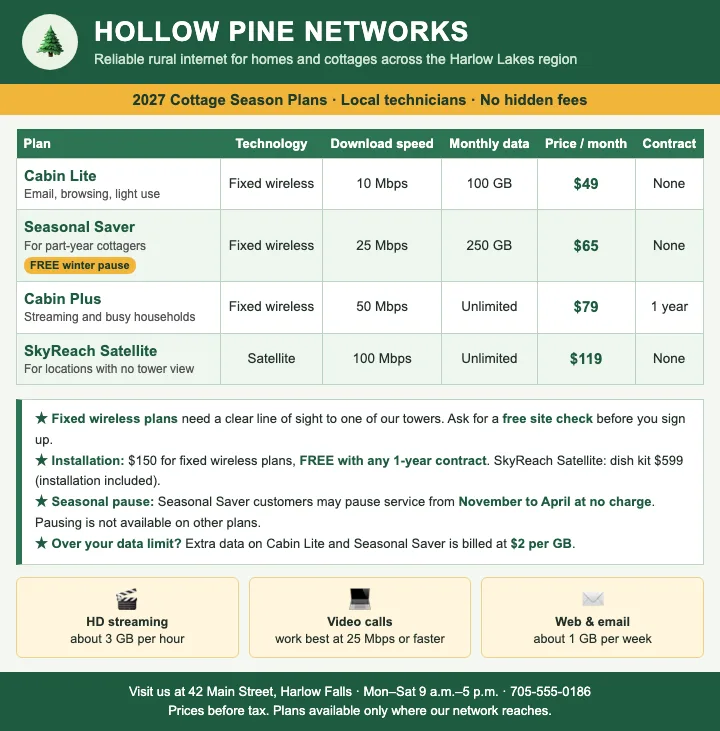
Read the following email message about the diagram on the left. Complete the email by filling in the blanks. Select the best choice for each blank from the drop-down menu.
Subject: Internet for the cottage
To: Nadia Brennan
From: Peter Kowalczyk
Hi Nadia,
I picked up Hollow Pine Networks’ price sheet in town on Saturday. Good news: their technician did the site check, and Mom and Dad’s cottage can see the Ridge Hill tower, so any of their fixed wireless plans would work.
Since you’ll be working from the cottage in July and your job means video calls most of the day, we can rule out right away. I’d lean toward the Seasonal Saver. Nobody uses the place from November until the end of April, and with this plan we during those months.
My only worry is data. The kids watch about three hours of movies every evening, and over a 30-day month that adds up to roughly in HD, which is more than the plan includes. If we go over, extra data costs , and I don’t want us to be nickel-and-dimed all summer. Cabin Plus has unlimited data, but we’d be locked into paying right through the winter when nobody is there.
The other downside is that we’d have to pay to get the Seasonal Saver installed, but split two ways, it isn’t too bad.
Mom will say the kids should be out fishing anyway! Let me know what you think by Friday so we can book before the long weekend.
Peter
Peter and Nadia are most likely
Why does Peter mention how much the children watch movies?
When Peter says he doesn’t want them to be “nickel-and-dimed,” he means being
Part 3: Reading for Information
Paragraph A
For decades, people had talked about building a road that would connect Alaska with the rest of North America by land, but the idea never got very far. Any route would have to cross enormous stretches of forest, muskeg, rivers and mountains where very few people lived, and neither Canada nor the United States saw enough reason to pay for it. Everything changed after Japan attacked Pearl Harbor in December 1941. American military planners worried that the ships supplying Alaska could be cut off, and they wanted a land route to support a string of airfields that already ran across northern British Columbia and the Yukon. In early 1942, the two governments reached an agreement: the United States would build the road and cover its cost, while Canada would allow it to pass through Canadian territory. The starting point was Dawson Creek, British Columbia, where the railway line ended and troops and heavy equipment could be unloaded.
Paragraph B
Construction began in March 1942, and the pace was extraordinary. Thousands of American soldiers, roughly a third of them African American, worked alongside civilian crews that included many Canadians. Teams pushed forward from several points at once, clearing trees and throwing up temporary bridges as they went. The conditions were punishing. Swarms of mosquitoes tormented the workers in summer, while temperatures in the north could plunge far below freezing. One of the hardest lessons involved permafrost. When crews stripped away the moss and plants covering the ground, the frozen soil underneath thawed into deep mud, and they had to find ways of building on top of the surface instead of cutting into it. In the autumn of 1942, crews working from the north and the south finally met in the Yukon, and an official ceremony was held near Kluane Lake that November.
Paragraph C
The first road was narrow, rough and frequently impassable, and much of it was rebuilt and rerouted by contractors in the following years. After the war, the United States handed the Canadian section over to Canada in 1946, and the Canadian Army took charge of maintaining it. Even so, the highway was not opened to unrestricted public travel until 1948. For the First Nations communities along the route, the road brought sudden and lasting change: new settlements, new jobs and a stream of outsiders, but also outbreaks of illnesses to which many people had little resistance.
Paragraph D
Today, the Alaska Highway is far smoother and straighter than the wartime trail, and decades of improvements have made the journey considerably shorter than the original route. It has become one of the continent’s great road adventures, drawing motorcyclists, cyclists and families in recreational vehicles every summer. Many travellers begin with a photograph beside the “Mile 0” post in Dawson Creek. Further north, in Watson Lake, Yukon, they stop at the Sign Post Forest. It began in 1942, when a homesick soldier working on the road put up a sign pointing toward his hometown. Visitors have been nailing up their own signs and licence plates ever since, and the collection now stretches across a large area.
Decide which paragraph, A to D, has the information given in each statement below. Select E if the information is not given in any of the paragraphs.
- The road’s starting point was chosen partly because of an existing transportation link.
- Builders had to adjust their methods because of what lay beneath the surface.
- Dawson Creek was founded to serve as the starting point of the new highway.
- The project had damaging consequences for some of the region’s original inhabitants.
- An event far from the route turned a long-discussed plan into a priority.
- A practice begun by one of the road’s builders is still being carried on by tourists.
- Ordinary drivers had to wait several years after the road was finished to use it freely.
- The highway was paved from end to end before it was opened to the public.
- The two ends of the road were joined in less than a year.
Part 4: Reading for Viewpoints
One line in the Riverbend School Board’s draft budget has eclipsed all others: a proposed $250 fee for every student joining a high school sports team. Escalating costs for buses, referees and insurance have left the board nearly $900,000 short, and athletics, which lie outside the required curriculum, can no longer be shielded.
Trustee Helen Marchetti, who chairs the budget committee, insists nobody relishes charging children to play. The alternative before trustees, however, is eliminating junior teams altogether. “I’d sooner ask families to contribute than tell a fourteen-year-old there’s no team for her.” Families receiving income assistance could apply for a full waiver.
That provision scarcely reassures Raymond Tessier, who has coached basketball at Eastview Secondary for nineteen years. “In my experience, the students most in need of a waiver are the least likely to request one,” says Tessier. “A teenager will abandon a sport before handing his coach a form announcing that his family is struggling.” Tessier acknowledges that tournament travel has grown expensive and that teams could finance out-of-town trips themselves, but he maintains that the basic right to try out should never carry a price tag.
Priya Natarajan, whose two children play volleyball and soccer, is more pragmatic. Having already spent several hundred dollars annually on club fees and equipment, she considers $250 modest. Her condition is transparency: the money must demonstrably reach referees and buses rather than vanish into general revenue, and the board should publish how many waivers it grants each year.
Dr. Alain Fortier, a sociologist who studies youth sport, accepts that shortfalls are genuine. Some cost recovery, he grants, is probably inevitable. His research, however, found that in districts introducing flat fees, participation among students from lower-income neighbourhoods fell by roughly a fifth within two years, waivers notwithstanding. “Waivers look generous on paper,” he observes, “but they depend on families identifying themselves.” He proposes a fee scaled to household income and applied automatically through existing school records, singling out no one.
Marchetti says she is receptive to amendments, but warns that every dollar trimmed from the fee must be found elsewhere.
Tessier and Fortier would most likely agree that
Whose support depends on how the money is used?
Tessier’s travel remarks suggest that he
It can be inferred that
Which headline would suit the article best?
The following is a comment by a visitor to the website page. Complete the comment by choosing the best option to fill in each blank.
I played three sports at Eastview in the early 2000s, and Mr. Tessier knows exactly what he is talking about. When my parents hit a rough patch in Grade 10, I would sooner have than admit it to anyone at school.
That said, Ms. Marchetti is no villain. The board is in a genuine bind, and she is right that . What troubles me is the flat rate. Dr. Fortier’s research shows that even with waivers in place, . His idea of strikes me as far fairer, because no teenager would ever have to ask for charity.
And if parents like Ms. Natarajan do end up paying, the least the board can do is make sure their money .
Answer key
Count your correct answers, then find your estimated CLB:
Show all 38 answers
- What is the main purpose of Carmen’s letter? D. to share party plans and ask for his help
- Why did the family decide against a dinner at the Portuguese hall? B. Grandma Rosa did not want a formal celebration.
- Why does Carmen want Daniel to deal with Grandma Rosa’s albums? C. Grandma Rosa trusts nobody else with them.
- Why can’t Mrs. Ferreira deliver the cake herself? A. She stopped driving some time ago.
- It can be inferred that Daniel D. sees his grandmother on a regular basis.
- When will Grandma Rosa most likely learn about the open house? D. around the eighth of March
- B. sit-down meal at the hall
- D. make copies of a few for my own family
- A. a lot quicker to use
- C. a little after ten
- A. anxious about her looks and the cost
- C. the Cabin Lite plan
- B. could put service on hold for free
- D. 270 GB
- A. $2 a gigabyte
- B. $150
- Peter and Nadia are most likely C. a brother and a sister
- Why does Peter mention how much the children watch movies? D. to explain why the plan’s data limit worries him
- When Peter says he doesn’t want them to be “nickel-and-dimed,” he means being A. charged a series of small extra amounts.
- The road’s starting point was chosen partly because of an existing transportation link. A
- Builders had to adjust their methods because of what lay beneath the surface. B
- Dawson Creek was founded to serve as the starting point of the new highway. E
- The project had damaging consequences for some of the region’s original inhabitants. C
- An event far from the route turned a long-discussed plan into a priority. A
- A practice begun by one of the road’s builders is still being carried on by tourists. D
- Ordinary drivers had to wait several years after the road was finished to use it freely. C
- The highway was paved from end to end before it was opened to the public. E
- The two ends of the road were joined in less than a year. B
- Tessier and Fortier would most likely agree that B. no family should have to plead.
- Whose support depends on how the money is used? D. Priya Natarajan’s
- Tessier’s travel remarks suggest that he B. accepts teams can share costs.
- It can be inferred that C. Marchetti considers the fee the lesser evil.
- Which headline would suit the article best? C. “A Price on Play: Should Riverbend’s Teams Charge?”
- B. hung up my sneakers
- A. the alternative is worse
- C. the poorest players disappear
- C. a scale applied automatically
- A. is spent on teams
What does your score mean? See the CELPIP Reading score chart.
Free CELPIP practice test · Free CELPIP Listening practice tests · CELPIP sample tests by part
CELPass is an independent practice platform and is not affiliated with Paragon Testing Enterprises. CELPIP is a trademark of Paragon Testing Enterprises. Check the official CELPIP website and IRCC for current test rules and requirements.