CELPIP Reading Practice Test 89
By Iris
A complete CELPIP Reading practice test: all 4 parts and 38 questions in the real test order. Set a timer for 55–60 minutes and do all four parts in one sitting. Check your answers at the bottom of the page to see your score and an estimated CLB.
Download as PDF with answer key
In this test
- Part 1: Reading Correspondence, “Apology for a Damaged Borrowed Projector” (questions 1–11) · practise this part alone
- Part 2: Reading to Apply a Diagram, “Renting Tools for a Backyard Patio Project” (questions 12–19) · practise this part alone
- Part 3: Reading for Information, “The Mackenzie River: Canada’s Longest River System” (questions 20–28) · practise this part alone
- Part 4: Reading for Viewpoints, “Pets On Public Transit Debate” (questions 29–38) · practise this part alone
Part 1: Reading Correspondence
Dear Hélène,
I have been putting off this letter for three days, which tells you how embarrassed I am. When you offered to lend me your projector at the photography club last month, I was touched, especially since we had only chatted a handful of times over coffee after the library sessions. I’m sorry to say I didn’t look after it the way you deserved.
As you know, I wanted it for the outdoor movie night we held for my daughter’s eleventh birthday. Everything went smoothly until about halfway through the film, when a sudden gust of wind caught the bedsheet we were using as a screen and dragged the folding table over with it. The projector landed on the patio stones. The children thought it was all part of the show, but I knew right away that something was wrong.
On Monday I took it to an electronics repair shop near my office. The technician told me the lens housing is cracked, but the bulb and the rest of the machine are fine. He can fix it, although the part has to be ordered from the manufacturer and will take about three weeks to arrive. The repair would cost $180, while a new projector of the same model sells for around $450.
I don’t want to make that choice for you. If you would prefer a new one, I will gladly buy it; if you would rather keep your own, which I know you’ve had for years, I’ll go ahead with the repair. Either way, the cost is mine.
I also remembered that you are presenting the club’s year-end slideshow on the 14th. Since the repair won’t be finished by then, I’ve arranged to borrow a projector from work for that evening. My manager has agreed, and I can drop it off at your house that afternoon and help you set it up if that would be useful.
Please don’t feel you have to reassure me. You trusted me with something valuable, and I should have kept it on the ground or weighed the table down. I have learned my lesson, and so has my daughter, who has already asked whether “the nice lady from the club” is mad at us.
Let me know which option you prefer, and I’ll take care of it this week.
With sincere apologies,
Raymond Tessier
What is the main purpose of Raymond’s letter?
It can be inferred that Raymond and Hélène
How was the projector damaged?
According to the technician,
Raymond has arranged to borrow a projector from work because
Raymond leaves it up to Hélène to decide
Here is a response to the message. Complete the response by filling in the blanks. Select the best choice for each blank from the drop-down menu.
Dear Raymond,
Thank you for your kind and honest letter. Please stop worrying! Nobody can control the wind, and I’m only sorry that your daughter’s ended in such a dramatic way.
As for the projector, I’d rather . I’m used to all its little quirks, and the price you were quoted seems very fair. Three weeks without it is no problem at all, now that you’ve for the 14th. I’d gladly accept your help that afternoon, since I always seem to press the wrong buttons.
Next summer, I think your idea of is a sensible one, and a heavy stone on each corner of the sheet wouldn’t hurt either.
Finally, please tell your daughter that I’m not in the least. If she likes, I’d be happy to show her how to take photos of the night sky at one of our club outings.
Warm regards,
Hélène
Part 2: Reading to Apply a Diagram
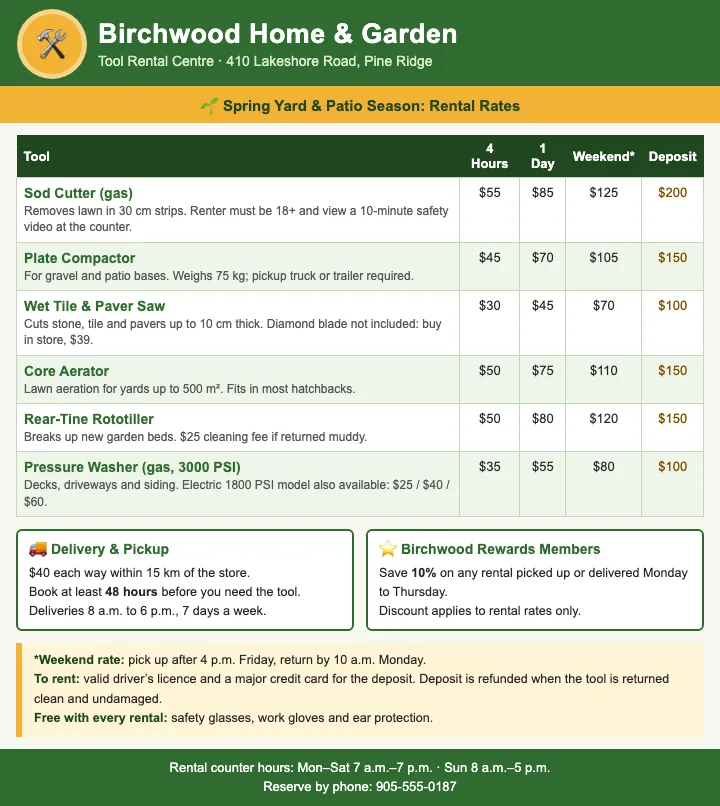
Read the following email message about the diagram on the left. Complete the email by filling in the blanks. Select the best choice for each blank from the drop-down menu.
Subject: Rentals for the patio weekend
To: Colin Byrne
From: Dev Malhotra
Hi Colin,
Thanks again for offering to give up your weekend for my patio. I picked up Birchwood’s rental sheet yesterday, so here’s my plan for Saturday, June 6, and Sunday, June 7.
First, the old lawn has to go. My son Owen turned seventeen last month and is keen to help, but he can’t be the one to sign for the sod cutter, because . Would you mind coming to the counter with me?
Since we’ll be packing down the gravel base on both days, renting the plate compactor will cost us , which beats paying the daily rate twice. Neither of us owns a truck, though, and we want to start at 8 on Saturday morning, so .
I usually get 10% off with my Birchwood Rewards card, but . Oh well. For the edges, I’ll rent the paver saw for Sunday only. Keep in mind that , so I’ll add one to the bill.
It should be just like the summer we painted every room of that basement apartment we shared in second year, when your mother kept phoning to ask if we’d finished. Let’s not bite off more than we can chew, though. If the base takes longer than planned, the stones can wait until the following weekend.
Cheers,
Dev
Dev and Colin know each other because they
Why is Dev writing to Colin?
When Dev says “Let’s not bite off more than we can chew,” he means they should
Part 3: Reading for Information
Paragraph A
Canada has thousands of rivers, but none can match the Mackenzie for sheer length. Its main channel runs about 1,700 kilometres from Great Slave Lake in the Northwest Territories to the Beaufort Sea, an arm of the Arctic Ocean. When the rivers upstream of the lake are included, such as the Peace and the Athabasca, whose waters combine in the Slave River and flow into Great Slave Lake, the system stretches more than 4,000 kilometres, making it the longest in the country and second in North America only to the Mississippi–Missouri. Its drainage basin is just as impressive. Rain and melting snow from parts of British Columbia, Alberta, Saskatchewan, the Yukon and the Northwest Territories all find their way into it, and in total the basin covers roughly one fifth of Canada’s land area.
Paragraph B
Long before Europeans arrived, the river served as a highway and a source of food for the Dene and other Indigenous peoples of the North. The Dene call it Deh Cho, meaning “big river.” Its English name comes from Alexander Mackenzie, a Scottish-born fur trader with the North West Company, who travelled its full length in 1789 with the help of Indigenous guides. Mackenzie had hoped the river would carry him west to the Pacific Ocean and open a new route for the fur trade. Instead, it led him north to the Arctic coast, a discovery that left him deeply disappointed. Within a few decades, trading posts had been built along its banks, and several of today’s communities, including Fort Simpson and Fort Good Hope, grew up around them.
Paragraph C
For much of the year, the Mackenzie is locked in ice. The freeze usually lasts from late fall until May or June, and spring breakup can be dramatic, as huge slabs of ice jam together and sometimes flood low-lying communities. In winter, crossings are built on the frozen river so that trucks can reach towns with no all-season road. When the ice is gone, the river becomes a supply route of a different kind: tugboats push barges loaded with fuel, building materials and groceries to settlements along its banks and on the Arctic coast. Because the shipping season is so short, a delivery that misses the last barge may not arrive until the following summer. Near Fort Providence, a bridge opened in 2012, replacing the ferry and ice crossing that drivers had relied on for decades.
Paragraph D
Near its mouth, the river spreads into the Mackenzie Delta, a maze of channels, lakes and wetlands that is one of the largest Arctic deltas in the world. The delta is home to muskrats, fish such as whitefish, and huge numbers of migrating birds in summer. Each July, beluga whales gather in the warm, shallow waters where the river meets the sea, and Inuvialuit hunters have harvested them there for generations. Today, scientists keep a close eye on the region. Thawing permafrost along the riverbanks and changes in when the ice forms and breaks up are seen as signs of a warming climate, with consequences for wildlife and for the people who depend on the river.
Decide which paragraph, A to D, has the information given in each statement below. Select E if the information is not given in any of the paragraphs.
- The explorer the river is named after did not reach the destination he was aiming for.
- Heavy goods that are not shipped in time may be delayed for many months.
- Beluga whales swim upriver as far as Great Slave Lake during the summer.
- The river collects rain and snowmelt from parts of three provinces and two territories.
- Changes in frozen ground near the river are viewed as evidence of a changing climate.
- Only one river system on the continent is longer than the Mackenzie when its upstream rivers are counted.
- Mackenzie’s 1789 journey down the river was funded by the British government.
- At one point on the river, drivers no longer depend on seasonal crossings.
- The area where the river reaches the ocean is a seasonal gathering place for a sea mammal.
Part 4: Reading for Viewpoints
When the Harbourton Transit Commission announced it would revisit its decades-old ban on animals other than service animals, staff anticipated a trickle of letters. Instead, more than 3,000 residents completed the online survey in its first week.
The draft policy would admit small pets in closed carriers at any hour and leashed dogs of any size outside rush hour, at a reduced fare. Commission chair Paula Ferreira presents the change as an obligation, not a perk. A third of households own no car, and many keep pets; getting a sick cat to the veterinarian currently means a taxi fare or imposing on a neighbour. “A public service shouldn’t abandon its most loyal riders in that predicament,” she maintains.
Dr. Kevin Osei, a downtown allergist, is less enthusiastic. “Dander embeds itself in upholstered seats and can afflict sensitive riders long after an animal has disembarked,” he explains. Yet he pointedly avoids defending the status quo. “A cat zipped into a carrier hardly troubles me. A large dog meandering through a packed car does.” Should the commission venture beyond carriers, he recommends designating one car per train for animals. Buses, however, which carry most passengers, cannot be partitioned that way.
Marie-Claude Thibodeau, representing Harbourton’s bus operators, stresses that her members bear animals no ill will. Enforcement is what troubles them. “A driver responsible for forty passengers in heavy traffic can’t simultaneously assess whether a dog is calm or its leash adequately short,” says Thibodeau. A carrier demands no such judgment; anything more ambitious belongs on a handful of routes first, and only after drivers have been trained.
For Ben Ashworth, executive director of the Harbourton Humane Society, the debate concerns animal welfare. His shelter annually receives pets surrendered partly because owners had no practical way to reach a veterinarian. He would prefer dogs welcome at all hours, but has no appetite for a battle over rush hour. “A narrower rule is acceptable as a start. A pilot project that becomes a pretext for stalling isn’t.”
The commission will issue its recommendation in the spring, after analyzing the survey and meeting the operators’ union.
Osei and Thibodeau would both accept
Ferreira presents the change chiefly as
Ashworth’s attitude to limiting dogs off-peak is
It is reasonable to infer that
Which would make the best title?
The following is a comment by a visitor to the website page. Complete the comment by choosing the best option to fill in each blank.
As a cat owner who rides the bus to work, I expected to cheer this plan, but the article has tempered my enthusiasm about its pace. Ms. Ferreira is right that the ban penalizes , and Mr. Ashworth’s experience suggests the ban .
Still, the operators deserve a better hearing. Expecting someone who is to make judgment calls about dogs as well is simply unreasonable. Dr. Osei’s compromise sounds sensible on paper, yet it would do little for , and that describes most of us.
My advice to the commission: allow carriers now, , and decide about larger dogs once the results are in.
Answer key
Count your correct answers, then find your estimated CLB:
Show all 38 answers
- What is the main purpose of Raymond’s letter? C. to apologize for an accident and offer to make it right
- It can be inferred that Raymond and Hélène A. do not know each other very well.
- How was the projector damaged? D. Wind pulled over the table it was sitting on.
- According to the technician, B. it can be fixed, but not right away.
- Raymond has arranged to borrow a projector from work because A. Hélène will need one before hers is ready.
- Raymond leaves it up to Hélène to decide C. whether to fix the projector or replace it.
- B. birthday celebration
- D. have my own one fixed
- A. found me a stand-in projector
- C. keeping the projector low
- B. cross with either of you
- C. only adults may rent it
- A. $105
- D. I’ll need to book delivery by Thursday morning
- B. that doesn’t cover weekend rentals
- C. we have to pay for our own saw blade
- Dev and Colin know each other because they D. used to live together as students.
- Why is Dev writing to Colin? B. to organize the rentals for their joint project
- When Dev says “Let’s not bite off more than we can chew,” he means they should A. not try to do too much at once.
- The explorer the river is named after did not reach the destination he was aiming for. B
- Heavy goods that are not shipped in time may be delayed for many months. C
- Beluga whales swim upriver as far as Great Slave Lake during the summer. E
- The river collects rain and snowmelt from parts of three provinces and two territories. A
- Changes in frozen ground near the river are viewed as evidence of a changing climate. D
- Only one river system on the continent is longer than the Mackenzie when its upstream rivers are counted. A
- Mackenzie’s 1789 journey down the river was funded by the British government. E
- At one point on the river, drivers no longer depend on seasonal crossings. C
- The area where the river reaches the ocean is a seasonal gathering place for a sea mammal. D
- Osei and Thibodeau would both accept D. admitting pets in carriers right away.
- Ferreira presents the change chiefly as B. a duty to transit-dependent riders.
- Ashworth’s attitude to limiting dogs off-peak is A. reluctant acceptance.
- It is reasonable to infer that C. bus operators may sway the recommendation.
- Which would make the best title? B. “Pets on Transit: Broad Sympathy, Narrow Agreement”
- D. transit’s most captive riders
- A. has victims with four legs
- C. already stretched thin
- B. the bus-riding majority
- D. trial dogs on a few routes
What does your score mean? See the CELPIP Reading score chart.
Free CELPIP practice test · Free CELPIP Listening practice tests · CELPIP sample tests by part
CELPass is an independent practice platform and is not affiliated with Paragon Testing Enterprises. CELPIP is a trademark of Paragon Testing Enterprises. Check the official CELPIP website and IRCC for current test rules and requirements.