CELPIP Reading Practice Test 96
By Iris
A complete CELPIP Reading practice test: all 4 parts and 38 questions in the real test order. Set a timer for 55–60 minutes and do all four parts in one sitting. Check your answers at the bottom of the page to see your score and an estimated CLB.
Download as PDF with answer key
In this test
- Part 1: Reading Correspondence, “Extension Request for a Design Portfolio” (questions 1–11) · practise this part alone
- Part 2: Reading to Apply a Diagram, “Laundry Pickup After Surgery” (questions 12–19) · practise this part alone
- Part 3: Reading for Information, “James Naismith and the Invention of Basketball” (questions 20–28) · practise this part alone
- Part 4: Reading for Viewpoints, “Social Media Age Checks For Teens Debate” (questions 29–38) · practise this part alone
Part 1: Reading Correspondence
Dear Mr. Sayegh,
I am a student in the part-time Graphic Design Certificate program, and I am writing about the final portfolio for Design Studio 2, which is due on Friday, April 17. I would like to ask whether I could submit it two weeks late, on May 1, without losing marks.
As you may know, our instructor, Ms. Lindqvist, has been on medical leave since early March. The substitute instructor has been very helpful, but she only confirmed last week which of our earlier assignments may be included in the portfolio. Two of the five pieces I had planned to use turned out not to qualify, so I now have to produce two new pieces from scratch. I believe several classmates are in a similar position, although I can only speak for myself.
My situation is complicated by my job. I work as a pharmacy assistant, and because a colleague is away, I have agreed to cover extra weekend shifts until the end of the month. I could ask my manager to release me from them, but the pharmacy is already short-staffed, and I would rather not leave my co-workers in a difficult spot if there is another solution.
I have read the program handbook, and I understand that late portfolios normally lose 10 percent per day unless the coordinator approves an extension at least five business days before the deadline. That is why I am writing now rather than waiting until the last minute. I also noticed that students may request an “incomplete” grade and finish their work the following term. I would prefer to avoid this, because my certificate would then not be issued until the fall. I am hoping to graduate in June so that I can apply for a junior designer position that a local printing company has advertised.
If an extension is not possible, would you consider allowing me to submit four pieces instead of five, along with a short written reflection on how my work has developed? I have attached the three pieces I have already finished so that you can see the progress I have made.
Thank you for considering my request. I can be reached by email or at 604-555-0148 after 6 p.m. on weekdays.
Sincerely,
Marisol Duarte
What is the main purpose of Marisol’s letter?
Why must Marisol create new pieces for her portfolio?
Marisol is reluctant to ask her manager to release her from her shifts because
Why is Marisol writing more than a week before the deadline?
What would be the main drawback of an incomplete grade for Marisol?
What has Marisol sent along with her letter?
Here is a response to the message. Complete the response by filling in the blanks. Select the best choice for each blank from the drop-down menu.
Dear Ms. Duarte,
Thank you for writing well before the deadline. I had not realized that the change of instructor had left some students needing to so late in the term, and I appreciate you bringing it to my attention.
Because your request arrived in time, I am able to approve an extension. However, I cannot offer the full two weeks, as final grades must reach the registrar by April 28. Your portfolio will therefore be due on April 24, which I hope still gives you enough time while you are .
I would also advise against . The portfolio is assessed as a complete set, and anything shorter would be marked accordingly.
With this extension, there should be no need for an incomplete grade, and you should be on track to . The three pieces you sent show real progress, and I wish you the best of luck with .
Kind regards,
Hamid Sayegh
Program Coordinator
Part 2: Reading to Apply a Diagram
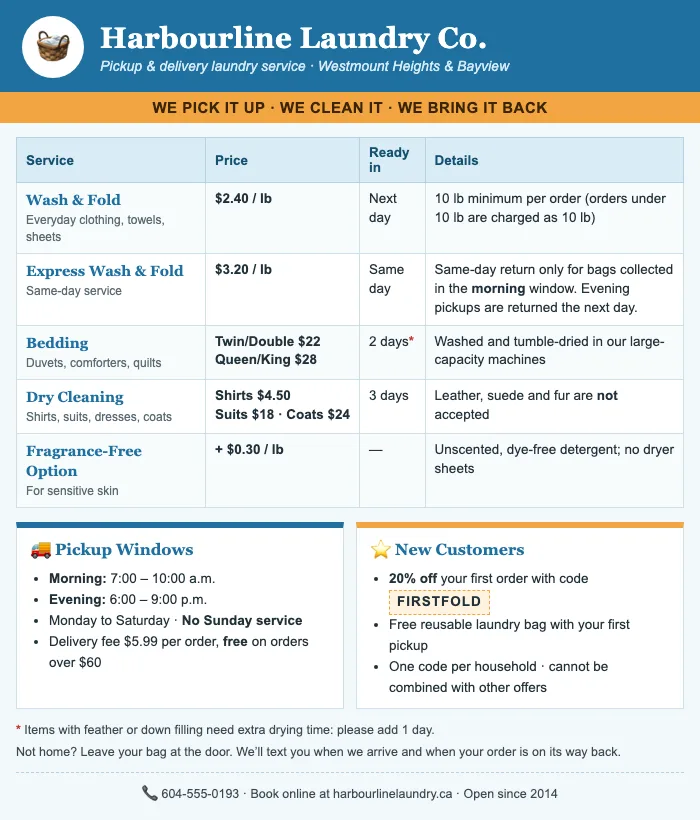
Read the following email message about the diagram on the left. Complete the email by filling in the blanks. Select the best choice for each blank from the drop-down menu.
Subject: Laundry while your knee heals
To: Marcus Bell
From: Joanne Ortiz
Hi Marcus,
Mom told me your surgeon says no stairs for six weeks, which means no trips down to your building’s laundry room. Laundry is the last thing you need on your plate right now, so I looked up Harbourline, the service Dad used after his hip operation.
You have physio every weekday morning and you spend Saturdays at Mom’s, so is really the only time that would work for a pickup. You usually do about eight pounds of laundry a week, so you’d be charged for each time, but it’s still cheaper than paying me in pizza.
Don’t bother with Express, though. Since they’d be collecting your bag in the evening, it . Your down comforter could go in as well, as long as you don’t mind waiting to get it back. And because you’ve never ordered from them before, you can get if you enter their code when you book.
I’m only twenty minutes away if you need anything else, so don’t be too proud to call!
Jo
Joanne and Marcus are most likely
Why is Joanne writing to Marcus?
When Joanne says laundry is “the last thing you need on your plate,” she means that
Part 3: Reading for Information
Paragraph A
Basketball is often thought of as an American game, but the man who invented it was Canadian. James Naismith was born in 1861 near Almonte, a small town in eastern Ontario. He lost both of his parents to illness while he was still a boy and was raised largely by an uncle on the family farm. As a child he enjoyed a game called “duck on a rock,” in which players tried to knock a stone off a larger rock by throwing stones of their own. He went on to study at McGill University in Montreal, where he was a keen all-round athlete. During those years he became convinced that physical activity could build a young person’s character as well as the body, and in 1890 he moved to Springfield, Massachusetts, to work at a training school run by the YMCA.
Paragraph B
In December 1891, Naismith was given a difficult assignment. A class of young men, restless at being kept indoors during the long New England winter, had grown bored with marching and gymnastics, and the head of the department asked him to invent a game that could be played inside. Naismith wanted a contest that rewarded accuracy and teamwork rather than sheer strength, and one that would not leave players bruised on a hard gymnasium floor. He therefore decided that no one could run while holding the ball, and that the goal should be placed above the players’ heads so that it could only be reached with a gentle, arcing throw. Two peach baskets were fastened to a balcony railing about three metres above the floor, a height that remains the standard today. He then wrote out thirteen basic rules for the new game.
Paragraph C
Basketball spread with remarkable speed. Graduates of the training school took jobs at YMCAs across North America, and the organization printed the rules in its magazine, so within a few years the game was being played in many cities and in several other countries. Early games looked very different from modern ones. Because the peach baskets still had their bottoms, play stopped every time a basket was made while someone climbed up to fetch the ball. Naismith himself later trained as a doctor and spent most of his career at the University of Kansas, where he taught physical education and became the school’s first basketball coach. He showed little interest in profiting from his invention.
Paragraph D
Canada has also played a notable part in the sport’s later history. When basketball first appeared as an official event at the 1936 Olympic Games in Berlin, Naismith attended as an honoured guest, and the Canadian team won the silver medal after losing the final, played outdoors in heavy rain, to the United States. Ten years later, on November 1, 1946, Maple Leaf Gardens in Toronto hosted the first game ever played in the Basketball Association of America, the league that later became the NBA. The home team, the Toronto Huskies, lasted only a single season, and almost fifty years passed before NBA basketball returned to the country with the arrival of the Toronto Raptors and the Vancouver Grizzlies in 1995. In 2019, the Raptors became the first Canadian team to win the NBA championship.
Decide which paragraph, A to D, has the information given in each statement below. Select E if the information is not given in any of the paragraphs.
- Naismith believed that sport could do more than improve physical fitness.
- Scoring in the earliest games caused regular interruptions in play.
- The first basketball games used a ball made especially for the new sport.
- Canada went for decades without a top professional team after an early attempt failed.
- Concern for players’ safety influenced the way the game was designed.
- Naismith spent much of his youth in the care of a relative.
- Most of the players on Canada’s 1936 Olympic team came from university programs.
- A measurement chosen for the first game is still in use.
- A Canadian city hosted the opening game of a league that grew into a major professional one.
Part 4: Reading for Viewpoints
The provincial government has tabled legislation obliging social media companies to verify that every user in the province is at least sixteen, with substantial fines for platforms that fail to exclude younger children. Few dispute that adolescents’ online lives warrant scrutiny. Far fewer consider an age threshold the appropriate instrument.
Families Minister Denise Arsenault, who introduced the bill, portrays it as long overdue. “Parents have long been told that online safety is their responsibility, then left to compete with corporations employing thousands of engineers to keep children scrolling,” she argues. Conceding that no verification system will be flawless, she maintains that a legal age gives parents something to point to: “Right now, a parent who says no is the only parent saying no.”
Dr. Kevin Osei, a psychologist specializing in adolescent mental health, shares the minister’s alarm but questions her remedy. His research links heavy use to disrupted sleep and heightened anxiety, yet he attributes the damage to features such as endless feeds and streaks, not to a user’s birthday. Shielding a fifteen-year-old entirely while handing a seventeen-year-old “the full machine” strikes him as arbitrary. He grants that a minimum age might buy younger children time, but prefers obliging platforms to disable compulsive features for everyone under eighteen.
Privacy lawyer Farah Haddad identifies a less obvious consequence. “To confirm that someone’s under sixteen, you’ve got to check everyone,” she explains. Adults could be required to upload identification or facial scans to companies with an uneven record of safeguarding data. Haddad favours holding platforms accountable, but believes the wrong target has been chosen: “Regulate what the product does, not who is allowed through the door.”
Tessa Morin, a Grade 11 student who chairs her city’s youth advisory council, doubts the law would keep many classmates offline. Half of them, she estimates, opened their first account with an older sibling’s email address. Though she coordinates food-drive volunteers online, Morin last year deleted a photo-sharing app after noticing she felt worse whenever she opened it. “Nobody taught me that. I stumbled on it by accident,” she remarks. Compulsory digital literacy lessons would, in her estimation, accomplish more than any ban.
On which point do Haddad and Osei converge?
Why does Arsenault mention thousands of engineers?
Morin recounts deleting an app to
What can reasonably be inferred?
Which headline best captures the article?
The following is a comment by a visitor to the website page. Complete the comment by choosing the best option to fill in each blank.
As a father of two teenagers, I understand the minister’s impulse; parents really do feel . This bill, however, is the wrong instrument. Ms. Morin is surely right that determined teens will simply , and I balk at the notion that I, a grown man, should have to merely to stay in touch with my old hockey teammates.
Dr. Osei makes the stronger case: the trouble lies less in who is online than in . My son spent last winter chasing a daily streak, and no birthday rule would have changed that. Fund , as Ms. Morin suggests, and I will gladly support the province.
Answer key
Count your correct answers, then find your estimated CLB:
Show all 38 answers
- What is the main purpose of Marisol’s letter? A. to ask for more time to finish required work
- Why must Marisol create new pieces for her portfolio? C. Some work she intended to include is not eligible.
- Marisol is reluctant to ask her manager to release her from her shifts because A. she does not want to burden her colleagues.
- Why is Marisol writing more than a week before the deadline? D. An extension must be approved well in advance.
- What would be the main drawback of an incomplete grade for Marisol? B. It could delay her chance at a job opportunity.
- What has Marisol sent along with her letter? C. the part of her portfolio that is ready
- D. replace planned portfolio pieces
- C. working additional weekend hours
- B. submitting a smaller set of pieces
- A. graduate in June as planned
- A. the job at the printing company
- B. a weekday evening
- C. the ten-pound minimum
- D. wouldn’t come back any sooner
- D. three days
- C. 20 percent off that first order
- Joanne and Marcus are most likely C. brother and sister.
- Why is Joanne writing to Marcus? D. to suggest help with a chore during his recovery
- When Joanne says laundry is “the last thing you need on your plate,” she means that A. it is one more task he shouldn’t have to deal with.
- Naismith believed that sport could do more than improve physical fitness. A
- Scoring in the earliest games caused regular interruptions in play. C
- The first basketball games used a ball made especially for the new sport. E
- Canada went for decades without a top professional team after an early attempt failed. D
- Concern for players’ safety influenced the way the game was designed. B
- Naismith spent much of his youth in the care of a relative. A
- Most of the players on Canada’s 1936 Olympic team came from university programs. E
- A measurement chosen for the first game is still in use. B
- A Canadian city hosted the opening game of a league that grew into a major professional one. D
- On which point do Haddad and Osei converge? D. Regulation should target platform design.
- Why does Arsenault mention thousands of engineers? B. to show families are outmatched
- Morin recounts deleting an app to A. illustrate an unguided lesson
- What can reasonably be inferred? B. Adults, too, would face scrutiny.
- Which headline best captures the article? D. “Birthday Test for Social Media: False Comfort?”
- A. like David facing Goliath
- B. borrow their way in
- C. surrender my ID
- B. machinery built to hook users
- D. lessons in critical scrolling
What does your score mean? See the CELPIP Reading score chart.
Free CELPIP practice test · Free CELPIP Listening practice tests · CELPIP sample tests by part
CELPass is an independent practice platform and is not affiliated with Paragon Testing Enterprises. CELPIP is a trademark of Paragon Testing Enterprises. Check the official CELPIP website and IRCC for current test rules and requirements.