CELPIP Reading Practice Test 98
By Iris
A complete CELPIP Reading practice test: all 4 parts and 38 questions in the real test order. Set a timer for 55–60 minutes and do all four parts in one sitting. Check your answers at the bottom of the page to see your score and an estimated CLB.
Download as PDF with answer key
In this test
- Part 1: Reading Correspondence, “Mix-Up Over a Cape Breton Coach Tour” (questions 1–11) · practise this part alone
- Part 2: Reading to Apply a Diagram, “Picking an Evening Class at the Arts Centre” (questions 12–19) · practise this part alone
- Part 3: Reading for Information, “The Quebec Winter Carnival and Its Traditions” (questions 20–28) · practise this part alone
- Part 4: Reading for Viewpoints, “Pickleball Noise In City Parks Debate” (questions 29–38) · practise this part alone
Part 1: Reading Correspondence
Dear Mr. Lavoie,
I am writing about my booking for your eight-day “Cabot Trail and Cape Breton” coach tour, reference MT-48213. When I booked by phone on June 2, I asked your agent, Kayla, to reserve two places on the departure of Saturday, October 10, for my mother and me. Kayla’s confirmation email that afternoon clearly listed October 10. However, the final itinerary I received last week shows a departure date of October 3, and our room at each stop is listed as a standard twin on an upper floor.
The date matters because my mother and I are travelling from Calgary, and my manager approved my vacation for those exact dates. She has said she could push it back by a week if necessary, but not earlier, as our office is short-staffed until the 9th. The room matters even more. My mother had knee surgery in the spring and still uses a walker. When I booked, I explained that we would need a ground-floor room, or at least a hotel with an elevator, at every stop, and Kayla assured me this had been noted.
When I phoned your office on Monday to sort this out, the person I spoke to told me that moving to a different departure would mean a change fee of $150 per person. I understand that such fees exist, but I don’t think it is fair to charge them when the mistake was not mine. I have attached Kayla’s email so that you can see the original dates for yourself.
I would rather not cancel. My mother and I took your Prince Edward Island tour two years ago and still talk about it, which is why we chose your company again. Besides, cancelling now would cost us our $800 deposit, since we are past the 60-day cutoff, and our travel insurance covers cancellations only for medical reasons.
If the October 10 tour is already full, we would happily take the October 17 departure instead, provided the change fee is waived and suitable rooms can be guaranteed. Could you please let me know by Friday which option is possible? Flights from Calgary to Halifax are filling up quickly, and I don’t want to book them until our dates are settled.
Thank you for your help. I look forward to hearing from you.
Sincerely,
Priya Sandhu
What is the main purpose of Priya’s letter?
Why can’t Priya accept the October 3 departure?
Priya asks for a ground-floor room or an elevator because
What has Priya sent along with her letter?
Why did Priya and her mother choose this tour company again?
Priya would rather not cancel partly because
Here is a response to the message. Complete the response by filling in the blanks. Select the best choice for each blank from the drop-down menu.
Dear Ms. Sandhu,
Thank you for your letter, and please accept my sincere apologies. Having read the email you attached, I agree that the error was entirely ours: Kayla , but it was entered incorrectly in our booking system.
Unfortunately, the October 10 departure is now full. I have, however, reserved two places for you on October 17, which I hope will still work, as your manager . Naturally, .
I have also contacted each of the hotels on the route, and every one of them has confirmed for you and your mother.
Your updated itinerary will be emailed to you on Thursday, a day before , so you can go ahead and book your flights to Halifax. We are delighted to welcome back two travellers from our Prince Edward Island tour.
Sincerely,
Daniel Lavoie
Customer Care Manager
Part 2: Reading to Apply a Diagram
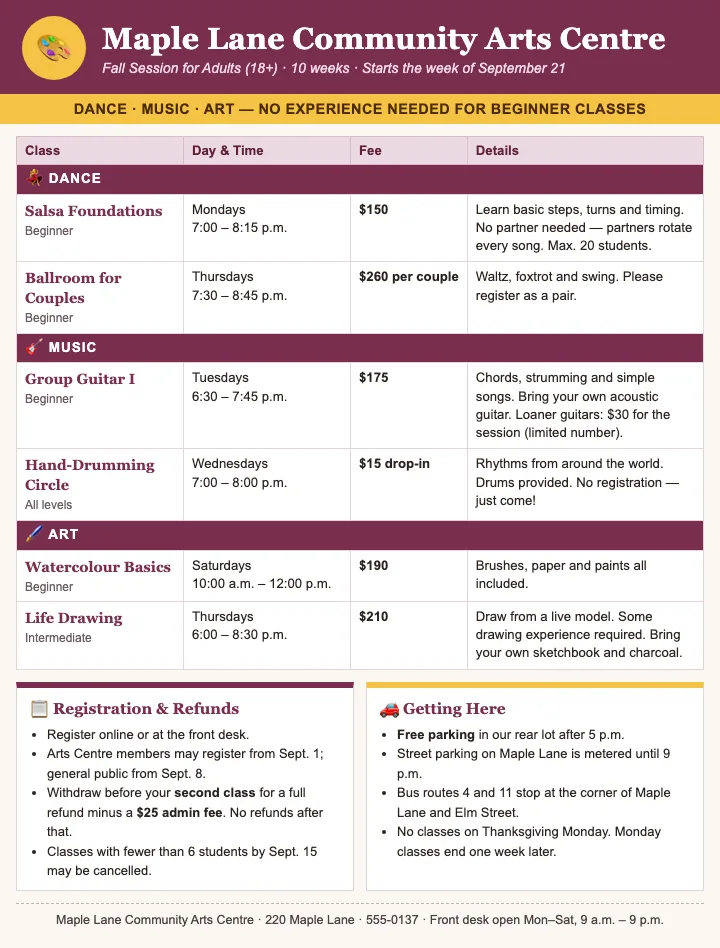
Read the following email message about the diagram on the left. Complete the email by filling in the blanks. Select the best choice for each blank from the drop-down menu.
Subject: Something new for the fall?
To: Tomas Reyes
From: Lena Kowalczyk
Hi Tomas,
Remember at lunch on Friday when you said you wanted to try something this fall besides hockey? I picked up the Maple Lane Arts Centre flyer on my way home, and I think I’ve found the answer. I’ve been stuck in a rut lately myself, so I’m keen too.
You said you’d rather dance than paint, and since you play hockey on Thursday nights, would be the one for us. My cousin Ana wants to join as well, which makes three of us, but that’s not a problem because .
I’m also tempted by the guitar class. I gave my old guitar to my nephew when I moved, though, and I’m not ready to buy a new one, so I’d . Maybe next session!
Since we both leave the clinic at six, there’s time to grab a bite before class, and we can instead of feeding a meter. And if you’re worried you’ll hate it, don’t be. We could always .
Let me know by Wednesday so I can register all three of us. Dr. Brandt has me on the front desk all day Thursday, so I won’t have time then.
Lena
Lena and Tomas are most likely people who
Why is Lena writing to Tomas?
When Lena says she has been “stuck in a rut,” she means that
Part 3: Reading for Information
Paragraph A
Long before cheap flights made winter getaways common, the people of Quebec City found their own way of coping with the coldest weeks of the year: they threw a party. The word “carnival” itself points to the event’s roots in the festive days that Catholic communities traditionally enjoyed just before Lent, the season of fasting that leads up to Easter. Quebec City staged several large winter carnivals in the late nineteenth century, but these were held only occasionally. In 1955, a group of local business people revived the idea as an annual event, hoping that a few weeks of celebration would lift residents’ spirits and draw visitors, and their spending, to the city at a quiet time of year. The plan worked. Today the Quebec Winter Carnival is regarded as one of the largest winter festivals in the world.
Paragraph B
The festival’s best-known figure appeared in that same year. Bonhomme Carnaval, a cheerful snowman, wears a red tuque and a colourful woven belt known as the ceinture fléchée, or arrow sash, a garment associated with the voyageurs and rural workers of earlier centuries. Bonhomme is treated less as a mascot than as the carnival’s official host. At the opening of the festivities, he is traditionally presented with the keys to the city, and for the length of the carnival he is said to live in an ice palace built in the heart of town. Visitors who want to take part in many of the main events buy a small plastic figure of Bonhomme, called an effigy, and wear it on their coats, where it serves as an entry pass.
Paragraph C
Of all the carnival’s competitions, none is more closely tied to local history than the ice canoe race on the St. Lawrence River. For generations, the river was clogged with drifting ice for much of the winter, yet people still needed to cross between Quebec City and Lévis on the opposite shore. Crews of canoeists carried mail, supplies and passengers, paddling through stretches of open water and then climbing out to push and drag their boats over floating slabs of ice. Long after the crossing stopped being a necessity, the skill survived as a sport. Today’s racers face the same difficulties their predecessors did. Strong currents and tides constantly rearrange the ice, so a passage that looks clear one moment may be closed the next.
Paragraph D
Other carnival traditions are more light-hearted. Night parades of illuminated floats wind through the streets, and an international snow sculpture competition brings teams from many countries, who turn enormous blocks of packed snow into detailed works of art in a matter of days. Among the most daring events is the snow bath, in which participants wearing little more than swimsuits roll and play in the snow while crowds cheer them on. Many spectators keep warm with caribou, a sweet, strong drink traditionally made by mixing red wine with spirits and often sold in hollow plastic canes. For the city’s hotels, restaurants and shops, the result is a welcome rush of customers in a season that would otherwise be one of the slowest of the year.
Decide which paragraph, A to D, has the information given in each statement below. Select E if the information is not given in any of the paragraphs.
- Those who relaunched the festival had financial as well as social motives.
- Ice canoe racing is now practised only as part of the carnival.
- Some carnival activities are open only to people displaying a particular souvenir.
- Competitors must be ready to change their plans as conditions shift quickly.
- Some participants travel from abroad to take part in an artistic contest.
- The festival’s name reflects its connection to a religious calendar.
- Bonhomme’s ice palace is built to the same design every winter.
- Part of the host’s costume recalls what labourers once wore.
- One event developed from a practical method of transportation.
Part 4: Reading for Viewpoints
Three summers ago, Ashford Falls converted two cracked tennis courts in Linden Park into eight pickleball courts, an inexpensive way, it seemed, to get residents of all ages moving. Today the courts are occupied from early morning until ten at night, and the game’s sharp, hollow pop, repeated hundreds of times an hour, ranks among the most contentious files at city hall. A motion before council would confine play to between 9 a.m. and 7 p.m. and commission a study of relocating the courts beside the Harlow industrial park, three kilometres from the nearest homes.
Councillor Marion Lefebvre, the motion’s author, insists she harbours no hostility to the sport. “Thirty people may be enjoying those courts,” she calculates, “with three hundred within earshot who never consented to listen.” Relocation, she acknowledges, would be expensive and the site poorly served by transit; the study is merely “a question worth asking.” On the time limits, her language hardens: inaction “hands the whole cost to the neighbours.”
Graham Whitaker, whose back fence stands forty metres from the nearest court, works overnight as an ultrasound technician and sleeps from late morning until mid-afternoon. “Earplugs and a white-noise machine have scarcely helped; it’s the irregularity that torments me,” he explains. He bears the players no ill will, but maintains the courts should never have been built so close to houses.
That conclusion alarms Shirley Nakamura, whose 140-member Linden Park Pickleball Club consists mostly of retirees, many of whom no longer drive. The club has already encouraged quieter foam-core paddles, voluntarily postponed its morning drop-in from seven to eight and offered to fundraise for a sound barrier. The curfew, she complains, would transform a public park into “a daytime club for people like me.”
Acoustical engineer Helen Okafor contends that the debate fixates on the wrong numbers. A single strike may register no louder than conversation; what averages conceal is a sound that is sudden, high-pitched and unpredictable. Quieter paddles and properly engineered barriers can soften the impact, but limiting hours merely determines the timing of the disturbance. Within about a hundred metres of homes, she concludes, distance is the only dependable remedy.
Okafor and Whitaker would dismiss the time limits as
Why does Lefebvre call the study “a question”?
What would Nakamura make of a 7 p.m. closing?
What follows from the motion as written?
The most fitting headline would be
The following is a comment by a visitor to the website page. Complete the comment by choosing the best option to fill in each blank.
I play at Linden Park three mornings a week, and I respect my neighbours. Even I admit Mr. Whitaker has a point: the sound is hard to tune out because it is so . Councillor Lefebvre’s plan to , however, would shut out my daughter, whose office closes at six.
As Ms. Okafor observes, a schedule only alters when people are bothered, not . Harlow would be worse: Ms. Nakamura knows that many of us . Accept what the club has already tabled, including , and give it one full season. If those measures fail, councillors can revisit relocation.
Answer key
Count your correct answers, then find your estimated CLB:
Show all 38 answers
- What is the main purpose of Priya’s letter? B. to get a booking mistake corrected at no cost
- Why can’t Priya accept the October 3 departure? D. She cannot start her vacation any sooner.
- Priya asks for a ground-floor room or an elevator because A. her mother still has trouble getting around.
- What has Priya sent along with her letter? C. a message showing the date she first booked
- Why did Priya and her mother choose this tour company again? B. They had a good experience with it before.
- Priya would rather not cancel partly because D. she would lose the money she has already paid
- C. noted the date you asked for
- A. could move your vacation a week later
- D. you will not pay anything to switch dates
- B. a room with no stairs to climb
- A. the deadline you gave us
- B. Salsa Foundations
- C. partners rotate during the class
- A. need to pay $30 to borrow one
- D. park behind the building for free
- D. drop out before week two and lose only $25
- Lena and Tomas are most likely people who A. work at the same clinic.
- Why is Lena writing to Tomas? C. to suggest they sign up for a class together
- When Lena says she has been “stuck in a rut,” she means that B. her daily routine has become dull.
- Those who relaunched the festival had financial as well as social motives. A
- Ice canoe racing is now practised only as part of the carnival. E
- Some carnival activities are open only to people displaying a particular souvenir. B
- Competitors must be ready to change their plans as conditions shift quickly. C
- Some participants travel from abroad to take part in an artistic contest. D
- The festival’s name reflects its connection to a religious calendar. A
- Bonhomme’s ice palace is built to the same design every winter. E
- Part of the host’s costume recalls what labourers once wore. B
- One event developed from a practical method of transportation. C
- Okafor and Whitaker would dismiss the time limits as C. beside the point
- Why does Lefebvre call the study “a question”? A. to signal the curfew matters more
- What would Nakamura make of a 7 p.m. closing? D. It would favour retirees over workers.
- What follows from the motion as written? B. The drop-in would start later.
- The most fitting headline would be C. “Whose Park? Pickleball’s Pop Tests a Town”
- A. erratic
- D. end play early in the evening
- B. whether they’re bothered at all
- C. have hung up their car keys
- A. a barrier fundraiser
What does your score mean? See the CELPIP Reading score chart.
Free CELPIP practice test · Free CELPIP Listening practice tests · CELPIP sample tests by part
CELPass is an independent practice platform and is not affiliated with Paragon Testing Enterprises. CELPIP is a trademark of Paragon Testing Enterprises. Check the official CELPIP website and IRCC for current test rules and requirements.