CELPIP Reading Practice Test 99
By Iris
A complete CELPIP Reading practice test: all 4 parts and 38 questions in the real test order. Set a timer for 55–60 minutes and do all four parts in one sitting. Check your answers at the bottom of the page to see your score and an estimated CLB.
Download as PDF with answer key
In this test
- Part 1: Reading Correspondence, “A Letter to an Old Saskatoon Neighbour” (questions 1–11) · practise this part alone
- Part 2: Reading to Apply a Diagram, “A Saturday Paddle at Kestrel Lake” (questions 12–19) · practise this part alone
- Part 3: Reading for Information, “Saskatchewan and the Birth of Medicare” (questions 20–28) · practise this part alone
- Part 4: Reading for Viewpoints, “Port Alder Museum Admission Fee Debate” (questions 29–38) · practise this part alone
Part 1: Reading Correspondence
Dear Gloria,
I hope this finds you and Frank well, and that your tomatoes are still the envy of Larkspur Crescent. It’s hard to believe it has been almost four years since we packed up the van and headed east. Moncton has been good to us, but I still miss our chats over the back fence, especially on those long summer evenings when the whole street seemed to be outside.
First, the news. Our Nadia has been accepted into the nursing program at the university in Saskatoon, starting this fall. She had offers from two schools much closer to home, but she says she has never stopped thinking of Saskatoon as home, and I suspect your stories about your years on the hospital wards had something to do with it as well. Karim and I are very proud, though I confess I’ve already started worrying about prairie winters without her father around to warm up the car every morning.
That brings me to a favour, and please feel free to say no. Nadia has a room in residence from the first of September, but her program begins with a two-week clinical orientation in mid-August, and the residence won’t allow anyone to move in early. Would you consider letting her stay in your spare room for those two weeks? She’s a quiet, tidy guest, and she has promised to cook at least twice a week. Her biryani, I’m sorry to say, is now better than mine. We would, of course, cover her groceries.
If that isn’t possible, I’d be just as grateful for a smaller kindness. Her residence asks every first-year student to name someone within an hour’s drive who can be called in an emergency. Would you be willing to be that person for her first term? It would mean the world to me to know that someone who has known her since she was wobbling down the sidewalk on training wheels is nearby.
As for the rest of us, Karim’s contract at the airport has turned into a permanent position, and I’ve finally gone back to teaching part-time. Our youngest, Sami, has discovered hockey, which means I now spend my Saturday mornings in a freezing arena with a thermos of coffee, exactly as you told me I would.
There’s no rush to answer. Please talk it over with Frank before you decide. Whatever you choose, we’re hoping to see you both when we fly out to help Nadia settle in.
With love,
Rania
What is the main purpose of Rania’s letter?
Gloria has probably
Why does Nadia need somewhere to stay in August?
If Gloria cannot host Nadia, Rania hopes she will
By mentioning the hockey arena, Rania suggests that Gloria
What does Rania ask Gloria to do before replying?
Here is a response to the message. Complete the response by filling in the blanks. Select the best choice for each blank from the drop-down menu.
Dear Rania,
What a treat to find a real letter in the mailbox! Frank and I are so pleased that Nadia chose to study . I’ll admit I’m flattered if my old ward stories played a small part.
We talked it over, just as you asked, and we would be delighted to have her in the spare room . And please don’t give another thought to . Frank says that if her biryani really is better than yours, we’ll be the ones in her debt.
I’m also happy to be for the whole first term, so you can cross that off your list. Saskatoon winters aren’t as fierce as you remember, but she may have to learn to on cold mornings, since her dad won’t be around to do it for her.
Congratulations to Karim, and good luck in that arena!
Love,
Gloria
Part 2: Reading to Apply a Diagram
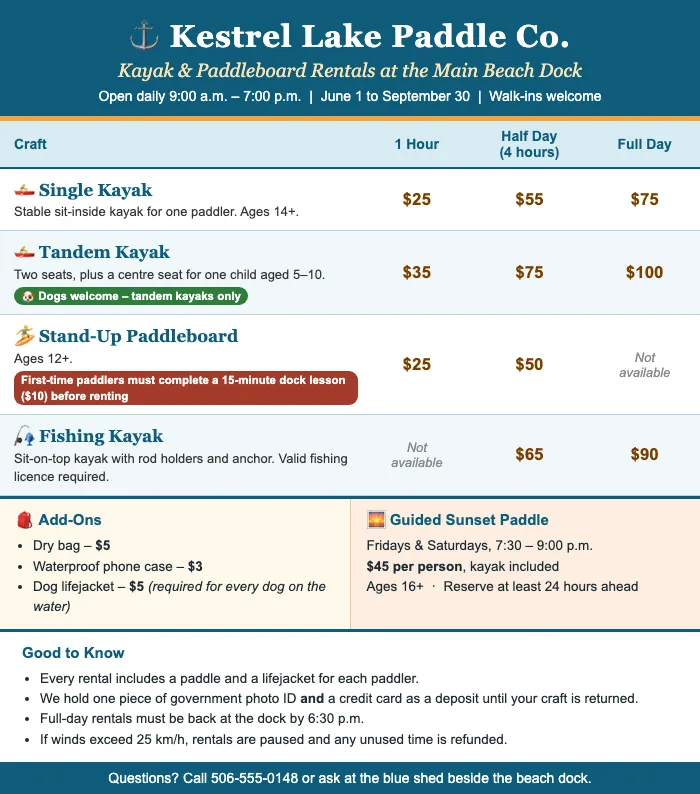
Read the following email message about the diagram on the left. Complete the email by filling in the blanks. Select the best choice for each blank from the drop-down menu.
Subject: Saturday on the water?
To: Priya Nair
From: Owen Lachance
Hi Priya,
Now that your exams are finally over, let’s get out on Kestrel Lake before the season ends. I grabbed this rental sheet when I was out there with my brother last weekend. It’ll be our first real day out together since you moved out of our old place on Albert Street. I still miss your Sunday pancakes!
I know you’re itching to try paddleboarding, but since you’ve never stood on a board before, you’d need before they’d rent you one, and that would eat into our morning. I’d rather we shared this time so my dog, Biscuit, can come along. Maybe paddleboarding next time?
We only need the boat until lunch, so a half day is plenty. That comes to for the boat, which I’m happy to cover since this whole thing was my idea. Biscuit will need his own lifejacket, but that only adds .
One more thing: please bring . The shop holds on to it as a deposit until the boat is back, and I lost my wallet last week, so I’m still waiting for new cards.
Let me know if Saturday works!
Owen
How do Owen and Priya most likely know each other?
What is the main purpose of Owen’s email?
When Owen says Priya is “itching to” try paddleboarding, he means she
Part 3: Reading for Information
Paragraph A
Few Canadians today give much thought to who will pay when they visit a family doctor, but the arrangement is younger than many people assume, and it began in a single province. Its best-known champion, Tommy Douglas, carried a personal memory into politics. As a young boy, he developed a serious bone infection in his leg, and doctors in Winnipeg later considered amputating it. His family could not afford a specialist, but a surgeon offered to treat him free of charge if medical students could observe, and the leg was saved. Douglas later said the experience convinced him that no one’s health should depend on the size of their bank account. After his Co-operative Commonwealth Federation won power in Saskatchewan in 1944, his government introduced universal hospital insurance in 1947, the first such program in North America.
Paragraph B
Hospital coverage was only half the picture, however. The 1947 plan paid for hospital stays, but patients still received bills for visits to doctors’ offices, and the province lacked the money to cover both. The situation eased in the late 1950s, when Ottawa agreed to share the cost of provincial hospital insurance, freeing up funds in Saskatchewan’s budget. Douglas announced plans for a medical care program in 1959 and made it the centrepiece of the following year’s provincial election, which his party won. He did not, however, see the program through himself. In 1961 he left to lead the newly formed federal New Democratic Party, and it fell to his successor, Woodrow Lloyd, to bring the plan into force.
Paragraph C
When the Medical Care Insurance Act took effect on July 1, 1962, most of the province’s doctors closed their offices in protest, offering only emergency services in hospitals. Many physicians feared that government payment would lead to government control of their practices. Tempers ran high on both sides, and the province brought in doctors from Britain and elsewhere to keep some clinics running. After 23 days, a settlement mediated by a British physician, Lord Taylor, brought the strike to an end. Known as the Saskatoon Agreement, it gave doctors more choice in how they billed for their services, but the principle of universal coverage survived intact.
Paragraph D
Saskatchewan’s experiment soon attracted national attention. A federal royal commission chaired by Emmett Hall, appointed in 1961, reported in 1964 that Canada should adopt a similar program across the country. Parliament passed the Medical Care Act in 1966, offering to share the cost with any province whose plan met national standards, and by the early 1970s every province and territory had signed on. Those standards were later reinforced by the Canada Health Act of 1984. Douglas himself remains closely associated with the system: in 2004, a nationwide CBC viewer vote named him “The Greatest Canadian.”
Decide which paragraph, A to D, has the information given in each statement below. Select E if the information is not given in any of the paragraphs.
- One politician’s views on health care were shaped by an event from his youth.
- Physicians from abroad helped keep some medical services available.
- The national inquiry into health services was led by a medical doctor.
- Federal help with one type of coverage made it possible to plan another.
- Saskatchewan offered a form of public coverage before anywhere else on the continent.
- A compromise gave one side part of what it wanted without undoing the program.
- Doctors who took part in the strike lost their right to practise in the province.
- The figure most linked to the program was no longer in provincial politics when it began.
- Other provinces were given a financial reason to follow Saskatchewan’s lead.
Part 4: Reading for Viewpoints
For more than thirty years, anyone could enter the Port Alder Museum and Art Gallery without opening a wallet. Confronted with a $420,000 operating shortfall, municipal politicians are now contemplating a $12 admission for adults, with children under 12 exempt.
Councillor Margaret Okafor, who chairs the finance committee, is unapologetic. “Free is never really free,” she remarks: every household subsidizes the institution through property taxes, whether or not its members ever visit, and roughly a third of visitors reside elsewhere. “Attendance will probably dip initially,” she admits, yet a modest fee distributes the burden more equitably than another tax increase or reduced opening hours.
Director Tobias Lindqvist has avoided taking sides publicly, though he doubts the fee debate addresses the institution’s fundamental difficulties. Two principal galleries have gone unrefreshed for over a decade, and “audiences seldom return to see the same thing twice,” he notes drily. Conceding the deficit must somehow be closed, he has floated a compromise: a free permanent collection, with admission charged solely for temporary exhibitions, for which visitors already anticipate paying. School groups, whose excursions run on shoestring budgets, remain his chief anxiety.
Helen Bruneau, a cultural policy scholar in Halifax, finds the evidence from elsewhere more nuanced than either camp admits. Fees do depress attendance, but abolishing them seldom alters who comes: free museums attract the same well-educated, comfortable clientele. “Many families simply don’t regard such places as meant for them,” she suggests. She therefore favours targeted measures, such as passes borrowed with a library card and community partnerships.
Arturo Mendes, whose café faces the museum across the square, perceives something more immediate: summer weekends fill his patio with museum-goers. “Charge the tour buses if you must,” he proposes, “but don’t make the people who live here pay to see their own history.” His petition for free resident admission has gathered more than 1,500 signatures. Beneath the arithmetic lies a broader disagreement: whether a public museum should be judged by the revenue it collects or by the range of people it reaches.
Why does Councillor Okafor mention visitors from elsewhere?
Which arrangement would Lindqvist likely accept?
Bruneau and Lindqvist would both contend that
It is reasonable to assume that
The article would be best headed
The following is a comment by a visitor to the website page. Complete the comment by choosing the best option to fill in each blank.
My children and I have visited Port Alder’s museum almost monthly for years, so this article caught my attention. Councillor Okafor has a point that , and I see no reason why a busload of tourists shouldn’t chip in. But a blanket charge is misguided. Ms. Bruneau pinpoints the problem: my neighbours stay away not over the price, but because they .
What they need is an invitation, not a new price list: hence the appeal of . Mr. Mendes, I grant, , yet signatures won’t close that deficit. And if those galleries haven’t changed since my kids were toddlers, . Refresh the walls first, and then we can discuss tickets.
Answer key
Count your correct answers, then find your estimated CLB:
Show all 38 answers
- What is the main purpose of Rania’s letter? B. to share news and ask for help with her daughter
- Gloria has probably A. worked in a hospital at some point.
- Why does Nadia need somewhere to stay in August? D. Students may not move in ahead of time.
- If Gloria cannot host Nadia, Rania hopes she will C. agree to be called if Nadia has an emergency.
- By mentioning the hockey arena, Rania suggests that Gloria A. had predicted this would happen.
- What does Rania ask Gloria to do before replying? B. discuss the request with her husband
- C. here rather than at a school nearer home
- D. until she can move into residence
- A. paying for her food
- B. the person her residence can call
- D. get the car warmed up
- C. a short lesson on the dock
- A. a tandem kayak
- B. $75
- D. $5
- C. photo ID and a credit card
- How do Owen and Priya most likely know each other? A. They used to share a home.
- What is the main purpose of Owen’s email? D. to suggest a day out and sort out details
- When Owen says Priya is “itching to” try paddleboarding, he means she B. is keen to give it a go.
- One politician’s views on health care were shaped by an event from his youth. A
- Physicians from abroad helped keep some medical services available. C
- The national inquiry into health services was led by a medical doctor. E
- Federal help with one type of coverage made it possible to plan another. B
- Saskatchewan offered a form of public coverage before anywhere else on the continent. A
- A compromise gave one side part of what it wanted without undoing the program. C
- Doctors who took part in the strike lost their right to practise in the province. E
- The figure most linked to the program was no longer in provincial politics when it began. B
- Other provinces were given a financial reason to follow Saskatchewan’s lead. D
- Why does Councillor Okafor mention visitors from elsewhere? B. to imply outsiders benefit from taxes
- Which arrangement would Lindqvist likely accept? C. charges for temporary shows
- Bruneau and Lindqvist would both contend that D. the fee isn’t the real issue.
- It is reasonable to assume that A. the fee remains undecided.
- The article would be best headed B. “Port Alder’s Past: What Would $12 Really Solve?”
- C. taxpayers already foot the bill
- A. feel like outsiders
- D. a library-card scheme
- B. has skin in the game
- C. no price will tempt them
What does your score mean? See the CELPIP Reading score chart.
Free CELPIP practice test · Free CELPIP Listening practice tests · CELPIP sample tests by part
CELPass is an independent practice platform and is not affiliated with Paragon Testing Enterprises. CELPIP is a trademark of Paragon Testing Enterprises. Check the official CELPIP website and IRCC for current test rules and requirements.