Most CELPIP Speaking AI checkers look the same from the outside: you record an answer and get a score. Underneath, they work very differently. Some turn your recording into text and grade the text. Others also measure the recording itself: how fast you speak, where you pause, how often you say "um", and which words were hard to hear. The difference matters for feedback, because a transcript cannot show most of what CELPIP's Listenability rating is about. This post explains the difference, gives you a two-minute test to try on any site, and shows what each major CELPIP site says about how it scores Speaking. (CELPass is our own product. Facts about other sites come only from their own public pages, dated below.)
Does a CELPIP Speaking AI checker listen to your recording?
Not always. Many AI checkers send your recording to speech recognition, get back the words as text, and score only that text. The text keeps your ideas, vocabulary and grammar, but it loses how you said them: your pace, your silences, your hesitations and how clear your words were. A checker that measures the recording itself can judge those too.
| Transcript-only scoring | Transcript plus speech analysis | |
|---|---|---|
| What the AI receives | The words you said, as text | The words, plus a timestamp and a clarity score for every word |
| Ideas, vocabulary, task | Yes | Yes |
| Grammar | Mostly, though speech recognition may tidy small slips | Mostly, with the same caveat |
| Speaking rate | No: text has no time | Measured in words a minute |
| Long pauses | No: a 5-second silence looks like a full stop | Each gap found and timed |
| Fillers (um, uh) | Only if the recogniser kept them; many remove them | Counted from the recording |
| Unclear words | No: the recogniser's best guess looks like any other word | Flagged where the recogniser was unsure |
What does CELPIP Speaking rate that a transcript cannot show?
Mainly Listenability, one of the four rating areas alongside Content and Coherence, Vocabulary, and Task Fulfillment. Listenability covers pronunciation, rhythm and intonation, how often you hesitate or fill silence, and grammar. Only grammar survives in a transcript.
Fluency also affects the other areas. An answer that stops for long silences covers fewer points in the time, which shows up in Content and Task Fulfillment. But a transcript-only checker sees only the shorter text, not why it is short, so it cannot tell you that pausing was the problem.
How can I test whether a Speaking AI really listens?
Record the same answer twice and compare. It takes about two minutes on any site that scores Speaking, and it tells you more than any marketing page.
- Write a short answer to any Speaking task, 6 to 8 sentences.
- Recording 1: read it smoothly at a natural pace.
- Recording 2: read the same words, but stop for 4 or 5 seconds three times, add an "um" before most sentences, and mumble two words.
- Compare the two results. A checker that measures delivery should score recording 2 lower and say why: the pauses, the fillers, the unclear words.
- If both get the same score and the same comments, the checker is almost certainly grading the text only.
Run the same test on CELPass too. Recording 2 should show long pauses, fillers marked Watch or Fix, and the mumbled words flagged as hard to hear.
What does speech analysis measure in a CELPIP answer?
Speech analysis uses the word timings and clarity scores that speech recognition returns for every word. From those, the delivery numbers are calculated, not guessed by a language model:
- Speaking rate: words a minute over the whole answer.
- Long pauses: every silent gap of two seconds or more, and where it fell.
- Fillers: how many times you said um, uh, er and similar.
- Word clarity: the share of words the recogniser understood confidently, and which words it struggled with.
- Time used: how much of the speaking time your answer filled.
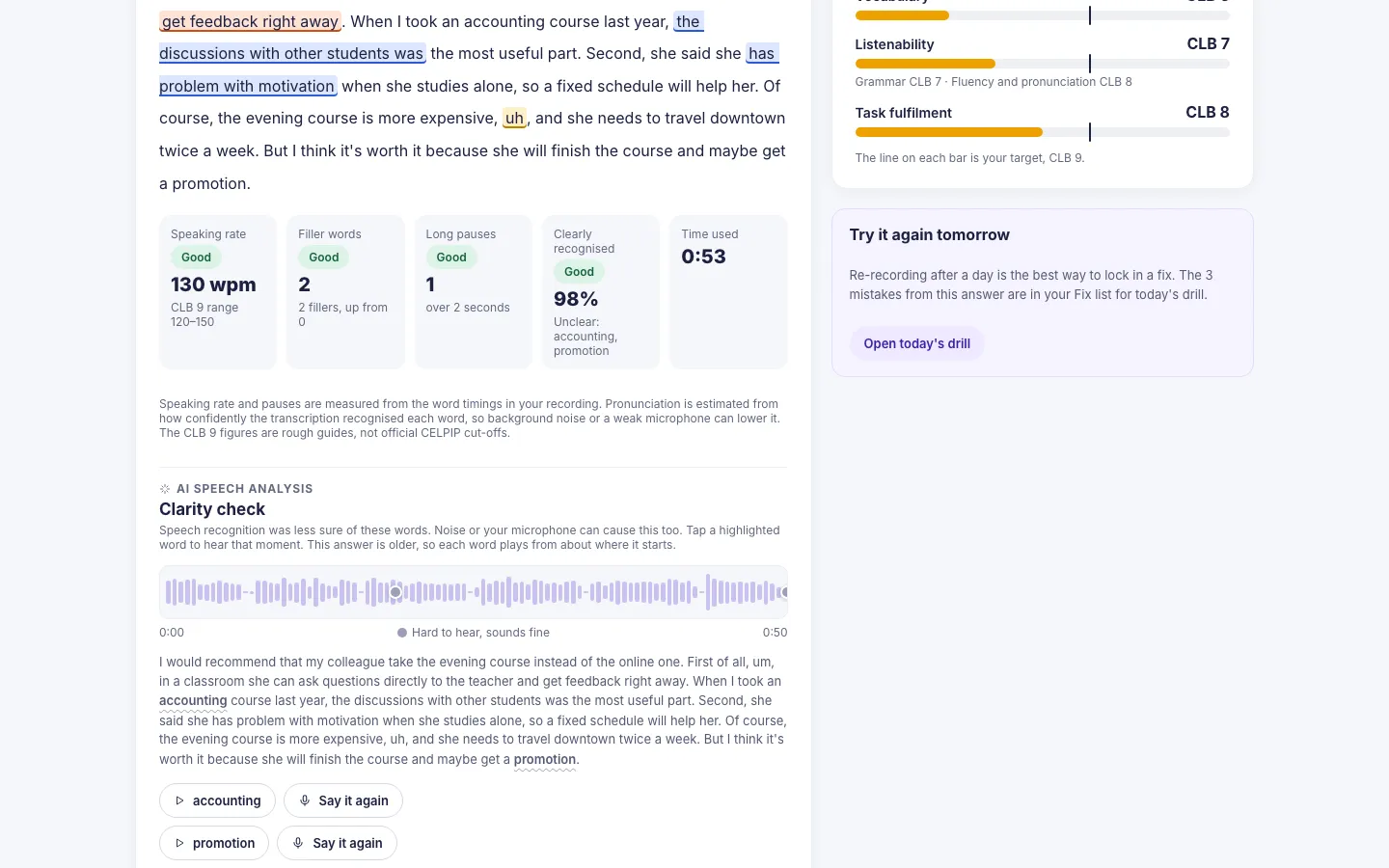
Word clarity needs care. It drops with an accent the recogniser hears less often, but also with background noise, a weak microphone or an unusual name. Good speech analysis treats it as a hint to listen again, not as a pronunciation score, and lets you hear the moment it flagged.
What do CELPIP practice sites say about how they score Speaking?
They differ more than their marketing suggests. Two sites say they measure delivery from the recording, two say openly that they grade the transcript, one uses teachers, and several don't say. Here is what each site states on its own pages.
| Site | What it says about scoring Speaking | Delivery measured from the recording? |
|---|---|---|
| CELPass | SpeechTrace™ measures speaking rate, long pauses, fillers and word clarity from the recording; the AI rates the four CELPIP areas with those measurements; hard-to-hear words are checked sound by sound | Yes |
| CELTESTPIP | "Pace, pauses, fillers and pronunciation, measured"; its sample report shows words a minute, filler words, intonation and pronunciation | Yes, as stated |
| HelloCELPIP | Scores Listenability from "your pace, your pausing" and says this "is not possible from a typed transcript alone"; its sample shows words a minute, fillers and long pauses | Yes, as stated |
| PrepAmigo | The recording is "transcribed word for word" and its engine "grades from the transcript alone"; fillers and restarts stay in the transcript | No: transcript only, as stated |
| CELPIP Practice | "Speaking is graded from a transcript"; it says adding the recording, pause timings and speaking rate did not beat the transcript by more than run-to-run noise | No: transcript only, as stated |
| E2Language | Speaking assessments "marked by a teacher", feedback within 48 hours | A teacher listens |
| Celpip.me | AI marking "on the official CELPIP criteria"; sample scores include Pronunciation and Fluency, method not given | Not stated |
| USpeak AI | "Speech recognition and natural language processing" against the CELPIP rubrics; pace, pauses and pronunciation not named | Not stated |
| CELPIPguide | Nothing on how Speaking answers are scored | Not stated |
| Official CELPIP sample test | No score for Speaking; rated sample responses to compare with | Not scored |
Two things are worth knowing. First, grading from a transcript is a fair design choice, and CELPIP Practice publishes its reasoning: for the score itself, the words carry most of the signal. Second, a score is not the same as feedback. Even when the words predict the level well, only measurements from the recording can tell you that your pauses, your fillers or one unclear word are what to fix next. That is what the two-recording test checks.
How does CELPass score a Speaking answer?
In two layers. SpeechTrace™, our delivery analyser, measures your speaking rate, long pauses, fillers and word clarity from the recording. The scoring engine then rates Content and Coherence, Vocabulary, Listenability and Task Fulfillment from the transcript with those measurements in front of it, and shows a CLB for each against your target.
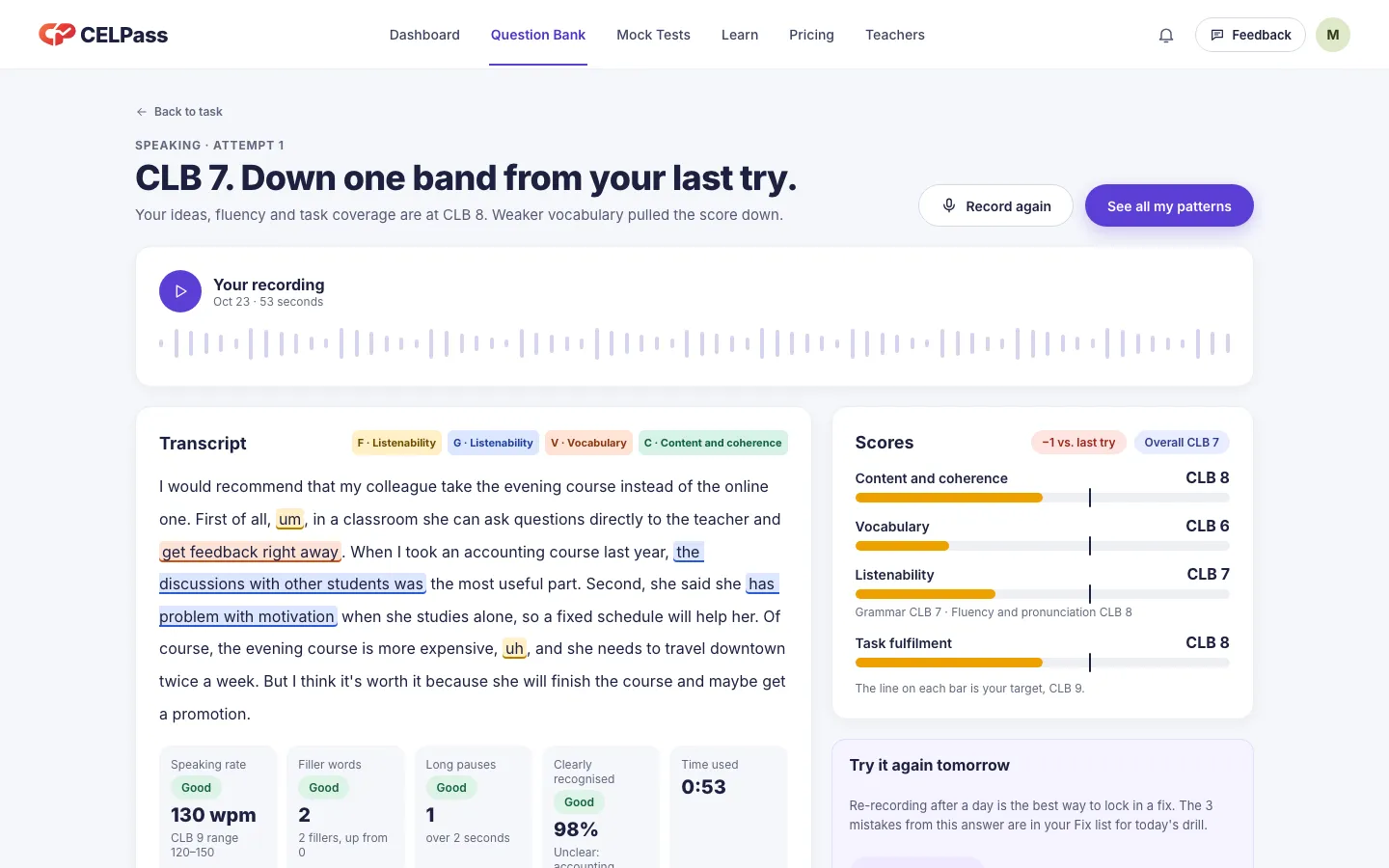
- Clarity check: hard-to-hear words are marked in the transcript and on a waveform of your recording. Tap one to hear that moment, and see whether a sound needs work or whether noise or speed was the more likely cause.
- Say it again: repeat the phrase and see whether the word came through clearly this time.
- Words that stay unclear in two or more of your answers come back in your Fix list.
- The speech analysis explains your Listenability score; it never changes the score on its own.
How do I improve the delivery part of my Speaking score?
Practise speaking, not only writing answers in your head. Shadowing works well: listen to a strong answer and speak along with it until its pace and pauses become yours. On CELPass, Shadow mode plays a recorded CLB 11-12 answer to the question in four rounds (listen and read, echo one sentence, shadow the whole answer, then from memory) and shows the words you missed and your pace beside the sample's.
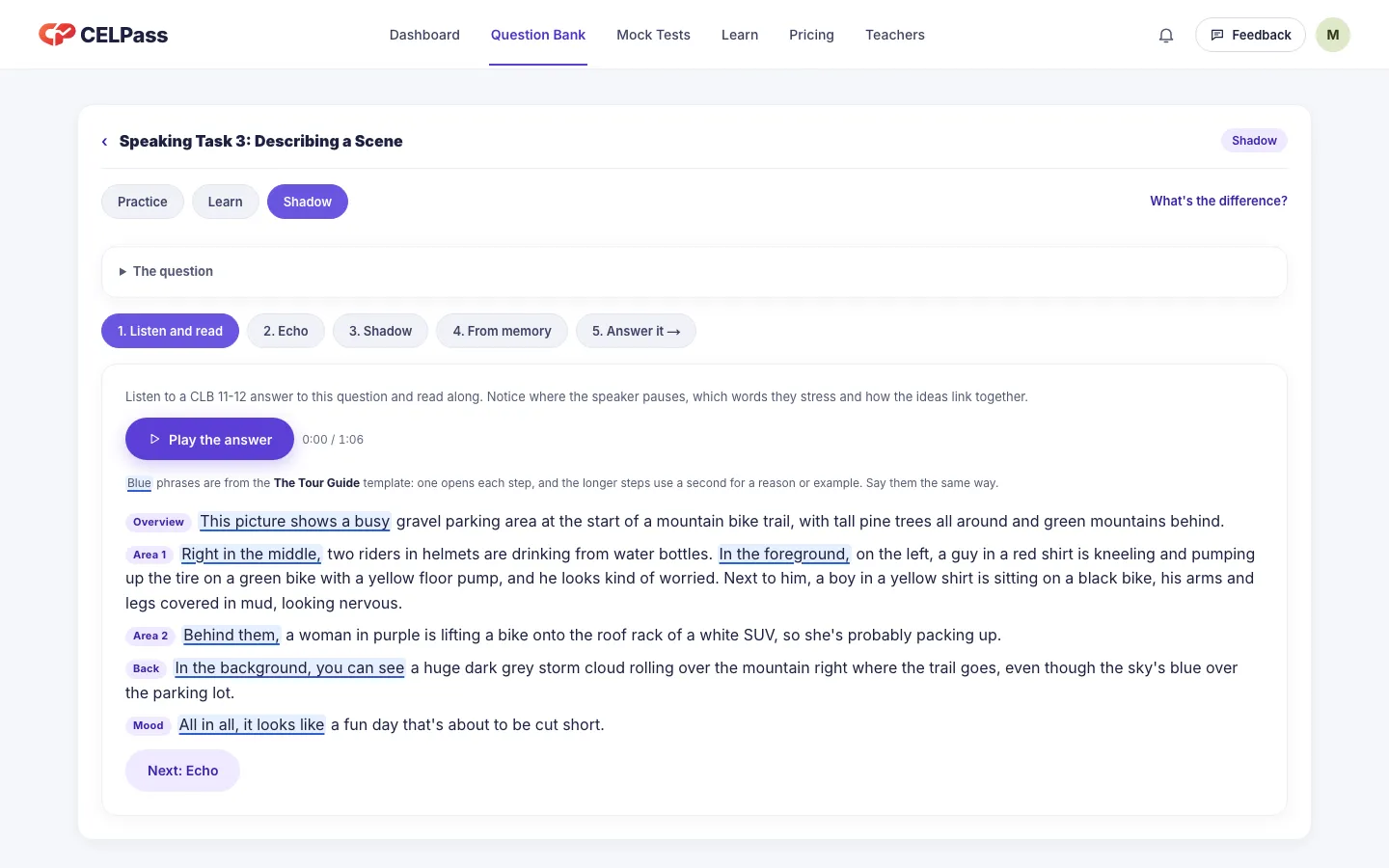
- Use a template so you always know your next step; most long pauses come from not knowing what to say next.
- Replace "um" with a short silence. A one-second pause sounds calm; a filler before every sentence does not.
- Aim for a steady pace. Roughly 120 to 150 words a minute is a comfortable range for CLB 9; much faster is often less clear.
- Record yourself every day and listen back, or let a tool that measures the recording do it for you.
Frequently asked questions
Can ChatGPT score my CELPIP Speaking from a recording?
A general chatbot usually works from a transcript of what you said, so it can comment on ideas, vocabulary and grammar but not reliably on your pace, pauses or pronunciation. Use the two-recording test in this post to see what any tool really measures.
Is an AI Speaking score the same as an official CELPIP score?
No. Every AI Speaking score, ours included, is a practice estimate. Only the official CELPIP test produces a result IRCC accepts.
Will my accent lower an AI Speaking score?
It can lower word clarity, because speech recognition hears some accents less often. A good checker treats clarity as a hint, lets you hear the flagged moment, and does not lower your score for an accent alone. CELPIP itself rates how easy you are to understand, not whether you sound Canadian.
Does CELPass record or keep my Speaking answers?
Your Speaking recordings are kept on your account so you can play them back next to your feedback, and they are deleted with your account.