CELPIP Reading Practice Test 110
By Iris
A complete CELPIP Reading practice test: all 4 parts and 38 questions in the real test order. Set a timer for 55–60 minutes and do all four parts in one sitting. Check your answers at the bottom of the page to see your score and an estimated CLB.
Download as PDF with answer key
In this test
- Part 1: Reading Correspondence, “A Basement Room for Six Weeks” (questions 1–11) · practise this part alone
- Part 2: Reading to Apply a Diagram, “Choosing First Aid Courses in Grande Prairie” (questions 12–19) · practise this part alone
- Part 3: Reading for Information, “Five-Pin Bowling: A Toronto Original” (questions 20–28) · practise this part alone
- Part 4: Reading for Viewpoints, “Westmere’s Proposed Drive-Through Ban Debate” (questions 29–38) · practise this part alone
Part 1: Reading Correspondence
Dear Aisha,
Your mother phoned me last week with the news that you’ve been placed at the hospital here in Corner Brook for your final nursing placement, and I’ve hardly stopped smiling since. The last time I saw you, you were six years old and refusing to let go of your mother’s hand at my wedding, so I find it hard to believe you’ll soon be the one taking care of patients! I hope you’ll forgive me for writing before we’ve properly spoken, but I wanted to make you an offer before you sign a lease somewhere else.
Gerald and I have a furnished room in our basement with its own small bathroom, and it is yours for the six weeks if you want it. We won’t accept rent. Your mother and I shared a tiny apartment in St. John’s for four years when we were students, and she fed me through more exam weeks than I can count, so I consider this a very small repayment. If you insist on helping, though, there is one thing. On Tuesday and Thursday evenings I work late at the lab, and our old dog, Biscuit, would be thrilled to have someone take him around the block.
Now for a few practical matters. The house is about a twenty-five-minute walk from the hospital, mostly uphill on the way home, and in February the sidewalks can be treacherous, so please bring proper winter boots and some ice grips for your soles. The first bus doesn’t run early enough for a seven o’clock shift, but since I work in the hospital lab myself, I can drive you whenever our schedules line up. If you email me your placement schedule once you have it, we can work out the rides in advance.
You should also know that Gerald leaves for work at five in the morning, so he is usually asleep by nine. The basement is quite private, but we’d appreciate it if you kept music and phone calls low after that. The kitchen is yours to use, and the Wi-Fi is reliable, which I’m told matters a great deal to people your age.
Please don’t feel obliged to say yes. If you’d rather live closer to your classmates, I’ll completely understand, and I would still love to have you over for a meal.
Warmly,
Maureen Kelly
What is the main purpose of Maureen’s letter?
How does Maureen know Aisha?
What does Maureen ask Aisha to do in return for the room?
Why does Maureen mention Gerald’s working hours?
What does Maureen say about getting to the hospital?
Maureen advises Aisha to
Here is a response to the message. Complete the response by filling in the blanks. Select the best choice for each blank from the drop-down menu.
Dear Maureen,
Thank you so much for your kind letter. When I read it to Mom, she laughed and said she still remembers during your student days.
I would love to accept your offer of the room, and I’m more than happy to on the evenings you work late. I grew up with a dog, and I really miss having one around.
My placement begins on February 3, and I should receive my shifts in mid-January. I’ll as soon as I have them, so we can see which mornings we can travel together.
Please don’t worry about noise. I know Gerald , so I’ll keep my music down in the evenings.
Thank you also for the warning about the sidewalks. I’ve already ordered .
See you in February,
Aisha
Part 2: Reading to Apply a Diagram
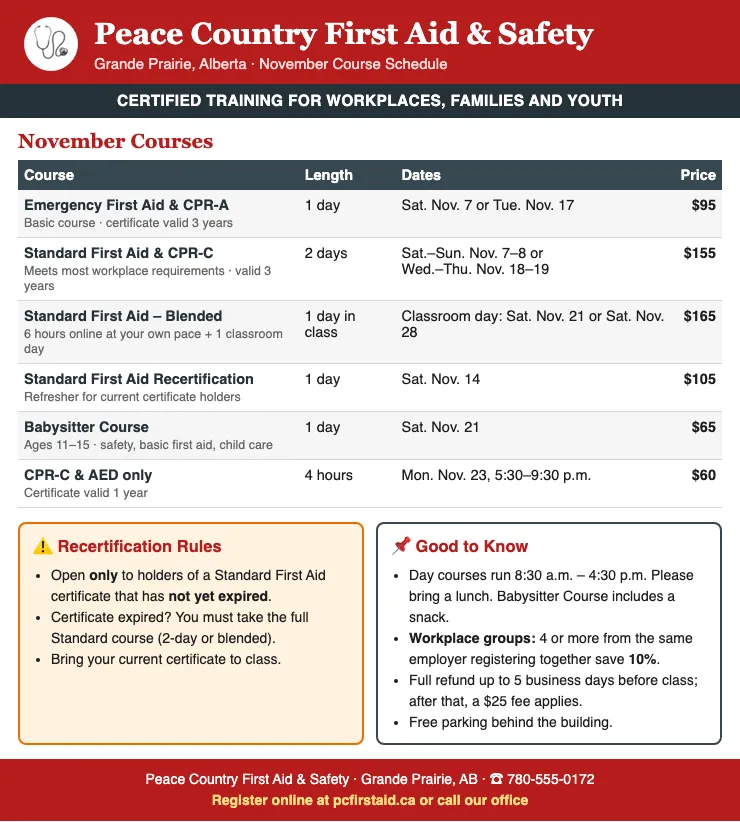
Read the following email message about the diagram on the left. Complete the email by filling in the blanks. Select the best choice for each blank from the drop-down menu.
Subject: First aid before December
To: Kwame Boateng
From: Renée Lavoie
Hi Kwame,
At Monday’s staff meeting, Dr. Singh reminded us that everyone at the clinic needs a valid Standard First Aid certificate by December 1, so I picked up this schedule on my way home.
You mentioned that your certificate is good until January, so the one-day on the 14th would be enough for you. Mine ran out in August, though, which means I .
Weekends are tricky because I coach Amélie’s ringette team on Sundays, and weekdays at the front desk are a zoo, so the option suits me best. I can do most of it online in the evenings. I’ll do my classroom day on , since Luc has his babysitter course on the 21st and I have to drive him.
He turned twelve last month and has been begging to start babysitting for the neighbours. At least he won’t go hungry, since .
Also, Marisol and Tyler in the lab need to renew theirs too, so if the four of us register together, we’ll each save ten percent. Could you let me know by Friday?
Renée
Renée and Kwame know each other because they
What is true about Renée’s son?
When Renée says weekdays at the front desk are “a zoo,” she means they are
Part 3: Reading for Information
Paragraph A
Bowling has been played in one form or another for centuries, but one version of the game is almost entirely Canadian. Five-pin bowling was created in the early 1900s by Thomas F. Ryan, who ran a bowling club in downtown Toronto. According to the story usually told, some of his customers, many of them businessmen who dropped in during their lunch hour, complained that the traditional ten-pin game was too tiring and took too long. Ryan responded by having a set of ten-pin pins shaved down to a smaller size and replacing the heavy ball with one that fit in the hand. The result was a lighter, faster game that could be enjoyed during a short break from the office.
Paragraph B
The equipment is what sets five-pin apart from its older cousin. The ball is small enough to be held in the palm of the hand, has no finger holes, and weighs less than two kilograms. The pins are smaller as well, and each one has a thick rubber band around its widest part, which makes the pins bounce and scatter in lively ways when they are struck. The lanes, however, are the same length as ten-pin lanes. As a result, many bowling centres in Canada are able to offer both games under one roof, sometimes switching some of their lanes from one game to the other.
Paragraph C
Scoring is also quite different. The five pins are set up in a V shape, and they are not all of equal value: the centre pin, known as the head pin, is worth five points, the two pins beside it are worth three points each, and the two pins at the corners are worth two each, for a total of fifteen. Instead of the two balls allowed in ten-pin, a player gets three balls in each of the game’s ten frames. Knocking down all five pins with the first ball is a strike, and because strikes earn bonus points, the highest possible score is 450. A perfect game is extremely rare, and many keen bowlers never manage one.
Paragraph D
Today, five-pin bowling is played almost exclusively in Canada, and for many Canadians it brings back childhood memories of birthday parties, school outings and Saturday-morning youth leagues. Because the ball is so light, even young children can play the same game as adults. However, the number of bowling centres has dropped over the past few decades, as rising costs and changing leisure habits forced many to close their doors. Those that remain have looked for new ways to bring in customers, adding music and coloured lights for evening “glow bowling,” as well as expanded food and drink menus. Supporters argue that the game is a piece of Canadian heritage worth keeping alive.
Decide which paragraph, A to D, has the information given in each statement below. Select E if the information is not given in any of the paragraphs.
- Some places can use the same lanes for either kind of bowling.
- The game was originally meant for people who had little free time.
- Ryan’s new version of the game made him a wealthy man.
- Knocking down one pin may earn more points than knocking down another.
- Many places to bowl have gone out of business in recent decades.
- Bowlers get an extra attempt in each frame compared with the older game.
- Players do not need to put their fingers inside the ball.
- The first five-pin pins were made from a lighter wood than ten-pin pins.
- Bowling centres are offering new kinds of entertainment to attract business.
Part 4: Reading for Viewpoints
Westmere, a fast-growing city of about 70,000, already has 23 drive-throughs, and four further applications sit on the planning department’s desk. Should Councillor Naomi Laflamme prevail, those four may be the last ever approved: she proposes amending the zoning bylaw to forbid new drive-throughs citywide, while allowing existing ones to remain.
Laflamme accuses the municipality of undermining its own objectives, professing a commitment to walkable neighbourhoods and reduced emissions while approving “another lot designed around a line of idling cars.” Particularly galling are lineups that overflow parking lots during the morning rush, obstructing bus stops and bike lanes. “The immediate effect would be slight,” she admits, “but each new outlet locks in thirty more years of car-first design.”
Craig Dempsey, owner of two coffee franchises with drive-throughs, charges that the proposal overlooks the actual clientele. “Roughly seventy percent of my sales pass through the window, many to parents with sleeping children, people with mobility difficulties and tradespeople on short breaks,” he says. The queue at his Pembina Street location, he does not deny, regularly backs onto the road, and a second ordering lane there could be built at his expense. “Punishing businesses that haven’t opened yet remedies nothing,” he insists.
Femi Adeyemi, a transportation engineer who has reviewed traffic studies across the Prairies, is unimpressed by the idling argument: “Set against the distances Westmere’s vehicles travel daily, a lot’s worth of waiting engines scarcely registers.” The defect he identifies is design, many older sites having been built to accommodate only six or seven cars. He recommends mandatory capacity for twelve, with entrances set well back from busy intersections, while allowing that a drive-through makes little sense beside a rapid-transit station.
For Shirley Vandermeer, the debate is personal. Her backyard faces a twenty-four-hour burger outlet whose headlights and ordering speaker keep her awake past midnight, and two complaints earned only the reply that the volume satisfies municipal rules. She has publicly applauded Laflamme’s initiative, but continues pressing separately for overnight restrictions on outlets adjoining homes. A hearing follows early next year.
Who, like Adeyemi, would fix lineups through site design?
How would Dempsey answer complaints about his queue?
How would Adeyemi answer Laflamme on idling cars?
Which of these follows from the article?
The article might best be titled
The following is a comment by a visitor to the website page. Complete the comment by choosing the best option to fill in each blank.
Driving along Pembina Street every morning, I know precisely what the councillor means: lineups . Sitting in that line is nobody’s idea of a good start to the day. My own coffee stop, I admit, has a window. But a blanket prohibition strikes me as excessive.
To his credit, the franchise owner , which is more than most proprietors would volunteer. The engineer’s prescription of addresses the cause instead of the symptom.
I sympathize with the neighbour whose backyard is lit all night, but her torment stems from . Her overnight proposal deserves a separate discussion. Council should at the hearing, holding the ban in reserve should that fail.
Answer key
Count your correct answers, then find your estimated CLB:
Show all 38 answers
- What is the main purpose of Maureen’s letter? B. to offer Aisha a place to stay
- How does Maureen know Aisha? C. She is an old friend of Aisha’s mother.
- What does Maureen ask Aisha to do in return for the room? A. help with the dog on certain evenings
- Why does Maureen mention Gerald’s working hours? D. to explain why the house should be quiet at night
- What does Maureen say about getting to the hospital? B. She can give Aisha a lift on some days.
- Maureen advises Aisha to C. pack footwear suited to icy conditions.
- D. making sure you were well fed
- A. get Biscuit out for some exercise
- C. email them to you
- B. starts work very early
- D. spikes that slip over my boots
- A. refresher course
- D. have to take the full course again
- B. blended
- C. November 28
- A. the course includes a snack
- Renée and Kwame know each other because they C. work at the same clinic.
- What is true about Renée’s son? D. He wants to start looking after other people’s children.
- When Renée says weekdays at the front desk are “a zoo,” she means they are B. very busy and hectic.
- Some places can use the same lanes for either kind of bowling. B
- The game was originally meant for people who had little free time. A
- Ryan’s new version of the game made him a wealthy man. E
- Knocking down one pin may earn more points than knocking down another. C
- Many places to bowl have gone out of business in recent decades. D
- Bowlers get an extra attempt in each frame compared with the older game. C
- Players do not need to put their fingers inside the ball. B
- The first five-pin pins were made from a lighter wood than ten-pin pins. E
- Bowling centres are offering new kinds of entertainment to attract business. D
- Who, like Adeyemi, would fix lineups through site design? B. Craig Dempsey
- How would Dempsey answer complaints about his queue? A. by funding changes at one site
- How would Adeyemi answer Laflamme on idling cars? D. It overstates waiting vehicles’ pollution.
- Which of these follows from the article? C. Vandermeer’s complaint would remain.
- The article might best be titled A. “Should Westmere Brake on New Drive-Throughs?”
- B. spilling onto the road
- D. admits one site’s flaw
- A. more room for waiting cars
- C. a restaurant already open
- D. try stricter design first
What does your score mean? See the CELPIP Reading score chart.
Free CELPIP practice test · Free CELPIP Listening practice tests · CELPIP sample tests by part
CELPass is an independent practice platform and is not affiliated with Paragon Testing Enterprises. CELPIP is a trademark of Paragon Testing Enterprises. Check the official CELPIP website and IRCC for current test rules and requirements.