CELPIP Reading Practice Test 111
By Iris
A complete CELPIP Reading practice test: all 4 parts and 38 questions in the real test order. Set a timer for 55–60 minutes and do all four parts in one sitting. Check your answers at the bottom of the page to see your score and an estimated CLB.
Download as PDF with answer key
In this test
- Part 1: Reading Correspondence, “Passing On the Saturday Book Swap” (questions 1–11) · practise this part alone
- Part 2: Reading to Apply a Diagram, “Fall Music Lessons in Brandon” (questions 12–19) · practise this part alone
- Part 3: Reading for Information, “The Lynx and the Snowshoe Hare” (questions 20–28) · practise this part alone
- Part 4: Reading for Viewpoints, “Roundabouts for Bellhaven Debate” (questions 29–38) · practise this part alone
Part 1: Reading Correspondence
Dear Daniel,
I hope you and Grace are enjoying the spring sunshine. I’ve been meaning to speak to you over the fence for weeks, but every time I see you, I lose my nerve, so I’ve decided to put my question in writing instead.
As you may have heard, I’ll be leaving Kingston for Peterborough at the end of June. My daughter is expecting twins in August, and I’ve decided I would rather be a grandmother down the road than one at the other end of a phone line. The hardest part of leaving, apart from my garden, is the book swap. I started it eleven years ago with one folding table and a box of my late husband’s westerns, and it has grown into something the whole neighbourhood looks forward to. I can’t bear the thought of it ending when I leave, and I can’t think of anyone better suited to take it over than you.
You’ve come to every swap since you moved in next door last fall, and I noticed that you were always the last to leave, stacking chairs without being asked. Besides, a man who spent thirty years running a school library can surely handle a room full of paperbacks!
The work itself isn’t heavy. The swap runs on the first Saturday of each month, from ten until one, at the Elm Street Community Centre. The centre lets us use the room free of charge, on the condition that it is cleared and the chairs are put away by half past one, when the seniors’ dance class arrives. The books are kept in a locked cupboard, and Lorraine at the front desk holds the spare key. Teresa Wong will go on running the children’s table, but she has made it very clear that she has no interest in being in charge.
There is one problem I should be honest about. Since January, people have been leaving bags of mouldy and water-damaged books outside the centre’s door between swaps, and the staff are not pleased. I put up a sign, which helped a little, but whoever takes over will need to keep an eye on it. I’ll also pass on the notebook where I write down requests from regulars, so that when a book someone is hoping for turns up, it can be set aside for them.
If you’re willing, I’d love for you to come with me to the May swap so I can introduce you to Lorraine. And if the answer is no, please don’t give it a second thought. I’ll simply put a notice in the community newsletter asking for volunteers.
With warm regards,
Marjorie Hale
What is the main purpose of Marjorie’s letter?
Why is Marjorie moving?
Why does Marjorie think Daniel is well suited to the role?
The community centre allows the swap to use the room as long as
What does Marjorie say about Teresa Wong?
What will Marjorie probably do if Daniel says no?
Here is a response to the message. Complete the response by filling in the blanks. Select the best choice for each blank from the drop-down menu.
Dear Marjorie,
Thank you for your lovely letter, and congratulations on the twins! I completely understand why you would want to be when they arrive.
I would be honoured to keep the book swap going. After three decades of , I’ve missed being surrounded by shelves, so this suits me perfectly. Grace has even offered to bake something for the first Saturday.
I’ll certainly come along in May so that you can . I also promise to have everything cleared away before turns up, so we stay on the centre’s good side.
As for the damaged books, I wonder whether a box inside the centre, clearly marked for donations, would help, so people have . I’ll ask the staff what they think.
And yes, please leave me your notebook of requests. It sounds like a wonderful tradition.
Warm wishes,
Daniel
Part 2: Reading to Apply a Diagram
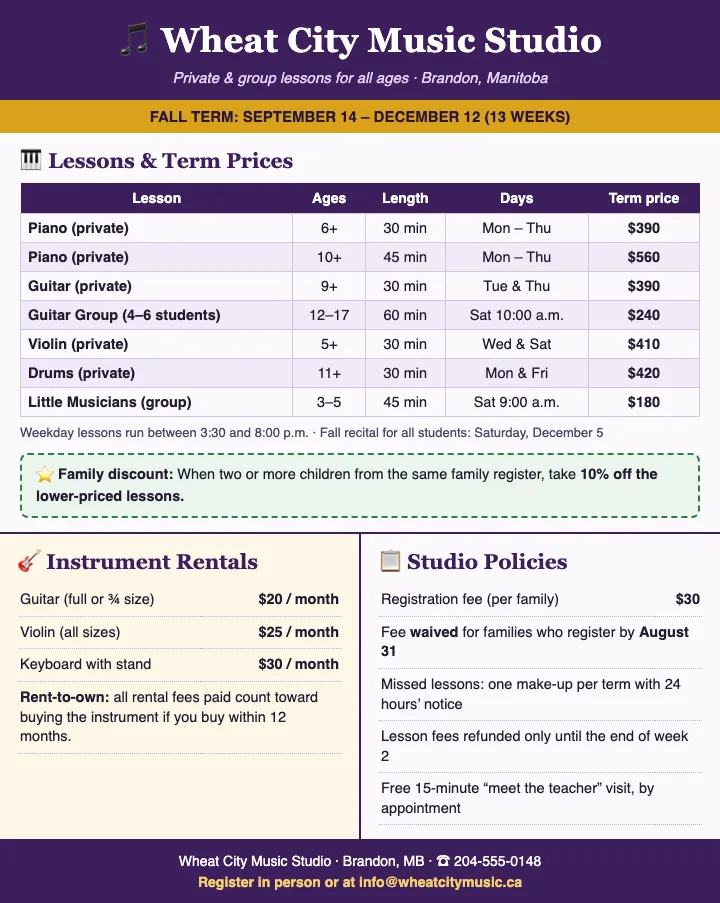
Read the following email message about the diagram on the left. Complete the email by filling in the blanks. Select the best choice for each blank from the drop-down menu.
Subject: Music lessons this fall
To: Liam Fraser
From: Hannah Kowalski
Hi Liam,
I stopped by the music studio after work and picked up their fall schedule. Both of our kids are keen, so I wanted to sort things out with you before you fly back up north to the mine on Sunday.
Noah has his heart set on guitar. Since he turned thirteen in June, he could join the on Saturday mornings. It costs less than private lessons, and playing alongside other teenagers might help him come out of his shell a bit.
Ella wants piano. At seven, she’s too young for the lessons, which is probably just as well, since that girl has ants in her pants. I finish work at three, so I can take her on any weekday afternoon.
Your mom’s old piano will do fine for Ella, but we’d need to rent a guitar for Noah. It’s only a month, and if he sticks with it, , so we wouldn’t be throwing money away.
The best part is that, with two children enrolled, we’d get ten percent off .
Can you call me tonight? I’d like to register them this week so that we don’t have to pay the registration fee.
Love,
Hannah
Hannah and Liam are most likely
Why does Hannah think the group class would be good for Noah?
When Hannah says Ella “has ants in her pants,” she means that Ella
Part 3: Reading for Information
Paragraph A
Across Canada’s boreal forest, few relationships between predator and prey are as closely linked as the one between the Canada lynx and the snowshoe hare. Both animals are built for deep snow. The hare takes its name from its oversized hind feet, which spread its weight so that it can bound across soft drifts without sinking. Its coat also changes with the seasons, turning from brown in summer to white in winter, a shift triggered by the changing length of the day rather than by the arrival of snow. The lynx, a medium-sized wild cat with tufted ears and a short, black-tipped tail, has long legs and wide, heavily furred paws that work much like a pair of snowshoes. In winter especially, hares make up most of what a lynx eats.
Paragraph B
What makes the pair famous among scientists is a pattern that repeats itself roughly every ten years. Over several years, hare numbers climb until, in some places, the forest seems to be overrun with them. Then the population crashes, sometimes falling to a small fraction of its peak, before slowly beginning to rise again. Lynx numbers follow the same curve, usually a year or two behind. The pattern was first documented not by biologists but by fur traders. The Hudson’s Bay Company kept careful records of the lynx pelts it bought from trappers throughout the 1800s, and when scientists examined those ledgers in the twentieth century, the regular rise and fall of the lynx population stood out clearly. The figures still appear in ecology textbooks today.
Paragraph C
For decades, researchers debated what drives the cycle. The obvious explanation is that lynx simply eat too many hares, but the reality has proven more complicated. Long-term experiments in the Yukon, in which some areas were fenced to keep predators out and others were given extra food, suggested that several factors work together. As hare numbers peak, the twigs and shrubs they feed on in winter become scarce. At the same time, lynx, coyotes, owls and hawks all multiply. Constant danger also appears to stress the surviving hares so much that they produce fewer young, which helps explain why their numbers stay low for some time even after many of their predators have disappeared.
Paragraph D
For the lynx, a crash in the hare population means hard times. Adults lose condition, few females breed, and kittens born in such years rarely survive. Some lynx travel hundreds of kilometres in search of better hunting grounds, which occasionally brings them into areas where they are seldom seen. Researchers are now watching for a newer threat. As winters grow shorter in parts of the country, snow sometimes arrives later or melts earlier than it once did, leaving white hares standing out against a brown forest floor. Because the change in coat colour follows daylight, the hares cannot easily adjust, and scientists are studying whether this mismatch makes them easier for predators to find.
Decide which paragraph, A to D, has the information given in each statement below. Select E if the information is not given in any of the paragraphs.
- The shape of an animal’s feet helps it move across deep snow.
- Records kept for business purposes turned out to be useful to science.
- Lynx have been brought back to regions where they had died out.
- Hares may have fewer babies simply because danger is all around them.
- Young lynx are unlikely to live when their main food is hard to find.
- Researchers tested their ideas by controlling which animals could enter certain areas.
- Trappers kept diaries describing changes in the number of hares they saw.
- Some hares may now be easier for predators to spot.
- Changes in predator numbers lag slightly behind those of their prey.
Part 4: Reading for Viewpoints
Bellhaven drivers may soon require a new habit. The engineering department has recommended converting the town’s three busiest intersections to roundabouts: the four-way stop at Main and Kerr Streets, and the two traffic-light crossings where Prairie Avenue meets the highway bypass. Construction, if councillors consent in April, would occupy June through August next year.
Traffic engineer Priya Raman rests her case chiefly on safety. Because vehicles circulate in one direction at low speed, the head-on and right-angle collisions causing the gravest injuries become far less probable, and comparable municipalities have recorded sharp declines in serious crashes. Reduced idling and the elimination of signal maintenance are additional dividends. “A mailed guide and information sessions have been planned on the strength of what those municipalities experienced in their opening months,” she adds.
Walter Brandt, 78, chair of the seniors’ advisory committee, has navigated roundabouts across Europe and has no quarrel with the concept. His apprehension concerns pedestrians with poor eyesight, who depend on the sound of traffic halting before stepping off the curb. “In a roundabout, vehicles never truly stop,” he explains. He demands a firm commitment to push-button crossings before construction begins.
Grain hauler Dale Prokopchuk, whose trucks cross the Prairie Avenue intersections dozens of times daily during harvest, considers the current drawings impossibly tight for a semi-trailer or combine. “Generous Alberta roundabouts with a centre trucks can climb have handled my rigs effortlessly,” he adds. Built on that scale, these would earn his applause; built small to economize, he predicts, they will mean “pulling rigs off the curb every week.”
Annika Sørensen, who runs the café at Main and Kerr, is less concerned with the finished product than with the summer of its construction. “My year’s income is made or lost on cottagers passing through between June and August, and detour signs would send them on to another community,” she fears. She also doubts that her corner requires any intervention. “I can’t recall a serious accident in twelve years here.” Mayor Colleen Ostrowski has promised that revised drawings will be unveiled in March.
Like Brandt, who would accept roundabouts conditionally?
The guide and sessions suggest that Raman expects
Why does Sørensen object to the timing?
What is suggested about the final form?
Which title suits the article best?
The following is a comment by a visitor to the website page. Complete the comment by choosing the best option to fill in each blank.
A decade in a Quebec town full of roundabouts convinces me that Bellhaven drivers have nothing to fear. The engineer’s own preparations reveal what she foresees: . I certainly needed a few weeks myself. I am less sure about pedestrians. For anyone with failing vision, , so the committee’s request deserves a firm answer.
Another objection should prove the easiest to resolve: if the town , everybody wins, even at some extra cost.
The café owner’s anxiety is understandable, since construction . Yet her twelve accident-free years are . I would sooner see the town act first. My neighbours there stopped complaining within a year.
Answer key
Count your correct answers, then find your estimated CLB:
Show all 38 answers
- What is the main purpose of Marjorie’s letter? A. to ask Daniel to take charge of something she began
- Why is Marjorie moving? D. She wants to be near her growing family.
- Why does Marjorie think Daniel is well suited to the role? D. He has run a library and is quick to pitch in.
- The community centre allows the swap to use the room as long as B. it is ready for the next group on time.
- What does Marjorie say about Teresa Wong? A. She will keep helping but does not want to lead.
- What will Marjorie probably do if Daniel says no? D. look for someone else to run the swap
- D. close at hand
- A. looking after a school’s books
- B. introduce me to the receptionist
- B. the dance group
- A. somewhere better to drop them
- C. guitar group class
- B. 45-minute
- D. $20
- C. the rent we’ve paid would go toward buying it
- D. Noah’s guitar class
- Hannah and Liam are most likely C. Noah and Ella’s parents.
- Why does Hannah think the group class would be good for Noah? B. It could help him become more confident.
- When Hannah says Ella “has ants in her pants,” she means that Ella C. finds it hard to keep still.
- The shape of an animal’s feet helps it move across deep snow. A
- Records kept for business purposes turned out to be useful to science. B
- Lynx have been brought back to regions where they had died out. E
- Hares may have fewer babies simply because danger is all around them. C
- Young lynx are unlikely to live when their main food is hard to find. D
- Researchers tested their ideas by controlling which animals could enter certain areas. C
- Trappers kept diaries describing changes in the number of hares they saw. E
- Some hares may now be easier for predators to spot. D
- Changes in predator numbers lag slightly behind those of their prey. B
- Like Brandt, who would accept roundabouts conditionally? C. Dale Prokopchuk
- The guide and sessions suggest that Raman expects C. drivers to struggle at first
- Why does Sørensen object to the timing? D. her peak-season income
- What is suggested about the final form? B. Its drawings may yet be revised.
- Which title suits the article best? A. “A Turn Toward Roundabouts for Bellhaven?”
- A. teething troubles
- B. crossing is a gamble
- C. scales up for rigs
- A. would hit her high season
- A. partly good fortune
What does your score mean? See the CELPIP Reading score chart.
Free CELPIP practice test · Free CELPIP Listening practice tests · CELPIP sample tests by part
CELPass is an independent practice platform and is not affiliated with Paragon Testing Enterprises. CELPIP is a trademark of Paragon Testing Enterprises. Check the official CELPIP website and IRCC for current test rules and requirements.